
Medicines
SPC of 17/07/2026
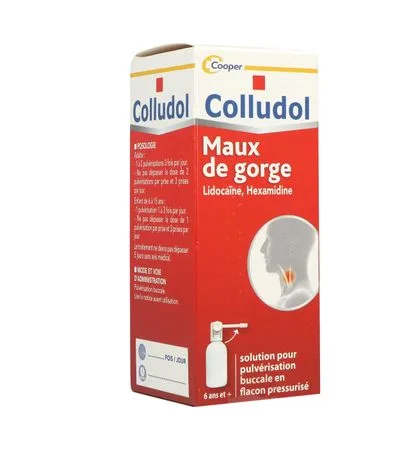
COLLUDOL, oral spray solution in pressurized bottle
Forms and presentations
Oral spray solution.
Pressurized bottle (plasticized glass) of 30 ml, with valve (acetate resin), dip tube and mouthpiece.
Composition
For 100 ml of solution:
Hexamidine diisethionate: 0,100 g
Lidocaine hydrochloride: 0,200 g
Excipients with known effect: sucrose, ethanol.
Glycerol, sucrose, passion fruit flavor*, peach flavor**, mint flavor***, purified water.
* Composition of passion fruit flavor: terpene-free orange oil, methyl isobutyrate, gamma-undecalactone, isoamyl acetate, hexyl hexanoate, propylene glycol, ethyl citrate.
** Composition of peach flavor: nonalactone, undecalactone, benzaldehyde, linalool, benzyl benzoate, geranyl butyrate, terpinyl butyrate, ethyl acetate, ethyl butyrate, dimethyl succinate, propylene glycol.
*** Composition of mint flavor: peppermint essential oil, ethanol 96 %, water and menthol.
Pressure: 7 bars.
Pressurizing gas: nitrogen
Indications
Adjunctive local antibacterial and analgesic treatment of conditions limited to the oral mucosa and oropharynx
Dosage and administration
Doses must be spaced at least 4 hours apart.
Adults: 1 to 2 sprays 3 times a day.
Do not exceed a dose of 2 sprays per dose and 3 doses per day.
Children aged 6 to 15 years: 1 spray 1 to 3 times a day.
Do not exceed a dose of 1 spray per dose and 3 doses per day.
Contraindications
- Do not use in children under 6 years of age.
- Known allergy to local anesthetics and to hexamidine.
Warnings and precautions
Special warnings
Possibility of aspiration due to anesthesia of the oropharyngeal junction:
- Do not use this medicine before meals or before drinking.
- Use this medicine with caution in children under 12 years of age.
The indication does not justify prolonged treatment beyond 5 days, as it could expose to an imbalance of the normal microbial flora of the oral cavity with a risk of bacterial or fungal spread.
Repeated or prolonged treatment of the mucosa may expose to the risks of toxic systemic effects of topical anaesthetics (central nervous system involvement with convulsions, depression of the cardiovascular system).
This medicine contains sucrose. Its use is not recommended in patients with fructose intolerance, glucose-galactose malabsorption syndrome or sucrase/isomaltase deficiency.
This medicine contains 0,015 ml of alcohol (ethanol) per dose (2 sprays), equivalent to 12,4 mg/ml of this medicine. A dose of two sprays of this medicine is equivalent to less than 1 ml of beer or 1 ml of wine. The small amount of alcohol contained in this medicine is not likely to cause any noticeable effect.
Precautions for use
If symptoms persist beyond 5 days and/or associated fever occurs, the course of action should be re-evaluated.
Interactions
Concurrent or sequential use of other antiseptics should be avoided given possible interferences (antagonism, inactivation ...).
Fertility, pregnancy and breastfeeding
Use with caution in pregnant or breastfeeding women, due to a lack of usable clinical data.
Driving and using machines
No effect on the ability to drive vehicles or use machines has been observed.
Adverse effects
- Sensitization to hexamidine and to local anesthetics with risks of anaphylactic reaction.
- Transient numbness of the tongue and possibility of choking (see section Warnings and precautions).
Reporting of suspected adverse reactions
Reporting suspected adverse reactions after authorisation of the medicinal product is important. It allows continued monitoring of the benefit/risk balance of the medicinal product. Healthcare professionals are asked to report any suspected adverse reactions via the national reporting system: National Agency for the Safety of Medicines and Health Products (ANSM) and the network of Regional Pharmacovigilance Centres - Website: https://signalement.social-sante.gouv.fr.
Overdose
Excessive application could lead to an overdose.
Symptoms of an overdose include excitation, nervousness, drowsiness, nystagmus, tinnitus, blurred vision, nausea, vomiting, convulsions, CNS depression.
Other symptoms may include cardiac depression, vasodilation, hypotension, arrhythmias and cardiac arrest. Treatment is symptomatic (respiratory and/or cardiac resuscitation) and possibly by the use of fast-acting anticonvulsant agents such as benzodiazepines or barbiturates.
In case of methemoglobinemia, after biological confirmation of the diagnosis, treatment will include slow intravenous administration of 1 to 2 mg/kg of diluted methylene blue.
Pharmacodynamics
Pharmacotherapeutic class: LOCAL ANTISEPTIC/LOCAL ANESTHETIC
(R: Respiratory system), ATC code: R02AA20.
Preparation for buccal or oropharyngeal use combining a local antiseptic (hexamidine) and a local anesthetic (lidocaine hydrochloride).
Special storage precautions
Pressurized container:
- Do not expose to a temperature above 50 °C, nor to sunlight.
- Do not puncture.
- Do not throw into fire even when empty.
SPECIAL PRECAUTIONS FOR DISPOSAL AND OTHER HANDLING
No special requirements.
Any unused medicinal product or waste material should be disposed of in accordance with local requirements.
Prescription, supply and reimbursement
| Marketing authorisation (AMM) |
|
COOPER
Coopération Pharmaceutique Française
Place Lucien-Auvert. 77020 Melun cdx
Tel: 01 64 87 20 00
Source: VIDAL · Updated on 10/11/2026. This information does not replace advice from a healthcare professional.