
Medicines
SmPC of 15/12/2022
Colchicine has a narrow therapeutic margin and the maximum dosages mentioned must not be exceeded.
Diarrhoea, nausea and vomiting may be the first signs of colchicine overdose. Patients must be informed of these signs of potential overdose. A reduction in dosage or discontinuation of treatment should then be considered.
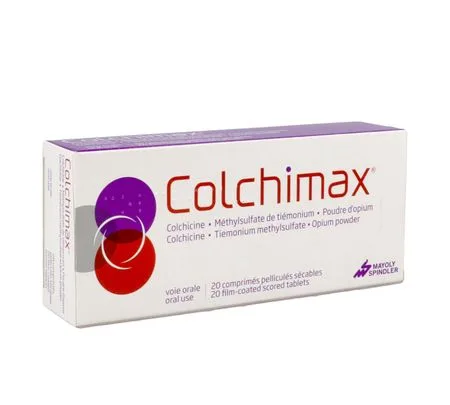
COLCHIMAX, scored film-coated tablet
Forms and presentations
Scored film-coated tablet.
The tablet can be divided into two equal half-doses.
Composition
Tiemonium methylsulfate .................................................................................................50,0 mg
Opium powder ..................................................................................................................12,5 mg
Crystallised colchicine .............................................................................................................1,0 mg
For a scored tablet.
Excipients with known effect : lactose, glucose
Lactose, maize starch, povidone, magnesium stearate, hypromellose, anhydrous glucose, propylene glycol, titanium dioxide (E 171), patent blue V (E 131).
Indications
- Acute gout attack,
- Prophylaxis of acute gout attacks in chronic gout patients, particularly when initiating urate-lowering therapy,
- Other acute microcrystalline attacks: chondrocalcinosis and hydroxyapatite rheumatism,
- Familial Mediterranean fever,
- Behçet's disease
- Treatment of idiopathic acute pericarditis in combination with conventional anti-inflammatory treatments (NSAIDs or corticosteroids) in patients presenting a first episode of pericarditis or a recurrence (with abnormal CRP), excluding post-operative pericarditis following cardiac surgery.
Dosage and administration
The dosage of Colchicine depends on the patient's age, renal function, hepatic function and the use of other co-administered medicinal products, in particular potent inhibitors of CYP3A4 and/or of P-glycoprotein (P-gp).
Colchicine treatment must be reduced or discontinued in case of signs of diarrhoea, nausea and vomiting.
Acute gout attack
Colchicine must be initiated as early as possible, 1 mg within the first 12 hours, followed by 0,5 mg one hour later, and continued on the following days at 0,5 mg 2 to 3 times per day depending on the course of the disease and the possible occurrence of signs of intolerance.
In case of diarrhoea, colchicine treatment must be reduced or discontinued.
Prophylaxis of acute gout attacks in chronic gout patients particularly when initiating urate-lowering treatment,
0,5 mg to 1 mg per day depending on the course of the disease and the possible occurrence of signs of intolerance.
In case of diarrhoea, colchicine treatment must be reduced or discontinued.
Elderly population
Colchicine must be used with extreme caution in elderly patients. A dosage reduction should be considered due to impaired hepatic and renal function.
It is important to monitor for the possible occurrence of signs of intolerance (particularly diarrhoea) and to reduce the dosage.
Patients with mild to moderate renal and/or hepatic impairment:
A dose reduction should be considered due to impaired hepatic and/or renal function. It is recommended to start at a dose of 0,5 mg of colchicine.
Close monitoring of adverse effects and a reduction in the colchicine dose (i.e., 0,5 mg every two days) should be carried out in case of moderate renal insufficiency.
Prophylaxis of other acute microcrystalline attacks / Behçet's disease
1 mg of colchicine per day.
Reduce the dose to 0,5 mg of colchicine (1/2 tablet) in case of diarrhea.
Elderly patients (in particular > 75 years) and patients presenting a risk factor for toxicity (see section Warnings and precautions).
It is recommended to start at a dose of 0,5 mg of colchicine (1/2 tablet) per day and to adjust the dose if necessary according to the clinical response.
Periodic fever syndrome
Adult
1 mg to 2 mg of colchicine per day.
It is recommended to increase the dose in steps of 0,5 mg (1/2 tablet) up to a maximum of 2 mg of colchicine per day according to the clinical and biological response.
Child
Due to the presence of tiemonium sulfate and opium powder, the use of COLCHIMAX in children is not recommended.
Acute idiopathic pericarditis (first episode or recurrence)
Colchicine is prescribed in combination with conventional anti-inflammatory treatments (NSAIDs or corticosteroids).
Adults
The dose must be adjusted to the patient's weight.
For a body weight less than 70 kg (<70 kg), the dose is 0,5 mg of colchicine (1/2 tablet) per day.
For a body weight greater than 70 kg (≥ 70 kg), the dose is 0,5 mg of colchicine twice a day (1/2 tablet twice a day)
The duration of treatment is 3 months.
Paediatric population
There are few data on the use of colchicine in children with acute idiopathic pericarditis (first episode or recurrence); the use of colchicine in this subset of the population is not recommended.
Contraindications
- Hypersensitivity to the active substances or to any of the excipients listed in section Composition.
Related to colchicine:
- severe renal failure (creatinine clearance < 30 ml/min),
- severe hepatic insufficiency,
- association with a macrolide (except spiramycin),
- association with pristinamycin.
- acute idiopathic pericarditis (first episode or recurrence) occurring during pregnancy due to the need for association with conventional anti-inflammatory treatments. See section Fertility, pregnancy and breastfeeding
Related to tiemonium methylsulfate:
- risk of angle-closure glaucoma,
- risk of urinary retention related to urethroprostatic disorders,
- breastfeeding (see section Fertility, pregnancy and breastfeeding).
Warnings and precautions
Special warnings
Use of this medicine is not recommended in combination with verapamil, ciclosporin, telaprevir, protease inhibitors boosted by ritonavir, azole antifungals (itraconazole, ketoconazole, voriconazole, posaconazole) (see section Interactions).
To avoid any overdose, do not combine with a treatment already containing colchicine.
Related to excipients:
This medicinal product contains lactose. Its use is not recommended in patients with galactose intolerance, Lapp lactase deficiency or glucose-galactose malabsorption syndrome (rare hereditary disorders).
This medicine contains glucose. Its use is not recommended in patients with glucose-galactose malabsorption syndrome.
Related to opium powder:
Possibility of physical and psychological dependence with prolonged use and at high doses.
Risks related to concomitant use of sedative medicinal products such as benzodiazepines or related medicinal products:
Concomitant use of COLCHIMAX and sedative medicinal products such as benzodiazepines or related medicinal products may result in sedation, respiratory depression, coma and death. Because of these risks, concomitant prescribing with these sedative medicinal products should be reserved for patients for whom other treatment options are not possible. If the decision is made to prescribe COLCHIMAX concomitantly with sedative medicinal products, the lowest effective dose should be used and the duration of treatment should be as short as possible.
Patients must be closely monitored for the occurrence of signs and symptoms of respiratory depression and sedation. In this regard, it is strongly recommended to inform patients and their caregivers of these symptoms (see section Interactions).
Precautions for use
Related to colchicine
- Before initiating colchicine treatment:
- it is recommended, particularly in elderly people, to assess creatinine clearance.
- to consider prescribing concomitant treatment that may impair renal/hepatic function, but also induce bone marrow/muscle toxicity.
In case of renal impairment and/or hepatic impairment, it is recommended, during the first month of treatment:
- to perform a full blood count (FBC) and a platelet count,
- to reassess creatinine clearance,
Systematically inform patients when prescribing and dispensing colchicine about:
- the first signs of overdose (diarrhoea, nausea, vomiting) and the need to consult if these signs appear,
- the importance of properly understanding the dosing regimen,
- the need to tell health professionals that they are taking this treatment before any new prescription or dispensing of another medicine.
In case of long-term treatment, monitor by testing platelets, full blood count and creatinine, especially during the first month of treatment.
In case of treatment for idiopathic acute pericarditis (first episode or recurrence), an etiological assessment should be carried out by measuring CRP and troponin before initiating colchicine treatment.
Relatedes to tiemonium methylsulfate
Use with caution in case of:
- prostatic hypertrophy,
- hepatic and/or renal insufficiency,
- coronary insufficiency, rhythm disorders, hyperthyroidism,
- chronic bronchitis due to increased viscosity of bronchial secretions,
- paralytic ileus, intestinal atony in the elderly subject, toxic megacolon.
Interactions
Contraindicated combinations (see section Contraindications)
+ Macrolides (telithromycin, azithromycin, clarithromycin, dirithromycin, erythromycin, josamycin, midecamycin, roxithromycin).
Increased undesirable effects of colchicine with potentially fatal consequences. Concomitant administration of macrolides with a P-glycoprotein (P-gp) substrate such as colchicine has been reported to lead to an increase in serum colchicine levels.
+ Pristinamycin
Increased adverse effects of colchicine with potentially fatal consequences.
Combinations not recommended (See section Warnings and precautions)
+ Ciclosporin
Risk of additive neuromuscular adverse effects and increased colchicine toxicity with risk of overdose due to inhibition of its elimination by ciclosporin, particularly in cases of pre-existing renal impairment.
+ Verapamil
Risk of increased adverse effects of colchicine, due to increased plasma concentrations of colchicine caused by verapamil.
+ Protease inhibitors boosted by ritonavir
Increased adverse effects of colchicine, with potentially fatal consequences.
+ Telaprevir
Risk of increased adverse effects of colchicine, due to decreased metabolism of colchicine, particularly in patients with renal and hepatic impairment.
+ Potent inhibitors of CYP3A4
Risk of increased adverse effects of colchicine, due to increased plasma concentrations of colchicine caused by the inhibitor.
Associations requiring precautions for use
+ Vitamin K antagonists
Increased effect of vitamin K antagonists and risk of haemorrhage. More frequent monitoring of INR. Possible adjustment of the vitamin K antagonist dose during colchicine treatment and for 8 days after its discontinuation.
+ HMG-CoA reductase inhibitors (atorvastatin, fluvastatin, pitavastatin, pravastatin, rosuvastatin, simvastatin)
Risk of increased muscular adverse effects of these substances, and in particular of rhabdomyolysis. Clinical and biological monitoring, particularly at the start of the combination.
Associations to be taken into account
+ Sedatives such as benzodiazepines or related medicinal products
Concomitant use of opioids such as those contained in COLCHIMAX and sedative medicinal products such as benzodiazepines or related medicinal products increases the risk of sedation, respiratory depression, coma and death due to a cumulative depressant effect on the central nervous system. The dose and duration of concomitant use should be limited (see section Warnings and precautions).
Fertility, pregnancy and breastfeeding
Pregnancy
In case of acute idiopathic pericarditis (first episode or recurrence) occurring during pregnancy, colchicine is contraindicated given the association with NSAIDs. See section Contraindications.
In other indications, in In case of pregnancy, treatment may be continued until the end of pregnancy if the condition warrants it.
Due to the presence of tiemonium methylsulfate, administer with caution at the end of pregnancy: risk of atropine-like effects in the newborn (meconium ileus).
Breast-feeding
Do not administer to a breastfeeding woman due to decreased milk secretion and passage into milk (risk of atropine-like effects in the child at therapeutic doses).
Adverse effects
The side effects are listed below, by organ class and by frequency. Frequencies are defined as very common (≥ 1/10), common (≥ 1/100 and < 1/10), uncommon (≥ 1/1000 and < 1/100), rare (≥ 1/10000 and < 1/1000) and very rare (< 1/10000), including isolated cases. Very common and common effects have generally been described in clinical trials. Rare and very rare adverse effects generally come from spontaneous reports after marketing.
Related to colchicine:
Gastrointestinal disorders
Common: diarrhoea, nausea, vomiting. These are the first signs of an overdose. Reduce doses or discontinue treatment.
Disorders hepatobiliary
Frequency not known: hepatotoxicity.
Musculoskeletal and systemic disorders
Uncommon: neuromyopathic disorders reversible on discontinuation of treatment.
Very rare cases of rhabdomyolysis.
Blood and lymphatic system disorders
Uncommon: leukopenia, neutropenia, thrombocytopenia.
Very rare cases of pancytopenia due to bone marrow toxicity have been reported in patients at risk of colchicine overdose and/or in patients receiving treatment likely to induce bone marrow toxicity (see section Warnings and precautions).
Skin and subcutaneous tissue disorders
Rare: urticaria and morbilliform eruptions.
Disorders of the reproductive organs and breast
Exceptional: azoospermia, reversible on stopping treatment.
Related to tiemonium methylsulfate:
- dry mouth,
- thickening of bronchial secretions,
- decreased tear secretion,
- accommodation disorders,
- tachycardia, palpitations,
- constipation,
- urinary retention,
- excitability,
- irritability,
- mental confusion in elderly people.
Reporting of suspected adverse reactions
Reporting of suspected adverse effects after authorisation of the medicine is important. It allows continuous monitoring of the benefit/risk balance of the medicine. Healthcare professionals report any suspected adverse effect via the national reporting system: National Agency for the Safety of Medicines and Health Products (ANSM) and network of Regional Centres of Pharmacovigilance - Website: www.signalement-sante.gouv.fr
Overdose
Rare but very serious poisoning in both deliberate and accidental contexts (narrow therapeutic margin and drug interactions).
Clinical
- Latency: 2 to 10 hours (delayed in case of association with an inhibitor of digestive motility).
- Digestive disorders: diffuse abdominal pain, vomiting, profuse diarrhoea sometimes bloody, leading to dehydration
- Cardiocirculatory disorders: hypotension or even cardiogenic shock.
- Multi-visceral failure, which generally occurs on day 2 or 3.
- Hematological disorders: pancytopenia due to bone marrow aplasia (infectious and/or hemorrhagic risks).
- Frequent polypnea.
- Alopecia on day 10, peripheral neuropathy, and rare SIADH.
- Poor prognostic factors: occurrence during the first 48 hours of a marked transient hyperleukocytosis and a PT < 20%.
- Acute renal toxicity with oliguria and hematuria.
- Unpredictable course. Death, generally on day 2 or 3 from fluid and electrolyte imbalance, septic shock, respiratory arrest (ascending paralysis) or cardiovascular collapse.
Treatment
In case of recent acute poisoning, elimination of the toxic substance by activated charcoal or gastric lavage depending on the context.
In all cases, constant clinical and biological monitoring in a hospital setting and appropriate symptomatic treatment.
There is no specific antidote for colchicine.
Hemodialysis is ineffective (high apparent volume of distribution).
Pharmacodynamics
Pharmacotherapeutic class: Antigout agents. Anti-inflammatory. ATC code: M04AC01
Mechanism of action
Colchicine decreases leukocyte influx, inhibits phagocytosis of urate microcrystals and therefore slows lactic acid production by maintaining the normal local pH (acidity favouring the precipitation of urate crystals, which is the primum movens of gout).
Mixed antispasmodic tiemonium methylsulfate and opium powder are intended to limit the occurrence of diarrhoeal phenomena caused by colchicine.
Pharmacokinetics
After oral administration, colchicine is rapidly absorbed in the jejunum and ileum. Oral absorption is highly variable, between 24 and 88% of the administered dose with an average of 45%. Orally absorbed colchicine undergoes enterohepatic cycling.
An efflux mechanism via P-glycoproteins (P-gp) transporting colchicine from enterocytes into the intestinal lumen and partial metabolism of colchicine via intestinal CYP3A4 are described, which may explain the inter-individual variability in absorption.
After administration of a single oral dose of 1 mg, the plasma peak is reached between 30 and 90 minutes with a Cmax of 5.64 ± 1.37 ng/mL (range: 4.00-7.58).
In a multiple-dose study (1 mg/day for 15 days), the steady-state concentration is reached in 8 days after the first administration, with concentrations between 0.3 and 2.5 ng/mL.
The volume of distribution is 7-10 L/kg, suggesting extensive tissue distribution. Colchicine concentrations are high in leukocytes, the kidney, the liver and the spleen. Concentrations are low in the myocardium, skeletal muscles and the lungs.
It binds to all tissues, mainly the intestinal mucosa, liver, kidneys and spleen, with the exception of the myocardium, skeletal muscles and lungs.
Binding of colchicine results in tissue accumulation as soon as the daily dose exceeds 1 mg, which may lead to toxic effects.
Albumin binding is moderate (40 %).
Colchicine is metabolised into two primary metabolites: 2-O-demethylcolchicine and 3-O-demethylcolchicine (2-DMC and 3-DMC), and into one minor metabolite: 10-O-demethylcolchicine. Studies in vitro on human hepatic microsomes have shown that CYP3A4 are involved in the metabolism of colchicine into 2-DMC and 3-DMC. Plasma levels of these metabolites are minimal (less than 5 % of the parent molecule).
More than 2/3 of colchicine is eliminated in the faeces (biliary route) and 15 to 30% is excreted in the urine within the first 24 hours. Renal elimination depends on glomerular filtration and tubular secretion.
The elimination half-life varies between 20 and 40 hours.
Colchicine is not eliminated by haemodialysis.
SPECIAL PRECAUTIONS FOR DISPOSAL AND OTHER HANDLING
No special requirements.
Any unused medicinal product or waste material should be disposed of in accordance with local requirements.
Prescription, supply and reimbursement
| Marketing authorisation (AMM) |
|
| Price: |
|
Social Security reimbursement at 65% (Blister/15) for the indications:
- Indication(s) listed in the marketing authorisation at the date of publication of this decree (Blister/15)
Collection.
3 PLACE RENAULT
92500 RUEIL-MALMAISON
Tel: 01 34 80 55 55 contact@mayoly.com
https://www.mayoly-spindler.fr/
Source: VIDAL · Updated on 10/11/2026. This information does not replace advice from a healthcare professional.