
VIDAL
Parapharmacy
Update of 07/06/2024
CE COALGAN®
Coalgan is recommended in patients with congenital (Rendu-Osler, von Willebrand, haemophilia) or acquired (on platelet antiaggregants, vitamin K antagonists or heparin) haemostasis disorders. Persistent bleeding requires medical advice.
Coalgan is used in children, adults and pregnant women.
Any remaining fibres after removal of Coalgan are eliminated naturally.
Coalgan may be used with lidocaine-naphazoline.
Persistent bleeding requires medical advice.
The powder form may be used for 6 months after opening.
Les Laboratoires BROTHIER
41, rue de Neuilly. 92735 Nanterre cdx
Tel: 01 56 38 30 00. Fax: 01 47 25 51 58
http://www.brothier.com
E-mail: info@brothier.com
Tel (Freephone): 08 00 35 51 53
Parapharmacy
Update of 07/06/2024
CE COALGAN®
calcium alginate
Forms and presentations
Sterile wick, compress, dressing and powder:| Presentations | Dimensions/Weight | Number of units/box | ACL code |
| Coalgan wick | 4 cm | 5 | 3401073757667 |
| Coalgan-H compress, hospital use | 2 × 4 cm | 50 | 3401047315978 |
| Coalgan compress | 3 × 5 cm | 5 | 3401563015536 |
| Coalgan adhesive dressing | 7,2 × 2,5 cm and 7,2 × 3,4 cm | 12 | 3401521069847 |
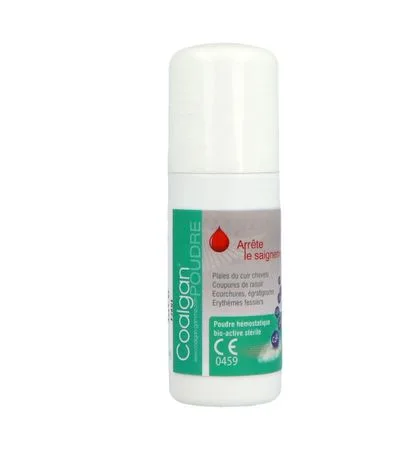
| Coalgan powder | bottle of 8 g | 1 | 3401521069908 |
Composition
Calcium alginate fibres (plant origin).Properties
Coalgan is a local haemostatic and healing agent.Indications
- Wick form:
-
- Haemostasis:
Nosebleeds (epistaxis), skin bleeding (cuts, grazes, puncture sites), oral bleeding, dental extractions.
- Healing:
Skin wounds ≤ 8 cm2 : surgical wounds, traumatic wounds (grazes, cuts, scrapes, open blisters, superficial burns); end of healing.
- Haemostasis:
- Compress form:
- Bleeding from superficial wounds, nosebleeds, bleeding from highly vascularised areas (eyebrow arches, ...), superficial and weeping burns, oral bleeding.
- Adhesive dressing form:
- Bleeding from superficial wounds (cuts, open blisters, small wounds).
- Powder form:
- Scalp wounds, razor cuts, abrasions, scratches, buttock erythema.
Coalgan is used in children, adults and pregnant women.
Precautions for use
Coalgan must be moistened only with a 0,9% NaCl solution (physiological saline): Na ions+ of the NaCl solution are exchanged with Ca ions 2+ of Coalgan, which allows gelling and painless removal of Coalgan. This will in particular facilitate insertion of Coalgan wick into the nostril.
Check the integrity of the sachet before using the product.
- Warnings:
- Always use Coalgan in its entirety (without cutting, without fraying).
- Coalgan must not remain in place for more than 24 hours.
- Single use (wick, compress, adhesive dressing forms). Do not reuse because of the risk of microbial contamination and loss of performance.
- Sterile product. Sterilised by β radiation. Do not resterilise.
- Interactions
- Coalgan must not be used with alkaline solutions, such as sodium hypochlorite solutions, or containing chlorhexidine, benzalkonium chloride or copper salts.
- If such products are used on the wound, rinse thoroughly only with a 0,9% NaCl solution before applying Coalgan.
- Adverse effects
- Coalgan contains traces of surfactant and may cause hypersensitivity reactions in some sensitised individuals.
Contraindications
None known to date.INSTRUCTIONS FOR USE
- Nosebleed (wick, compress forms):
-
- Tilt the head forward, blow the nose to remove clots.
- Tear open the Coalgan sachet along the dotted line.
- Twist Coalgan lengthwise to obtain a compact wick (Coalgan may be soaked only in 0,9% NaCl physiological saline to facilitate its insertion into the nostril).
- Insert Coalgan. Pinch both nostrils for 10 minutes.
- Leave Coalgan in place for at least 30 minutes and at most 24 hours.
- Use the sachet to dispose of it.
- Tilt the head forward, blow the nose to remove clots.
- Haemostasis and/or healing of skin wounds: cuts, abrasions, scrapes, puncture sites, open blisters, superficial burns (all Coalgan forms):
-
- Clean the wound with soap and water, or a 0,9% NaCl solution (physiological saline).
- Compress and wick forms: apply Coalgan to the lesion, exerting light pressure for a few seconds. Remove Coalgan once bleeding has stopped or leave it in place for healing and remove it after at most 24 hours.
- Powder form: remove the winged cap as indicated on the bottle and keep it, as it will be used to reseal the bottle after use. Sprinkle onto the wound or cut. Excess powder falls off naturally. If necessary, cover the wound or cut with a Coalgan adhesive dressing. Do not try to remove the powder from the wound; it will be eliminated with the blood clot (scab).
- Compress and wick forms: apply Coalgan to the lesion, exerting light pressure for a few seconds. Remove Coalgan once bleeding has stopped or leave it in place for healing and remove it after at most 24 hours.
- Clean the wound with soap and water, or a 0,9% NaCl solution (physiological saline).
- Oral bleeding/tooth extraction (lips, gums, tongue...) (wick, compress forms):
-
- Apply to the lesion.
- Remove Coalgan once bleeding has stopped.
- Apply to the lesion.
Coalgan may be used with lidocaine-naphazoline.
Persistent bleeding requires medical advice.
STORAGE CONDITIONS
Store in a dry place, protected from light, at a temperature below 30 °C. Observe the expiry date.The powder form may be used for 6 months after opening.
ADMINISTRATIVE INFORMATION
LPPR rate:
For the Coalgan Wick form: 2,40 euros (5 sachets).
Class IIb medical device. CE marking 0459.| Maximum selling price to the public: 4,51 euros. | |
| Reimbursed by the French social security system in accordance with the LPPR (LPPR code: 1314953) for epistaxis and other cutaneous and mucosal bleeding in patients with congenital or acquired haemostatic disorders. Its prescription is not substitutable. | |
| Compresses, dressings and powder: not reimbursed by French social security. |
Les Laboratoires BROTHIER
41, rue de Neuilly. 92735 Nanterre cdx
Tel: 01 56 38 30 00. Fax: 01 47 25 51 58
http://www.brothier.com
E-mail: info@brothier.com
Tel (Freephone): 08 00 35 51 53
Source: VIDAL · Updated on 10/11/2026. This information does not replace advice from a healthcare professional.