
Medicines
SmPC of 28/01/2026
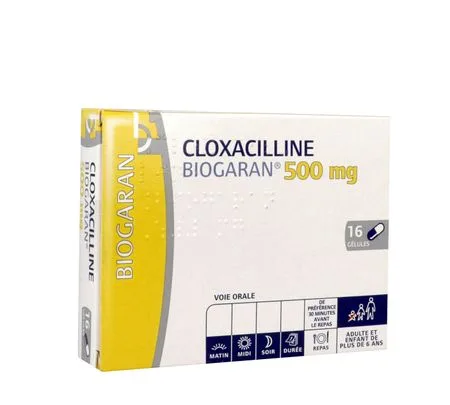
CLOXACILLIN BIOGARAN 500 mg, capsule
Composition
Cloxacillin sodium monohydrate
Quantity corresponding to cloxacillin base............................................................................................500 mg
For one capsule.
Excipient with known effect: This medicine contains sodium (26,4 mg).
For the full list of excipients, see section Composition.
Magnesium stearate.
Capsule shell : Gelatin, titanium dioxide (E171).
Indications
CLOXACILLIN BIOGARAN is indicated in adults and children for the treatment of mild skin infections due to sensitive staphylococci and/or streptococci (see section Pharmacodynamics), requiring oral treatment from the outset.
Official recommendations concerning the appropriate use of antibacterial agents should be taken into account.
Dosage and administration
Dosage
The dosage depends on the patient's body weight, renal function and/or hepatic function.
Adult
• In subjects with normal renal function
50 mg/kg/day in 3 daily doses, not exceeding 3 to 4 g/day.
• Renal impairment
- Creatinine clearance > 30 mL/min: no dosage adjustment;
- Creatinine clearance < 30 mL/min: halve the daily dosage.
• Hepatic impairment
If hepatic impairment is associated with renal impairment, regardless of the degree of renal impairment: halve the daily dosage.
Paediatric population
• In subjects with normal renal function
50 mg/kg/day in 3 daily doses, not exceeding 3 to 4 g/day.
The dosage in children with renal and/or hepatic impairment has not been studied.
Method of administration
ORAL USE
This medicine should preferably be taken half an hour before meals.
The capsules must be swallowed without opening them, with a glass of water.
Contraindications
Hypersensitivity to the active substance, to other antibiotics of the beta-lactam family (penicillins and cephalosporins), or to any of the excipients mentioned in the section Composition.
Warnings and precautions
Paediatric population
Taking the capsule is contraindicated in children under 6 years of age, as it may cause choking.
The occurrence of any allergic manifestation requires discontinuation of treatment and the initiation of appropriate treatment.
Severe and sometimes fatal hypersensitivity reactions (anaphylaxis) have exceptionally been observed in patients treated with beta-lactams. Their administration therefore requires a prior interview. In the presence of a history of typical allergy to these products, the contraindication is absolute.
Allergy to penicillins is cross-reactive with allergy to cephalosporins in 5 to 10 % of cases. This leads to penicillins being avoided when the subject is a known cephalosporin allergic patient.
Pseudomembranous colitis has been reported with virtually all antibiotics, including cloxacillin. This diagnosis should be considered in patients with persistent and/or severe diarrhoea during or after antibiotic treatment. In this situation, appropriate therapeutic measures must be initiated immediately. Discontinuation of antibiotic treatment should be considered. Medicines that inhibit peristalsis are contraindicated in this situation (see section Adverse effects).
Hypokalaemia (which may be life-threatening) has been reported with the use of cloxacillin (in particular with the IV formulation). Monitoring of potassium levels should be considered according to the patient's clinical condition and other potential risk factors.
In cases of renal impairment, dose adjustment is required if the creatinine clearance is less than 30 mL/min (see section Dosage and administration).
Acute kidney injuries have been reported during the post-marketing period in patients treated with cloxacillin (see section Adverse effects). These cases have generally been reported in patients who received a high dose of cloxacillin (in particular with the IV formulation) and/or who had one or more risk factors for acute kidney injury (elderly subjects, type II diabetes, (arterial) hypertension, pre-existing renal impairment or concomitant use of nephrotoxic medicines). Cloxacillin should be used with caution in these patients.
In cases of hepatic impairment associated with renal impairment, regardless of the degree of renal impairment, dose adjustment is required (see section Dosage and administration).
Beta-lactams expose patients to a risk of encephalopathy (confusion, disturbances of consciousness, epilepsy or abnormal movements), particularly in cases of overdose or renal impairment.
This medicine should generally not be used in combination with methotrexate (see section Interactions).
This medicine contains 26,4 mg of sodium per capsule, which is equivalent to 1,32 % of the maximum recommended daily dietary intake by the WHO of 2 g of sodium per adult.
Interactions
Combinations not recommended
+ Methotrexate
Increased effects and haematological toxicity of methotrexate: inhibition of renal tubular secretion of methotrexate by penicillins.
Specific problems with INR imbalance
Many cases of increased activity of oral anticoagulants have been reported in patients receiving antibiotics. A marked infectious or inflammatory context, age and general condition of the patient appear to be risk factors. In these circumstances, it is difficult to distinguish between the infectious disease and its treatment in the occurrence of the INR imbalance. However, certain classes of antibiotics are more involved: these include fluoroquinolones, macrolides, cyclines, cotrimoxazole and certain cephalosporins.
Fertility, pregnancy and breastfeeding
Pregnancy
The use of cloxacillin may be considered if necessary during pregnancy, regardless of the stage of gestation. Indeed, clinical data on a limited number of patients and animal data have not shown any malformative or foetotoxic effect.
Breast-feeding
The passage of penicillins into breast milk is low, and the quantities ingested are much lower than neonatal therapeutic doses. Consequently, breastfeeding is possible when this antibiotic is taken.
However, interrupt breastfeeding (or the medicinal product) if diarrhoea, candidiasis or skin rash occurs in the infant.
Driving and using machines
This medicine may have a significant influence on the ability to drive vehicles and use machines, in particular due to the possible occurrence of encephalopathy (see sections Warnings and precautions, 4.8, 4.9).
Adverse effects
The frequency of possible undesirable effects listed below is defined as follows: very common (≥ 1/10), common (≥ 1/100 to < 1/10), uncommon (≥ 1/1000 to < 1/100), rare (≥ 1/10 000 to < 1/1000), very rare (< 1/10 000), frequency not known (cannot be estimated from the available data).
Blood and lymphatic system disorders
Frequency not known: reversible haematological disorders: anaemia, thrombocytopenia, leukopenia, neutropenia and agranulocytosis.
Immune system disorders
Frequency not known: urticaria, angioedema, anaphylactic shock, eosinophilia (see section Warnings and precautions).
Metabolism and nutrition disorders
Frequency not known: hypokalaemia (see section Warnings and precautions).
Nervous system disorders
Frequency not known: beta-lactams expose patients to a risk of encephalopathy (confusion, disturbances of consciousness, epilepsy or abnormal movements), particularly in cases of overdose or renal insufficiency.
Gastrointestinal‑disorders
Rare: pseudomembranous colitis (see section Warnings and precautions).
Frequency not known: nausea, vomiting, diarrhoea.
Hepatobiliary disorders
Rare: moderate increase in transaminases (AST and ALT).
Frequency not known: cholestatic hepatitis.
Skin and subcutaneous tissue disorders‑cutaneous
Frequency not known: maculopapular rash of allergic or non-allergic origin. DRESS syndrome (drug reaction with eosinophilia and systemic symptoms).
Isolated cases of erythroderma and severe bullous skin reactions (erythema multiforme, Stevens-Johnson syndrome, toxic epidermal necrolysis).
Renal and urinary disorders
Frequency not known: acute immuno-allergic interstitial nephritis, acute renal failure.
General disorders and administration site conditions
Frequency not known: fever.
Reporting of suspected adverse reactions
Reporting suspected adverse reactions after authorisation of the medicinal product is important. It allows continued monitoring of the benefit/risk balance of the medicinal product. Healthcare professionals should report any suspected adverse reactions via the national reporting system: Agence nationale de sécurité du médicament et des produits de santé (ANSM) and the network of Regional Centres of Pharmacovigilance - Website: https://signalement.social-sante.gouv.fr/.
Overdose
Beta-lactams expose patients to a risk of encephalopathy (confusion, disturbances of consciousness, epilepsy or abnormal movements), particularly in cases of overdose or renal impairment.
Manifestations of overdose, neuropsychiatric, renal and digestive effects have been reported with penicillins M.
Pharmacodynamics
Pharmacotherapeutic class: PENICILLINS RESISTANT TO BETA-LACTAMASES, ATC code: J01CF02.
Cloxacillin is an antibiotic of the beta‑lactam family, of the group M penicillins.
ANTIBACTERIAL ACTIVITY SPECTRUM
Critical concentrations
The critical concentrations or minimum inhibitory concentration (MIC) breakpoints, on the basis of which the susceptibility of the bacterial strain is interpreted, are established by the " European Committee on Antimicrobial Susceptibility Testing" (EUCAST) for cloxacillin and are as follows: https://www.ema.europa.eu/documents/other/minimum-inhibitory-concentration-mic-breakpoints_en.xlsx
The prevalence of acquired resistance may vary by geography and over time for certain species. It is therefore useful to have information on local resistance prevalence, especially for the treatment of severe infections. If necessary, specialist advice should be sought, mainly when the usefulness of the drug in certain infections may be called into question because of the level of local resistance prevalence.
|
Classes |
|
SPECIES NORMALLY SUSCEPTIBLE |
|
Gram-positive aerobes |
|
Streptococcus pyogenes |
|
Anaerobes |
|
Clostridium perfringens |
|
INCONSISTENTLY SENSITIVE SPECIES (ACQUIRED RESISTANCE ≥ 10 %) |
|
Gram-positive aerobes |
|
Staphylococcus aureus (1) |
|
Coagulase-negative staphylococci (+) |
(+) The prevalence of bacterial resistance is ≥ 50 % in France.
(1) The frequency of methicillin resistance is approximately 20 to 30 % in Staphylococcus aureus and is found mainly in hospital settings.
Pharmacokinetics
Absorption
Cloxacillin is stable in gastric fluid. It is well absorbed by the digestive mucosa (70 %).
Distribution
• After oral administration, maximum blood concentrations are obtained after 1 hour and are proportional to the administered dose. They are in the range of 9 mg/L for a dose of 500 mg.
• After intravenous injection of 2 g as an infusion over 20 minutes, the serum peak obtained at the end of the infusion has a value of 280 mg/L.
• The half-life is in the range of 45 minutes in patients with normal renal function.
• Plasma protein binding is in the range of 90 %.
• Cloxacillin diffuses into amniotic fluid, fetal blood, synovial fluid and bone tissue.
Biotransformation
Cloxacillin is poorly metabolised.
Elimination
After oral administration, the unabsorbed fraction is eliminated via the intestine in inactive form. Elimination of the absorbed fraction occurs in active form mainly via the urinary route, and at 10 % via the biliary route.
After parenteral administration, elimination is:
• urinary, in active form, within 6 hours, approximately 70 to 80 % of the injected dose;
• biliary, in active form, 20 to 30 % of the injected dose.
SPECIAL PRECAUTIONS FOR DISPOSAL AND OTHER HANDLING
No special requirements.
Any unused medicinal product or waste material should be disposed of in accordance with local requirements.
Prescription, supply and reimbursement
Possible repackaging
| Marketing authorisation (AMM) |
|
| Price: |
|
Collection.
15 BOULEVARD CHARLES DE GAULLE
92707 COLOMBES CEDEX
Tel: 01 55 72 41 00 contact@biogaran.fr
https://www.biogaran.fr
Source: VIDAL · Updated on 10/11/2026. This information does not replace advice from a healthcare professional.