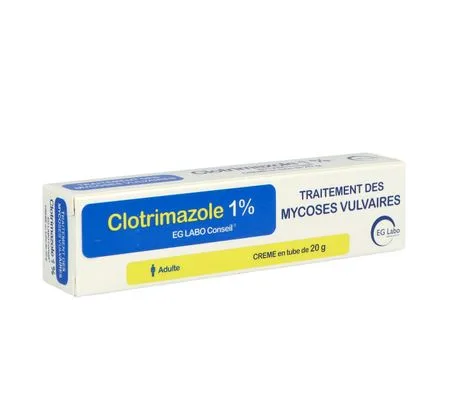

Medicines
SmPC of the 30/09/2026
CLOTRIMAZOLE EG LABO CONSEIL 1%, cream
Composition
Clotrimazole..................................................................................................................................................... 1,0 g
For 100 g of cream.
Excipient with known effect: 30 mg of benzyl alcohol, 100 mg of cetostearyl alcohol and 15 mg of polysorbate 60 (E 435) per gram of cream.
Sorbitan stearate, polysorbate 60, cetyl palmitate, cetostearyl alcohol, octyldodecanol, benzyl alcohol, purified water.
Indications
They are limited to vulvar lesions in cases of vulvovaginal mycosis due to susceptible yeasts. The treatment may be renewed if necessary; however, recurrent infections may indicate an underlying medical cause. The patient should consult her doctor if symptoms reappear.
This medicine is reserved for adults.
Dosage and administration
The product must be applied locally in the morning and evening after washing and drying the lesions to be treated.
Duration of treatment: 1 week.
Contraindications
Hypersensitivity to imidazole derivatives or to any of the excipients mentioned in section Composition.
Warnings and precautions
Special warnings
Medical advice is necessary if the mycosis episode is accompanied by any of the following symptoms:
• Fever, nausea, vomiting
• Lower abdominal pain
• Back or shoulder pain
• Vaginal discharge with a foul odour
• Vaginal haemorrhage
Precautions for use
For the treatment of candidiasis, it is not recommended to use an acidic pH soap (pH favouring the multiplication of Candida).
Avoid application near the eyes. Do not swallow. Keep out of the sight and reach of children.
Vaginal douches should be avoided.
The use of internal tampons, spermicides, condoms or diaphragms should be avoided during treatment with CLOTRIMAZOLE EG LABO CONSEIL (risk of rupture of the condom or diaphragm).
It is recommended to avoid sexual intercourse in cases of vulvovaginal mycosis in order to reduce the risk of infecting the partner.
To avoid recontamination, treatment of the sexual partner should be considered.
Information on excipients with known effect:
This medicine contains cetostearyl alcohol and may cause local skin reactions (for example contact dermatitis).
This medicine contains 30 mg of benzyl alcohol per gram. Benzyl alcohol may cause allergic reactions. Benzyl alcohol may cause mild local irritation.
This medicine contains 15 mg of polysorbate 60 (E 435) per gram of cream. Polysorbates may cause allergic reactions.
Interactions
Concomitant use of Clotrimazole and Tacrolimus or Sirolimus may lead to an increase in plasma levels. Patients concerned must be closely monitored in order to prevent the risk of overdose of Tacrolimus or Sirolimus. If necessary, determination of the respective plasma levels may be carried out.
Fertility, pregnancy and breastfeeding
Pregnancy
Epidemiological studies on the use of vaginal Clotrimazole in pregnant women do not show a teratogenic or fetotoxic risk.
Studies carried out in animals have not shown reproductive toxicity (see section Preclinical safety).
Prescription of Clotrimazole may be considered during pregnancy if necessary.
Breast-feeding
Pharmacodynamic and toxicological data in animals have shown excretion of Clotrimazole and its metabolites in milk.
There is no data on the excretion of Clotrimazole in human milk. No effect on breastfed newborns/infants is expected since the systemic exposure of the breastfeeding woman to vaginally administered Clotrimazole is negligible.
Clotrimazole may be used during breastfeeding.
Fertility
No human study of the effects of Clotrimazole on fertility has been performed; however, animal studies have shown no effect of this medicine on fertility.
Driving and using machines
CLOTRIMAZOLE EG LABO CONSEIL, cream has no or negligible effect on the ability to drive vehicles and use machines.
Adverse effects
Due to the low absorption rate of Clotrimazole through healthy skin, the risk of systemic effects can practically be excluded.
However, on skin where the skin barrier is damaged, greater absorption may occur. Attention should be paid to this possibility and to the possibility of systemic effects occurring.
Spontaneous reports collected since the marketing of clotrimazole have identified the following adverse effects. Their frequency is not known (cannot be estimated from the available data):
Immune system disorders:
• Hypersensitivity reactions including anaphylactic reaction and angioedema.
Skin and subcutaneous tissue disorders:
• Urticaria, rash.
General disorders and administration site conditions :
• Irritation at the application site, oedema, pain at the application site.
Vascular disorders:
• Syncope, hypotension.
Respiratory, thoracic and mediastinal disorders:
• Dyspnoea.
Disorders of the reproductive organs and breast:
• Vaginal discharge, vaginal haemorrhage, vulvovaginal pain, vulvovaginal discomfort, vulvovaginal pruritus, vulvovaginal erythema, vulvovaginal burning sensation.
Gastrointestinal disorders:
• Abdominal pain, nausea.
Reporting of suspected adverse reactions
Reporting suspected adverse reactions after authorisation of the medicinal product is important. It allows continued monitoring of the benefit/risk balance of the medicinal product. Healthcare professionals are asked to report any suspected adverse reaction via the national reporting system: National Agency for the Safety of Medicines and Health Products (ANSM) and the network of Regional Centres of Pharmacovigilance - Website: https://signalement.social-sante.gouv.fr.
Overdose
No cases of overdose have been reported to date.
An overdose, following a single cutaneous application (application over a large area and under conditions favouring absorption) or by unintended oral ingestion, is unlikely.
There is no specific antidote.
Pharmacodynamics
Pharmacotherapeutic class, ATC code: G: GENITO URINARY SYSTEM AND SEX HORMONES
Azoles (for example Clotrimazole) are generally recommended for the local treatment of vulvovaginal candidiasis characterised by vulvovaginal symptoms such as itching, burning, discharge, redness, swelling and pain. Clotrimazole is a synthetic imidazole derivative with a broad-spectrum antifungal effect. It is active against dermatophytes, moulds and yeasts.
Depending on its concentration at the site of infection, Clotrimazole may have a fungistatic or fungicidal effect.
It acts by inhibiting the synthesis of ergosterol, causing structural and functional disorders of the cytoplasmic membrane. In vitro, the activity is limited to the elements favouring fungal proliferation; spores are slightly sensitive.
In addition to its antifungal action, Clotrimazole acts on Gram-positive microorganisms
(Streptococci, staphylococci, Gardnerella vaginalis), and on Gram-negative bacteria (Bacteroides).
Resistant strains belonging to susceptible fungal species are very rarely observed. Indeed, the development of secondary resistance during therapeutic use has only been observed in isolated cases.
Pharmacokinetics
Clotrimazole in non-metabolised form penetrates the different dermal cell layers, with decreasing concentrations from the epidermis towards the deep dermis. In the keratinised layer and along the hair follicles, Clotrimazole reaches maximum concentrations.
The rate of systemic absorption is undetectable, approximately 0,1% and 0,5% of the applied dose are recovered in the urine.
Transcutaneous passage may be increased on damaged skin.
Preclinical safety
Preclinical data (repeated-dose toxicity, genotoxicity, carcinogenicity, reproductive toxicity) did not reveal any particular risk in humans.
Studies carried out in animals demonstrated no effect of the medicinal product on fertility. However, in humans, no study of the effects of Clotrimazole on fertility has been conducted.
Prescription, supply and reimbursement
| Marketing authorisation (AMM) |
|
CENTRAL PARK 9-15 RUE MAURICE MALLET
92130 ISSY-LES-MOULINEAUX
Tel: 01 46 94 86 86 contact@eglabo.fr
https://www.eglabo.fr/
Source: VIDAL · Updated on 10/11/2026. This information does not replace advice from a healthcare professional.