
Medicines
SmPC of 24/05/2023
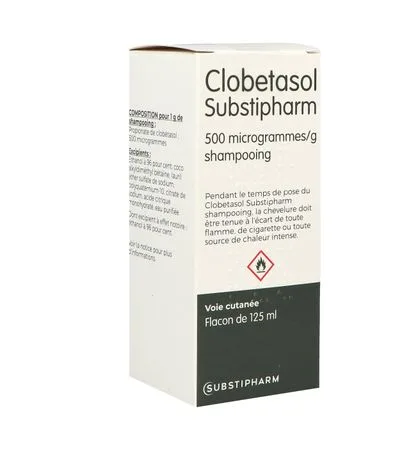
CLOBETASOL SUBSTIPHARM 500 micrograms/g, shampoo
Forms and presentations
Shampoo.
Viscous liquid shampoo, colourless to slightly yellow, with a clear to slightly cloudy appearance.
Composition
Clobetasol propionate.......................................................................................................500 micrograms
For 1 g of shampoo
Excipient with known effect : 1 g of shampoo contains 100 mg of ethanol at 96 percent.
Ethanol at 96%, cocoyl alkyldimethyl betaine, sodium lauryl ether sulfate, polyquaternium-10, sodium citrate, citric acid monohydrate, purified water.
Dosage and administration
Clobetasol propionate belongs to the most potent class of topical corticosteroids (group IV) and prolonged use may lead to serious adverse effects (see section Warnings and precautions). If treatment with a topical corticosteroid is clinically justified beyond 4 weeks, a less potent corticosteroid preparation should be considered. Repeated short-term courses of clobetasol propionate may be used to control exacerbations (see details below).
Dosage
CLOBETASOL SUBSTIPHARM should be applied once daily directly to dry scalp, taking care to fully cover and massage the lesions. An amount equivalent to approximately one ½ tablespoon (approximately 7,5 mL) per application is sufficient to cover the entire scalp.
The total dose must not exceed 50 g per week.
Method of administration
For cutaneous use on the scalp only.
After application, CLOBETASOL SUBSTIPHARM should be left on without covering for 15 minutes. Wash hands thoroughly after application. After 15 minutes, the product should be thoroughly rinsed off with water and/or the hair may be washed, adding if necessary an additional amount of normal shampoo to facilitate cleansing. Then the hair may be dried as usual.
The duration of treatment should not exceed 4 weeks. Once the expected clinical result is obtained, applications will be spaced out or replaced if needed by another treatment. If there is no visible improvement after 4 weeks, a re-evaluation of the diagnosis may be necessary.
Repeated treatments with CLOBETASOL SUBSTIPHARM may be used to treat flares of psoriasis, provided the patient is under regular medical supervision.
Populations populations
Elderly patients:
Safety and efficacy data for CLOBETASOL SUBSTIPHARM in geriatric patients aged 65 years and older have not been established.
Insufficiency Renal:
CLOBETASOL SUBSTIPHARM has not been studied in patients with renal impairment.
Insufficiency Hepatic:
Patients with severe hepatic impairment must be treated with particular care and be closely monitored for the occurrence of adverse effects.
Paediatric population :
Experience in the paediatric population is limited. The use of CLOBETASOL SUBSTIPHARM is not recommended in children and adolescents under 18 years. Use is contraindicated in children under 2 years (see sections Contraindications and Warnings and precautions).
Contraindications
• Hypersensitivity to the active substance or to any of the excipients listed in section Composition ;
• CLOBETASOL SUBSTIPHARM must not be applied to skin areas presenting an infection of bacterial, viral (chickenpox, herpes simplex, herpes zoster), fungal or parasitic origin, ulcerated wounds and specific skin diseases (cutaneous tuberculosis, skin diseases due to syphilis);
• CLOBETASOL SUBSTIPHARM must not be applied to the eyes and eyelids (risk of glaucoma, risk of cataract);
• Children under 2 years.
Warnings and precautions
Hypersensitivity to corticosteroids may be observed.
Therefore, clobetasol propionate is not recommended in patients with hypersensitivity to other corticosteroids.
Continuous long-term treatment with corticosteroids, use of an occlusive dressing, treatment of large surface areas especially in children may promote absorption and lead to a higher risk of systemic effects. In such cases, medical monitoring should be reinforced and patients may be periodically assessed to check for possible suppression of the hypothalamic-pituitary axis. Systemic absorption of topical corticosteroids induced by prolonged use, especially over large surface areas, has resulted in reversible adrenal suppression with potential glucocorticoid insufficiency, and onset of Cushing's syndrome in some patients. These systemic effects resolve when treatment is stopped. However, abrupt interruption may lead to acute adrenal insufficiency, particularly in children.
Cases of osteonecrosis, serious infections (including necrotising fasciitis) and systemic immunosuppression (sometimes resulting in reversible lesions of Kaposi's sarcoma) have been reported with long-term use of clobetasol propionate at doses higher than those recommended (see section Dosage and administration). In some cases, patients concurrently used other potent oral/topical corticosteroids or immunosuppressants (for example, methotrexate, mycophenolate mofetil). If local corticosteroid treatment is clinically justified beyond 4 weeks, a less potent corticosteroid preparation should be considered.
A patient with severe diabetes mellitus must be treated with particular care and closely monitored for side effects.
Topical corticosteroids must be used with caution as the development of tolerance (tachyphylaxis) may occur as well as local toxicity, such as skin atrophy, infection and telangiectasia of the skin.
CLOBETASOL SUBSTIPHARM is intended solely for the treatment of scalp psoriasis and must not be used to treat other skin areas. In particular, CLOBETASOL SUBSTIPHARM is not recommended for use on the face, intertriginous areas (axillary and genito-anal regions) and on other eroded skin surfaces as this could increase the risk of adverse effects such as atrophic changes, telangiectasias, corticosteroid-induced dermatitis or secondary infection. The face, more than other body regions, may show atrophic changes after prolonged treatment with potent topical corticosteroids.
In rare cases, treatment of psoriasis with corticosteroids (or its withdrawal) may cause generalised pustular psoriasis with intensive and prolonged topical use.
Clobetasol propionate is not recommended in patients with acne vulgaris, rosacea or perioral dermatitis.
There may be a risk of rebound effect after treatment or of relapse upon abrupt discontinuation of treatment with clobetasol propionate. Therefore, medical monitoring should be continued in the post-treatment period.
If CLOBETASOL SUBSTIPHARM gets into the eye, the affected eye should be rinsed with plenty of water.
Patients should be advised to use CLOBETASOL SUBSTIPHARM for the minimum time necessary to achieve the desired results. If signs of local intolerance appear, application should be suspended until they disappear. If signs of hypersensitivity appear, application should be stopped immediately.
In order to avoid any interaction with hair dyes, such as hair colourants, the clobetasol propionate shampoo must be rinsed thoroughly.
Visual disorders
Visual disturbances may occur during systemic or topical corticosteroid therapy. In case of blurred vision or onset of any other visual symptom occurring during corticosteroid therapy, an ophthalmological examination is required to look especially for cataract, glaucoma or a rarer lesion such as central serous chorioretinopathy, described with systemic or topical administration of corticosteroids.
Paediatric population
In this age group, growth retardation may also be observed with systemic absorption of topical corticosteroids. CLOBETASOL SUBSTIPHARM must not be used in children and adolescents aged 2 to 18 years.
If CLOBETASOL SUBSTIPHARM is used in children and adolescents under 18 years, treatment must be reassessed every week.
Excipient with known effect
This medicine contains 750 mg of alcohol (ethanol 96%) per 7,5 ml equivalent to 10 g per 100 ml.
This may cause a burning sensation on damaged skin.
During the application time of the CLOBETASOL SUBSTIPHARM shampoo, the hair must be kept away from any flame, cigarette or any source of intense heat.
Fertility, pregnancy and breastfeeding
Pregnancy
There is no sufficiently relevant data regarding the use of clobetasol propionate in pregnant women. Animal studies have demonstrated reproductive toxicity (see section Preclinical safety). The potential clinical risk is not known.
CLOBETASOL SUBSTIPHARM should not be used during pregnancy except in cases of real necessity.
Breast-feeding
Systemically administered corticosteroids pass into breast milk. No effects on children have been reported to date. Nevertheless, as there is not enough data on a possible passage of topical clobetasol propionate into breast milk, nor on the biological and clinical consequences, CLOBETASOL SUBSTIPHARM should not be prescribed to breastfeeding women except in cases of real necessity.
Fertility
No clinical data available. See section Preclinical safety.
Driving and using machines
CLOBETASOL SUBSTIPHARM has no effect or negligible effect on the ability to drive vehicles and use machines.
Adverse effects
Summary of the safety profile
During clinical development, out of a total of 558 patients treated with clobetasol propionate, the most frequently reported adverse effects are skin burning sensations. Their incidence is approximately 2,8%. Most of these adverse effects are considered mild to moderate and are related neither to race nor to gender. Clinical signs of skin irritation have infrequently been reported (0,2 %). No serious product-related adverse event was reported during the clinical studies.
List of adverse effects
Adverse effects are classified by System Organ Class and by frequency, using the following convention: very common (≥ 1/10), common (≥ 1/100 to < 1/10), uncommon (≥ 1/1000 to < 1/100), rare (≥ 1/10 000 to < 1/1000), very rare (< 1/10 000), frequency not known (cannot be estimated from the available data), and have been reported with clobetasol propionate in clinical and post-marketing studies (see table 1).
Table 1 - Adverse effects
|
System organ classes |
Frequency |
Adverse effects |
|
Endocrine disorders |
Uncommon |
Adrenal suppression |
|
Cushing's syndrome |
||
|
Eye disorders |
Uncommon |
Eye burning/tingling. |
|
Eye irritation |
||
|
Sensation of eye pressure |
||
|
Glaucoma |
||
|
Frequency not known |
Blurred vision (see section Warnings and precautions) |
|
|
Immune system disorder |
Uncommon |
Hypersensitivity |
|
Nervous system disorder |
Uncommon |
Headache |
|
Skin and subcutaneous tissue disorders |
Common |
Sensation of skin burning |
|
Folliculitis |
||
|
Uncommon |
Cutaneous pain |
|
|
Cutaneous discomfort |
||
|
Pruritus |
||
|
Acne |
||
|
Cutaneous oedema |
||
|
Telangiectasia |
||
|
Psoriasis (aggravation) |
||
|
Alopecia |
||
|
Dry skin |
||
|
Urticaria |
||
|
Skin atrophy |
||
|
Skin irritation |
||
|
Skin tightness |
||
|
Allergic contact dermatitis |
||
|
Erythema |
||
|
Redness |
CLOBETASOL SUBSTIPHARM should be applied for only 15 minutes before being rinsed off, systemic absorption is rarely observed (see section Pharmacokinetics) and, consequently, the risk of suppression of the hypothalamic-pituitary-adrenal axis is very low compared with potent corticosteroids that are not rinsed off. If suppression of the hypothalamic-pituitary-adrenal axis occurs, it should be transient with a rapid return to normal values.
Cataract has been reported when corticosteroids have been applied to the eyes or eyelids.
Immunosuppression and opportunistic infections have been reported in rare cases with prolonged use of potent topical corticosteroids.
Growth retardation may be observed in children in the event of systemic absorption of topical corticosteroids.
Although not observed with CLOBETASOL SUBSTIPHARM, prolonged and/or intensive treatment with a preparation containing potent corticosteroids may lead to striae, purpura and generalised pustular psoriasis.
Rebound effects may occur upon discontinuation of treatment.
When applied to the face, very potent corticosteroids may also cause perioral dermatitis or aggravate rosacea.
Cases of pigmentation change, eruption of pustules and hypertrichosis have been reported with topical corticosteroids.
Reporting of suspected adverse reactions
Reporting suspected adverse reactions after authorisation of the medicinal product is important. It allows continued monitoring of the benefit/risk balance of the medicinal product. Healthcare professionals are asked to report any suspected adverse reaction via the national reporting system: National Agency for the Safety of Medicines and Health Products (ANSM) and the network of Regional Centres of Pharmacovigilance - Website: https://signalement.social-sante.gouv.fr/.
Overdose
Acute overdose is very unlikely; however, in the event of chronic overdose or misuse, signs of hypercortisolism may appear, in which case treatment should be discontinued gradually. However, this gradual discontinuation should be carried out under medical supervision because of the risk of acute adrenal suppression.
Pharmacodynamics
Pharmacotherapeutic class: VERY STRONG CORTICOSTEROIDS (Group IV), ATC code: D07AD01
Mechanism of action
Like other topical corticosteroids, clobetasol propionate has anti-inflammatory, anti-pruritic and vasoconstrictive properties. In general, the mechanism of the anti-inflammatory activity of topical corticosteroids is not elucidated. However, corticosteroids would act by inducing phospholipase A inhibitory proteins2, termed lipocortins.
It is postulated that these proteins control the biosynthesis of potent mediators of inflammation such as prostaglandins and leukotrienes by inhibiting the release of their common precursor, arachidonic acid. Arachidonic acid is released from membrane phospholipids by phospholipase A2.
Pharmacokinetics
Studies in vitro release-penetration studies on human skin have shown that only a small percentage (0,1%) of the applied dose of the clobetasol propionate shampoo is found in the epidermis (stratum corneum included) after application for 15 minutes and rinsing. The very low local absorption of clobetasol propionate, when applied in accordance with clinical use recommendations (15 minutes before rinsing), resulted in negligible systemic exposure in animal and human studies.
The available clinical data show that only 1 patient out of 126 has a quantifiable plasma concentration of clobetasol propionate (0,43 ng/ml).
Current pharmacokinetic data indicate that systemic effects due to clinical treatment with clobetasol propionate are highly unlikely given the low systemic exposure to clobetasol propionate after topical administration.
Preclinical safety
Non-clinical data from conventional safety pharmacology, single and repeated dose toxicology and genotoxicity studies revealed no particular risk for humans. The carcinogenicity of clobetasol has not been studied.
In rabbits, the clobetasol propionate shampoo was found to be slightly irritating to the skin and eyes; no delayed hypersensitivity was observed on the skin of guinea pigs.
In congenital toxicity studies in rabbits and mice, clobetasol propionate was found to be teratogenic when administered subcutaneously at low doses. In an embryotoxicity study performed in rats with topical clobetasol, fetal immaturity and skeletal and visceral malformations were observed at relatively low doses. In addition to malformations, animal studies in which high systemic doses of glucocorticoids were given during pregnancy also showed other effects on litters, such as intrauterine growth retardation. The clinical relevance of the effects of clobetasol and other corticosteroids in animal developmental studies is unknown.
Prescription, supply and reimbursement
| Marketing authorisation (AMM) |
|
| Price: |
|
- Indication(s) appearing in the marketing authorisation at the date of publication of this decree
Collection.
24 RUE ERLANGER
75016 PARIS
Tel: 01 43 18 13 00 contact@substipharm.com
https://www.substipharm.com/legal-mention/
Source: VIDAL · Updated on 10/11/2026. This information does not replace advice from a healthcare professional.