
Medicines
SmPC of 02/08/2021
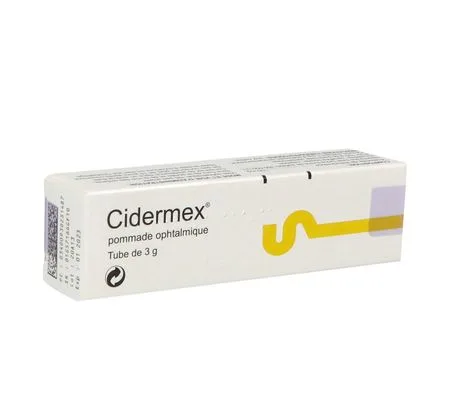
CIDERMEX, ophthalmic ointment
Composition
Triamcinolone acetonide .............................................................................................................. 0,1 g
Neomycin sulfate .............................................................................................................. 350.000 IU
For 100 g of ophthalmic ointment.
Vaseline, liquid paraffin.
Indications
Local anti-inflammatory and antibacterial treatment of the eye and its adnexa:
- following ophthalmic surgery,
- infections due to neomycin-sensitive germs with an inflammatory component.
Official recommendations concerning the appropriate use of antibacterial agents should be taken into account.
Dosage and administration
Dosage
1 half-centimetre ribbon in the treated eye, 1 to 2 times a day depending on severity for 7 days on average.
A longer treatment may be prescribed under strict ophthalmic monitoring.
Contraindications
Hypersensitivity to the active substances or to any of the excipients listed in section Composition.
Dendritic epithelial herpetic keratitis, mycotic keratitis, personal or family history of glaucoma, tubercular ocular involvement, early-stage viral keratoconjunctivitis.
Warnings and precautions
Special warnings
In case of hypersensitivity, stop treatment.
Repeated and/or prolonged application of the ointment may lead to a non-negligible systemic passage of the corticosteroid.
Precautions for use
In the absence of rapid improvement or in case of prolonged treatment, regular medical monitoring including bacteriological tests with study of the germ's sensitivity allows detection of resistance to the product and possible adjustment of treatment.
As with all ophthalmic preparations containing a corticosteroid, prolonged use requires particularly careful ophthalmological monitoring of the cornea, intraocular pressure and the lens.
Use of the product should be avoided in infants.
Contact lens wear should be avoided during treatment because of the risk of corticosteroid adsorption.
Interactions
With neomycin sulfate: the data available to date do not suggest the existence of clinically significant interactions.
With triamcinolone: at the recommended doses, topical triamcinolone is not likely to cause medically significant drug interactions.
Fertility, pregnancy and breastfeeding
In case of ocular administration, systemic passage is non-negligible. However, compared with the eye drop form, systemic passage of the ointment form is probably very low.
The presence of neomycin determines the course of action in case of pregnancy and breastfeeding.
Pregnancy
Studies performed in animals have shown cochleovestibular damage after parenteral administration of neomycin. In clinical practice, a few cases of foetal cochleovestibular damage have been described with other aminoglycosides after parenteral administration. Consequently, the use of Cidermex ophthalmic ointment should be avoided as a precaution during pregnancy.
Breast-feeding
Cidermex ophthalmic ointment may be prescribed during breastfeeding.
Driving and using machines
Vision may be blurred immediately after application of the ophthalmic ointment. It is preferable to wait for normal vision to return before driving a vehicle or operating a machine.
Adverse effects
Possibility of transient local irritation: discomfort, tearing, burning, conjunctival hyperaemia.
Risk of cutaneous-conjunctival hypersensitivity reaction.
With prolonged use: corticosteroid-induced ocular hypertension, lens opacification, superficial keratitis due to the presence of corticosteroid.
In case of corneal or scleral ulceration, corticosteroids may delay healing and promote superinfection.
Reporting of suspected adverse reactions
Reporting suspected adverse reactions after authorisation of the medicinal product is important. It allows continued monitoring of the benefit/risk balance of the medicinal product. Healthcare professionals are asked to report any suspected adverse reaction via the national reporting system: National Agency for the Safety of Medicines and Health Products (ANSM) and the network of Regional Centres of Pharmacovigilance - Website: www.signalement-sante.gouv.fr.
Overdose
No cases of overdose have been reported. However, repeated and prolonged applications of the ophthalmic ointment may lead to non-negligible systemic absorption of the active ingredients, corticosteroid-induced ocular hypertension, lens opacification, superficial keratitis, and delayed healing. As with all ophthalmic preparations containing a corticosteroid, prolonged use requires particularly careful ophthalmologic monitoring of the cornea, intraocular pressure and lens: cases of corneal thinning and cataract have been reported after prolonged treatment with certain topical corticosteroids.
Pharmacodynamics
Pharmacotherapeutic class: corticosteroid and anti-infective in combination, ATC code: S01CA01.
Triamcinolone is a steroidal anti-inflammatory agent.
Neomycin is a bactericidal antibiotic of the aminoglycoside family.
Spectrum of antibacterial activity of neomycin
The prevalence of acquired resistance can vary according to geography and time for certain species. It is therefore useful to have information on local resistance prevalence, especially for the treatment of severe infections. These data can only provide guidance on the probabilities of the susceptibility of a bacterial strain to this antibiotic.
Where the variability of resistance prevalence in France is known for a bacterial species, it is indicated in the table below:
|
Categories |
Frequency of acquired resistance in France (> 10 %) (extreme values) |
|
SUSCEPTIBLE SPECIES |
|
|
Gram-positive aerobes |
|
|
Corynebacterium |
|
|
Listeria monocytogenes |
|
|
Staphylococcus spp. meti-S |
|
|
Gram-negative aerobes |
|
|
Acinetobacter (essentially Acinetobacter baumannii) |
50-75 % |
|
Branhamella catarrhalis |
|
|
Campylobacter |
|
|
Citrobacter freundii |
20-25 % |
|
Citrobacter koseri |
|
|
Enterobacter aerogenes |
? |
|
Enterobacter cloacae |
10-20 % |
|
Escherichia coli |
15-25 % |
|
Haemophilus influenzae |
25-35 % |
|
Klebsiella |
10-15 % |
|
Morganella morganii |
10-20 % |
|
Proteus mirabilis |
20-50 % |
|
Proteus vulgaris |
? |
|
Providencia rettgeri |
? |
|
Salmonella |
? |
|
Serratia |
? |
|
Shigella |
? |
|
Yersinia |
? |
|
Categories |
Frequency of acquired resistance in France (> 10 %) (extreme values) |
|
MODERATELY SUSCEPTIBLE SPECIES |
|
|
(in vitro of intermediate susceptibility) |
|
|
Gram-negative aerobes |
|
|
Pasteurella |
|
|
RESISTANT SPECIES |
|
|
Gram-positive aerobes |
|
|
Enterococci |
|
|
Nocardia asteroides |
|
|
Staphylococcus spp. meti-R * |
|
|
Streptococcus |
|
|
Gram-negative aerobes |
|
|
Alcaligenes denitrificans |
|
|
Burkholderia |
|
|
Flavobacterium sp. |
|
|
Providencia stuartii |
|
|
Pseudomonas aeruginosa |
|
|
Stenotrophomonas maltophilia |
|
|
Anaerobes |
|
|
Strict anaerobic bacteria |
|
|
Other |
|
|
Chlamydia |
|
|
Mycoplasmas |
|
|
Rickettsiae |
* The frequency of resistance to methicillin is approximately 30 to 50 % of all staphylococci and is found mainly in hospital settings.
Note: this spectrum corresponds to that of systemic forms of antibiotics belonging to the aminoglycoside family. With local pharmaceutical presentations, the concentrations obtained in situ are much higher than plasma concentrations. Some uncertainties remain regarding the kinetics of in situ concentrations, the local physicochemical conditions that may modify the activity of the antibiotic, and the stability of the product in situ.
Prescription, supply and reimbursement
| Marketing authorisation (AMM) |
|
Collection.
104 BOULEVARD AUGUSTE BLANQUI
75013 PARIS
Tel: 01 81 79 38 75 info@frilab.ch
https://frilab.ch/
Source: VIDAL · Updated on 10/11/2026. This information does not replace advice from a healthcare professional.