
Medicines
SmPC of 27/03/2025
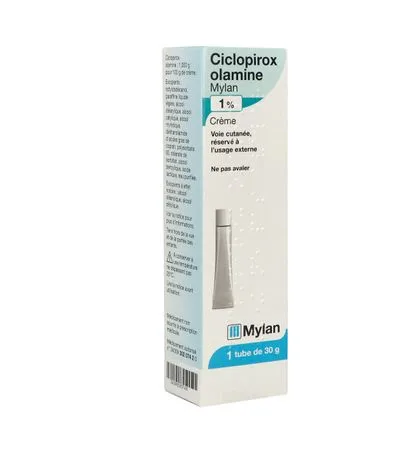
CICLOPIROX OLAMINE VIATRIS 1 %, cream
Composition
Ciclopirox olamine...................................................................................................................................... 1,000 g
For 100 g of cream.
Excipients with known effect : each gram of cream contains:
• 70,8 mg stearyl alcohol,
• 65,6 mg cetyl alcohol,
• 35,0 mg polysorbate 60 and
• 10,0 mg benzyl alcohol.
Octyldodecanol, light liquid paraffin, stearyl alcohol, cetyl alcohol, myristyl alcohol, copra fatty acid diethanolamide, polysorbate 60, sorbitan stearate, benzyl alcohol, lactic acid, purified water.
Indications
Superinfected or not superinfected by bacteria dermatoses:
• trichophyton dermatophytoses;
• epidermophyton, microsporum outside of tinea capitis;
• cutaneous candidiasis;
• pityriasis versicolor,
Dermatophyte onychomycoses.
Mild to moderate seborrheic dermatitis of the face.
Dosage and administration
• Cutaneous mycoses: 2 daily applications for 21 days on average.
• Onychomycoses due to dermatophytes: application of CICLOPIROX OLAMINE VIATRIS 1 % cream alone or in combination with another treatment for several months.
• Mild to moderate seborrheic dermatitis of the face:
- initial treatment (2 to 4 weeks): 2 applications per day,
- beyond that, as maintenance treatment: 1 application per day for 28 days.
Contraindications
Hypersensitivity to the active substance or to any of the excipients listed in section Composition.
Warnings and precautions
Avoid contact with the eyes and mucous membranes.
CICLOPIROX OLAMINE VIATRIS 1 %, cream must not be applied to open wounds.
Candidiasis: use of an acidic pH soap, which promotes the multiplication of Candida, is not recommended.
This medicine contains:
• cetostearyl alcohol and cetyl alcohol which may cause local skin reactions (for example: contact dermatitis);
• benzyl alcohol which may cause allergic reactions and, when applied topically, mild local irritation;
• polysorbate 60 which may cause allergic reactions.
Fertility, pregnancy and breastfeeding
Pregnancy
There are limited data (fewer than 300 pregnancies with known outcome) on the use of ciclopirox olamine in pregnant women.
However, no effect is expected during pregnancy, since systemic exposure to ciclopirox olamine is negligible (see section Pharmacokinetics) and no embryotoxic or teratogenic effect has been observed following oral, topical or subcutaneous administration of ciclopirox olamine in animals (see section Preclinical safety).
As a precaution, it is preferable to avoid using CICLOPIROX OLAMINE VIATRIS 1 %, cream during pregnancy.
Breast-feeding
There are no sufficient data on the excretion of ciclopirox olamine and its potential metabolites into human milk.
As a precaution, it is preferable to avoid using CICLOPIROX OLAMINE VIATRIS 1 %, cream during breast-feeding.
Fertility
No effect on male or female fertility has been demonstrated in rats after oral administration of ciclopirox olamine up to 5 mg/kg/day (see section Preclinical safety).
Driving and using machines
CICLOPIROX OLAMINE VIATRIS 1 %, cream has no effect on the ability to drive vehicles and use machines.
Adverse effects
Table of adverse reactions
Clinical adverse effects are listed below by system organ class and frequency. Frequencies are defined as: very common (≥1/10), common (≥1/100, <1/10), uncommon (> 1/1 000, < 1/100), rare (≥1/10 000, <1/1 000), very rare (<1/10 000), not known (cannot be estimated from the available data).
|
System organ class Frequency |
Adverse effects |
|
Immune system disorders Uncommon |
Hypersensitivity* |
|
Skin and subcutaneous tissue disorders Common Frequency not known |
Burning sensation Contact dermatitis** |
|
General disorders and administration site conditions Common
Uncommon |
Transient exacerbation of local signs at the application site, Erythema at the application site*** Pruritus at the application site*** Vesicles at the application site* |
* requires interruption of treatment
** cases of contact dermatitis have been reported since marketing
*** does not require discontinuation of treatment
Although no systemic effects have been reported, this possibility should be taken into account in case of prolonged treatment over a large surface area, on damaged skin, mucous membrane, or under an occlusive dressing.
Reporting of suspected adverse reactions
Reporting suspected adverse reactions after authorisation of the medicinal product is important. It allows continued monitoring of the benefit/risk balance of the medicinal product. Healthcare professionals are asked to report any suspected adverse reaction via the national reporting system: National Agency for the Safety of Medicines and Health Products (ANSM) and the network of Regional Centres of Pharmacovigilance - Website: https://signalement.social-sante.gouv.fr/.
Pharmacodynamics
Pharmacotherapeutic class: TOPICAL ANTIFUNGALS, ATC code: D01AE14.
Ciclopirox olamine is an antifungal (pyridone family) active in vitro against:
• Candida and yeasts: MIC 1 to 4 µg/mL;
• dermatophytes (Trichophyton and Epidermophyton, Microsporum): MIC 1 to 4 µg/mL;
• various fungi: MIC 0,5 to 8 µg/mL.
It furthermore has antibacterial properties against Gram-positive (staphylococci, streptococci) and Gram-negative (Escherichia coli, Proteus, Pseudomonas).
Pharmacokinetics
Percutaneous absorption is very low: 1,1 to 1,6 % of the applied dose is detected in the urine. Maximum plasma concentrations are minimal (0.2 to 0.3 µg/mL).
After cutaneous application of ciclopirox olamine, ciclopirox olamine diffuses into the epidermis and pilosebaceous follicles, with impregnation of the superficial layers of the stratum corneum being particularly significant. A contact time of one and a half hours yields concentrations in the epidermis of 70 to 579 µg/g. These then gradually decrease towards the dermis to reach at least 1 µg, at a depth of 1 800 µm.
Ciclopirox olamine has the particularity of penetrating and crossing the nail keratin.
Preclinical safety
Acute toxicity studies performed with ciclopirox and/or ciclopirox olamine in rats and mice after oral or subcutaneous administration show similar and moderate toxicities (LD50 between 1740 mg/kg and 2500 mg/kg).
Repeated-dose toxicity studies with ciclopirox olamine have demonstrated good systemic tolerance, with a chronic oral NOAEL (No Observable Adverse Effect Level: dose without observable adverse effect) of 10 mg/kg/day in rats and dogs.
A set of genotoxicity studies did not demonstrate any genotoxic potential of ciclopirox olamine.
An equivocal clastogenic activity was observed in the HPRT / V79 test with a significant increase in mutations preferentially affecting small colonies. Ciclopirox olamine also significantly inhibited DNA repair activity in the UDS test (Unscheduled DNA Synthesis : unscheduled DNA synthesis), but without any genotoxic effect in this test. However, the hypothesis is that the in vitro clastogenic activity of ciclopirox olamine is directly related to its calcium chelating potential present in the culture medium.
No carcinogenicity study has been performed with ciclopirox and/or ciclopirox olamine.
Ciclopirox olamine administered orally to rats (up to 5 mg/kg/day) induced no adverse effect on male or female fertility.
No embryotoxic or teratogenic effect has been observed after oral, topical or subcutaneous administration of ciclopirox olamine. Studies were conducted in several animal species: mice, rats, rabbits and monkeys.
Ciclopirox olamine administered orally to female rats at up to 5 mg/kg/day from the 15th day of gestation until weaning of the pups induced no adverse effect on peri- or postnatal development.
Local tolerance studies conducted in rabbits showed that the cream was slightly irritating to the skin and eyes. The product was judged sensitizing in guinea pigs (0,1 mL per application); its photosensitizing potential (in humans) cannot be ruled out because this could not be evaluated. The product is not phototoxic. In the LLNA (Local Lymph Node Assay: local lymph node stimulation test) in mice, the product was judged non-sensitizing.
Shelf life
2 years.
After first opening of the tube, this medicine must be stored for a maximum of 3 months.
Prescription, supply and reimbursement
| Marketing authorisation (AMM) |
|
| Price: |
|
- Indication(s) appearing in the marketing authorisation at the date of publication of this decree
Collection.
1 RUE DE TURIN
69007 LYON
Tel: 04 37 25 75 00 https://www.viatris.fr/
Source: VIDAL · Updated on 10/11/2026. This information does not replace advice from a healthcare professional.