
Medicines
SmPC of the 16/04/2026
IN THIS ANNEX, THE TERMS "MARKETING AUTHORISATION" ARE UNDERSTOOD AS "REGISTRATION OF TRADITIONAL HERBAL MEDICINAL PRODUCT" AND THE TERM "AUTHORISATION" AS "REGISTRATION"
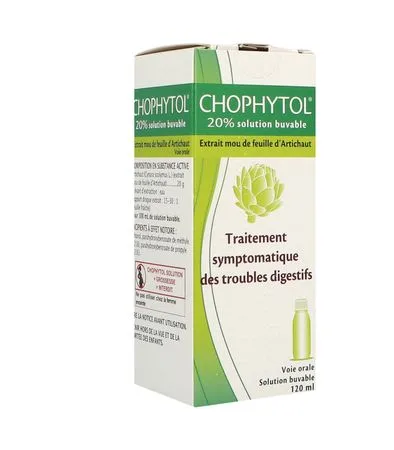
CHOPHYTOL 20 PERCENT, oral solution
Composition
Artichoke (Cynara scolymus L.) (soft leaf extract of)..........................................................................20 g
Extraction solvent: water
Drug extract ratio: 15-30 : 1 (fresh leaf)
For 100 mL of oral solution.
Excipients with known effect: ethanol, methyl parahydroxybenzoate (E 218), propyl parahydroxybenzoate (E 216).
Ethanol, orange peel alcoholate, glycerol, methyl parahydroxybenzoate (E 218), propyl parahydroxybenzoate (E 216), purified water.
Indications
Traditional herbal medicinal product used for the symptomatic treatment of digestive disorders such as dyspepsia with a feeling of heaviness, bloating and flatulence.
Its use is restricted to the specified indication exclusively on the basis of long-standing use.
CHOPHYTOL 20 PERCENT, oral solution is indicated in adults and adolescents from 12 years of age.
Dosage and administration
Dosage
Adults and adolescents from 12 years of age
1 teaspoon 3 times a day.
Paediatric population
This medicine is not recommended in children under 12 years of age (see section Warnings and precautions).
Method of administration
Oral use.
Swallow with a little water, before meals or at the time of the disorders.
Duration of treatment
2 to 3 weeks.
If symptoms persist beyond 2 weeks of use, a doctor or a qualified healthcare professional must be consulted.
Contraindications
• Hypersensitivity to the active substance, to another plant of the family Asteraceae (Compositae) or to any of the excipients listed in section Composition.
• Obstruction of the bile ducts and severe hepatocellular insufficiency.
• Association with acitretin (see section Interactions).
Warnings and precautions
In case of diarrhoea or abdominal pain, the product must be discontinued.
This medicine contains 5,1 % by volume of ethanol (alcohol), i.e. up to 0,20 g per dose, which is equivalent to 5 mL of beer or 2 mL of wine per dose. The use of this medicine is dangerous in alcoholics and must be taken into account in pregnant or breastfeeding women, children and high-risk groups such as patients with hepatic insufficiency or epilepsy.
This medicine contains methyl parahydroxybenzoate and propyl parahydroxybenzoate, which may cause allergic reactions (possibly delayed).
Paediatric population
In the absence of adequate sufficient data, use in children under 12 years of age is not recommended.
Interactions
Related to the presence of alcohol (200 mg per teaspoon)
Contraindicated combinations
+ Acitretin
In women of childbearing potential, risk of conversion of acitretin to etretinate, a potent teratogen whose very prolonged half-life (120 days) exposes to a major teratogenic risk in case of pregnancy, during treatment and for 2 months after its discontinuation.
Combinations not recommended
+ Medicines causing an antabuse reaction with alcohol
Antabuse effect (heat, flushing, vomiting, tachycardia).
Avoid taking alcoholic beverages and medicines containing alcohol. Take into account the complete elimination of the medicines by referring to their half-life before resuming alcoholic beverages or the medicine containing alcohol.
+ Irreversible MAOIs
Increase of the hypertensive and/or hyperthermic effects of tyramine present in certain alcoholic beverages (chianti, certain beers, etc.).
Avoid taking alcoholic beverages and medicines containing alcohol.
+ Insulin
Increase of the hypoglycaemic reaction (inhibition of compensatory reactions which may facilitate the occurrence of hypoglycaemic coma).
Avoid taking alcoholic beverages and medicines containing alcohol.
+ Sedative medicinal products
Alcohol increases the sedative effect of these substances.
Impairment of alertness may make driving vehicles and using machinery dangerous.
Avoid taking alcoholic beverages and medicines containing alcohol.
+ Metformin
Increased risk of lactic acidosis during acute alcohol intoxication, particularly in case of fasting or malnutrition, or hepatocellular insufficiency.
Avoid taking alcoholic beverages and medicines containing alcohol.
+ Hypoglycaemic sulfonylureas
Antabuse effect notably for glibenclamide, glipizide, tolbutamide. Increase of the hypoglycaemic reaction (inhibition of compensatory reactions) which may facilitate the occurrence of hypoglycaemic coma.
Avoid taking alcoholic beverages and medicines containing alcohol.
Associations to be taken into account
+ Nicotinic acid
Risk of pruritus, flushing and warmth related to potentiation of the vasodilatory effect.
Fertility, pregnancy and breastfeeding
Pregnancy
Safety in use has not been established during pregnancy. In the absence of sufficient data and due to the presence of alcohol, use of this medicine is contraindicated in pregnant women throughout pregnancy.
Breast-feeding
Safety in use has not been established during breastfeeding. In the absence of sufficient data and due to the presence of alcohol, use of this medicine is contraindicated during breastfeeding.
Fertility
No data available on fertility.
Driving and using machines
The effects on the ability to drive vehicles and use machines have not been studied.
Adverse effects
The following undesirable effects are classified by organ system class and may occur with an unknown frequency (cannot be estimated from the available data).
Immune system disorders :
Frequency not known: allergic reactions (possibly delayed) related to the presence of methyl and propyl parahydroxybenzoates.
Gastrointestinal disorders :
Frequency undetermined: mild diarrhoea with abdominal spasms, epigastric disorders such as nausea and heartburn.
Reporting of suspected adverse reactions
Reporting of suspected adverse reactions after registration of the medicine is important. It allows continuous monitoring of the benefit/risk balance of the medicine. Healthcare professionals report any suspected adverse reaction via the national reporting system: National Agency for the Safety of Medicines and Health Products (ANSM) and network of Regional Pharmacovigilance Centres - Website: https://signalement.social-sante.gouv.fr/.
Preclinical safety
The genotoxicity studies conducted in vitro with the artichoke leaf extract contained in the specialty CHOPHYTOL, oral solution, concluded to the absence of a mutagenic effect in the Ames test.
No study has been carried out on carcinogenesis or on reproductive and developmental function.
Shelf life
3 years.
After first opening of the bottle, this medicine must be stored for a maximum of 30 days.
Prescription, supply and reimbursement
| Marketing authorisation (AMM) |
|
3 PLACE RENAULT
92500 RUEIL-MALMAISON
Tel: 01 34 80 55 55 contact@mayoly.com
https://www.mayoly-spindler.fr/
Source: VIDAL · Updated on 10/11/2026. This information does not replace advice from a healthcare professional.