
Medicines
SmPC of 27/11/2024
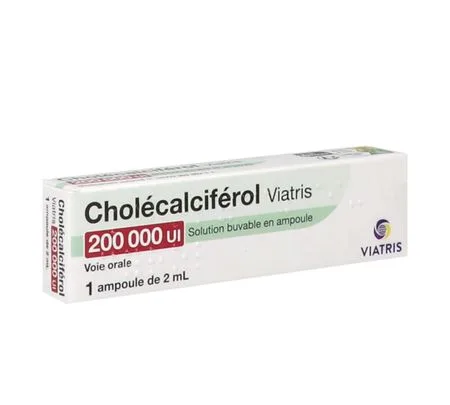
CHOLECALCIFEROL VIATRIS 200 000 IU, oral solution in ampoule
Composition
Cholecalciferol (vitamin D3)..............................................................................................................200 000 IU
For one ampoule.
Sweet orange essential oil, oleic macrogolglycerides, refined olive oil.
Dosage and administration
Dosage
Children over 2 years and adolescents
Prophylaxis
CHOLECALCIFEROL VIATRIS 200 000 IU, oral solution in ampoule is not suitable for the prophylaxis of vitamin D deficiency in the paediatric population.
Treatment
1 ampoule renewable 1 times over 6 months depending on the severity of the deficiency until serum calcium and phosphate return to normal, monitoring urinary calcium to avoid overdosing, then prophylactic treatment according to an appropriate regimen and presentation.
Adult and elderly subject
Prophylaxis
1 ampoule every 6 months.
Treatment
1 ampoule renewable 1 to 2 times depending on the severity of the deficiency until normalisation of serum calcium and phosphate, monitoring urinary calcium to avoid overdosing, then prophylactic treatment according to the regimen above, not exceeding 600 000 IU per year.
Method of administration
Oral use.
The contents of the ampoule may be taken neat from a small spoon or mixed into a liquid or semi-liquid food.
Contraindications
• Hypersensitivity to the active substance or to any of the excipients listed in section Composition,
• Hypercalcaemia, hypercalciuria, calcium lithiasis,
• Hypervitaminosis D,
• Nephrocalcinosis,
• Pathology and/or conditions leading to hypercalcaemia and/or hypercalciuria.
Warnings and precautions
Monitoring
• To avoid any overdosing, take into account the total vitamin D intake from all sources, whether nutritional sources, other supplements already containing this vitamin, or in case of use of vitamin D-fortified milk, as well as medicines likely to interact with CHOLECALCIFEROL VIATRIS 200 000 IU, oral solution in ampoule (see section Interactions).
• In indications requiring high and repeated doses, monitor urinary calcium and serum calcium and stop vitamin D intake if serum calcium exceeds 106 mg/l (2,65 mmol/l) or if urinary calcium exceeds 300 mg/24 h in adults or 4-6 mg/kg/day in children.
Sarcoidosis
When prescribing this medicine to patients with sarcoidosis, careful assessment of the benefit of treatment against the risks for these patients is necessary because of the risk of increased metabolism of vitamin D to its active form (1,25-dihydroxyvitamin D).. When its prescription is justified in patients with stable sarcoidosis (including in remission) in the absence of renal impairment and hypercalcaemia, the use of this medicine must be carried out with caution. In these patients, serum calcium and urinary calcium should be closely monitored.
Renal impairment
This medicine should be used with caution in patients with renal insufficiency and the effect on calcium and phosphate levels must be monitored.
The risk of soft tissue calcification must be taken into account.
Patients taking digoxin
The effect of vitamin D on serum calcium should prompt increased monitoring of patients taking digoxin with regard to the risk of cardiac arrhythmias.
Patients taking thiazide diuretics
There is an increased risk of hypercalcaemia when thiazide diuretics are used concomitantly because they reduce urinary calcium excretion.
Vitamin D toxicity in situations of hypervitaminosis D
The risk of vitamin D toxicity is increased in patients with a pathology and/or disorders leading to hypercalcaemia and/or hypercalciuria, and in patients with an increased genetic sensitivity to vitamin D, giving rise to hypervitaminosis D (see section Overdose).
Interactions
Precautions for use
+ ENZYME-INDUCING ANTICONVULSANTS (carbamazepine, fosphenytoin, phenobarbital, phenytoin, primidone or barbiturates)
Decrease in vitamin D concentrations more marked than in the absence of enzyme inducer.
Measurement of vitamin D concentrations and supplementation if necessary.
+ GLUCOCORTICOIDS
Glucocorticoids reduce the effect of vitamin D due to increased metabolism. Measurement of vitamin D concentrations and vitamin D and calcium supplementation if necessary.
+ CHELATING RESINS
Taking a chelating resin may decrease intestinal absorption and, potentially, the efficacy of other medicines taken simultaneously. In general, the resin should be taken at a distance from other medicines, with an interval of more than 2 hours, if possible.
+ RIFAMPICIN
Decrease in plasma vitamin D concentrations more marked than in the absence of treatment with rifampicin.
Measure plasma vitamin D concentrations and supplement if necessary.
To be taken into account
+ ORLISTAT
Decrease in vitamin D absorption.
+ LAXATIVES
With laxatives, particularly in view of endoscopic examinations: risk of decreased efficacy of the medicine administered with the laxative. Avoid taking other medicines during and after ingestion for at least 2 h after taking the laxative, or even until the examination is performed.
Fertility, pregnancy and breastfeeding
Pregnancy
Data are limited on the use of cholecalciferol in pregnant women.
Animal studies have shown teratogenic effects at very high doses.
Overdose of cholecalciferol should be avoided during pregnancy, due to the risk of prolonged hypercalcaemia which may lead to delayed physical and mental development, supravalvular aortic stenosis and retinopathy in the child.
Cholecalciferol is not recommended for prophylaxis of deficiency in pregnant women. In case of deficiency, CHOLECALCIFEROL VIATRIS 200 000 UI, oral solution in ampoule is not recommended in pregnant women due to its high dosage.
Breast-feeding
Cholecalciferol and its metabolites are excreted in breast milk. No overdose induced by a breastfeeding mother has been observed in the newborn; however, when prescribing a cholecalciferol supplement to a breastfed newborn, the physician must take into account any additional dose of cholecalciferol taken by the mother. CHOLECALCIFEROL VIATRIS 200 000 UI, oral solution in ampoule is not recommended in breastfeeding women due to its high dosage.
Fertility
There is no data regarding the effect of vitamin D on fertility.
Driving and using machines
Vitamin D has no or negligible effect on the ability to drive vehicles and use machines.
Adverse effects
The adverse effects of CHOLECALCIFEROL VIATRIS are listed according to the classification MedDRA by system class-organ and are presented in decreasing order of frequency according to the following convention: very common (≥1/10), common (>1/100, <1/10), uncommon (>1/1 000, <1/100), rare (>1/10 000, <1/1 000), very rare (<1/10 000), frequency not known (cannot be estimated from the available data).
|
System Organ Class |
Frequency |
Adverse reaction |
|
Immune system disorders |
Not known |
Hypersensitivity reactions |
|
Skin and subcutaneous tissue disorders |
Not known |
Pruritus, rash, erythema, angioedema |
|
General disorders and administration site conditions |
Not known |
Oedema, calcium lithiasis |
|
Metabolism and nutrition disorders |
Not known |
Hypercalcemia |
|
Renal and urinary disorders |
Not known |
Hypercalciuria, nephrolithiasis, nephrocalcinosis |
Reporting of suspected adverse reactions
Reporting suspected adverse reactions after authorisation of the medicinal product is important. It allows continued monitoring of the benefit/risk balance of the medicinal product. Healthcare professionals are asked to report any suspected adverse reactions via the national reporting system: National Agency for the Safety of Medicines and Health Products (ANSM) and the network of Regional Pharmacovigilance Centres - Website: https://signalement.social-sante.gouv.fr.
Overdose
An acute or chronic overdose of vitamin D may lead to hypervitaminosis D. Drug intoxication with vitamin D may cause abnormally high blood calcium levels, which can ultimately severely damage soft tissues and the kidneys.
The risk of overdose is particularly high if the patient receives multiple sources of vitamin D and the overall vitamin D supplementation does not match the patient's individual needs; as well as in patients with increased sensitivity to vitamin D, resulting in hypervitaminosis D (see section Warnings and precautions).
Clinical signs:
These are the signs associated with hypercalcaemia
• headache, asthenia, anorexia, weight loss, growth arrest,
• confusional state,
• bone pain,
• muscle weakness,
• nausea, vomiting,
• constipation, abdominal pain,
• polyuria, polydipsia, dehydration, thirst,
• arterial hypertension,
• calcium stones, tissue calcifications, particularly renal (nephrocalcinosis) and vascular,
• persistence of high calcium levels may lead to irreversible damage and calcification of soft tissues,
• renal failure,
• kidney stones,
• cardiac arrhythmia in severe cases,
• extreme hypercalcaemia may lead to coma and death.
Biological signs:
• hypercalcaemia, hypercalciuria, hyperphosphataemia, low concentration of parathyroid hormone and high concentration of 25-hydroxyvitamin D.
Management:
Stop administration of vitamin D, reduce calcium intake, increase diuresis, abundant drinks.
In cases of severe hypercalcaemia, hyperhydration, treatment alone or combined with loop diuretics, bisphosphonates, calcitonin and glucocorticoids should be considered. Serum electrolytes, renal function and diuresis should be monitored.
Pharmacodynamics
Pharmacotherapeutic class: VITAMIN D AND ANALOGUES, ATC code: A11CC05
The essential role of vitamin D is exerted on the intestine, where it increases the capacity to absorb calcium and phosphates, and on the skeleton, where it promotes mineralisation and regulates bone remodelling.
Pharmacokinetics
Vitamin D is absorbed passively in the small intestine, then reaches the general circulation via the lymphatic route, incorporated into chylomicrons.
After absorption, it binds to a specific carrier protein and is transported to the liver to be converted into 25-hydroxyvitamin D. The latter in turn binds to the same carrier protein and is transported to the kidneys where it is transformed into its active form, 1,25-dihydroxyvitamin D.
Its essential storage sites are adipose tissue, muscles, but also blood. 25-hydroxyvitamin D bound to its carrier protein is the circulating marker of vitamin status and reserves. Its half-life in the blood is 15 to 40 days.
Vitamin D and its metabolites are eliminated via the faeces, in unchanged form or in water-soluble form (calcitroic acid, glucuroconjugated derivatives).
Preclinical safety
Effects have been observed in animals only at exposures far greater than the maximum exposure recommended for therapeutic use in humans.
A genotoxicity study on Salmonella typhimurium s'is revealed to be negative.
Two carcinogenesis studies in rats showed a possible relationship between chronic consumption of high doses of vitamin D3 and an increased incidence of pheochromocytoma.
Studies of'embryotoxicity and teratogenicity showed :
• Degeneration of smooth muscle cells in pigs.
• A decrease in the elastic and contractile properties of the aorta in rats.
• A decrease in the number and mean weight of litters as well as in gestation time in albino mice.
Repeated-dose toxicity studies showed extensive mineralization of soft tissues, in particular the kidneys, lungs and myocardium.
Special storage precautions
Store at a temperature not exceeding 25°C.
Store the ampoule in the outer packaging, protected from light.
Prescription, supply and reimbursement
| Marketing authorisation (AMM) |
|
| Price: |
|
- Indication(s) appearing in the marketing authorisation at the date of publication of this decree
Collection.
1 RUE DE TURIN
69007 LYON
Tel: 04 37 25 75 00 https://www.viatris.fr/
Source: VIDAL · Updated on 10/11/2026. This information does not replace advice from a healthcare professional.