
Medicines
SmPC of 10/03/2025
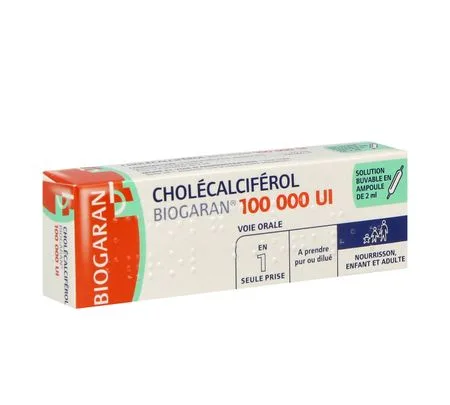
CHOLECALCIFEROL BIOGARAN 100 000 UI, oral solution in ampoule
Forms and presentations
Oral solution in ampoule.
Clear, yellowish oral solution in ampoule, with a lemon odour.
Composition
Cholecalciferol (or vitamin D3)................................................................................................................2,5 mg
Quantity corresponding to....................................................................................................................100 000 IU
For one ampoule of 2 ml.
For the full list of excipients, see section Composition.
Butylated hydroxytoluene, saccharin, sorbic acid, natural lemon flavour, oleic macrogolglycerides.
Dosage and administration
Dosage
Children over 2 years and adolescents
Prophylaxis:
It is preferable to administer daily doses as drops.
In case of non-compliance with daily supplementation:
• 1 ampoule twice a year (in autumn and winter) in healthy children.
• 1 ampoule every quarter in case of reduced vitamin D availability (obesity, pigmented skin, no sun exposure) or reduced intake (vegan diet).
Adult and elderly subject
Prophylaxis: 1 ampoule every 3 months.
Treatment: 1 to 2 ampoules per month depending on the severity of the deficiency until calcaemia and phosphataemia return to normal, monitoring calciuria to avoid overdose, then prophylactic treatment according to the regimen above, not exceeding 600 000 IU per year.
Method of administration
Oral use.
The contents of the ampoule may be administered neat on a small spoon or diluted in a little water (a slight cloudiness may appear).
Contraindications
• Hypersensitivity to the active substance or to any of the excipients listed in section Composition ;
• Hypercalcaemia, hypercalciuria, calcium lithiasis;
• Hypervitaminosis D;
• Nephrocalcinosis;
• Pathologies and/or conditions causing hypercalcaemia and/or hypercalciuria.
Warnings and precautions
To avoid any overdose, take into account the total doses of vitamin D in case of association with a treatment already containing this vitamin or in case of use of milk supplemented with vitamin D.
In indications requiring high and repeated doses, monitor calciuria and calcaemia and stop vitamin D intake if calcaemia exceeds 106 mg/ml (2,65 mmol/l) or if calciuria exceeds 300 mg/l in adults or 4 to 6 mg/kg/day in children.
Fertility, pregnancy and breastfeeding
Pregnancy
Data are limited on the use of cholecalciferol in pregnant women.
Animal studies have shown teratogenic effects at very high doses.
Overdose of cholecalciferol should be avoided during pregnancy, due to the risk of prolonged hypercalcaemia which may lead to delayed physical and mental development, supravalvular aortic stenosis and retinopathy in the child.
Cholecalciferol is not recommended for prophylaxis of deficiency in pregnant women. In case of deficiency, CHOLECALCIFEROL BIOGARAN is not recommended in pregnant women due to its high dosage.
Breast-feeding
Cholecalciferol and its metabolites are excreted in breast milk. No overdose induced by a breastfeeding mother has been observed in the newborn; however, when prescribing a cholecalciferol supplement to a breastfed newborn, the physician must take into account any additional dose of cholecalciferol taken by the mother. CHOLECALCIFEROL BIOGARAN is not recommended in breastfeeding women due to its high dosage.
Fertility
There is no data regarding the effect of vitamin D on fertility.
Driving and using machines
The effects on the ability to drive vehicles and use machines have not been studied.
Adverse effects
Very rarely and in particular in case of overdose (see section Overdose) :
• hypersensitivity reaction to cholecalciferol;
• hypercalcemia, hypercalciuria, calcium lithiasis.
Reporting of suspected adverse reactions
Reporting suspected adverse effects after marketing authorisation of the medicinal product is important. It allows continuous monitoring of the benefit/risk balance of the medicinal product. Healthcare professionals report any suspected adverse effect via the national reporting system: National Agency for the Safety of Medicines and Health Products (ANSM) and network of Regional Centres of Pharmacovigilance – Website: https://signalement.social-sante.gouv.fr/
Overdose
Clinical signs :
• headache, asthenia, anorexia, weight loss, growth arrest;
• nausea, vomiting;
• polyuria, polydipsia, dehydration;
• arterial hypertension;
• calcium lithiasis, tissue calcifications, particularly renal and vascular;
• renal failure.
Biological signs :
• hypercalcaemia, hypercalciuria, hyperphosphataemia, hyperphosphaturia.
Management :
Stop administration of vitamin D, reduce calcium intake, increase diuresis, abundant drinks.
Pharmacodynamics
Pharmacotherapeutic class: vitamin D and analogues, ATC code: A11CC05.
The essential role of vitamin D is exerted on the intestine, where it increases the capacity to absorb calcium and phosphates, and on the skeleton, where it promotes mineralisation (through its direct actions on bone being formed and its indirect actions involving the intestine, the parathyroid glands and already mineralised bone).
Pharmacokinetics
Vitamin D is absorbed passively in the small intestine, then reaches the general circulation via the lymphatic route, incorporated into chylomicrons.
After absorption, it binds to a specific carrier protein and is transported to the liver where it is converted into 25‑hydroxyvitamin D. This in turn binds to the same carrier protein and is transported to the kidneys where it is transformed into its active form, 1,25‑dihydroxyvitamin D.
Its essential storage sites are adipose tissue, muscles, but also blood. 25‑hydroxyvitamin D bound to its carrier protein is the major circulating reserve form of vitamin D. Its half-life in the blood is 15 to 40 days.
Vitamin D and its metabolites are eliminated via the faeces, in unchanged form or in water-soluble form (calcitroic acid, glucuroconjugated derivatives).
Special storage precautions
Store the ampoule in the outer packaging.
Do not refrigerate and do not freeze.
Prescription, supply and reimbursement
| Marketing authorisation (AMM) |
|
| Price: |
|
- Indication(s) appearing in the marketing authorisation at the date of publication of this decree
Collection.
15 BOULEVARD CHARLES DE GAULLE
92707 COLOMBES CEDEX
Tel: 01 55 72 41 00 contact@biogaran.fr
https://www.biogaran.fr
Source: VIDAL · Updated on 10/11/2026. This information does not replace advice from a healthcare professional.