
Medicines
RCP du 30/04/2026
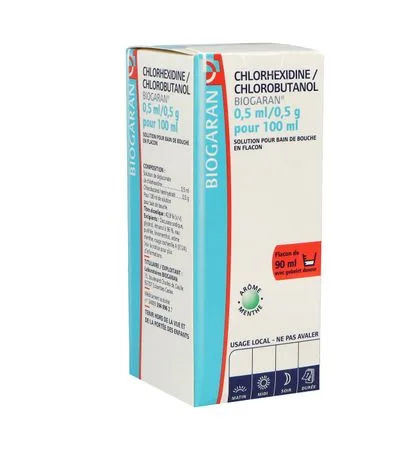
CHLORHEXIDINE / CHLOROBUTANOL BIOGARAN 0,5 mL / 0,5 g per 100 mL, mouthwash solution in bottle
Composition
Chlorhexidine digluconate solution.................................................................................................0,5 mL
Chlorobutanol hemihydrate............................................................................................................................0,5 g
For 100 mL of mouthwash solution.
Excipients with known effect :
• cochineal red A (E124),
• ethanol at 96 % (alcohol content 42,8 % (v/v)).
For the full list of excipients, see section Composition.
Docusate sodium, glycerol, ethanol at 96 %, purified water, levomenthol, mint flavouring, cochineal red A (E124).
Indications
Adjunctive local treatment of conditions of the oral cavity and during post-operative care in odonto-stomatology.
This medicine is indicated in adults, adolescents and children aged over 6 years.
Dosage and administration
Dosage
The usual dose is 10 to 15 mL of solution 2 times a day. If necessary, this dosage may be increased to 3 times a day, the maximum dose being 20 mL (to be diluted), 3 times a day.
The duration of treatment may be 2 weeks in gingival inflammation (gingivitis) and periodontitis. The duration of treatment may not be extended beyond 2 weeks except on medical advice.
If there is no improvement after 5 days, the need to continue treatment must be assessed by a doctor or a dental surgeon.
Paediatric population
This medicine is contraindicated in children under 6 years (see section Contraindications).
Method of administration
Local use as a mouthwash.
Do not swallow.
Brush your teeth before each use and rinse your mouth thoroughly with water before using CHLORHEXIDINE / CHLOROBUTANOL BIOGARAN.
For the bottle, dilute in the measuring cup by topping up to the upper mark with lukewarm water: carry out the mouth rinse until the measuring cup is empty. Leave the solution in contact for 1 minute then spit it out.
For the single-dose vial, dilute the contents of the vial in half a glass of water and carry out the mouth rinse. Leave the solution in contact for 1 minute then spit it out.
Contraindications
• Hypersensitivity to the active substances or to any of the excipients listed in section Composition ;
• in children under 6 years.
Warnings and precautions
Local use as a mouthwash.
Do not swallow the solution.
Do not put CHLORHEXIDINE / CHLOROBUTANOL BIOGARAN in contact with the eyes, nose and ears. In case of contact, rinse immediately and abundantly with water.
If symptoms persist beyond 5 days and/or if fever is associated, the advice of a doctor or dental surgeon must be sought.
This medicine may cause severe generalised allergic reactions due to the presence of chlorhexidine, which may occur a few minutes after exposure (see section Adverse effects).
Prolonged use may expose to staining of the tongue, teeth, dentures or filling materials. This staining is reversible and can be avoided on teeth and filling materials by brushing the teeth daily before using the mouthwash, or by a denture solution for removable (dental) prostheses.
Excipients
This medicine contains 7,13 g of alcohol (ethanol) per dose of 20 mL of solution, equivalent to 0,36 g/mL. The small amount of alcohol contained in this medicine is not likely to cause any noticeable effect. As this medicine is a mouthwash solution, it is therefore not swallowed. It must nevertheless be ensured that children using the product do not swallow it. The presence of alcohol must be taken into account in cases of alcohol withdrawal.
This medicine contains an azo colouring agent, cochineal red A (E124), and may cause allergic reactions.
Interactions
Chlorhexidine is incompatible with anionic agents generally present in conventional toothpastes. Therefore, a thorough rinsing of the mouth with water, after brushing the teeth with a toothpaste, must be carried out before using this medicine. An interval must be respected between the use of the 2 products.
Fertility, pregnancy and breastfeeding
Pregnancy
There are no data or there are limited data (fewer than 300 pregnancies) on the use of chlorhexidine and chlorobutanol in pregnant women.
Animal studies carried out with chlorhexidine have not shown any direct or indirect harmful effects (under normal conditions of use) on reproduction. An animal study showed reproductive toxicity after oral administration of chlorobutanol (see section Preclinical safety).
As a precaution, it is preferable to avoid the use of CHLORHEXIDINE / CHLOROBUTANOL BIOGARAN during pregnancy.
Breast-feeding
It is not known whether chlorhexidine and chlorobutanol are excreted in breast milk.
A risk to newborns/infants cannot be excluded.
CHLORHEXIDINE / CHLOROBUTANOL BIOGARAN must not be used during breastfeeding.
Fertility
Chlorhexidine has no effect on fertility. A study conducted in rats showed harmful effects on female fertility after oral administration of chlorobutanol (see section Preclinical safety).
Driving and using machines
No study on the ability to drive vehicles and use machines has been carried out with the combination of chlorhexidine and chlorobutanol.
Adverse effects
Undesirable effects are classified below by system organ class and by frequency. Frequencies are defined as follows: very common (≥ 1/10), common (≥ 1/100, < 1/10), uncommon (≥ 1/1000, < 1/100), rare (≥ 1/10 000, < 1/1000), very rare (< 1/10 000), and frequency not known (cannot be estimated from the available data).
|
System organ class |
MedDRA classification (preferred terms)
|
|
Immune system disorders |
• Anaphylactic shock, anaphylactic reaction *; • Hypersensitivity to chlorhexidine or to one of the constituents of the solution. |
|
Nervous system disorders |
• Dysgeusia; • Burning sensation of the mucous membranes; These effects may appear at the start of treatment and generally decrease with continued treatment. |
|
Gastrointestinal disorders |
• Brown discolouration of the tongue, reversible on stopping treatment (see section Warnings and precautions) ; Brown discoloration of teeth, dental prostheses or filling materials, reversible upon discontinuation of treatment (see section Warnings and precautions) ; Swelling of the parotid glands, reversible upon discontinuation of treatment; Oral desquamation: if this occurs, diluting the mouthwash solution with more than 50% water will often allow continued use of the mouthwash. |
* Risk of generalised allergy to chlorhexidine, which may lead to anaphylactic shock that could be fatal if medical care is not provided immediately. It may manifest as difficulty breathing, facial swelling, severe skin rash.
If the patient has an allergic reaction to chlorhexidine, they must immediately stop using this product and consult a doctor.
Reporting of suspected adverse reactions
Reporting suspected adverse reactions after authorisation of the medicinal product is important. It allows continued monitoring of the benefit/risk balance of the medicinal product. Healthcare professionals are asked to report any suspected adverse reactions via the national reporting system: National Agency for the Safety of Medicines and Health Products (ANSM) and the network of Regional Pharmacovigilance Centres - Website: https://signalement.social-sante.gouv.fr/.
Overdose
Overdose is not expected under normal conditions of use of this mouthwash solution.
Symptoms in case of ingestion
Systemic effects are rare because chlorhexidine is poorly absorbed by the gastrointestinal tract.
Local effects such as local irritation (throat, oesophagus) and burning sensation (mouth, throat) may occur.
However, in case of massive ingestion and systemic absorption, the following disorders may occur:
• neurological or hepatic disorders;
• digestive disorders (nausea, vomiting, epigastric pain, diarrhoea).
Treatment
Treatment is symptomatic and must be administered in a specialised setting.
Due to the alcohol content of the undiluted product, accidental ingestion of a large quantity of the mouthwash by children requires immediate medical attention for appropriate action.
Pharmacodynamics
Pharmacotherapeutic class: STOMATOLOGICAL PREPARATIONS – ANTI-INFECTIVES AND ANTISEPTICS FOR LOCAL ORAL TREATMENT, ATC code: A01AB03.
Chlorhexidine is a broad-spectrum bactericidal antiseptic belonging to the bisdiguanide family.
The antiseptic activity of the mouthwash solution combining chlorhexidine and chlorobutanol has been demonstrated in vitro in particular against pathogenic germs of the oral flora such as Porphyromonas gingivalis, A. actinomycetemcomitans, Prevotella intermedia, Capnocytophaga ochracea, Eikenella corrodens, Fusobacterium nucleatum, Campylobacter rectus.
By its antiseptic activity, the mouthwash solution combining chlorhexidine and chlorobutanol helps reduce dental plaque and, consequently, gingival inflammation.
Chlorobutanol has antibacterial and antifungal properties. It is also used as a local analgesic in preparations for inflammation and pain of the ear and oropharynx.
Pharmacokinetics
CHLORHEXIDINE
Oral use
Absorption
Chlorhexidine is poorly absorbed and very low concentrations of circulating chlorhexidine are detected in the blood.
Distribution
Mainly in the liver and kidneys.
Biotransformation and elimination
Chlorhexidine undergoes limited metabolism and is excreted essentially unchanged in the faeces (99,5% of the ingested dose).
Oral route
When used locally, chlorhexidine is adsorbed onto dental enamel, dentine, cementum, mucous membranes and dental prostheses, with slow desorption. Chlorhexidine remains detectable in saliva for 8 to 12 hours.
Due to its cationic nature, chlorhexidine digluconate binds strongly to the skin, mucous membranes and other tissues. It is therefore very poorly absorbed.
After contact with mucous membranes, chlorhexidine is absorbed by organic structures, which results in a local residual effect and limits passage into the systemic circulation.
CHLOROBUTANOL
Oral use
Absorption
When administered orally, chlorobutanol is rapidly absorbed. A decrease in absorption by half is observed during the 24 hours after intake.
Elimination
The terminal half-life is approximately 10 days. Urinary excretion is low, approximately 10% of the ingested dose.
Preclinical safety
CHLORHEXIDINE
Non-clinical data from conventional studies of safety pharmacology, repeated-dose toxicity and local tolerance, genotoxicity, carcinogenesis, and reproductive and developmental functions did not reveal any particular risk for humans.
In repeated-dose oral studies, effects were observed in animals only at exposures considered sufficiently higher than the maximum exposure observed in humans, and have little clinical significance after topical application.
CHLOROBUTANOL
A combined repeated-dose toxicity study with reproduction and developmental toxicity screening conducted orally in rats showed that chlorobutanol affects fertility and is embryotoxic at doses inducing maternal toxicity.
After repeated oral administration in rats, effects on the kidneys and liver were observed in both sexes. In addition, the reduction in locomotor activity was considered evidence of the sedative effects of chlorobutanol. Chlorobutanol is not genotoxic and no experimental study is available to assess its carcinogenic potential.
Prescription, supply and reimbursement
| Marketing authorisation (AMM) |
|
| Price: |
|
Collection.
15 BOULEVARD CHARLES DE GAULLE
92707 COLOMBES CEDEX
Tel: 01 55 72 41 00 contact@biogaran.fr
https://www.biogaran.fr
Source: VIDAL · Updated on 10/11/2026. This information does not replace advice from a healthcare professional.