
Medicines
SPC of 22/08/2023
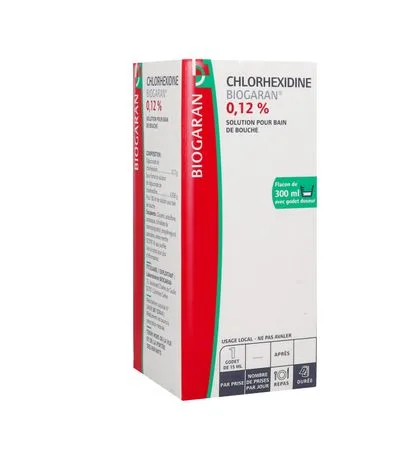
CHLORHEXIDINE BIOGARAN 0,12 %, mouthwash solution
Composition
Chlorhexidine digluconate..................................................................................................................0,1200 g
In the form of chlorhexidine digluconate solution …………………………………….........0,6360 g
For 100 ml of mouthwash solution
Excipients with known effect: azorubine, macrogolglycerol ricinoleate, propylene glycol.
Glycerol, acesulfame potassium, macrogolglycerol ricinoleate, propylene glycol, azorubine, peppermint flavour SC379118*, purified water
*Composition of peppermint flavour SC379118: eucalyptol, menthone, isomenthone, menthol, carvone, anethole, menthyl acetate, triacetin, propylene glycol, ethanol, menthofuran, pulegone, estragole, thujone, methyleugenol
Indications
Adjunctive treatment of oral infections and post-operative care in stomatology.
This medicine is indicated in adults and children over 6 years of age.
Dosage and administration
RESERVED FOR ADULTS AND CHILDREN OVER 6 YEARS OF AGE
Dosage
Paediatric population
This medicine is contraindicated in children under 6 years of age (see section Contraindications).
Method of administration
For each mouthwash, use the contents of one single-dose cup (15 ml).
The number of mouthwashes is 1 to 3 per day, lasting about one minute each (after meals and preferably after brushing the teeth).
Brush the teeth before each use and rinse the mouth thoroughly with water before using
CHLORHEXIDINE BIOGARAN.
This solution must be used neat, undiluted.
Local use as a mouthwash.
Do not swallow.
Contraindications
Hypersensitivity to the active substance or to any of the excipients listed in section Composition.
Children under 6 years.
Warnings and precautions
The indication does not justify prolonged treatment, especially as it could expose the patient to an imbalance of the normal oral cavity microbial flora, with a risk of bacterial or fungal spread (candidiasis).
If symptoms persist beyond 5 days and/or if associated fever occurs, the management should be reassessed and systemic antibiotic therapy considered.
Discontinue treatment in case of parotid swelling.
Do not put the product in contact with the eyes or nose.
Do not introduce the product into the ear canal.
The excipient "azorubine (E124)" may cause allergic reactions, the excipient "propylene glycol" may cause local irritation, and the excipient macrogolglycerol ricinoleate may cause skin reactions.
Interactions
Simultaneous or successive use of other antiseptics should be avoided due to possible interferences (antagonism, inactivation).
Chlorhexidine is incompatible with anionic agents generally present in conventional toothpastes. Therefore, a complete rinsing of the mouth with water, after brushing the teeth with a toothpaste, must be carried out before using this medicine. A short interval must be observed between the use of the 2 products
Fertility, pregnancy and breastfeeding
Pregnancy
There are no data or there are limited data (fewer than 300 pregnancies) on the use of chlorhexidine in pregnant women.
Studies performed in animals have not demonstrated any direct or indirect harmful effects (under normal conditions of use) on reproduction.
As a precautionary measure, it is preferable to avoid the use of CHLORHEXIDINE BIOGARAN during pregnancy.
Breast-feeding
It is not known whether chlorhexidine is excreted in breast milk.
A risk to newborns / infants cannot be excluded.
CHLORHEXIDINE BIOGARAN must not be used during breastfeeding.
Fertility
Studies performed in animals have not demonstrated any effect on fertility (under normal conditions of use).
Driving and using machines
The effects on the ability to drive vehicles and use machines have not been studied. No effect is expected.
Adverse effects
• Brown discoloration of the tongue and teeth, reversible on stopping treatment (particularly in tea and coffee drinkers)
• Risk of sensitization to one of the constituents of the solution (parotitis, mucocutaneous irritation, skin allergic reaction or even generalized reaction, swelling of the salivary glands), requiring discontinuation of treatment
• Occasionally dysgeusia or burning sensation of the tongue at the start of treatment.
• Occasionally desquamation of the oral mucosa.
Reporting of suspected adverse reactions
Reporting suspected adverse reactions after authorisation of the medicinal product is important. It allows continued monitoring of the benefit/risk balance of the medicinal product. Healthcare professionals should report any suspected adverse reactions via the national reporting system: National Agency for the Safety of Medicines and Health Products (ANSM) and the network of Regional Pharmacovigilance Centres - Website: https://signalement.social-sante.gouv.fr/ .
Overdose
In case of oral ingestion of chlorhexidine, the following effects have been reported: atrophic gastritis, oesophageal and hepatic lesions in case of very high doses.
In addition, this specialty contains terpene derivatives, as excipients, which may lower the epileptogenic threshold and lead, at excessive doses, to neurological accidents in children (such as convulsions) and in elderly subjects (such as agitation and confusion). Respect the recommended dosages and duration of treatment (see section Dosage and administration).
Accidental eye splashing of a chlorhexidine solution is likely to cause corneal lesions requiring specialised management,
Pharmacodynamics
Pharmacotherapeutic class: ANTI-INFECTIVES AND ANTISEPTICS FOR ORAL LOCAL TREATMENT; ATC code: A01AB03
Chlorhexidine is a broad-spectrum bactericidal antiseptic belonging to the bisdiguanide family.
Its bactericidal activity is exerted on Gram-positive organisms and, to a lesser degree, on Gram-negative organisms.
Pharmacokinetics
Route oral
Absorption
Chlorhexidine is poorly absorbed through the digestive tract, and very low circulating concentrations are detected in the blood.
Distribution
Mainly in the liver and kidneys.
Biotransformation and Elimination
Chlorhexidine undergoes limited metabolism and is excreted essentially unchanged in the faeces (99,5% of the ingested dose).
Oral route
When used locally, chlorhexidine is adsorbed onto dental enamel, dentine, cementum, mucous membranes and dental prostheses, with slow desorption. Chlorhexidine remains detectable in saliva for 8 to 12 hours.
Due to its cationic nature, chlorhexidine digluconate binds strongly to the skin, mucous membranes and other tissues. It is therefore very poorly absorbed.
After contact with mucous membranes, chlorhexidine is absorbed by organic structures, which results in a local residual effect and limits passage into the systemic circulation.
Preclinical safety
The currently available non-clinical data add no further relevant information for the prescriber beyond that already mentioned in the other sections of the SmPC.
SPECIAL PRECAUTIONS FOR DISPOSAL AND OTHER HANDLING
No special requirements.
Any unused medicinal product or waste must be disposed of in accordance with local regulations in force
Prescription, supply and reimbursement
| Marketing authorisation (AMM) |
|
| Price: |
|
- Indication(s) listed in the marketing authorisation on the date of publication of this order (Bottle/300ml, PET bottle/200ml)
Collection.
15 BOULEVARD CHARLES DE GAULLE
92707 COLOMBES CEDEX
Tel: 01 55 72 41 00 contact@biogaran.fr
https://www.biogaran.fr
Source: VIDAL · Updated on 10/11/2026. This information does not replace advice from a healthcare professional.