

Medicines
SmPC of 25/07/2024
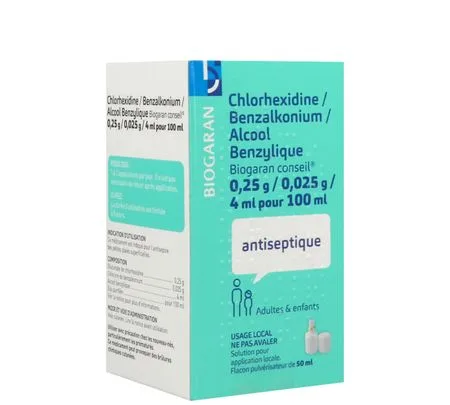
CHLORHEXIDINE/BENZALKONIUM/BENZYL ALCOHOL BIOGARAN CONSEIL 0,25 g/0,025g/4 mL per 100 mL, solution for topical application
Composition
Chlorhexidine gluconate ..................................................................................................................... 0,250 g
Benzalkonium chloride ....................................................................................................................... 0,025 g
Benzyl alcohol .................................................................................................................................... 4.000 mL
For 100 ml
Purified water.
Dosage and administration
Dosage
1 to 2 applications per day.
It is not necessary to rinse after application.
Method and route of administration
Cutaneous use.
For external use.
Duration of treatment
The duration of use is limited to 5 days.
Contraindications
• Hypersensitivity to the active substances (in particular to the chemical class of chlorhexidine or to the family of quaternary ammoniums) or to any of the excipients listed in the section Composition.
• This product must not be brought into contact with the brain and meninges, the eye, nor enter the ear canal in case of tympanic perforation.
• This product must not be used on mucous membranes, particularly genital ones (risk of balanitis or erosive vaginitis).
• This product must not be used for disinfecting medical-surgical equipment.
Warnings and precautions
For external use.
CHLORHEXIDINE/BENZALKONIUM/BENZYL ALCOHOL BIOGARAN CONSEIL must not come into contact with the eye. Serious cases of persistent corneal damage, which may require corneal transplantation, have been reported following accidental ocular exposure to medicinal products containing chlorhexidine despite taking eye protection measures, due to migration of the solution beyond the intended surgical preparation area.
During application, extreme caution should be exercised to ensure that CHLORHEXIDINE/BENZALKONIUM/BENZYL ALCOHOL BIOGARAN CONSEIL does not migrate beyond the intended site of application into the eyes. Special precautions must be taken in anaesthetised patients who are not able to immediately report ocular exposure. If CHLORHEXIDINE/BENZALKONIUM/BENZYL ALCOHOL BIOGARAN CONSEIL comes into contact with the eyes, rinse promptly and thoroughly with water. Advice should be sought from an ophthalmologist.
In the absence of data on cutaneous absorption, the risk of systemic effects cannot be ruled out. These are all the more to be feared when the antiseptic is used over a large surface area, under an occlusive dressing, on damaged skin, notably burned skin, a mucous membrane, or the skin of a premature infant or infant (due to the surface area/weight ratio and the occlusive effect of diapers in the napkin area).
Once an antiseptic preparation is opened, microbial contamination is possible.
The use of chlorhexidine solutions, alcoholic or aqueous, for skin antisepsis before an invasive procedure has been associated with chemical burns in newborns. Based on reported cases and published literature, this risk appears to be higher in premature children, particularly those born before 32 weeks of gestation and within the first 2 weeks of life.
Rare cases of severe hypersensitivity reactions progressing to anaphylactic shock have been reported with antiseptics containing chlorhexidine. In case of occurrence of breathing difficulties, rapidly progressing urticaria-type skin eruption or severe rash, clinical signs of shock, immediately stop application of CHLORHEXIDINE/BENZALKONIUM/BENZYL ALCOHOL BIOGARAN CONSEIL 0,25 g/0,025g/4 ml for 100 ml, solution for topical application and medical management must be initiated as soon as possible.
Interactions
Given possible interactions, simultaneous or successive use of antiseptics or soap should be avoided, except with other cationic compounds.
Fertility, pregnancy and breastfeeding
Use with caution in pregnant or breastfeeding women, due to a lack of usable data.
Adverse effects
Risk of local allergy, generally manifesting as contact eczema, particularly in case of use on damaged skin, mucous membranes and ulcerations of the lower limbs, with possible worsening of a superinfected lesion.
Risk of general allergy which may, in very rare cases, progress to anaphylactic shock.
Chemical burns in newborns (frequency unknown).
Eye disorders:
Frequency not determined: Corneal erosion, epithelial lesion/corneal lesion, permanent significant visual impairment*.
* Cases of severe corneal erosion and permanent significant visual impairment due to unintentional ocular exposure have been reported after marketing, which in some patients led to the need for corneal transplantation (see section Warnings and precautions).
Reporting of suspected adverse reactions
Reporting suspected adverse reactions after authorisation of the medicinal product is important. It allows continued monitoring of the benefit/risk balance of the medicinal product. Healthcare professionals are asked to report any suspected adverse reaction via the national reporting system: National Agency for the Safety of Medicines and Health Products (ANSM) and the network of Regional Centres of Pharmacovigilance - Website: https://signalement.social-sante.gouv.fr/.
Overdose
Excessive use risks leading to an exacerbation of adverse effects. Furthermore, systemic absorption cannot be ruled out in case of extensive application or under occlusive dressings.
In case of massive oral ingestion, perform gastric lavage. The acute oral toxicity of chlorhexidine is low (digestive absorption almost negligible).
Pharmacodynamics
Pharmacotherapeutic class: ANTISEPTICS AND DISINFECTANTS, ATC code: D08AC02
Combination of three active ingredients, possessing bactericidal activity against Gram-positive and Gram-negative germs, as well as fungicidal activity against Candida albicans.
The individual efficacy of each active ingredient is potentiated by the presence of the other two:
• chlorhexidine, a broad-spectrum bactericidal antiseptic of the biguanide family,
• benzalkonium chloride (an antiseptic of the quaternary ammonium family), confers slightly detergent properties to the solution;
• benzyl alcohol, at the concentration used, exerts a slight local anesthetic and analgesic activity.
INCOMPATIBILITIES
Chlorhexidine and benzalkonium chloride must not be combined with soaps and anionic compounds.
Prescription, supply and reimbursement
| Marketing authorisation (AMM) |
|
15 BOULEVARD CHARLES DE GAULLE
92707 COLOMBES CEDEX
Tel: 01 55 72 41 00 contact@biogaran.fr
https://www.biogaran.fr
Source: VIDAL · Updated on 11/11/2026. This information does not replace advice from a healthcare professional.