
Medicines
Update of the 19/03/2024
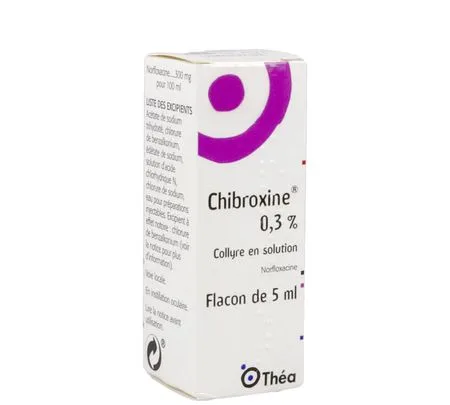
CHIBROXINE®
norfloxacin
Forms and presentations
Eye drops in solution at 0,3 % : Dropper bottle of 5 ml.Composition
| p bottle | |
| Norfloxacin
|
15 mg |
Excipient with known effect: benzalkonium chloride (1,2 microgram per drop of eye drops).
Indications
Local antibacterial treatment of severe ocular infections (severe conjunctivitis, keratitis and corneal ulcers) due to germs sensitive to norfloxacin.Official recommendations concerning the appropriate use of antibacterial agents should be taken into account.
Dosage and administration
DosageThe usual dosage is 1 or 2 drops 4 times a day in the affected eye(s). If the severity of the infection requires it, 1 or 2 drops of eye drops may be prescribed on the first day of treatment, every 2 hours, during the day.
Method of administration:
Topical use.
For ocular instillation.
Contraindications
This medicine must not be used in the following cases:- Hypersensitivity to any of the components of these eye drops.
- Hypersensitivity to quinolones.
Warnings and precautions
- Do not inject, do not swallow.
- The eye drops must not be used by peri- or intraocular injection.
- Emergence of resistance or selection of resistant strains is possible, particularly during long-term treatment.
- Cross-resistance between quinolones may exist.
- Treatment must be discontinued at the first signs of a skin rash or any other sign of a hypersensitivity reaction.
- During instillation, do not touch the eye with the tip of the bottle.
- Wearing contact lenses is not recommended during eye infections. However, if the physician deems the use of contact lenses possible, the patient must be informed as follows: avoid contact with soft contact lenses. Remove contact lenses before application and wait at least 15 minutes before reinserting them.
- When different eye drops are administered simultaneously, the instillations must be spaced at least 15 minutes apart.
This medicine contains 1,2 microgram of benzalkonium chloride per drop.
Benzalkonium chloride is known to cause eye irritation, dry eye syndrome symptoms, and may affect the tear film and corneal surface. Should be used with caution in patients with dry eye and those at risk of corneal damage.
Patients should be monitored in case of prolonged use.
Benzalkonium chloride may be absorbed by soft contact lenses and change their colour. Patients must be informed that they must remove contact lenses before using this medicine and wait at least 15 minutes before reinserting them.
Interactions
No specific drug interaction studies have been performed with norfloxacin eye drops.
Fertility, pregnancy and breastfeeding
Pregnancy:Given the low doses administered, the use of these eye drops may be considered during pregnancy if necessary.
With norfloxacin administered systemically, animal studies have not shown a teratogenic effect, and clinical data are still insufficient.
Joint damage has been described in children treated with quinolones, but to date, no case of arthropathy secondary to exposure in utero has been reported.
Breastfeeding:
Norfloxacin, administered systemically, passes into breast milk. Therefore, in the absence of data on passage after ocular administration, it is not recommended to administer these eye drops during breastfeeding.
Adverse effects
- Most frequently encountered: local burning or stinging sensations.
- Less commonly: conjunctival hyperaemia, chemosis, photophobia, bitter taste after instillation.
- Very rarely: corneal deposits.
- Due to the presence of benzalkonium chloride, risk of contact eczema and irritation.
Reporting suspected adverse reactions after authorisation of the medicinal product is important. It allows continuous monitoring of the benefit/risk balance of the medicinal product. Healthcare professionals should report any suspected adverse reaction via the national reporting system: National Agency for the Safety of Medicines and Health Products (ANSM) and the network of Regional Pharmacovigilance Centres. Website: https://signalement.social-sante.gouv.fr.
Overdose
To date, no cases of overdose have been reported with these eye drops.
Pharmacodynamics
Pharmacotherapeutic class: Antibiotic of the quinolone family, ATC code: S01AE02.
(J: anti-infectives; S: sense organs (eye)).
Norfloxacin is an antibacterial agent of the quinolone family.
Norfloxacin inhibits the synthesis of bacterial deoxyribonucleic acid. It is bactericidal.
- Spectrum of antibacterial activity:
- The critical concentrations separate susceptible strains from strains of intermediate susceptibility, and the latter from resistant ones: S ≤ 1 mg/L and R > 2 mg/L.
- The prevalence of acquired resistance can vary according to geography and time for certain species. It is therefore useful to have information on local resistance prevalence, especially for the treatment of severe infections. These data can only provide guidance on the probabilities of the susceptibility of a bacterial strain to this antibiotic.
- When the variability of resistance prevalence in Europe is known for a bacterial species, the frequency of acquired resistance in Europe is indicated in parentheses.
-
Susceptible species:
- Aerobic Gram-positive: Staphylococcus spp. meti-S (0 - 16 %).
- Aerobic Gram-negative: Acinetobacter baumannii (50 - 88 %), Citrobacter freundii (0 - 36 %), Citrobacter koseri (0 - 12 %), Enterobacter aerogenes (0 - 65 %), Enterobacter cloacae (0 - 27 %), Escherichia coli (0 - 15 %), Klebsiella oxytoca (0 - 13 %), Klebsiella pneumoniae (0 - 15 %), Morganella morganii (0 - 15 %), Neisseria gonorrhoeae, Proteus mirabilis (0 - 17 %), Proteus vulgaris, Providencia rettgeri, Providencia stuartii (0 - 71 %), Pseudomonas aeruginosa (0 - 45 %), Serratia marcescens (0 - 30 %).
- Aerobic Gram-positive: Staphylococcus spp. meti-S (0 - 16 %).
-
Resistant species:
- Aerobic Gram-positive: Enterococcus, Staphylococcus spp. methicillin-R*.
- Anaerobes: Gram-positive anaerobic bacteria except for some strains of Clostridium perfringens, all Gram-negative anaerobic bacteria.
- Aerobic Gram-positive: Enterococcus, Staphylococcus spp. methicillin-R*.
-
* The frequency of methicillin resistance is approximately 30 to 50 % of all staphylococci and is found mainly in hospital settings.
- Resistance to norfloxacin due to spontaneous mutations is of the order of 10-7 at 10-8 cells.
- This spectrum corresponds to that of the systemic forms of norfloxacin. With the local pharmaceutical presentations, the concentrations obtained in situ are far higher than plasma concentrations.
- Some uncertainties remain regarding the kinetics of the concentrations in situ, the local physicochemical conditions that may alter the activity of the antibiotic, and the stability of the product in situ.
Pharmacokinetics
In animals, one hour after the administration of one drop of this eye drop solution into the conjunctival cul-de-sac, the tear concentration of this eye drop solution is higher than the MICs of the main germs encountered in ocular infections.
After administration of this eye drop solution as a single dose or as repeated doses, it was not possible to detect the antibiotic in the blood during the 3 hours following instillation.
Storage conditions
- Shelf life before opening:
- 3 years.
After opening: The medicinal product may be stored for a maximum of 15 days.
Store at a temperature not exceeding 25 °C.
Store the bottle in the outer packaging.
HANDLING/DISPOSAL INSTRUCTIONS
No special requirements.
Prescription, supply and reimbursement
LIST I| Marketing authorisation (AMM) | 3400933132255 (1988, SmPC rev 03.06.2020). |
| Price: | 2,83 euros (bottle of 5 ml). |
| Reimbursed by Social Security at 65 %. Collective. | |
THÉA PHARMA
37, rue Georges-Besse
63100 Clermont-Ferrand
http://www.theapharma.fr
Source: VIDAL · Updated on 10/11/2026. This information does not replace advice from a healthcare professional.