
Medicines
Update of the 19/03/2024
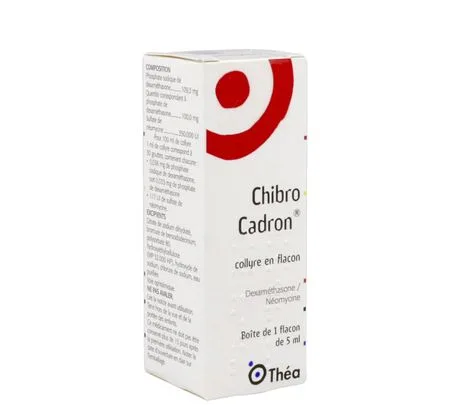
CHIBRO-CADRON® eye drops
dexamethasone, neomycin
Forms and presentations
Eye drops: Bottle of 5 ml, with dropper tip.Composition
| p bottle | |
| Dexamethasone (INN) phosphate
|
5 mg |
| (as sodium phosphate: 5,465 mg/bottle) | |
| Neomycin (INN) sulfate
|
17 500 IU |
1 ml = 30 drops.
Indications
Local anti-inflammatory and antibacterial treatment of the eye:- following ophthalmic surgery;
- infections due to neomycin-sensitive germs with an inflammatory component.
Dosage and administration
Dosage1 drop into the lower conjunctival sac every hour at the start of treatment in severe acute conditions, 3 to 6 times a day in other cases, for 7 days on average.
Longer treatment or more frequent instillations may be prescribed under strict ophthalmological supervision.
- Paediatric population:
- The use of this medicine should be avoided in infants.
Contraindications
- Hypersensitivity to the active substances or to any of the excipients listed in section Composition.
- Herpetic epithelial dendritic keratitis.
- Mycotic and tuberculous infections of the eye.
- Personal or family history of glaucoma.
- Early-stage viral keratoconjunctivitis.
- Purulent infections of the eyelids and eye secondary to germs resistant to neomycin.
Warnings and precautions
Warnings:
- Repeated and/or prolonged instillations of the eye drops may lead to a not insignificant systemic passage of the active ingredients.
- Repeated and/or prolonged instillations of the eye drops may lead to ocular hypertension in some patients and/or delayed healing.
- Cushing's syndrome and/or inhibition of adrenal function associated with systemic absorption of ophthalmic dexamethasone may occur after intensive continuous or long-term treatment in predisposed patients, including children and patients treated with CYP3A4 inhibitors (including ritonavir and cobicistat). In this case, treatment must be discontinued gradually.
- Visual disturbances: visual disturbances may appear during corticosteroid therapy by systemic or local route. In case of blurred vision or onset of any other visual symptom during corticosteroid therapy, an ophthalmological examination is required to look for, in particular, cataract, glaucoma, or a rarer lesion such as central serous chorioretinopathy, as described with the administration of systemic or local corticosteroids.
- Athletes' attention is drawn to the fact that this specialty contains an active ingredient that may induce a positive reaction in tests performed on athletes during anti-doping controls.
- This medicine contains 6 micrograms of phosphates per drop (see Undesirable effects).
- The eye drops must not be administered by peri- or intra-ocular injection.
- In case of concomitant treatment with another eye drop, instil the eye drops at 15 minutes' interval.
- Neomycin sulfate may sometimes cause skin sensitization; in this case, administration of the medicine must be stopped.
- In the absence of rapid improvement or in case of prolonged treatment, regular medical monitoring including bacteriological checks with sensitivity study of the germ makes it possible to detect drug resistance and possibly adapt the treatment.
- This type of association is generally contraindicated after simple removal of a superficial corneal foreign body.
- The use of corticosteroids in the treatment of stromal herpes simplex requires careful monitoring; an examination with a slit lamp is frequently required.
- As with all ophthalmic preparations containing a corticosteroid, prolonged use requires particularly careful ophthalmological monitoring of the cornea, intraocular pressure and the lens: cases of corneal thinning and cases of cataract have been reported after prolonged treatment with certain topical corticosteroids.
- Hereditary and degenerative eye diseases generally do not show a response to treatment with this medicine.
- Wearing contact lenses should be avoided during treatment due to the risk of adsorption of the active ingredients and the preservative.
Interactions
CYP3A4 inhibitors (including ritonavir and cobicistat) may decrease the clearance of dexamethasone, resulting in increased effects and inhibition of adrenal function/Cushing's syndrome. The combination should be avoided, unless the benefit outweighs the increased risk of systemic corticosteroid side effects, in which case patients should be monitored for systemic corticosteroid effects.
Fertility, pregnancy and breastfeeding
Pregnancy:As a precautionary measure, it is preferable not to use Chibro-Cadron eye drops in bottle during pregnancy. Indeed, clinical and animal data with this combination by this route of administration are insufficient. In clinical practice, fetotoxic effects have been described with systemic use of certain aminoglycosides and corticosteroids.
Breastfeeding:
Breastfeeding is possible in case of short-term treatment (10 days). It is preferable to avoid breastfeeding in case of prolonged treatment.
Adverse effects
- Possibility of transient local irritation: discomfort, tearing, burning, conjunctival hyperaemia.
- Risk of cutaneous-conjunctival hypersensitivity reaction.
- With prolonged use: corticosteroid-induced ocular hypertension, lens opacification, superficial keratitis.
- In case of corneal or scleral ulceration, corticosteroids may delay healing and promote superinfection.
- A few rare cases of corneal calcification have been reported in association with the use of phosphate-containing drops in some patients with severely damaged corneas.
- Undesirable effects from post-marketing data (frequency not determined):
-
The following undesirable effects have been observed after marketing:
- Endocrine disorders: Cushing's syndrome, inhibition of adrenal function (see Warnings and Precautions for Use).
- Eye disorders: blurred vision (see Warnings and Precautions for Use).
- Endocrine disorders: Cushing's syndrome, inhibition of adrenal function (see Warnings and Precautions for Use).
Reporting suspected adverse reactions after authorisation of the medicinal product is important. It allows continuous monitoring of the benefit/risk balance of the medicinal product. Healthcare professionals should report any suspected adverse reaction via the national reporting system: National Agency for the Safety of Medicines and Health Products (ANSM) and the network of Regional Pharmacovigilance Centres. Website: https://signalement.social-sante.gouv.fr.
Overdose
No cases of overdose have been reported. However, repeated and prolonged instillations of the eye drops may lead to a not insignificant systemic passage of the active ingredients, corticosteroid-induced ocular hypertension, opacification of the lens, superficial keratitis and delayed healing.
As with all ophthalmic preparations containing a corticosteroid, prolonged use requires particularly careful ophthalmological monitoring of the cornea, intraocular pressure and the lens: cases of corneal thinning and cases of cataract have been reported after prolonged treatment with certain topical corticosteroids.
Pharmacodynamics
Pharmacotherapeutic class: Corticosteroids and anti-infectives in combination (ATC code: S01CA01).
Dexamethasone is a steroidal anti-inflammatory agent.
Neomycin is a bactericidal antibiotic of the aminoglycoside family.
- Antibacterial activity spectrum of neomycin:
- The prevalence of acquired resistance can vary according to geography and time for certain species. It is therefore useful to have information on local resistance prevalence, especially for the treatment of severe infections. These data can only provide guidance on the probabilities of the susceptibility of a bacterial strain to this antibiotic.
- When the variability of resistance prevalence in France is known for a bacterial species, the frequency of acquired resistance in France (> 10 %; extreme values) is indicated in parentheses:
-
Susceptible species:
- Gram-positive aerobes: corynebacterium, Listeria monocytogenes, methicillin-sensitive staphylococcus.
- Gram-negative aerobes: acinetobacter (50-75 %) essentially Acinetobacter baumannii, Branhamella catarrhalis, campylobacter, Citrobacter freundii (20-25 %), Citrobacter koseri, Enterobacter aerogenes (?), Enterobacter cloacae (10-20 %), Escherichia coli (15-25 %), Haemophilus influenzae (25-35 %), klebsiella (10-15 %), Morganella morganii (10-20 %), Proteus mirabilis (20-50 %), Proteus vulgaris (?), Providencia rettgeri (?), salmonella (?), serratia (?), shigella (?), yersinia (?).
- Gram-positive aerobes: corynebacterium, Listeria monocytogenes, methicillin-sensitive staphylococcus.
-
Moderately susceptible species (in vitro of intermediate susceptibility):
- Gram-negative aerobes: pasteurella.
- Gram-negative aerobes: pasteurella.
-
Resistant species:
- Gram-positive aerobes: enterococci, Nocardia asteroides, methicillin-resistant staphylococcus*, streptococcus.
- Gram-negative aerobes: Alcaligenes denitrificans, burkholderia, flavobacterium sp, Providencia stuartii, Pseudomonas aeruginosa, Stenotrophomonas maltophilia.
- Anaerobes: strict anaerobic bacteria.
- Others: chlamydia, mycoplasmas, rickettsiae.
- Gram-positive aerobes: enterococci, Nocardia asteroides, methicillin-resistant staphylococcus*, streptococcus.
-
* The frequency of methicillin resistance is approximately 30 to 50 % of all staphylococci and is found mainly in hospital settings.
- Note: this spectrum corresponds to that of systemic forms of antibiotics belonging to the aminoglycoside family. With local pharmaceutical presentations, the concentrations obtained in situ are much higher than plasma concentrations. Some uncertainties remain regarding the kinetics of the concentrations in situ, on local physicochemical conditions which may modify the activity of the antibiotic and on the stability of the product in situ.
Pharmacokinetics
For topical use, neomycin penetrates the cornea poorly.
Storage conditions
- Shelf life before opening the vial:
- 3 years.
No special precautions for storage.
After opening the vial: 15 days.
HANDLING/DISPOSAL INSTRUCTIONS
No special requirements.
Prescription, supply and reimbursement
LIST I| Marketing authorisation (AMM) | 3400930217412 (1992, SmPC rev 08.06.2018). |
| Price: | 1,95 euros (vial of 5 ml). |
| Social Security reimbursement at 30%. Collect. | |
THÉA PHARMA
37, rue Georges-Besse
63100 Clermont-Ferrand
http://www.theapharma.fr
Source: VIDAL · Updated on 10/11/2026. This information does not replace advice from a healthcare professional.