
Medicines
SmPC of 23/01/2025
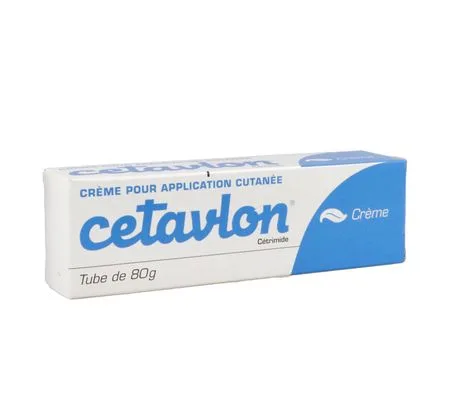
CETAVLON, cream
Composition
Cetrimide......................................................................................................................................................0,500 g
For 100 g of cream.
Excipients with known effect:
• Methyl parahydroxybenzoate (E218) 0,135 g,
• Propyl parahydroxybenzoate (E216) 0,011 g,
• Cetostearyl alcohol 12 g,
• Ethanol 0,084 g,
• Lavender essential oil (fragrance) containing the following allergens: benzyl alcohol, benzyl benzoate, coumarin, eugenol, farnesol, geraniol, limonene, linalool.
Ethanol, cetostearyl alcohol (mixture of cetyl alcohol (63% minimum) and stearyl alcohol (33% minimum)), liquid paraffin, methyl parahydroxybenzoate (E218), propyl parahydroxybenzoate (E216), lavender essential oil*, purified water.
*Main components of lavender essential oil (fragrance): benzyl alcohol, benzyl benzoate, coumarin, eugenol, farnesol, geraniol, limonene, linalool.
Indications
Adjuvant treatment of skin conditions primarily of bacterial origin or liable to become superinfected, in adults and children over 30 months of age.
Remark : antiseptic agents are not sterilising. They temporarily reduce the number of microorganisms.
Dosage and administration
Dosage
Adults and children over 30 months of age :
The application may be repeated 1 to 2 times daily.
Paediatric population
CETAVLON is contraindicated in children under 30 months of age (see section Contraindications).
Method of administration
Cutaneous use.
Clean the wound with water and soap, rinse thoroughly with clear water. Dry. Apply the cream, taking care that the tip of the tube does not touch the wound directly.
Contraindications
- Hypersensitivity to the active substance (or quaternary ammonium derivatives) or to any of the excipients listed in section Composition.
- This preparation must not be used on mucous membranes, particularly genital ones (risk of balanitis and erosive vaginitis).
- This product must not be brought into contact with the eye, brain or meninges, nor enter the auditory canal in the case of tympanic perforation.
- Due to the presence of terpene derivatives as excipients:
- In children with a history of febrile or non-febrile convulsions.
- In children under 30 months of age.
Warnings and precautions
Systemic effects are more likely to occur if the antiseptic is used:
• over a large area,
• under an occlusive dressing,
• on damaged skin (particularly burned skin),
• on a mucous membrane (use on the rectal mucosa may cause atony comparable to that observed with neuromuscular blockers),
• on the skin of a young child (due to the surface-area-to-weight ratio and the occlusive effect of diapers in the diaper area).
This medicine contains terpene derivatives as excipients, which may lower the epileptogenic threshold.
At excessive doses (see section Overdose) :
• Risk of neurological adverse events such as convulsions in children.
• Possibility of agitation and confusion in elderly subjects..
Follow the dosage and instructions for use, in particular:
• do not apply to a large surface area of the body,
• do not apply to the breasts during breastfeeding (see section Fertility, pregnancy and breastfeeding).
This medicine contains:
• Methyl parahydroxybenzoate (E218) and propyl parahydroxybenzoate (E216) and may cause allergic reactions (possibly delayed);
• Cetostearyl alcohol and may cause local skin reactions (for example contact dermatitis);
• Ethanol (0,84 mg per g of CETAVLON) and may cause a burning sensation on damaged skin;
• Lavender essential oil (fragrance) containing benzyl alcohol, benzyl benzoate, coumarin, eugenol, farnesol, geraniol, limonene and linalool and may cause allergic reactions.
Precautions for use
As soon as the packaging of an antiseptic preparation is opened, microbial contamination is possible.
In case of a history of epilepsy, the presence of terpene derivatives as excipients must be taken into account.
Interactions
Given the possible interferences (antagonism/inactivation), simultaneous or successive use of antiseptics or soap should be avoided (see section Incompatibilities).
Fertility, pregnancy and breastfeeding
Pregnancy
There are no or few data to assess the use of CETAVLON in pregnant women.
Animal studies are insufficient to assess reproductive toxicity (see section Preclinical safety).
The use of CETAVLON is not recommended during pregnancy or in women of childbearing potential not using a contraceptive method.
Breast-feeding
It is not known whether cetrimide and/or its metabolites are excreted in human milk.
A risk to newborns or infants cannot be excluded.
Given the presence of terpene derivatives in the excipients, the use of CETAVLON should be avoided during breastfeeding due to the lack of data on the passage of terpene derivatives into milk and their potential neurotoxicity for the newborn or infant.
CETAVLON must not be applied to the breasts during breastfeeding (see section Warnings and precautions).
Fertility
In animals, there is no conventional fertility study data available.
Adverse effects
The adverse effects mentioned below are listed by System Organ Class (SOC). The frequency of adverse effects is defined using the following convention: very common (≥1/10); common (≥1/100 to <1/10); uncommon (≥1/1 000 to <1/100); rare (≥1/10 000 to <1/1 000); very rare (<1/10 000); frequency not known (cannot be estimated from the available data).
|
System Organ Classes |
MedDRA preferred term Frequency not known |
|
Immune system disorders |
Hypersensitivity at the application site |
|
Skin and subcutaneous tissue disorders |
Skin erosion* |
*Erosive lesions that may progress to ulcer and necrosis under occlusive dressing
Reporting of suspected adverse reactions
Reporting suspected adverse reactions after authorisation of the medicinal product is important. It allows continued monitoring of the benefit/risk balance of the medicinal product. Healthcare professionals are asked to report any suspected adverse reaction via the national reporting system: National Agency for the Safety of Medicines and Health Products (ANSM) and the network of Regional Centres of Pharmacovigilance - Website: https://signalement.social-sante.gouv.fr/.
Overdose
An overdose may lead to:
• Risk of neurological accidents such as convulsions in children;
• Possible agitation and confusion in elderly subjects.
Pharmacodynamics
Pharmacotherapeutic class: Antiseptics and disinfectants – Quaternary ammonium compounds, ATC code: D08AJ04
This product contains cetrimide from the quaternary ammonium family. It is a bacteriostatic, non-bactericidal antiseptic, active mainly against gram-positive bacteria and inactive against Pseudomonas bacteria.
It is inhibited in the presence of biological products (pus, blood and exudates).
Preclinical safety
No non-clinical data are available based on conventional studies of safety pharmacology, repeated-dose toxicity, genotoxicity, carcinogenic potential and reproductive toxicity.
The acute toxicity in rats of a 40% cetrimide solution in water is low (LD50 = 1000 mg/kg).
No data are available regarding the local tolerance of the finished product CETAVLON. Cetrimonium bromide, which represents 10% of the cetrimide used in CETAVLON, is irritating to the skin and eyes based on in vitro tests, suggesting that CETAVLON may be irritating to the skin and eyes.
INCOMPATIBILITIES
Quaternary ammoniums are incompatible with soaps and anionic compounds.
Quaternary ammoniums are inactivated in the presence of cellulose fibre and cotton.
Prescription, supply and reimbursement
| Marketing authorisation (AMM) |
|
Collection.
CHARTREUSE INDUSTRIAL PARK
81106 CASTRES CEDEX
Tel: 01 49 10 80 00 Tel (Freephone): 0 800 326 326
https://www.pierrefabremedicament.fr/
Source: VIDAL · Updated on 10/11/2026. This information does not replace advice from a healthcare professional.