

Medicines
SmPC of 13/11/2024
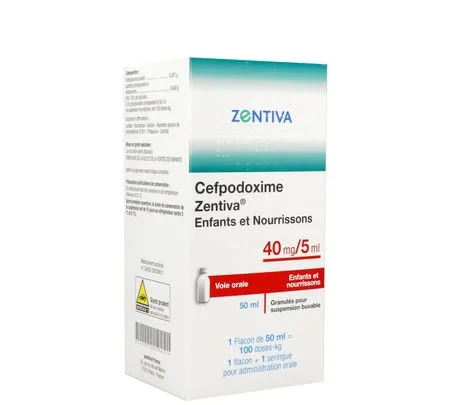
CEFPODOXIME ZENTIVA CHILDREN AND INFANTS 40 mg/5 ml, granules for oral suspension
Composition
Cefpodoxime proxetil
Quantity corresponding to cefpodoxime.....................................................................................................40 mg
For 5 ml of reconstituted suspension.
• 8,35 g of granules corresponds to 50 ml of reconstituted suspension, i.e. 100 dose-kg.
• 16,7 g of granules corresponds to 100 ml of reconstituted suspension, i.e. 200 dose-kg.
Excipients with known effect: Lactose, sucrose, sodium, aspartame (source of phenylalanine) (E951) and sorbitol.
Calcium carmellose, sodium chloride, monosodium glutamate, aspartame, yellow iron oxide, sodium carmellose, sucrose, citric acid monohydrate, hydroxypropylcellulose, sorbitan trioleate, talc, anhydrous colloidal silica, banana flavouring*, potassium sorbate, lactose monohydrate.
*Composition of banana flavouring: isoamyl acetate, isoamyl isovalerate, ethyl butyrate, geranyl formate, acetaldehyde, citral, nonyl aldehyde, orange essential oil, vegetable gum, sorbitol, maltodextrin.
Indications
They result from the antibacterial activity and the pharmacokinetic characteristics of cefpodoxime.
In children, they are limited to the treatment of infections due to germs sensitive to cefpodoxime, and in particular:
• Acute otitis media,
• Documented group A beta-haemolytic streptococcal tonsillitis,
• Sinusitis,
• Lower respiratory tract infections.
Official recommendations concerning the appropriate use of antibacterial agents should be taken into account.
Dosage and administration
La Presentation oral suspension is recommended in children. For certain cases, the use of a Presentation sous tablet form is envisageable in les indications and paediatric dosages validated if the child can swallow the tablet.
Dosage
Normal renal function children
The average dosage is 8 mg/kg/day, not exceeding the adult dose (200 mg/day in tonsillitis and 400 mg/day in the other indications), divided into 2 doses at 12 hour intervals.
|
The dose per dose is indicated, according to the child's weight, on the plunger of the oral syringe graduated in kg of body weight (graduations from 5 to 25 kg). The dose per intake can therefore be read directly. Thus, the indicated weight corresponds to the dose for one administration. The dose to be administered for one intake is therefore obtained by pulling the plunger to the graduation corresponding to the child's weight. Two doses per day are required. For example, the graduation 12 kg corresponds to the dose to be administered per intake for a child weighing 12 kg, and this twice a day. |
The duration of treatment for tonsillitis is 5 days.
Renal insufficiency :
If the creatinine clearance is > 40 ml/min/1,73 m2, refer to the dosage for the normo-renal subject.
If the creatinine clearance is < 40 ml/min/1,73 m2, see the table below:
|
Creatinine clearance (ml/min/1.73 m2) |
Doses |
|
10 - 39 |
a unit dose every 24 hours |
|
< 10 |
a unit dose every 48 hours |
In case of haemodialysis, one unit dose will be administered after each dialysis session.
Hepatic impairment :
It is not necessary to modify the dosage.
Method of administration
Oral use.
The oral suspension is to be administered during a meal.
Before preparing the suspension, the capsule containing the desiccant, located inside the cap, must be removed and discarded. The granules contained in the bottle are suspended by adding water at the time of use up to the graduation mark. The bottle must be shaken in order to homogenise the resulting suspension.
Contraindications
• Hypersensitivity to the active substance or to any of the excipients listed in section Composition.
• In case of known allergy to antibiotics of the cephalosporin group.
• Due to the presence of aspartame, this medicine is contraindicated in cases of phenylketonuria.
Warnings and precautions
Special warnings
• The occurrence of any allergic reaction requires discontinuation of treatment.
• Prescribing cephalosporins requires prior questioning, as penicillin allergy is cross-reactive with cephalosporin allergy in 5 to 10% of cases:
- The use of cephalosporins must be extremely cautious in patients sensitive to penicillin: strict medical monitoring is necessary from the first administration.
- The use of cephalosporins is formally contraindicated in subjects with a history of immediate-type allergy to cephalosporins. In case of doubt, the presence of the physician with the patient is essential at the first administration, in order to treat a possible anaphylactic accident.
• Hypersensitivity reactions (anaphylaxis) observed with these two types of beta-lactams can be severe and sometimes fatal.
• The occurrence of an episode of diarrhea may, exceptionally, be symptomatic of pseudomembranous colitis, the diagnosis of which relies on colonoscopy.
This accident, rare with cephalosporins, requires immediate discontinuation of treatment and initiation of appropriate specific antibiotic therapy (vancomycin). In this case, the administration of products promoting fecal stasis must absolutely be avoided.
• Hematological disorders
As with other antibiotics of the beta-lactam class, neutropenia and more rarely agranulocytosis may develop during treatment with cefpodoxime, particularly if treatment is long-term. In this case, hematological monitoring should be considered.
• Bullous eruptions
As with other cephalosporins, cases of bullous eruptions (erythema multiforme, Stevens-Johnson syndrome, Lyell syndrome) have been reported. If skin and/or mucous membrane involvement occurs, patients must immediately contact their physician, before continuing treatment.
• Superinfection
As with other antibiotics, administration of cefpodoxime, particularly if treatment is long-term, may lead to excessive growth of non-susceptible microorganisms. Regular assessments of the patient's condition are essential. If superinfection occurs during treatment, appropriate measures must be taken.
• Encephalopathy
Beta-lactams, including cefpodoxime, predispose the patient to the risk of encephalopathy (which may include convulsions, confusion, impaired consciousness or abnormal movements) and, particularly, in cases of overdose or renal insufficiency.
• Severe cutaneous adverse reactions (SCARs)
Severe cutaneous adverse reactions (SCARs) of indeterminate frequency, such as Stevens-Johnson syndrome (SJS), toxic epidermal necrolysis (TEN), drug reaction with eosinophilia and systemic symptoms (DRESS), and acute generalized exanthematous pustulosis (AGEP), which may be life-threatening or fatal, have been reported in association with cefpodoxime treatment.
Patients must be informed of the signs and symptoms and be closely monitored in case of skin reactions.
If signs or symptoms suggestive of these reactions appear, treatment with cefpodoxime must be stopped immediately and an alternative treatment should be considered.
If the patient develops a severe reaction such as SJS, TEN, DRESS or AGEP associated with the use of cefpodoxime, treatment with cefpodoxime must not be restarted in this patient at any time.
Precautions for use
• In patients allergic to other beta-lactams, the possibility of cross-allergy must be taken into account.
• In cases of severe renal impairment, it may be necessary to adjust the daily dose according to the creatinine clearance (see section Dosage and administration).
• This medicine must not be used in children under 15 days old, in the absence of specific studies.
• As with other broad-spectrum antibiotics, prolonged use of cefpodoxime proxetil may lead to selection of non-susceptible germs, which may require interruption of treatment.
• Interactions with laboratory tests
A positive Coombs test has been reported during treatment with cephalosporins.
A falsely positive reaction may occur when testing for glucose in urine with reducing substances, but not when glucose oxidase methods are used.
Excipients
This medicine contains lactose. Patients with galactose intolerance, total lactase deficiency or glucose-galactose malabsorption syndrome (rare hereditary diseases) must not take this medicine.
This medicine contains sucrose. Patients with fructose intolerance, glucose-galactose malabsorption syndrome or sucrase/isomaltase deficiency (rare hereditary diseases) must not take this medicine.
This medicine contains sorbitol. Patients with hereditary fructose intolerance (HFI) must not take/receive this medicine.
This medicine contains 6,655 mg of sodium per 5 ml dose of reconstituted suspension, which is equivalent to 3,3 % of the maximum recommended daily dietary intake of 2 g of sodium for an adult, as recommended by the WHO.
This medicine contains 20 mg of aspartame per 5 ml dose of reconstituted suspension. Aspartame is a source of phenylalanine and may be harmful for people with phenylketonuria (PKU) (see section Contraindications). There is no clinical or non-clinical data on the use of aspartame in children under 12 weeks of age.
Interactions
Modification of gastric pH
Increased gastric pH: anti-H2 (ranitidine) and antacids (aluminium hydroxide, sodium bicarbonate) lead to a decrease in bioavailability.
On the other hand, a decrease in gastric pH (pentagastrin) causes an increase in bioavailability.
The clinical consequences remain to be established.
Specific problems with INR imbalance
Many cases of increased activity of oral anticoagulants have been reported in patients receiving antibiotics. A marked infectious or inflammatory context, age and general condition of the patient appear to be risk factors. In these circumstances, it is difficult to distinguish between the infectious disease and its treatment in the occurrence of the INR imbalance. However, certain classes of antibiotics are more involved: these include fluoroquinolones, macrolides, cyclines, cotrimoxazole and certain cephalosporins.
Driving and using machines
In case of adverse effects such as dizziness or encephalopathy (which may include convulsions, confusion, impaired consciousness or abnormal movements) (see sections Warnings and precautions, Adverse effects, Overdose), the patient must not drive or use machines.
Adverse effects
Frequencies were defined using the following criteria: very common (≥ 10%); common (≥ 1% and < 10%); uncommon (≥ 0,1% and < 1%); rare (≥ 0,01% and < 0,1%); very rare (< 0,01%), not known (cannot be estimated from the available data).
• Blood and lymphatic system disorders
Uncommon: neutropenia
Rare: thrombocytosis, leukopenia
Not known: agranulocytosis, eosinophilia, thrombocytopenia, haemolytic anaemia
• Ear and labyrinth disorders
Common: tinnitus
• Gastrointestinal disorders
Very common: abdominal pain, diarrhoea
Common: nausea, vomiting
Uncommon: enterocolitis
Frequency not determined: haematochezia, pseudomembranous colitis, Clostridium difficile colitis.
• General disorders and administration site conditions
Frequency not determined: malaise, asthenia
• Hepatobiliary disorders
Common: increased AST (aspartate aminotransferase), increased ALT (alanine aminotransferase), increased alkaline phosphatase
Frequency not known: increased blood bilirubin, hepatic injury, cholestatic hepatic injury
• Immune system disorders
Uncommon: anaphylactic reactions, bronchospasm
Frequency not known: anaphylactic shock, Quincke's oedema
• Infections and infestations
Frequency not known: superinfection
• Nervous system disorders
Very common: headache
Common: dizziness
Frequency not known: paraesthesia, convulsions
Beta-lactams, including cefpodoxime, predispose the patient to the risk of encephalopathy (which may include convulsions, confusion, impaired consciousness or abnormal movements) and, particularly, in cases of overdose or impaired renal function.
• Skin and subcutaneous tissue disorders:
Common: rash, pruritus, urticaria
Frequency not known: purpura, bullous dermatitis, erythema multiforme, Stevens-Johnson syndrome, toxic epidermal necrolysis (Lyell's syndrome), acute generalised exanthematous pustulosis (AGEP), drug reaction with eosinophilia and systemic symptoms (DRESS)
• Renal and urinary tract disorders:
Rare: slight increase in blood urea and serum creatinine
Frequency not known: renal function impairment has been reported with antibiotics belonging to the same therapeutic class as cefpodoxime, particularly when they are associated with aminoglycosides and/or potent diuretics.
Reporting of suspected adverse reactions
Reporting suspected adverse reactions after authorisation of the medicinal product is important. It allows continued monitoring of the benefit/risk balance of the medicinal product. Healthcare professionals are asked to report any suspected adverse reactions via the national reporting system: National Agency for the Safety of Medicines and Health Products (ANSM) and the network of Regional Pharmacovigilance Centres - Website: https://signalement.social-sante.gouv.fr/.
Overdose
Beta-lactams, including cefpodoxime, predispose the patient to the risk of encephalopathy, particularly in cases of overdose or renal insufficiency.
Pharmacodynamics
Pharmacotherapeutic class: Antibacterials for systemic use, ATC code: J01DD13.
(Cephalosporins of 3th generation)
Cefpodoxime proxetil is a semi-synthetic antibiotic of the beta-lactam family, from the group of oral third-generation cephalosporins, a prodrug of cefpodoxime.
After oral administration, cefpodoxime proxetil is absorbed in the intestine and rapidly hydrolysed by non-specific esterases into cefpodoxime, a bactericidal antibiotic.
The mechanism of action of cefpodoxime is based on inhibition of bacterial cell wall synthesis. Cefpodoxime is stable against many beta-lactamases.
ANTIBACTERIAL ACTIVITY SPECTRUM
Critical concentrations separate susceptible strains from strains of intermediate susceptibility, and the latter from resistant ones:
S ≤ 1 mg/l and R > 2 mg/l
The prevalence of acquired resistance can vary according to geography and time for certain species. It is therefore useful to have information on local resistance prevalence, especially for the treatment of severe infections. These data can only provide guidance on the probabilities of the susceptibility of a bacterial strain to this antibiotic.
Where the variability of resistance prevalence in France is known for a bacterial species, it is indicated in the table below:
|
Categories |
Frequency of acquired resistance in France (> 10%) (extreme values) |
|||
|
SUSCEPTIBLE SPECIES |
|
|||
|
Gram-positive aerobes |
|
|||
|
Corynebacterium diphtheriae |
|
|||
|
Streptococcus |
|
|||
|
Streptococcus pneumoniae |
20 - 60 % |
|||
|
Gram-negative aerobes |
|
|||
|
Branhamella catarrhalis |
|
|||
|
Citrobacter koseri |
|
|||
|
Escherichia coli |
|
|||
|
Haemophilus influenzae |
|
|||
|
Klebsiella |
0 - 30 % |
|||
|
Neisseria gonorrhoeae |
|
|||
|
Pasteurella |
|
|||
|
Proteus mirabilis |
|
|||
|
Proteus vulgaris |
29 - 38 % |
|||
|
Providencia |
|
|||
|
Anaerobes |
|
|||
|
Fusobacterium |
10 - 20 % |
|||
|
Prevotella |
30 - 70 % |
|||
|
Propionibacterium acnes |
|
|||
|
MODERATELY SUSCEPTIBLE SPECIES |
|
|||
|
(in vitro of intermediate susceptibility) |
|
|||
|
Gram-positive aerobes |
|
|||
|
Staphylococcus spp. meti-S |
|
|||
|
Categories |
|
|||
|
RESISTANT SPECIES |
|
|||
|
Gram-positive aerobes |
|
|||
|
Enterococci |
|
|||
|
Listeria monocytogenes |
|
|||
|
Staphylococcus spp. meti-R * |
|
|||
|
Gram-negative aerobes |
|
|||
|
Acinetobacter |
|
|||
|
Citrobacter freundii |
|
|||
|
Enterobacter |
|
|||
|
Morganella morganii |
|
|||
|
Pseudomonas |
|
|||
|
Serratia |
|
|||
|
Anaerobes |
|
|||
|
Bacteroides fragilis |
|
|||
|
Clostridium |
|
|||
|
Peptostreptococcus |
|
|||
* The frequency of resistance to methicillin is approximately 30 to 50 % of all staphylococci and is found mainly in hospital settings.
Pharmacokinetics
In adults
Absorption
The absorption of cefpodoxime proxetil administered orally to fasting subjects, in the form of a tablet corresponding to 100 mg of cefpodoxime, is 40 to 50%.
This is increased by food intake, so it is recommended that the product be administered with meals.
Distribution
• Plasma concentrations:
- After oral administration of a single dose of 100 mg, the maximum plasma concentrations of cefpodoxime (Cmax) are 1 mg/l to 1,2 mg/l. After administration of a dose of 200 mg, the maximum plasma concentrations are 2,2 to 2,5 mg/l. In both cases (100 or 200 mg), they are reached (Tmax) in 2 to 3 hours.
The residual concentrations at 12 hours are respectively 0,08 mg/L and 0,18 mg/L after administration of 100 mg and 200 mg.
- After administration for 14,5 days of 100 to 200 mg, 2 times daily, the plasma pharmacokinetic parameters of cefpodoxime are not modified, reflecting the absence of accumulation of the active substance.
• The volume of distribution of cefpodoxime is 30-35 L in healthy young subjects (=0,43 L/kg).
• Binding to plasma proteins
The plasma protein binding rate of cefpodoxime is in the order of 40% and occurs mainly on albumin. This binding is of the non-saturable type.
• Humoral and tissue diffusion
- Cefpodoxime has good diffusion into lung parenchyma, bronchial mucosa, pleural fluid, tonsils and interstitial fluid.
- 4 to 7 hours after a single 100 mg dose, tonsil concentrations are 0,24 to 0,1 microgram/g (20 to 25% of plasma concentrations).
After a single 200 mg dose of cefpodoxime, concentrations in interstitial fluid are 1,5 to 2,0 mg/L (80% of plasma concentrations).
- 3 to 12 hours after a single 200 mg dose of cefpodoxime, concentrations in lung tissue are 0,6 to 0,2 microgram/g; in pleura, they are 0,6 to 0,8 mg/L.
- In bronchial mucosa, between 1 and 4 hours after administration of 200 mg, cefpodoxime concentrations are around 1 microgram/g (40 to 45% of plasma concentrations).
- The measured concentrations are higher than the MICs of susceptible microorganisms.
Biotransformation and elimination
• After absorption, the main metabolite is cefpodoxime, resulting from the hydrolysis of cefpodoxime proxetil.
• Cefpodoxime is very little metabolised.
• After absorption of cefpodoxime proxetil, 80% of the released cefpodoxime is eliminated unchanged in the urine.
• The elimination half-life of cefpodoxime is on average 2,4 hours.
At-risk subjects :
• The pharmacokinetic parameters of cefpodoxime are very slightly modified in elderly subjects with normal renal function.
However, the small increase in maximum serum concentrations and elimination half-life does not justify any dose reduction in this type of population, except in subjects whose renal clearance is less than 40 ml/min.
• In case of renal impairment, corresponding to a creatinine clearance less than 40 ml/min, the increase in plasma elimination half-life and maximum plasma concentrations leads to halving the dose and administering it as a single daily dose.
• In case of hepatic impairment, the small kinetic changes observed do not justify a specific dose adjustment.
In children
After oral administration of a single dose of 5 mg/kg (200 mg maximum) expressed as cefpodoxime, to subjects aged 4 to 12 years, the maximum plasma concentrations of cefpodoxime (Cmax) are on average 2,6 mg/L. They are reached in 2 to 4 hours.
In patients under 2 years of age receiving repeated administration of 5 mg/kg every 12 hours, mean plasma concentrations, 2 hours after administration, range between 2,7 mg/L (1 month-6 months) and 2,0 mg/L (7 months-2 years).
In patients aged 1 month to 12 years after repeated administration of 5 mg/kg every 12 hours, residual plasma concentrations of cefpodoxime (C12h) at steady state range between 0,2 to 0,3 mg/L (1 month-2 years) and 0,1 mg/L (2 years-12 years).
Special storage precautions
Store below 25°C.
After first opening, the shelf life of the reconstituted suspension is 10 days between 2°C and 8°C.
Prescription, supply and reimbursement
| Marketing authorisation (AMM) |
|
| Price: |
|
Collection.
35 RUE DU VAL DE MARNE CS 91439
75214 PARIS CEDEX 13
Tel: 0 800 089 219 https://www.zentiva.com/
Source: VIDAL · Updated on 10/11/2026. This information does not replace advice from a healthcare professional.