
Medicines
SmPC of 23/06/2026
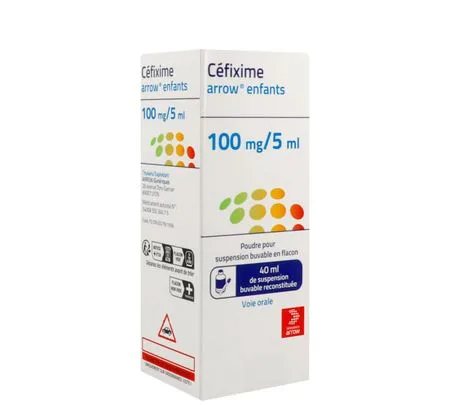
CEFIXIME ARROW CHILDREN 100 mg/5 mL, powder for oral suspension in bottle
Composition
Cefixime trihydrate..............................................................................................................................111,919 mg
Quantity corresponding to anhydrous cefixime...........................................................................................100 mg
Per 5 mL of reconstituted suspension
1 bottle contains 40 mL of reconstituted suspension.
Excipients with known effect: sucrose and maltodextrin (source of glucose).
5 mL of CEFIXIME ARROW CHILDREN 100 mg/5 mL suspension (i.e. 1 dose unit for 25 kg) contain approximately 2,35 g of sugar.
Sucrose, anhydrous colloidal silica, xanthan gum, Guarana strawberry flavour (flavourings, corn maltodextrin, propylene glycol (E1520), triethyl citrate (E1505), water).
Indications
In children older than 6 months, they are limited to infections due to organisms defined as susceptible, when these infections allow oral antibiotic therapy, and in particular:
• bronchial and pulmonary infections;
• acute otitis media, in particular recurrent;
• acute pyelonephritis as a follow-on to parenteral antibiotic therapy of at least 4 days;
• lower urinary tract infections in children older than 3 years and excluding severe infectious conditions.
Official recommendations concerning the appropriate use of antibacterial agents should be taken into account.
Dosage and administration
Dosage
The dosage of CEFIXIME ARROW CHILDREN in children (over 6 months) is 8 mg/kg/day in two administrations, 12 hours apart, i.e. 4 mg/kg per dose.
The oral suspension is to be reconstituted by adding water up to the graduation mark to obtain a total volume of 40 mL and shaken before use.
|
The dose per intake is indicated, according to the child's weight, on the plunger of the pipette graduated in kg. It can therefore be read directly on the graduations of the pipette. Thus, the indicated point corresponds to the dose for one intake. Two doses per day are required. For example, the 10 kg graduation corresponds to the dose to be administered per dose for a child of 10 kg, twice daily. |
|
|
Recommended presentations according to age |
|
|
6 to 30 months |
Cefixime INFANTS 40 mg/5 mL, powder for oral suspension in bottle |
|
30 months to 12 years |
Cefixime CHILDREN 100 mg/5 mL, powder for oral suspension in vial |
|
> 12 years and adults |
Cefixime, tablet at 200 mg |
In patients with renal impairment
When creatinine clearance values are greater than 20 mL/min, it is not useful to modify the dosage. For lower values, including in hemodialysed patients, the dosage of cefixime should not exceed 4 mg/kg/day, in a single administration.
In patients with hepatic impairment
It is not necessary to modify the dosage.
Method of administration
Oral use.
Contraindications
Hypersensitivity to the active substance or to an antibiotic of the cephalosporin group, or to any of the excipients mentioned in section Composition.
Warnings and precautions
Warning
• The occurrence of any allergic reaction requires discontinuation of treatment.
• Prescription of cephalosporins requires prior questioning. Allergy to penicillins being cross-reactive with that to cephalosporins in 5 to 10 % of cases:
- the use of cephalosporins must be extremely cautious in penicillin-sensitive patients; close medical monitoring is necessary from the first administration;
- the use of cephalosporins is strictly contraindicated in subjects with a history of immediate-type allergy to cephalosporins. In case of doubt, the presence of the physician with the patient is essential at the first administration, in order to treat a possible anaphylactic accident.
• Hypersensitivity reactions (anaphylaxis) observed with these two types of substances can be serious and sometimes fatal.
• Cases of colitis associated with the administration of an antibacterial product and pseudomembranous colitis have been reported with almost all antibacterial products, including cefixime, with severity ranging from mild to life-threatening. Consequently, it is important to consider this diagnosis in patients who present with diarrhoea during or after administration of cefixime. Discontinuation of cefixime treatment and administration of specific treatment against Clostridium difficile should be considered. Any administration of peristalsis inhibitors is contraindicated.
• Severe skin reactions:
- Severe skin reactions such as toxic epidermal necrolysis (TEN, also called Lyell syndrome), Stevens-Johnson syndrome (SJS), drug reaction with eosinophilia and systemic symptoms (DRESS) and acute generalised exanthematous pustulosis (AGEP) have been reported in patients treated with cefixime. Patients must be informed of the signs and symptoms of severe skin manifestations and must be closely monitored. Treatment with cefixime must be stopped immediately at the first appearance of a skin rash, mucosal lesions or any other sign of skin hypersensitivity.
• Serious cases of haemolytic anaemia, including deaths, have been reported in patients receiving antibacterials of the cephalosporin class (class effect). Recurrence of haemolytic anaemia after reintroduction of a cephalosporin in a patient with a history of haemolytic anaemia under a cephalosporin, including cefixime, has also been described. If a patient develops anaemia on cefixime, the diagnosis of cephalosporin-associated anaemia should be considered and cefixime discontinued until the aetiology is established (see section Adverse effects).
Encephalopathy
Cases of encephalopathy have been reported with the use of beta-lactam antibiotics, including cefixime (see sections Adverse effects and Overdose), particularly in elderly patients and in patients with severe renal insufficiency or central nervous system disorders. If encephalopathy associated with cefixime is suspected, discontinuation of treatment should be considered.
Precautions for use
• In patients allergic to other beta-lactams, the possibility of cross-allergy must be taken into account.
• In case of severe renal insufficiency, it may be necessary to adjust the daily dose according to creatinine clearance (see sections Dosage and administration and Pharmacokinetics).
• In children under 6 months, to date, in the absence of specific studies, it is recommended not to use cefixime.
Excipients with known effect
This medicine contains sucrose. Patients with fructose intolerance, glucose-galactose malabsorption syndrome or sucrase/isomaltase deficiency (rare hereditary diseases) must not take this medicine.
This medicine contains maltodextrin (a source of glucose). Patients with glucose-galactose malabsorption syndrome (a rare hereditary disease) must not take this medicine.
Interactions
Drug interactions
No clinically significant interaction has been reported during clinical trials.
In pharmacokinetics, it has been shown that the combination of 1 g of probenecid with cefixime resulted in a 25 % decrease in the total clearance of the product.
In humans, the association of an antacid does not decrease the absorption of cefixime.
Interaction with laboratory tests
• False-positive reactions when testing for ketones in urine (by nitroprusside method).
• False-positive reactions when testing for glycosuria (preferably use glucose oxidase-based assay methods).
• A false-positive Coombs test has been reported during treatment with cephalosporins.
Specific problems with INR imbalance
Numerous cases of increased activity of oral anticoagulants have been reported in patients receiving antibiotics. Marked infectious or inflammatory conditions, age and general condition of the patient appear to be risk factors. In these circumstances, it appears difficult to distinguish between the infectious disease and its treatment in the occurrence of INR imbalance. However, certain classes of antibiotics are more often implicated: these include fluoroquinolones, macrolides, cyclines, cotrimoxazole and certain cephalosporins.
Fertility, pregnancy and breastfeeding
Pregnancy
Given the expected benefit, the use of cefixime may be considered during pregnancy if needed. Indeed, although clinical data are insufficient, animal data have not shown any malformative or foetotoxic effect.
Breast-feeding
There is no data available to determine whether cefixime passes into breast milk. However, breastfeeding is possible if this antibiotic is taken.
Nevertheless, breastfeeding (or treatment) must be interrupted and a doctor must be consulted immediately if diarrhoea, candidiasis or a skin rash occurs in the infant.
Driving and using machines
If undesirable effects such as encephalopathy occur (which may include convulsions, confusion, impaired consciousness or abnormal movements) (see sections Warnings and precautions, Adverse effects and Overdose), the patient must not drive or use machines.
Adverse effects
Frequencies are defined as follows: very common (≥ 1/10); common (≥ 1/100, < 1/10); uncommon (≥ 1/1 000, < 1/100); rare (≥ 1/10 000, < 1/1 000); very rare (< 1/10 000); and frequency not known (cannot be estimated from the available data).
Blood and lymphatic system disorders
• Hypereosinophilia, thrombocytosis, thrombocytopenia, leukopenia, neutropenia, granulocytopenia and agranulocytosis.
• Very rare cases of haemolytic anaemia (see section Warnings and precautions).
Gastrointestinal disorders
• Abdominal pain, diarrhoea (see section Warnings and precautions), nausea, vomiting, dyspepsia, flatulence.
General disorders and administration site conditions
• Fever.
Infections and infestations
• Pseudomembranous colitis, vaginitis.
Immune system disorders
• Rare cases of anaphylactic reactions such as urticaria or angioedema, serum sickness.
Investigations
• Moderate and transient elevation of the transaminases AST and ALT and of alkaline phosphatases.
• Slight increase in blood urea and serum creatinine.
• Increase in blood bilirubin.
Hepato-biliary disorders
• Jaundice, hepatitis.
Nervous system disorders
• Headache, dizziness.
• Unknown frequency: cases of convulsion have been reported with cephalosporins including cefixime, encephalopathy.
Respiratory, thoracic and mediastinal disorders
• Dyspnoea.
Renal and urinary disorders
• Acute renal failure due to interstitial nephritis.
Skin and subcutaneous tissue disorders
• Skin rash, pruritus.
• Very rare cases of bullous eruptions (erythema multiforme, Stevens-Johnson syndrome (SJS), toxic epidermal necrolysis (TEN, also called Lyell's syndrome)), drug reaction with eosinophilia and systemic symptoms (DRESS), acute generalised exanthematous pustulosis (AGEP) (see section Warnings and precautions).
Reporting of suspected adverse reactions
Reporting suspected adverse reactions after authorisation of the medicinal product is important. It allows continued monitoring of the benefit/risk balance of the medicinal product. Healthcare professionals are asked to report any suspected adverse reaction via the national reporting system: National Agency for the Safety of Medicines and Health Products (ANSM) and the network of Regional Centres of Pharmacovigilance - Website: https://signalement.social-sante.gouv.fr/
Overdose
There is a risk of encephalopathy associated with beta-lactam antibiotics such as cefixime, particularly in cases of overdose.
In case of ingestion of large quantities of cefixime, symptomatic treatment will be initiated. There is no specific antidote. Haemodialysis or peritoneal dialysis does not allow cefixime to be eliminated from the plasma.
Pharmacodynamics
Pharmacotherapeutic class: antibiotic of the beta-lactam family, of the cephalosporin group, third generation 3th generation, ATC code: J01DD08.
Like other cephalosporins, the mechanism of action of cefixime is based on inhibition of bacterial cell wall synthesis.
Cefixime has a bactericidal activity in vitro against many Gram-positive or Gram-negative organisms.
Critical concentrations
The critical concentrations or breakpoints of minimum inhibitory concentrations (MIC) by which the susceptibility of the bacterial strain is interpreted are established by the European Committee on Antimicrobial Susceptibility Testing (EUCAST) for cefixime and are as follows:
https://www.ema.europa.eu/documents/other/minimum-inhibitory-concentration-mic-breakpoints_en.xlsx
The prevalence of acquired resistance can vary according to geography and time for certain species. It is therefore useful to have information on local resistance prevalence, especially for the treatment of severe infections. These data can only provide guidance on the probabilities of the susceptibility of a bacterial strain to this antibiotic.
Where the variability of resistance prevalence in France is known for a bacterial species, it is indicated in the table below:
|
Categories |
Frequency of acquired resistance in France (> 10 %) (extreme values) |
|
SUSCEPTIBLE SPECIES |
|
|
Gram-positive aerobes |
|
|
Streptococcus |
|
|
Streptococcus pneumoniae |
30 - 70 % |
|
Gram-negative aerobes |
|
|
Branhamella catarrhalis |
|
|
Citrobacter koseri |
|
|
Escherichia coli |
5 - 15 % |
|
Haemophilus influenzae |
|
|
Klebsiella |
0 - 20 % |
|
Neisseria gonorrhoeae |
|
|
Pasteurella |
|
|
Proteus mirabilis |
|
|
Proteus vulgaris |
|
|
Providencia |
|
|
Anaerobes |
|
|
Fusobacterium |
10 - 20 % |
|
Prevotella |
30 - 70 % |
|
RESISTANT SPECIES |
|
|
Gram-positive aerobes |
|
|
Corynebacterium diphtheriae |
|
|
Enterococci |
|
|
Listeria |
|
|
Staphylococcus spp. |
|
|
Gram-negative aerobes |
|
|
Acinetobacter |
|
|
Citrobacter freundii |
|
|
Pseudomonas |
|
|
Serratia |
|
|
Anaerobes |
|
|
Except Prevotella and Fusobacterium |
|
Pharmacokinetics
Pharmacokinetic studies have demonstrated the bioequivalence of the tablet and granule forms.
In adults
Absorption
• After oral administration, as a single intake of 200 mg, the maximum serum concentrations (Cmax) are, on average, 3 micrograms/mL and are reached (Tmax) in 3 at about 4 hours. After administration of a dose of 400 mg, the maximum serum concentrations are higher (3,4-5 micrograms/mL) but not proportional to the increase in doses.
• After repeated administrations for 15 days of doses of 400 mg/day in one or two administrations, serum concentrations and bioavailability are not modified, thus reflecting the absence of accumulation of the active ingredient.
• The bioavailability of cefixime is approximately 50% at a dose of 200 mg. It is not modified by food intake. The time to reach maximum serum concentrations is, however, delayed by about one hour.
Distribution
• The apparent volume of distribution is of the order of 15 litres. In animals, cefixime diffuses into the vast majority of tissues studied, with the exception of the brain. In humans, after intakes of 200 mg at 12-hour intervals, lung concentrations, 4 and 8 hours after the last intake, are of the order of 1 microgram/g of tissue, these concentrations being higher than the M.I.C. 90% of susceptible germs responsible for lung infections.
Elimination
• The elimination of cefixime is characterised by a half-life (T½) between 3 and 4 hours (mean: 3.3 hours). The product is eliminated by the renal route in unchanged form (16 to 20% of the ingested dose), extra-renal elimination is essentially biliary (25%).
• No metabolite, in serum or urine, could be detected in animals or in humans.
• In cases of severe renal impairment (creatinine clearance < 20 mL/min), the increase in plasma elimination half-life and maximum serum concentrations makes it necessary to reduce the daily dosage from 400 to 200 mg/day.
• In patients with hepatic impairment, elimination is slowed (T½ = 6,4 hours), but it is not necessary to modify the dosage.
• Binding to serum proteins is on the order of 70 % and occurs mainly with albumin, independently of concentration (at therapeutic doses).
The pharmacokinetic characteristics of cefixime are very slightly modified in elderly subjects. The small increase in maximum serum concentrations and bioavailability and the small decrease in the amount excreted (15 to 25%) do not require any dosage reduction in this population.
In children
• Serum concentrations obtained after a single administration of 4 mg/kg of cefixime (granules) range from 1,7 to 2,5 micrograms/mL.
• Five hours after an intake of 4 mg/kg of cefixime, concentrations in non-fibrous tonsils average 0,6 to 0,8 micrograms/g for a concomitant serum concentration of 1,24 ± 0,94 micrograms/mL.
Shelf life
Before opening: 2 years.
After first opening: the reconstituted suspension must be used within 14 days.
Special storage precautions
Before opening: store at a temperature not exceeding 30°C.
After first opening: the reconstituted suspension is to be stored at a temperature not exceeding 25°C.
SPECIAL PRECAUTIONS FOR DISPOSAL AND OTHER HANDLING
Check that the sealing stopper is intact before use. Turn over and shake the bottle to loosen the powder.
Fill the bottle with water up to the graduation mark.
Turn the bottle over and shake well, then top up again with water up to the mark if necessary.
Turn over and shake well again for five minutes. Shake the bottle well before each use.
Any unused medicinal product or waste material should be disposed of in accordance with local requirements.
Prescription, supply and reimbursement
| Marketing authorisation (AMM) |
|
| Price: |
|
- Indication(s) appearing in the marketing authorisation at the date of publication of this decree
Collection.
26 AVENUE TONY GARNIER
69007 LYON
Tel: 04 72 72 60 72 Tel (toll-free): 0811 65 27 76
contact@laboratoire-arrow.com
http://www.laboratoire-arrow.com/
Source: VIDAL · Updated on 11/11/2026. This information does not replace advice from a healthcare professional.