
Medicines
Update of 10/07/2025
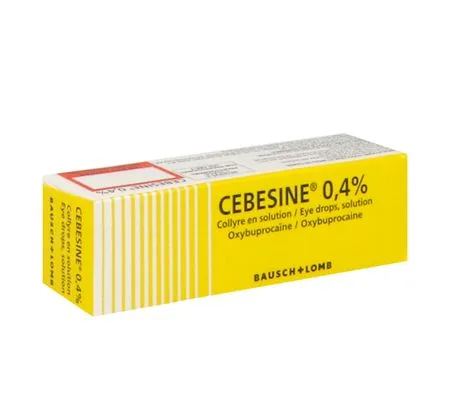
CEBESINE®
oxybuprocaine
Forms and presentations
Eye drops in solution at 0,4 %: Bottle of 10 ml, with piercing stopper.Composition
| p 100 ml | |
| Oxybuprocaine hydrochloride
|
0,4 g |
Indications
Local anesthesia.- Tonometry.
- Examinations using contact lens.
- Removal of superficial foreign bodies from the cornea and conjunctiva.
- Any procedure requiring local anesthesia of the cornea and conjunctiva.
Dosage and administration
DosageOphthalmic use.
1 to 2 drops of eye drops, one to two minutes before the examination or procedure.
Method of administration:
Wash hands thoroughly before instilling.
Avoid contact of the container tip with the eye or eyelids.
Instill 1 to 2 drops of eye drops into the inferior conjunctival sac of the affected eye(s), looking upward and gently pulling the lower eyelid downward. A single instillation is sufficient to provide corneoconjunctival anesthesia lasting about ten minutes. To obtain deeper or longer-lasting anesthesia, repeat the procedure 2 to 4 times at one-minute intervals.
Systemic absorption may be reduced by nasolacrimal occlusion or by closing the eyelids for 2 minutes. This method may help to reduce systemic adverse effects and increase local efficacy.
With the eye closed, cleanly wipe away the excess.
Replace the cap on the bottle after each use.
Before first use, screw the cap fully onto the bottle so as to pierce it with the internal spike of the cap.
Contraindications
This medicine is contraindicated in cases of:- Hypersensitivity to the active substance or to any of the excipients listed in section Composition.
- Hypersensitivity to local anesthetics.
Warnings and precautions
Warnings:
Do not inject, do not swallow.
The eye drops must not be administered by peri- or intraocular injection.
This eye drop must not be used repeatedly or for prolonged periods, and it is imperative to respect the recommended dosages because:
- Corneal opacifications and delayed wound healing may occur.
- Due to its local anaesthetic activity which reduces pain, the product may cause serious eye lesions, particularly corneal ones.
Due to the risk of alteration of the corneal epithelium, linked to the presence of a local anaesthetic, care must be taken to ensure that the eye drops do not penetrate into the anterior chamber of the eye.
In ophthalmology, whether used alone or in combination, local anaesthetics all carry a risk of alteration of the corneal epithelium, even at low concentrations. It is imperative to always prefer general analgesics as pain relievers.
Athletes are advised that this product contains an active substance (local anaesthetic) that may cause a positive reaction in tests carried out during anti-doping controls.
Interactions
The data available to date do not suggest the existence of clinically significant interactions.
Fertility, pregnancy and breastfeeding
Pregnancy:There is no reliable data on teratogenicity in animals.
In clinical use, no particular malformative or foetotoxic effect has appeared to date. However, the follow-up of pregnancies exposed to this medicine is insufficient to exclude any risk. Consequently, use of this medicine should be considered during pregnancy only if necessary.
Breastfeeding:
Due to the lack of data on the passage of this medicine into breast milk, use of this eye drop should only be considered if necessary and with breastfeeding suspended.
Driving and using machines
It is advised not to drive or use machines until normal vision has returned.Adverse effects
A transient irritation may occur upon instillation.
Eye disorders:
Frequency unknown: ocular allergy, allergic blepharitis.
Immune system disorders:
Frequency unknown: hypersensitivity, anaphylactic reaction/shock.
Reporting of suspected adverse reactions:Reporting suspected adverse reactions after authorisation of the medicinal product is important. It allows continuous monitoring of the benefit/risk balance of the medicinal product. Healthcare professionals should report any suspected adverse reaction via the national reporting system: National Agency for the Safety of Medicines and Health Products (ANSM) and the network of Regional Pharmacovigilance Centres. Website: https://signalement.social-sante.gouv.fr.
Overdose
Repeated and prolonged overdose exposes to a risk of serious eye lesions, particularly corneal ones.
Pharmacodynamics
Pharmacotherapeutic class: Local anaesthetic/ophthalmology (S: sensory organs), ATC code: S01HA02.
Local anaesthetic derived from para-aminobenzoic acid.
Storage conditions
Shelf life before opening: 30 months.
Store at a temperature not exceeding 25 °C.
After first opening: 15 days.
HANDLING/DISPOSAL INSTRUCTIONS
No special requirements.
Any unused medicinal product or waste material should be disposed of in accordance with local requirements.
Prescription, supply and reimbursement
LIST I| Medicinal product reserved for professional use. | |
| Marketing authorisation (AMM) | 3400931923428 (1997, SPC rev 24.10.2019). |
| Collection. |
CHAUVIN Laboratory
416, rue Samuel-Morse. CS 99535. 34961 Montpellier
Tel: 04 67 12 30 30
Source: VIDAL · Updated on 10/11/2026. This information does not replace advice from a healthcare professional.