
Parapharmacy
Update of 19/05/2022
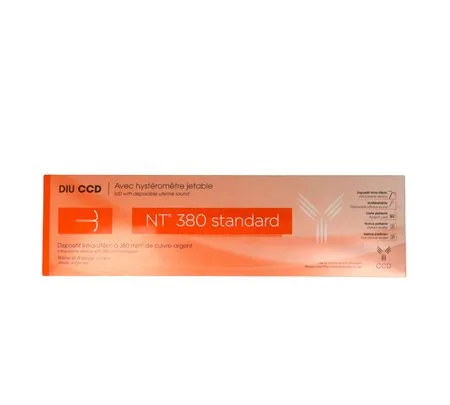
CE NT 380® Standard and NT 380® Short, Insertion Kits
Forms and presentations
Sterile copper-silver intrauterine contraceptive devices (IUDs) and accessories:4 presentations available.
- Standard Type: 31 mm wide × 33 mm long (EAN 3700111496477), unit box, in sterile peelable pouch.
- Standard Type with complete insertion kit: 31 mm wide × 33 mm long (EAN 3700111400344), unit cardboard box, in sterile peelable pouch.
- Short Type: 24 mm wide × 30,5 mm long (ACL 3401043964668), unit box, in sterile peelable pouch.
- Short Type with complete insertion kit: 24 mm wide × 30,5 mm long (EAN 3700111400337), unit cardboard box, in sterile peelable pouch.
A sterile hysterometer individually packaged is supplied in the 4 presentations.
Composition
- CCD IUD: NT 380 Standard and NT 380 Short:
- NT 380 Standard and NT 380 Short CCD are composed of a mixture of low-density polyethylene and barium sulfate, and surrounded by a copper/silver wire with a diameter of 0,40 mm providing a surface area of 380 mm2 ± 23 mm2. The T is fitted with a single-filament polyamide thread (suture thread) to facilitate removal. It is packaged with an inserter and a pusher in a sterile peelable pouch, with a patient card, a patient leaflet and a practitioner leaflet. The inserter is equipped with a sliding ring to help measure the depth to which it must be introduced into the uterine cavity through the cervical canal.
- The copper-silver alloy core delays fragmentation of the copper wire and increases the longevity of the device.
- NT 380 Standard or Short CCD with complete insertion kit:
- Composition copper, silver, low-density polyethylene with barium sulfate.
- Description:
- The presentation includes:
- 1 NT 380 Standard or Short (short) IUD, composed of two flexible T-shaped arms, made of low-density polyethylene and barium sulfate, extending from a vertical axis around which a copper-silver alloy wire of 0,40 mm diameter is wound providing a surface area of 380 mm2. X-ray opaque. With removal thread attached to the base of this device. Duration of efficacy: 5 years. Dimensions: width 31 mm × length 33 mm (Standard); width 24 mm × length 30,5 mm (Short);
- 1 complete IUD insertion kit, with 1 hysterometer, 1 Pozzi forceps, 1 Chéron forceps, 1 pair of thread-cutting scissors, 1 patient card, 1 patient leaflet, 1 practitioner leaflet.
- 1 NT 380 Standard or Short (short) IUD, composed of two flexible T-shaped arms, made of low-density polyethylene and barium sulfate, extending from a vertical axis around which a copper-silver alloy wire of 0,40 mm diameter is wound providing a surface area of 380 mm2. X-ray opaque. With removal thread attached to the base of this device. Duration of efficacy: 5 years. Dimensions: width 31 mm × length 33 mm (Standard); width 24 mm × length 30,5 mm (Short);
- Single use.
Indications
Intrauterine contraception intended for women of childbearing age.Duration of contraceptive action: NT 380 may be left in place for a maximum duration of 60 months (5 years). If the patient wishes to continue contraception beyond this period, a new NT 380 must be inserted without delay.
NT 380 is recommended for women:
- of reproductive age,
- without history of pelvic inflammatory disease (MIP),
- having chosen not to use hormonal contraceptives.
NT 380 Short is an intrauterine device suitable for uterine cavities whose height is less than 7,5 cm.
Directions for use
- Choice of insertion timing:
- Insertion must take place during the first part of the menstrual cycle. It is recommended to perform insertion at the end of the menstrual period, the most appropriate period. The NT 380 IUD may be inserted during the first part of the menstrual cycle, provided that the woman is not pregnant and that she has been using an effective method of contraception systematically since her last menstrual period.
- Given its small diameter, the inserter is easy to introduce and generally does not require additional dilatation.
- Insertion procedure:
- Insertion must absolutely be performed by a qualified healthcare professional, equipped with appropriate instruments, under aseptic conditions. It is imperative that a “no-touch” technique be used throughout the insertion procedure to ensure sterile handling.
- The inner packaging of the IUD must not have been opened or damaged. Insertion must not be performed if the IUD or its accessories are damaged.
- Preparation:
-
- Perform a careful bimanual gynecological examination to determine the version, flexion and axis of the uterus.
- Introduce a vaginal speculum to expose the cervix. Clean the cervix and vaginal walls with sterile cotton soaked in an antiseptic solution. Wipe away any secretion from the external os of the cervix.
- To straighten the uterine axis, grasp the anterior lip of the cervix with a Pozzi forceps ensuring a good grip in order to maintain constant downward traction without risk of cervical laceration. The reflex contraction, which causes uterine cramping during placement of the Pozzi forceps, can be prevented by injecting a local anesthetic into the anterior lip or by performing a paracervical block.
- Sound the uterus carefully using a hysterometer to determine its depth and confirm the direction of its axis. If the hysterometer encounters stronger than normal resistance at the internal os, it may be advisable to gently dilate the cervical canal up to 4-5 mm using a sterile conical rather than cylindrical dilator. If no other instruments are available to measure the internal dimensions of the uterine cavity, the hysterometer may be used to obtain an idea of its configuration.
- Perform a careful bimanual gynecological examination to determine the version, flexion and axis of the uterus.
- Placement procedure:
- NT 380 Standard or Short CCD must always be placed under aseptic conditions with sterile gloves. Insertion of NT 380 Standard or Short must be carried out according to the following steps:
- Open the sachet at the end bearing the inscription “OPEN”, up to halfway along the collar; without removing the IUD from the sachet, pull the threads to retract the horizontal arms of the IUD into the inserter up to the ends of the arms.
- While keeping the threads taut with one hand, use the free hand to slide the plunger into the inserter. This ensures that the threads remain straight in the inserter and are not displaced by the plunger.
- Read the position of the ring on the centimeter scale of the inserter to check the depth of the uterus. The IUD is then ready to be inserted.
- Open the sachet at the end bearing the inscription “OPEN”, up to halfway along the collar; without removing the IUD from the sachet, pull the threads to retract the horizontal arms of the IUD into the inserter up to the ends of the arms.
- Placement of NT 380 Standard or Short CCD:
-
- Clean the cervix with an antiseptic solution.
- Remove the loaded inserter from the sachet and gently introduce it through the cervical canal until the ring touches the cervix. This indicates that the folded arms are in contact with the fundus of the uterus.
- Immobilize the plunger and withdraw the inserter to the level of the thumb grip of the plunger to release the arms of the T; the arms of NT 380 Standard or Short are now deployed.
- Gently push the inserter upward until the ring touches the cervix again. NT 380 Standard or Short is then in contact with the fundus of the uterus.
- Remove the plunger while keeping the inserter immobilized. Gently remove the inserter. Cut the threads so that only 2-3 cm protrude from the cervical os.
- Clean the cervix with an antiseptic solution.
- Removal:
- Pull the threads with forceps as close as possible to the external os of the cervix.
- Steady traction on the threads and downward traction with the Pozzi forceps allow removal of the IUD without difficulty. If this is very difficult, removal under general anesthesia must be considered by the most appropriate method.
- Duration of action:
- NT 380 may remain inserted in the uterus for a maximum duration of 5 years.
Contraindications
- Absolute:
-
- Pregnancy.
- Acute pelvic inflammatory disease or history of pelvic inflammatory disease (MIP).
- Postpartum or abortion endometritis.
- Sexually transmitted diseases (MST), including lower genital tract infections (gonorrhea, chlamydia infection...).
- High risks of STI due to multiple partners.
- Known or suspected malignant tumor of the genital tract, notably dysfunctional abnormal uterine bleeding not diagnosed.
- Congenital uterine anomaly.
- Allergy to copper.
- Acute cervicitis or vaginitis not treated, including bacterial vaginosis, until the infection is controlled.
- Condition associated with increased sensitivity to infections by microorganisms including leukemia, acquired immunodeficiency syndrome (AIDS) and intravenous drug addiction.
- Wilson's disease.
- Small uterine cavity.
- Uterine fibroid.
- Pregnancy.
- To avoid burns/perforations, radiotherapy and diathermy must be contraindicated, especially if they are applied to the lower pelvic region.
- Relative:
-
- Severe dysmenorrhea.
- Blood coagulation disorder.
- Cardiovascular disease.
- Severe dysmenorrhea.
Precautions for use
An IUD must not be used as first intention in the following cases: painful or long periods, severe anemia, cervical stenosis (narrowing of the cervical canal), lack of access to a medical center for follow-up care, history of ectopic pregnancy.
- Pregnancy:
- In case of menstrual delay greater than 10 days and symptoms of pregnancy (nausea, sensitive breasts...), contact a physician. When a pregnancy is confirmed, the IUD must be removed as soon as possible (without invasive procedure).
- If a woman becomes pregnant with an IUD in place, there is a risk of extrauterine pregnancy.
- Pelvic infection:
- IUDs may be associated with an increased relative risk of MIP compared to other forms of contraception and to the absence of contraception. The highest incidence of MIP occurs in the 20 days following insertion. It is therefore important to evaluate and treat promptly any woman presenting signs or symptoms of MIP.
- PID may be a cause of sterility and requires removal of the IUD and administration of appropriate antibiotic therapy.
- Expulsion:
- The cervix remaining slightly open during the menstrual period, sometimes an IUD is expelled from the uterus to the vagina when periods are heavy. This can result in a pregnancy not desired if the phenomenon goes unnoticed.
- Perforation:
- A partial or total perforation of the uterine wall or cervix may occur in rare cases during insertion, although it may be detected later. Spontaneous migration has also been reported. If a perforation occurs, quickly remove the NT 380.
- Magnetic resonance imaging (MRI):
- Magnetic resonance examinations up to 1,5 Tesla in women with a copper intrauterine device for contraception (DIU) influence neither the results of magnetic resonance examinations nor the functional efficacy of the device.
- Radiotherapy or electrotherapy using high-frequency current (diathermy or short waves) is contraindicated, in particular when applied to the pelvic region. Regarding the use of low-frequency direct current (ionization), it appears that it cannot have a harmful effect on women using a copper IUD.
- The energy state of the copper will not be modified by imaging.
- Tarnishing of the copper:
- Copper-containing IUDs may exhibit a color change in their sterile packaging, but there is no cause for concern. The copper tarnishes because the sterile packaging containing the IUD is permeable to air, which causes the formation of an oxide or sulfide film on the surface of the metal. The packaging of IUDs must be permeable to allow their sterilization. As long as the packaging is not damaged and the expiration date shown on it has not been reached, the IUD will be sterile even if the copper it contains is tarnished. Laboratory studies show that tarnishing does not affect either the safety or the efficacy of the IUD.
- Adverse effects
- The following adverse reactions and side effects have been reported and may occur after insertion of the IUD. Consult a physician for any of the following reasons:
- Pregnancy with the IUD in place in the uterus or partially or completely expelled.
- Bleeding or spotting between periods.
- Absence or delay of periods.
- Heavy or prolonged periods.
- Painful periods.
- Anemia.
- Pain or cramps at insertion or after insertion of the IUD.
- Vaginal discharge (leukorrhea) and infection.
- Back pain.
- Muscle aches and pain in the legs.
- Fever.
- Skin allergic reaction due to the IUD.
- Pregnancy with the IUD in place in the uterus or partially or completely expelled.
- The occurrence of an adverse event must be notified to the distributing laboratory (Laboratoire CCD).
- Risk of interactions:
-
- Non-steroidal anti-inflammatory drugs (NSAIDs): the use of NSAIDs (including acetylsalicylic acid [ASA], naproxen and ibuprofen) reduces the efficacy of all IUDs (according to WHO recommendations).
- Intrauterine devices must be used with caution in patients receiving anticoagulant treatment or presenting a coagulation disorder.
- Non-steroidal anti-inflammatory drugs (NSAIDs): the use of NSAIDs (including acetylsalicylic acid [ASA], naproxen and ibuprofen) reduces the efficacy of all IUDs (according to WHO recommendations).
The manufacturer requests that the healthcare professional read the information contained in the package insert.
The manufacturer cannot be held responsible if this information is not followed.
The healthcare professional must inform the patient of the advantages and risks of intrauterine contraception. He/she will provide the package insert to the patient and ask her to read it completely.
The information intended for patients is found in a package insert intended for them.
It is particularly important that the patient be able to recognize the onset of a complication as quickly as possible.
The patient must learn to locate the threads to ensure that the IUD has not been expelled.
STORAGE CONDITIONS
- Shelf life
- 5 years.
ADMINISTRATIVE INFORMATION
| Public price: | 28,37 euros. |
| Reimbursed on the basis of the LPPR tariff. | |
CCD NT 380/TCu 380Ag with complete insertion kit of Standard or Short type : CE marking 2460, class III.
Manufacturer: SMB Corporation of India, Prem Industrial Estate, Jogeshwari (E), Mumbai 400 060, India.
Authorized representative: Obelis SA, Général-Wahis boulevard 53, 1030 Brussels, Belgium.
Operator/Distributor: CCD Laboratory.
CCD Laboratory
36, Brunel street. 75017 Paris
Tel: 01 44 95 14 95. Toll-free number: 08 00 35 80 00
E-mail: infomed@ccdlab.com
Source: VIDAL · Updated on 10/11/2026. This information does not replace advice from a healthcare professional.