
Parapharmacy
Update of 19/05/2022
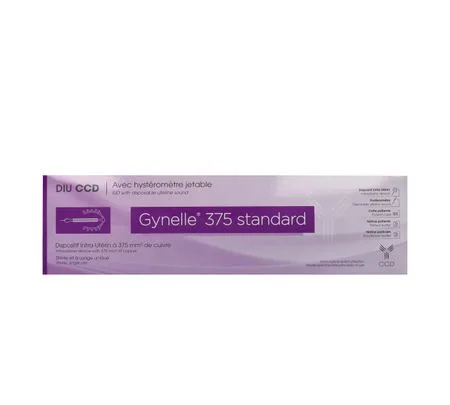
CE GYNELLE® 375
Forms and presentations
Copper intrauterine contraceptive device (IUD) and accessories: Single-unit box (ACL 3401073560595).Dimensions: 19,0 mm wide × 35,5 mm long.
Ready to use, under peelable sterile pouch, single use.
One individually packaged sterile uterine sound is supplied in the same case.
Composition
Gynelle 375 is an intrauterine contraceptive device made of polyethylene, whose stem is extended by two flexible branches fitted with lugs. The stem is wrapped with copper wire with a total surface area of 375 mm2. The flexible lateral branches serve to keep Gynelle 375 in the highest possible position at the fundus of the uterus without stretching the uterine cavity in any way. A single-filament nylon thread is attached to the stem.The contraceptive effect of the IUD is mainly due to reactions of the endometrium to the foreign body and, ancillary to this, to the presence of metallic copper.
Indications
Intrauterine contraception in women of reproductive age. Gynelle 375 is intended for single use and must be inserted by a qualified healthcare professional.- Reuse:
- The intrauterine device must not be reused. Its reuse may cause pelvic infections with a risk of subsequent infertility.
Directions for use
- Timing of insertion:
- The best time for IUD insertion is during the last days of menstruation or the first days of the intermenstrual interval (immediately after menstruation). The risk of inserting an IUD during an undiagnosed pregnancy is thereby reduced. An IUD may also be inserted immediately (within 10 minutes) after an abortion or delivery, although the risks of unwanted pregnancy, displacement and expulsion are then higher. Insertion of an IUD immediately after an abortion or delivery has no adverse effect on uterine involution or on breastfeeding. If IUD insertion after delivery or abortion does not take place immediately, it should be postponed until complete involution of the uterus, that is, at least 6 weeks after delivery or abortion (delayed postpartum insertion). After a caesarean section, no insertion should be attempted within 12 weeks following delivery.
- Recommended insertion procedure:
- To ensure sterile handling, it is imperative to observe aseptic principles, avoiding any direct contact with the IUD throughout the insertion procedure. Do not use an IUD whose inner packaging is damaged.
-
- Preparation for insertion in the intermenstrual interval:
-
- Perform a careful bimanual gynaecological examination to determine the version, flexion and axis of the uterus.
- Introduce a vaginal speculum to expose the cervix. Clean the cervix and vaginal walls with a sterile cotton swab soaked in antiseptic solution. Wipe away any secretion at the external os of the cervix.
- To straighten the uterine axis, grasp the anterior lip of the cervix with a Pozzi forceps, ensuring a firm grip so as to maintain constant downward traction without risk of cervical laceration. The reflex contraction, which causes uterine cramping on application of the Pozzi forceps, may be prevented by injecting a local anaesthetic into the anterior lip or by performing a paracervical block.
- Carefully sound the uterus using a uterine sound to determine its depth and confirm the direction of its axis. If the uterine sound meets greater resistance than usual at the internal os, it may be advisable to gently dilate the cervical canal up to 4 - 5 mm using a sterile conical rather than cylindrical dilator. If other instruments are not available to measure the internal dimensions of the uterine cavity, the uterine sound may be used to obtain an idea of its configuration.
- Perform a careful bimanual gynaecological examination to determine the version, flexion and axis of the uterus.
- Insertion of Gynelle 375:
-
- Open the pouch by tearing it at the end bearing the inscription "OUVRIR" (OPEN).
- Open the pouch sufficiently to be able to grasp the inserter (containing the IUD) by its distal end, together with the threads, but without removing Gynelle 375 from its pouch.
- Hold the cervical stop with the thumb of one hand and adjust the position of the upper part of Gynelle 375 by pushing the inserter with the other hand until reaching the mark corresponding approximately to the length of the uterus (in cm) measured with the uterine sound.
- The distal end of the inserter tube can be held in the hand without risk of contaminating the IUD. By holding both the threads and the tube, one ensures that the IUD will not fall from the inserter. Gynelle 375 can now be removed from its pouch.
- Carefully introduce Gynelle 375 into the uterus until it reaches the fundus of the uterus and the cervical stop rests against the external os, while exerting constant downward traction with the Pozzi forceps to keep the uterine axis straightened. No forced insertion should be attempted. Insufficient axial straightening may sometimes result in a subendometrial insertion. This risk can be reduced by exerting sufficient downward traction on the cervix, which will completely straighten the axis of the uterus against its ligamentous supports.
- When Gynelle 375 reaches the fundus, release it into the uterine cavity by simply withdrawing the inserter. During this procedure, continue to pull the cervix downward using the Pozzi forceps. No plunger is necessary to insert Gynelle 375. Check the cervical canal with the uterine sound to ensure that the IUD stem is entirely inside the uterine cavity. Cut the threads of Gynelle 375, leaving only 2 to 3 cm protruding from the external os of the cervix.
- It is imperative to follow the recommended insertion procedure precisely in order to minimise the risk of subendometrial placement, a phenomenon that could result in complete or partial incorporation of the IUD into the endometrium. If this occurs, it may be necessary to apply more than normal force to remove the IUD from where it has lodged, which may increase the risk of arm breakage. Furthermore, it may be clinically difficult to confirm the subendometrial location of the IUD, since this is not evident to the physician during device insertion and the patient is probably not experiencing any pain. It is accepted that correct insertion of the device could reduce the incidence of both IUD arm breakage and uterine perforations.
- Open the pouch by tearing it at the end bearing the inscription "OUVRIR" (OPEN).
- Copper tarnishing:
- Copper-containing IUDs may show a change in colour within their sterile packaging, but there is nothing to be concerned about. The copper tarnishes because the sterile packaging containing the IUD is permeable to air, which causes an oxide or sulphide film to form on the surface of the metal. IUD packaging must be permeable to allow sterilisation. As long as the packaging is not damaged and the expiry date printed on it has not been reached, the IUD will remain sterile even if the copper it contains has tarnished. Laboratory studies show that tarnishing does not affect the safety or effectiveness of the IUD.
- Replacement intervals:
- Gynelle 375 intrauterine contraceptive devices must be replaced every five years.
- Removal procedure:
- After disinfecting the cervix and vagina, insert the speculum as for IUD insertion. To facilitate removal, it is recommended to always use Pozzi forceps to straighten the uterine axis, which also minimises the risk of breakage of the IUD arms. Using forceps, grasp the two IUD threads as close as possible to the exit of the external cervical os. By exerting constant traction from top to bottom while maintaining the uterine axis straightened with the Pozzi forceps, the Gynelle 375 IUD should be easily removable from the uterus. Do not apply excessive force.
- Difficult removal and IUD breakage during removal:
- Removal of an IUD sometimes presents difficulties. If removal proves to require more physical force than usual, the possibility that Gynelle 375 has anchored into the uterine wall should be considered. Cases have been reported in which a part (in particular an arm) of the IUD broke inside the uterine cavity when an abnormally high force had to be applied to remove it. Retained fragments may be expelled painlessly during menstruation, and IUD arms that have become embedded in the wall may be released by uterine contractions. A few rare cases of breakage not associated with anchoring have also been reported. If application of normal force does not allow removal of the IUD or if a fragment has remained in the uterus, diagnostic measures, including ultrasound, must be taken to exclude perforation or incorporation. Plastic fragments, for example IUD arms, can be located by ultrasound or hysteroscopy, a technique that also allows them to be removed at the same time. Reports indicate, however, that routine curettage often succeeds in removing a fragment, whether or not it was located in advance. Removal of fragments must be attempted in all cases.
- Displacement of the IUD:
- In rare cases, an IUD may pass through the uterine wall. If this occurs, surgery is required to remove the IUD and repair the uterine wall.
- Expulsion:
- As the cervix of the uterus remains slightly open during menstruation, an IUD is sometimes expelled from the uterus into the vagina when menstrual bleeding is heavy. This may result in an unwanted pregnancy if the phenomenon goes unnoticed.
- Medical examination:
- Before inserting an IUD, care should be taken to exclude any possible medical contraindications to IUD use on the basis of the woman's medical history and physical examination. The physical examination should include a pelvic examination, a cervical smear and, if possible, tests for sexually transmitted diseases. IUD users should be re-examined shortly after their first period if insertion took place during the intermenstrual interval, and monthly during the first three months if the IUD was inserted immediately after an abortion or childbirth. Thereafter, appropriate examination should take place at regular intervals, for example every six months. A woman in whom the IUD threads cannot be felt on palpation, without her having noticed expulsion of the device, should undergo an examination to exclude perforation or an unnoticed expulsion. Ultrasound may be used to locate the IUD.
Contraindications
-
- Tumours of the uterus or cervix.
- Vaginal bleeding of unknown cause.
- Pregnancy or suspected pregnancy.
- Abnormalities of the uterus or cervix; large or numerous fibroids associated with very heavy menstrual bleeding; endometriosis.
- Infection of the reproductive organs, with the exception of candidiasis (fungal infection caused by Candida albicans).
- Sexually transmitted disease contracted within the past 12 months, with the exception of bacterial vaginal infections, candidiasis and certain viral infections (herpes, hepatitis B or cytomegalovirus).
- Septic miscarriage or septic abortion within the past 3 months.
- Current or recurrent PID (pelvic inflammatory disease, infection of the uterus or Fallopian tubes).
- Copper allergy.
- Tumours of the uterus or cervix.
Precautions for use
If a woman with an IUD becomes pregnant, she may have an ectopic pregnancy (a fertilised egg implanted not in the uterus but, for example, in a Fallopian tube).
Although a copper IUD also offers protection against ectopic pregnancies, it protects better against normal pregnancies. An ectopic pregnancy is a serious medical emergency.
Some signs of ectopic pregnancy:- Delay of menstruation by two weeks or more.
- Severe unilateral lower abdominal pain, with or without vaginal bleeding.
- Pain at the top of the shoulder
- Dizziness or fainting.
- Pregnancy with Gynelle 375 in place in the uterus or partially or completely expelled.
- Complete or partial expulsion.
- Bleeding or intermenstrual spotting.
- Absence or delay of menstruation.
- Heavy or prolonged periods.
- Painful periods.
- Anaemia.
- Pain or cramps during or after insertion.
- Infections and vaginal discharge.
- Back pain.
- Leg pain.
- Allergic skin reaction to copper, a component of the Gynelle 375 IUD.
The laboratory asks the healthcare professional to read the information given in the leaflet.
The laboratory's liability cannot be engaged if this information is not respected.
The occurrence of an undesirable event must be reported to the distributing laboratory.
Information for patients is recorded in the part of the leaflet called "INFORMATION FOR THE USER", designed specifically for them, which must be given to them by the healthcare professional after being cut out.
STORAGE CONDITIONS
- Shelf life
- 5 years.
ADMINISTRATIVE INFORMATION
| Public price: | 28,37 euros. |
| Reimbursed on the basis of the LPPR rate. | |
Manufacturer: SMB Corporation of India, Prem Industrial Estate, Jogeshwari (E), Mumbai 400 060, India.
Authorised representative: Obelis SA, boulevard Général-Wahis 53, 1030 Brussels, Belgium.
Distributor:
CCD Laboratory
36, rue Brunel. 75017 Paris
Tel: 01 44 95 14 95. Toll-free number: 08 00 35 80 00
E-mail: infomed@ccdlab.com
Website: http://www.laboratoire-ccd.fr
Source: VIDAL · Updated on 10/11/2026. This information does not replace advice from a healthcare professional.