Medicines
SPC of 12/10/2026
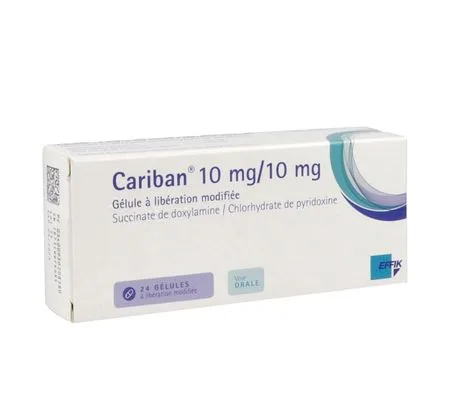
CARIBAN 10 mg/10 mg, modified-release capsule
Forms and presentations
Modified-release capsule.
Green capsule (15,9 mm long and 5,82 mm wide) containing whitish-yellow granules.
Composition
Doxylamine succinate.............................................................................................................................10 mg
Pyridoxine hydrochloride..........................................................................................................................10 mg
For one modified-release capsule.
Excipient with known effect :
Each modified-release capsule contains up to 72,7 mg of sucrose.
Modified-release granules : sucrose, maize starch, shellac, povidone, talc, methacrylic acid and methyl methacrylate copolymer (1:1), anhydrous colloidal silica.
Capsule shell : gelatin, indigo carmine (E132), quinoline yellow (E104), titanium dioxide (E171).
Indications
CARIBAN is indicated in adults for the symptomatic treatment of nausea and vomiting of pregnancy that does not respond to conventional treatment.
Restrictions on use: the doxylamine/pyridoxine combination has not been studied in the case of hyperemesis gravidarum (see section Warnings and precautions).
Dosage and administration
Dosage
The recommended dose is as follows:
If nausea occurs in the morning, the recommended initial dose is two capsules at bedtime (Day 1). If this dose is sufficient to control symptoms the following day, the patient may continue to take two capsules per day at bedtime.
However, if symptoms persist in the afternoon of day 2, the patient should continue the usual dose of two capsules at bedtime on day 2 and on Day 3 take three capsules (one capsule in the morning and two capsules at bedtime).
If these three capsules do not adequately control symptoms on Day 3, the patient may take four capsules from Day 4 (one capsule in the morning, one capsule in mid-afternoon and two capsules at bedtime).
The recommended maximum daily dose is four capsules (one in the morning, another in mid-afternoon and two at bedtime).
CARIBAN must be administered daily as prescribed and not as needed. The need to continue treatment with CARIBAN should be reassessed during pregnancy.
To avoid a sudden recurrence of nausea and vomiting of pregnancy symptoms, it is recommended to gradually reduce the dose of CARIBAN when discontinuing treatment.
Special populations
Hepatic impairment
No pharmacokinetic study has been conducted in patients with hepatic impairment.
No data are available on the pharmacokinetic differences of the doxylamine succinate and pyridoxine hydrochloride combination in patients with hepatic impairment. However, as doxylamine is metabolised by the liver, the dose should be adjusted according to the degree of hepatic impairment.
Renal impairment
No pharmacokinetic study has been conducted in patients with renal impairment.
No data are available regarding the pharmacokinetic differences of the doxylamine succinate and pyridoxine hydrochloride combination in patients with renal impairment. However, the dose should be reduced according to the degree of renal impairment given a possible accumulation of metabolite.
Paediatric population
CARIBAN must not be used in children under 18 years of age. The safety and efficacy of doxylamine/pyridoxine have not yet been established in this population.
Method of administration
Oral use.
The capsules must be taken on an empty stomach (see section Interactions).
The capsules must be swallowed whole, with a glass of water, and must not be chewed so as not to alter the characteristics of the modified release.
.
Contraindications
• Hypersensitivity to the active substances or to any of the excipients listed in section Composition.
• Hypersensitivity reactions to any other antihistamine derived from ethanolamine.
• Concomitant use with monoamine oxidase inhibitors (MAOIs), as the central nervous system adverse effects of CARIBAN are increased and prolonged.
• Concomitant use with potent inhibitors of CYP450 isoenzymes.
• Porphyria.
Warnings and precautions
The appropriateness of treatment should be evaluated in patients in the following cases:
• Increased intraocular pressure, angle-closure glaucoma, urinary obstruction, thyroid dysfunction, cardiovascular abnormalities, hypertension, stenosing gastroduodenal ulcer, pyloroduodenal obstruction and bladder neck obstruction, as the anticholinergic effects of this medicine may worsen these conditions.
• Asthma or other respiratory conditions, such as chronic bronchitis and pulmonary emphysema. Antihistamines have been shown to reduce the volume of bronchial secretions and increase their viscosity, thus making bronchial expectoration more difficult. This may lead to respiratory obstruction likely to worsen these conditions. Caution is therefore advised in these patients.
• Photosensitivity reactions: although reactions have not been observed with doxylamine, increased skin sensitivity to sunlight, with photodermatosis, has been observed with some antihistamines; sunbathing should be avoided during treatment.
• Ototoxic medicines: sedating antihistamines of the ethanolamine class, such as doxylamine, may mask the early signs of damage caused by ototoxic medicines, in particular antibacterial aminoglycosides, carboplatin, cisplatin, chloroquine and erythromycin.
• Caution is advised in patients suffering from epilepsy, as antihistamines have sometimes been associated with paradoxical hyperexcitability reactions, even at therapeutic doses.
• Due to decreased sweating caused by anticholinergic effects, antihistamines may worsen the symptoms of dehydration and heat stroke.
• Special precautions must be taken in patients with long QT syndrome, as several antihistamines may prolong the mentioned QT interval, although this effect has not been specifically observed with doxylamine.
• Hypokalaemia or other disorders of electrolyte balance.
• There are limited data regarding the doxylamine/pyridoxine combination in cases of hyperemesis gravidarum. These patients should be managed by a specialist. Early treatment of symptoms related to typical morning sickness of pregnancy is recommended to prevent progression to hyperemesis gravidarum. Caution is advised in patients with hyperemesis gravidarum as this combination has not been studied in these cases (see section Indications).
• Modified-release capsules of doxylamine succinate and pyridoxine hydrochloride may cause drowsiness due to the anticholinergic properties of doxylamine succinate, an antihistamine. Women should avoid engaging in activities requiring full mental alertness, such as driving vehicles or operating heavy machinery, while using modified-release capsules of doxylamine succinate and pyridoxine hydrochloride until their doctor authorises them to do so.
• CARIBAN is not recommended if the patient is concurrently using central nervous system (CNS) depressants, including alcohol. The combination may cause severe drowsiness leading to falls or accidents (see section Interactions).
• The risk of abuse and dependence on doxylamine is low. The occurrence of signs suggestive of abuse or dependence should be closely monitored, particularly in patients with a history of medicine-use disorders.
• CARIBAN contains pyridoxine hydrochloride, an analogue of vitamin B6; therefore, additional intake from diet and food supplements containing vitamin B6 should be assessed.
Interference with skin allergy tests
Antihistamines may suppress the skin histamine response to allergen extracts and should be stopped several days before skin testing.
Precautions regarding excipients
This medicine contains sucrose. Patients with rare fructose intolerance, glucose-galactose malabsorption syndrome, or sucrase-isomaltase deficiency (rare hereditary diseases) must not take this medicine.
Interactions
No interaction studies have been performed with CARIBAN.
With regard to antihistamines of the ethanolamine class, interactions are known with the following medicines:
+ Anticholinergic agents (tricyclic antidepressants, MAOIs, neuroleptics): they may increase toxicity by potentiating their anticholinergic effects.
+ Sedatives (barbiturates, benzodiazepines, antipsychotic agents, opioid analgesics): they may increase the hypnotic action.
+ Antihypertensives with a sedative effect on the CNS (in particular, alpha-methyldopa), because they may increase the sedative effect when administered with antihistamines.
+ Alcohol : increased toxicity, with impaired psychomotor and intellectual capacity, has been reported in some studies. The mechanism has not been established.
+ Sodium oxybate is not recommended in combination with doxylamine due to its significant central depressant effect.
+ Ototoxic medicinal products : sedating antihistamines of the ethanolamine class, such as doxylamine, may mask the early warning signs of damage caused by ototoxic medicinal products, such as antibacterial aminoglycosides.
+ Photosensitizing medicinal products : concomitant use of antihistamines with other photosensitizing medicinal products, including amiodarone, quinidine, imipramine, doxepin, amitriptyline, griseofulvin, chlorphenamine, piroxicam, furosemide, captopril, may cause cumulative photosensitizing effects.
+ Several antihistamine agents that may prolong the QT interval, although this effect has not been observed with doxylamine, concomitant use of medicinal products that prolong the QT interval should be avoided (e.g. antiarrhythmics, certain antibiotics, certain antimalarials, certain antihistamines, certain antilipidemics or certain neuroleptic agents).
+ Concomitant use of cytochrome P-450 inhibitors should be avoided (e.g. azole derivatives or macrolides).
+ Concomitant use of medicinal products causing disturbances of electrolyte balance, such as hypokalaemia or hypomagnesaemia (e.g. certain diuretics), should be avoided.
Interactions of pyridoxine are known with the following medicinal products:
+ Pyridoxine reduces the effect of levodopa, unless it is co-administered with a DOPA decarboxylase inhibitor.
+ A reduction in plasma levels of certain antiepileptics such as phenobarbital and phenytoin has been described.
+ Certain medicinal products such as hydroxyzine, isoniazid or penicillamine may interfere with pyridoxine and may increase the requirements for vitamin B6.
The anticholinergic effects of doxylamine, an active component of this medicine, may give false negatives in skin hypersensitivity tests with antigen extracts. In this case, discontinuation of treatment is recommended several days before the test is performed.
The effect of food on the bioavailability of doxylamine and pyridoxine has been studied. The AUC and Cmax parameters of doxylamine demonstrate no effect of food on its bioavailability; only a delay in Tmax was observed. The onset of action may be prolonged when the capsules are taken with food (see section Dosage and administration).
Fertility, pregnancy and breastfeeding
Pregnancy
CARIBAN is intended for use in pregnant women. Epidemiological studies and meta-analyses have revealed no teratogenicity of doxylamine succinate and pyridoxine hydrochloride.
Due to the anticholinergic and sedative properties of doxylamine succinate (see section Pharmacodynamics), in the event of treatment of the mother up to delivery, precautions should be taken with the newborn.
Breast-feeding
Physicochemical data suggest that doxylamine succinate passes into human breast milk. As newborns may be more sensitive to the effects of antihistamines and to paradoxical reactions of irritability and excitation, a risk for the infant cannot be excluded. CARIBAN is not recommended during breastfeeding.
Fertility
A study conducted on the administration of doxylamine in rats did not reveal undesirable effects on fertility (see section Preclinical safety). There are no data available for humans.
Driving and using machines
CARIBAN has a significant influence on the ability to drive vehicles and use machines.
This medicine may cause drowsiness and blurred vision, particularly during the first days of treatment. Therefore, patients should avoid engaging in activities requiring a high level of alertness, such as driving or operating heavy machinery.
Adverse effects
Summary of the safety profile
The adverse effects associated with the use of the doxylamine/pyridoxine combination are comparable to those occurring with sedating antihistamines as the sole active substance.
Like all medicines, this medicine can cause adverse effects.
The most frequent adverse effects include drowsiness and anticholinergic effects (1%-9%) such as dry mouth, constipation, urinary retention, thickening of bronchial secretions and blurred vision.
Tabulated list of adverse reactions
The following list of adverse effects is based on post-marketing experience.
Adverse effects are listed below by system organ class according to MedDRA terminology and by their frequency:
• Very common (≥ 1/10)
• Common (≥ 1/100 to < 1/10)
• Uncommon (≥ 1/1000 to < 1/100)
• Rare (≥ 1/10 000 to < 1/1000)
• Very rare (< 1/10 000, including isolated cases)
• Not known (cannot be estimated from the available data)
|
System organ class |
Adverse reaction |
Frequency |
|
Nervous system disorders |
Somnolence |
Common |
|
Confusional state |
Uncommon |
|
|
Tremors, convulsion, agitation |
Rare |
|
|
Gastrointestinal disorders |
Dry mouth, constipation |
Common |
|
Nausea, vomiting, diarrhoea |
Uncommon |
|
|
Eye disorders |
Blurred vision |
Common |
|
Diplopia, glaucoma |
Uncommon |
|
|
Renal and urinary disorders |
Urinary retention |
Common |
|
Respiratory, thoracic and mediastinal disorders |
Thickening of bronchial secretions |
Common |
|
General disorders and administration site conditions |
Asthenia, peripheral oedema |
Uncommon |
|
Vascular disorders |
Orthostatic hypotension |
Uncommon |
|
Ear and labyrinth disorders |
Tinnitus |
Uncommon |
|
Vertigo |
Unknown |
|
|
Skin and subcutaneous tissue disorders |
Skin rash, photosensitivity reactions |
Uncommon |
|
Hematological disorders |
Haemolytic anaemia |
Rare |
|
Cardiac disorders |
Tachycardia |
Unknown |
|
Respiratory disorders |
Dyspnoea |
Unknown |
Reporting of suspected adverse reactions
Reporting suspected adverse reactions after authorisation of the medicinal product is important. It allows continued monitoring of the benefit/risk balance of the medicinal product. Healthcare professionals are asked to report any suspected adverse reaction via the national reporting system: National Agency for the Safety of Medicines and Health Products (ANSM) and the network of Regional Centres of Pharmacovigilance - Website: https://signalement.social-sante.gouv.fr.
Overdose
Overdose manifestations have been described at doses between 250 and 1000 mg/day for doxylamine.
Symptoms of an overdose with antihistamines include excitation with agitation, hallucinations, ataxia, loss of coordination and convulsions. The latter occur intermittently. Prodromal symptoms may include tremors and athetoid movements.
Fixed and dilated pupils, skin flushing (face) and hyperaemia are the signs most often resembling atropine poisoning. The terminal phase is accompanied by coma, worsened by cardiovascular collapse. Death may occur within 2 to 98 hours. Sometimes depression and coma may precede a phase of excitation and convulsions.
Rhabdomyolysis has also been reported in cases of doxylamine overdose.
Given that CARIBAN is a modified-release formulation, signs and symptoms of poisoning may not appear immediately.
Pyridoxine is associated with adverse effects only after prolonged use of high doses. Severe neuropathy has been reported in patients receiving high doses of pyridoxine (2 to 6 g per day) over a period of 2 to 40 months.
Treatment consists of gastric lavage, emetics, a universal antidote, respiratory stimulants, parenteral cholinergic agents, such as bethanechol, where appropriate.
Paediatric population
Cases of death have been reported following doxylamine overdose in children. Overdose cases were characterised by coma, generalised convulsive seizures and cardiorespiratory arrest. Children appear to be at high risk of cardiorespiratory arrest. A toxic dose above 1,8 mg/kg has been reported in a child. A 3-year-old child died 18 hours after ingesting 1 000 mg of doxylamine succinate. However, no correlation was observed between the amount of doxylamine ingested, the plasma doxylamine level and the clinical symptomatology.
Pharmacodynamics
Pharmacotherapeutic class: ANTIHISTAMINES FOR SYSTEMIC USE, AMINOALKYL ETHERS, ATC code: R06AA59.
Mechanism of action and pharmacodynamic effects
This medicine combines the action of two unrelated substances: doxylamine succinate (an antihistamine) and pyridoxine hydrochloride (vitamin B6).
Doxylamine succinate is an ethanolamine derivative, a first-generation antihistamine that competitively, reversibly and non-specifically inhibits H1 receptors. It is also a non-specific antagonist capable of inhibiting other receptors, such as central or peripheral muscarinic receptors.
The antiemetic action of doxylamine is also associated with inhibition of cholinergic receptors and central H1 receptors, although the mechanism of action is unknown.
Pyridoxine hydrochloride is a water-soluble vitamin factor (vitamin B6) whose active form is pyridoxal 5'-phosphate. It acts as an enzymatic cofactor in many biochemical reactions involved in the digestive breakdown of proteins and amino acids and, to a lesser extent, lipids and carbohydrates. Pyridoxine is also involved in the metabolism of unsaturated fatty acids (conversion of linoleic acid to arachidonic acid). It is a coenzyme of transaminases and decarboxylases, and it enables the conversion of tryptophan to nicotinic acid.
Safety and clinical efficacy
Clinical experience with the combination of doxylamine succinate and pyridoxine hydrochloride has been widely reported in the literature. Several double-blind, placebo-controlled studies, as well as open studies, demonstrate the efficacy and safety of the combination in the symptomatic treatment of nausea and vomiting of pregnancy.
Pharmacokinetics
The active substances are incorporated into microgranules coated with a dialysis membrane that releases the active substances after a certain time. Consequently, the onset of pharmacological effects is delayed and Cmax is reached approximately 6 to 7 hours after fasting intake for doxylamine and approximately 4 hours for pyridoxine.
Absorption
Doxylamine is absorbed from the gastrointestinal tract. Maximum concentrations are reached 6 to 7 hours after oral administration on an empty stomach, and its therapeutic activity lasts for 4 to 6 hours.
Pyridoxine is rapidly absorbed from the gastrointestinal tract, mainly in the jejunum. Absorption does not vary with age but is impaired in alcoholic patients.
A study on the effect of food showed that the onset of action of CARIBAN may be delayed and that its absorption may also be reduced when the capsules are administered with meals.
Distribution
Doxylamine is distributed widely and rapidly. Its binding to plasma proteins is low compared with other antihistamines, with human albumin binding values of 24%. Doxylamine is able to cross the blood-brain barrier.
The main active metabolite of pyridoxine (pyridoxal 5-phosphate) is released into the blood, where it binds strongly to plasma proteins.
Biotransformation
Doxylamine is biotransformed in the liver by N-dealkylation into its main metabolites, N-desmethyl-doxylamine and N,N-didesmethyl-doxylamine, which are excreted by the kidneys.
Pyridoxine is mainly metabolised in the liver by phosphorylation.
Elimination
The elimination half-life of doxylamine is approximately 10 hours. Its main metabolites (N-desmethyl-doxylamine and N,N-didesmethyl-doxylamine) are excreted in the urine.
The elimination half-life of pyridoxine, administered fasting at a dose of 20 mg, is 1,90 hour, while for its main metabolites it is 454,71 hours for pyridoxal-5-phosphate and 118,56 hours for pyridoxal. Regarding relative serum concentrations, a steady state is not reached during the 6 to 8 weeks that nausea and vomiting during pregnancy generally last, unless doses of vitamin B6 are administered. The main metabolite of pyridoxine, 4-pyridoxic acid, is inactive and excreted in the urine.
Pharmacokinetic/pharmacodynamic relationships
A study examined the pharmacokinetic effects of doxylamine in 12 healthy female volunteers receiving an oral dose of 2 capsules (20 mg of doxylamine succinate and 20 mg of pyridoxine hydrochloride) fasting and after a meal. The mean pharmacokinetic parameters (± SD) were as follows:
|
Main pharmacokinetic parameters of CARIBAN under fasting conditions |
|||
|
|
Cmax (ng/ml) |
Tmax (h) |
t1/2 (h) |
|
R-doxylamine |
47,30 ± 6,25 |
6,58 ± 1,52 |
10,84 ± 2,65 |
|
S-doxylamine |
43,78 ± 5,64 |
6,50 ± 1,37 |
12,33 ± 2,02 |
|
Pyridoxal-5-phosphate |
64,99 ± 45,17 |
50,42 ± 99,46 |
454,71 ± 663,56 |
|
Pyridoxal |
35,85 ± 9,51 |
4,94 ± 1,04 |
118,56 ± 51,88 |
|
Pyridoxine |
15,80 ± 2,96 |
3,89 ± 0,98 |
1,90 ± 1,38 |
|
Main pharmacokinetic parameters of CARIBAN after a meal |
|||
|
|
Cmax (ng/ml) |
Tmax (h) |
t1/2 (h) |
|
R-doxylamine |
44,89 ± 5,90 |
11,28 ± 2,50 |
10,98 ± 2,44 |
|
S-doxylamine |
42,07 ± 3,54 |
11,28 ± 2,50 |
12,19 ± 2,09 |
|
Pyridoxal-5-phosphate |
61,81 ± 25,97 |
83,13 ± 134,93 |
191,75 ± 199,72 |
|
Pyridoxal |
31,72 ± 9,71 |
5,83 ± 1,44 |
106,00 ± 69,27 |
|
Pyridoxine |
11,87 ± 5,34 |
4,79 ± 2,48 |
3,34 ± 1,50 |
Preclinical safety
No repeated-dose toxicity study with the combination of doxylamine and pyridoxine is available.
Regarding pyridoxine, the effects recorded after repeated oral, subcutaneous and intravenous administration in rats and dogs at doses ≥ 40 times the maximum recommended human doses (MRHD), on a mg/m2, were mainly neurological effects such as ataxia, muscle weakness, lack of coordination, hypotonia, flexed forelimbs and proprioceptive abnormalities. In dogs, these effects were accompanied by lesions in the nervous system (loss of myelin and axons in the posterior funiculus and posterior dorsal roots, and degenerative lesions in the posterior funiculus, the trigeminal nerve fibre and the spinal tracts of the trigeminal nerves).
Doxylamine causes liver damage in rodents at doses ≥10 times the MRHD.
No genotoxicity or carcinogenicity study has been conducted with pyridoxine or with the combination of pyridoxine and doxylamine.
Genotoxicity studies conducted with doxylamine do not indicate a genotoxic risk in humans.
Carcinogenicity studies revealed that doxylamine causes liver tumours in mice and rats, and thyroid tumours in mice. Induction of the enzyme CYP450 and glucuronoconjugation of thyroxine, with the subsequent decrease in serum thyroxine levels and increase in thyroid-stimulating hormone, are the most likely mechanisms underlying the induction of these tumours in animals. These mechanisms are not considered relevant in humans.
No fertility study has been conducted in animals with pyridoxine. Pyridoxine shows no signs of reproductive toxicity in embryo-foetal development studies in rats at oral doses up to 200 times the MRHD.
Doxylamine had no effect on the fertility of male and female rats at doses of 24 times the MRHD. Studies in mice show that doxylamine crosses the placental barrier and that the drug is detected in embryos at concentrations higher than the plasma levels in pregnant females. Doxylamine administered alone or in combination with pyridoxine to rats, rabbits and monkeys during the period of organogenesis caused adverse effects on foetuses (decreased prenatal viability, foetal weight and skeletal malformations). Signs of teratogenicity were observed at doses of 9 to 120 times the MRHD, indicating low clinical relevance.
Prescription, supply and reimbursement
| Marketing authorisation (AMM) |
|
BUILDING LE NEWTON 9-11 RUE JEANNE BRACONNIER
92360 MEUDON-LA-FORÊT CEDEX
Tel: 01 41 28 20 20 contact@effik.fr
https://effik.fr/
Source: VIDAL · Updated on 10/11/2026. This information does not replace advice from a healthcare professional.