
Medicines
SmPC of 06/01/2026
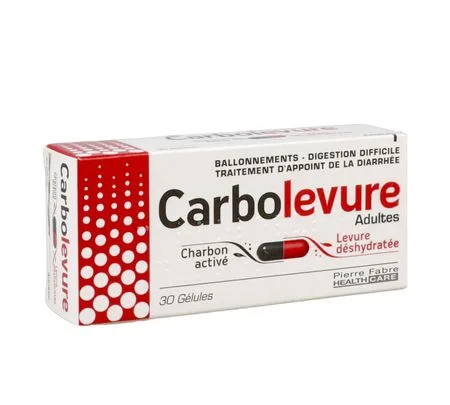
CARBOLEVURE ADULTS, capsule
Composition
Live dehydrated yeast containing at least
108 cells of Saccharomyces cerevisiae per gram..................................................................108.5 mg
Activated charcoal.........................................................................................................................................109.0 mg
For one capsule No. 1.
Povidone, anhydrous colloidal silica.
Composition of the capsule shell :
• Cap: black iron oxide (E172); titanium dioxide (E171); gelatin.
• Body: erythrosine (E127); red iron oxide (E172); titanium dioxide (E171); gelatin.
Indications
CARBOLEVURE ADULTS, capsule is indicated in adults for:
• Symptomatic treatment of functional intestinal disorders, including bloating.
• As a complement to rehydration and/or dietary measures, adjunctive symptomatic treatment of diarrhea.
The extent of rehydration by oral rehydration solution or by intravenous route must be adapted according to the intensity of the diarrhoea, the age and the particularities of the patient (associated diseases…).
Dosage and administration
Dosage
Reserved for adults.
3 capsules per day.
Method of administration
Oral use.
Swallow the capsules whole with a glass of water.
Duration of treatment
The duration of treatment is 3 days.
If symptoms persist or worsen, medical advice is required.
Contraindications
Hypersensitivity to the active substances or to any of the excipients listed in section Composition.
Warnings and precautions
Special warnings :
If the diarrhoea is associated with a fever above 39°C, dehydration, the presence of blood or mucus in the stools, abnormally severe abdominal pain accompanying it, or if the symptoms last more than 72h, patients should be advised to consult their doctor in order to undergo further investigations.
Precautions for use
In case of bloating and/or flatulence, patients should be advised to avoid dried legumes such as lentils, flageolet beans and peas, as well as certain green vegetables such as cabbage, cauliflower and broccoli, or bran bread and wholemeal bread.
In case of diarrhoea, patients should be advised of the need to:
• rehydrate by drinking plenty of fluids, salted or sweetened, in order to compensate for the fluid losses due to diarrhoea (the average daily water intake for an adult is 2 litres).
• eat for the duration of the diarrhoea,
- excluding certain foods, particularly raw vegetables, unpeeled fruit, spicy dishes, as well as iced foods or drinks.
- favouring lean meats, potatoes and rice.
Adequate water and electrolyte intake should be considered, particularly in elderly patients.
Special populations
The pharmacokinetics of CARBOLEVURE have not been studied in elderly patients, patients with renal or hepatic impairment. As the active substances are not absorbed, no particular effect is expected in these populations.
Interactions
In general, with medicines administered orally, due to the properties of charcoal, the potential decrease in absorption of medicines leads to administering any other medication at a distance (more than 2 hours, if possible) from taking this medicine.
Combinations not recommended (see section Warnings and precautions)
- Integrase inhibitors: raltegravir, bictegravir, dolutegravir, cabotegravir.
Decreased absorption of these medicines.
As a precaution, an interval (more than 2 hours if possible) should be respected between taking CARBOLEVURE and these medicines.
Associations requiring precautions for use
- Medicines administered orally:
The absorption of medicines taken orally and concomitantly with CARBOLEVURE may potentially be reduced (incomplete absorption or delayed absorption) due to the non-selective absorbing properties of activated charcoal (see section Pharmacokinetics). Therefore, this medicine should be administered with an interval (more than 2 hours if possible) between taking any other oral medicine.
- Calcium polystyrene sulfonate and sodium polystyrene sulfonate:
Risk of metabolic alkalosis in renally impaired patients.
As with any oral medicine taken with CARBOLEVURE, respect an interval between doses (more than 2 hours, if possible).
- Substances with reduced absorption by gastrointestinal topicals, antacids and adsorbents (acetylsalicylic acid, alendronic acid, clodronic acid, etidronic acid, ibandronic acid, oxidronic acid, pamidronic acid, risedronic acid, tiludronic acid, zoledronic acid, alimemazine, atenolol, betamethasone, bictegravir, budesonide, chlorpromazine, chlortetracycline, cimetidine, ciprofloxacin, clindamycin, cortisone, cyamemazine, demeclocycline, dexamethasone, digoxin, dolutegravir, doxycycline, elvitegravir, enoxacin, ethambutol, famotidine, iron, fexofenadine, fluorine, fluphenazine, isoniazid, lansoprazole, ledipasvir, levofloxacin, levomepromazine, levothyroxine, lincomycin, liothyronine sodium, lomefloxacin, lymecycline, methylenecycline, methylprednisolone, metopimazine, metoprolol, minocycline, moxifloxacin, nizatidine, norfloxacin, ofloxacin, oxomemazine, oxytetracycline, pefloxacin, penicillamine, phosphorus, piperazine, pipotiazine, prednisolone, prednisone, proguanil, promethazine, propericiazine, propranolol, raltegravir, ranitidine, rosuvastatin, sulpiride, teriflunomide, tetracycline, thyroxines, tigecycline, tiratricol, triamcinolone, ulipristal):
Decreased absorption of these medicines.
As a precaution, CARBOLEVURE should be taken at a distance from these medicines (more than 2 hours if possible).
Fertility, pregnancy and breastfeeding
Pregnancy
There are few or no data on the use of CARBOLEVURE in pregnant women.
Nevertheless, the available absorption data show no risk of foetal exposure to Saccharomyces cerevisiae and activated charcoal. Animal studies concerning reproductive toxicity have not been conducted (see section Preclinical safety). Finally, pharmacovigilance data show no infection with Saccharomyces cerevisiae after administration of CARBOLEVURE.
CARBOLEVURE can be used during pregnancy.
Breast-feeding
Neither Saccharomyces cerevisiae, nor activated charcoal, is excreted in breast milk.
CARBOLEVURE can be used during breast-feeding.
Fertility
There are no data on the fertility of animals with CARBOLEVURE.
Driving and using machines
CARBOLEVURE has no or negligible influence on the ability to drive and use machines.
Adverse effects
Undesirable effects are listed by System Organ Class (SOC) (MedDRA dictionary) and by frequency category. Frequency categories are defined as follows: very common (≥ 1/10), common (≥ 1/100 to < 1/10), uncommon (≥ 1/1000 to < 1/100), rare (≥ 1/10 000 to < 1/1000), very rare (< 1/10 000) and not known (cannot be estimated from the available data).
|
System organ class (MedDRA classification) |
Preferred MedDRA terms Frequency Not known |
|
Immune system disorder
|
Anaphylactic reactions |
|
Gastrointestinal disorders |
Discolouration of faeces* |
|
Skin and subcutaneous tissue disorders |
Rash Pruritus Urticaria |
*Use of this medicine at high doses may cause darker coloration of the stools.
Reporting of suspected adverse reactions
Reporting suspected adverse reactions after authorisation of the medicinal product is important. It allows continued monitoring of the benefit/risk balance of the medicinal product. Healthcare professionals are asked to report any suspected adverse reaction via the national reporting system: National Agency for the Safety of Medicines and Health Products (ANSM) and the network of Regional Centres of Pharmacovigilance - Website: https://signalement.social-sante.gouv.fr/.
Overdose
Symptoms
Ingestion of high doses may lead to constipation.
Treatment
In case of overdose, treatment will be symptomatic.
Pharmacodynamics
Pharmacotherapeutic class: Medicinal charcoal in combination, ATC code: A07BA51.
(A: alimentary tract and metabolism)
CARBOLEVURE is a combination of activated charcoal and yeasts. Thanks to its adsorbent properties, the activated charcoal captures excess liquids, toxins and gases that appear in the digestive tract during acute diarrhoea.
The yeast, Saccharomyces cerevisiae, has a favourable action on the intestinal flora during acute diarrhoea.
Pharmacokinetics
As the active substances are not absorbed and act locally, no pharmacokinetic study has been performed.
Preclinical safety
No formal non-clinical safety study has been conducted.
Concerning plant-derived activated charcoal of pharmaceutical quality (having less than 1 µg of polycyclic aromatic hydrocarbons (PAH)/kg), non-clinical data from the literature do not reveal any particular danger for humans concerning genotoxicity. No data on plant charcoal were available regarding chronic toxicity, carcinogenicity and reproductive and developmental toxicity.
Concerning Saccharomyces cerevisiae, no non-clinical data are available.
SPECIAL PRECAUTIONS FOR DISPOSAL AND OTHER HANDLING
No special requirements.
Any unused medicinal product or waste material should be disposed of in accordance with local requirements.
Prescription, supply and reimbursement
| Marketing authorisation (AMM) |
|
CHARTREUSE INDUSTRIAL PARK
81106 CASTRES CEDEX
Tel: 01 49 10 80 00 Tel (Freephone): 0 800 326 326
https://www.pierrefabremedicament.fr/
Source: VIDAL · Updated on 10/11/2026. This information does not replace advice from a healthcare professional.