Medicines
Update of 12/05/2025
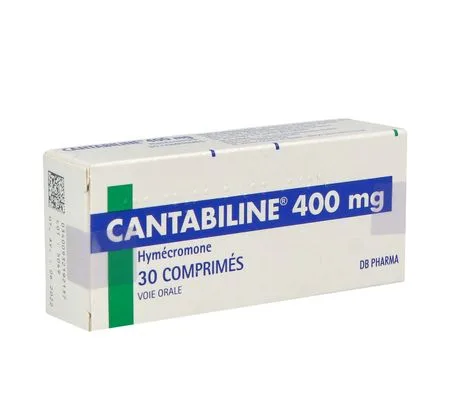
CANTABILINE®
hymecromone
Forms and presentations
Tablet at 400 mg (white): Box of 30, under thermoformed blister.Composition
| p tab | |
| Hymecromone (INN)
|
400 mg |
Excipient with known effect: wheat starch (gluten).
Indications
Symptomatic treatment of pain associated with dyspeptic disorders.Dosage and administration
Dosage1 tablet at the start of the main meals.
Method of administration:
Oral use.
Contraindications
Hypersensitivity to the active substance or to any of the excipients listed in section Composition.Warnings and precautions
Precautions for use
Do not use in case of obstruction of the bile ducts and severe hepatocellular insufficiency.
This medicine contains a very low gluten content (from wheat starch) and is therefore unlikely to cause problems in case of coeliac disease.
One tablet does not contain more than 142,5 micrograms of gluten.
If you have a wheat allergy (other than coeliac disease), you must not take this medicine.
Interactions
The data available to date do not suggest the existence of clinically significant interactions.
Fertility, pregnancy and breastfeeding
Pregnancy:Experimental data in animals have not shown a teratogenic effect. In the absence of data in humans, it is preferable not to prescribe it to pregnant women.
Adverse effects
The following adverse effects may occur during treatment with hymecromone. Frequencies are defined as follows: common (≥ 1/100 and < 1/10), uncommon (≥ 1/1000 and < 1/100), rare (≥ 1/10 000 and < 1/1000), and very rare (< 1/10 000); unknown frequency (cannot be estimated from the available data).
Gastrointestinal disorders:- Common: diarrhea.
- Unknown frequency: anaphylactic reactions including urticaria, pruritus, dyspnea, Quincke's edema and hypotension that may progress to anaphylactic shock.
Reporting suspected adverse reactions after authorisation of the medicinal product is important. It allows continuous monitoring of the benefit/risk balance of the medicinal product. Healthcare professionals should report any suspected adverse reaction via the national reporting system: National Agency for the Safety of Medicines and Health Products (ANSM) and the network of Regional Pharmacovigilance Centres. Website: https://signalement.social-sante.gouv.fr.
Overdose
No cases of overdose have been reported. However, a possible overdose may lead to an exacerbation of the adverse effects.
Pharmacodynamics
Pharmacotherapeutic class: Drug for hepatobiliary disorders, ATC code: A05AX02.
Hymecromone exerts a spasmolytic effect on the extrahepatic bile ducts.
The mechanism of this action is of the musculotropic type, without anticholinergic effects.
An increase in choleresis is also observed without stimulation of gallbladder contraction.
Pharmacokinetics
The maximum blood concentration is reached between 2 and 3 hours after oral administration.
Hymecromone is highly concentrated in bile and follows an enterohepatic cycle.
The plasma half-life is approximately 1 hour.
Excretion occurs via the urinary route in the form of glucuro- and sulfoconjugates.
Storage conditions
- Shelf life
- 3 years.
No special precautions for storage.
HANDLING/DISPOSAL INSTRUCTIONS
No special requirements.
Prescription, supply and reimbursement
| Marketing authorisation (AMM) | 3400932192137 (1978/91, SmPC rev 19.01.2024). |
| Not reimbursed by Social Security. |
DB PHARMA Laboratories
1 bis, avenue du Cdt-Rivière
La Varenne-St-Hilaire
94210 Saint-Maur-des-Fossés
Tel: 01 48 83 25 14. Fax: 01 48 83 27 57
http://www.db-pharma.com
Source: VIDAL · Updated on 10/11/2026. This information does not replace advice from a healthcare professional.