
Medicines
SmPC of 22/06/2017
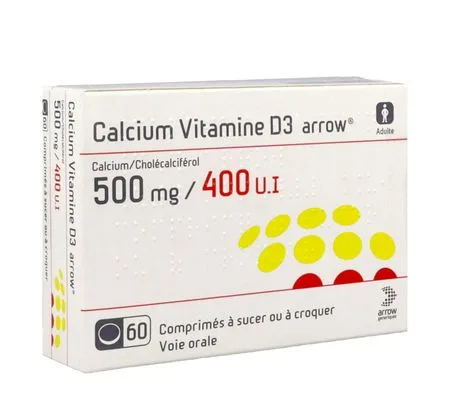
CALCIUM VITAMIN D3 ARROW 500 mg/400 IU, sucking or chewable tablet
Composition
Calcium carbonate........................................................................................................................ 1248,75 mg
Corresponding to 500 mg of calcium
Cholecalciferol, powder form ............................................................................................................ 4 mg
That is 400 IU of vitamin D3
For one tablet.
Excipients with known effect: sucrose, aspartame, sorbitol.
Alphatocopherol, gelatin, dietary fats, sucrose, corn starch, pregelatinized starch, sorbitol, magnesium stearate, aspartame, lemon flavor (lemon essential oil, citral, ascorbic acid, maltodextrin, sucrose).
Indications
- Correction of vitamin and calcium deficiencies in elderly subjects.
- Vitamin and calcium supplementation associated with specific treatments of osteoporosis, in patients who are deficient or at high risk of vitamin D and calcium deficiency.
Dosage and administration
Reserved for adults.
Dosage
The daily dosage is 2 tablets per day, that is 1 tablet morning and evening, to be sucked or chewed.
Method of administration
Oral use.
Contraindications
- Hypersensitivity to the active substances or to any of the excipients listed in section Composition,
- hypercalcaemia, hypercalciuria, calcium lithiasis,
- hypervitaminosis D,
- prolonged immobilization accompanied by hypercalciuria and/or hypercalcemia: vitamin-calcium treatment should only be used when mobility resumes,
- phenylketonuria (due to the presence of aspartame).
Warnings and precautions
During long-term treatment, serum calcium levels should be monitored and renal function should be monitored by means of serum creatinine. This monitoring is particularly important in patients under concomitant treatment with cardiac glycosides or thiazide diuretics (see section Interactions) and in patients with a high tendency to form stones. In case of hypercalcemia or signs of renal function impairment, the dose should be reduced or treatment discontinued.
In case of associated treatment with digitalis, bisphosphonates, sodium fluoride, thiazide diuretics, cyclines, iron salts, estramustine, thyroid hormones, strontium, zinc, orlistat: see section Interactions.
Take into account the vitamin D dose per intake unit (400 IU) and any other vitamin D prescription. As this product already contains vitamin D, additional administration of vitamin D or calcium must be carried out under strict medical supervision, with weekly monitoring of calcemia and calciuria.
The product should be prescribed with caution in patients with sarcoidosis due to a possible increase in the metabolism of vitamin D to its active form. In these patients, calcemia and calciuria should be monitored.
The product must be used with caution in patients with renal impairment, with monitoring of calcium-phosphate balance. A risk of soft tissue calcification should be considered. Vitamin D in the form of cholecalciferol is not metabolised normally in patients with severe renal failure, and other forms of vitamin D should be used.
The combination of calcium carbonate/cholecalciferol must be prescribed with caution in immobilised patients with osteoporosis, due to the increased risk of hypercalcaemia.
This medicine contains sorbitol. Its use is not recommended in patients with fructose intolerance (a rare hereditary disease).
This medicine contains sucrose. Its use is not recommended in patients with fructose intolerance, glucose-galactose malabsorption syndrome or sucrase/isomaltase deficiency.
Interactions
Associations requiring precautions for use
+ Cyclines:
Decreased digestive absorption of tetracyclines.
It is recommended to separate the intake of cycline by at least 2 hours before or 4 to 6 hours after the
oral intake of calcium.
+ Digitalis glycosides:
Risk of rhythm disorders.
Clinical monitoring and, if necessary, monitoring of the ECG and serum calcium.
+ Bisphosphonates:
Decreased digestive absorption of bisphosphonates.
It is recommended to separate the intake of calcium Vitamin D3 by at least 3 hours, as their digestive absorption may be reduced.
+ Estramustine:
Decreased digestive absorption of estramustine.
Take calcium salts apart from estramustine (more than 2 hours if possible).
+ Iron (salts) (oral route):
Decreased digestive absorption of iron salts.
Take iron away from meals and in the absence of calcium.
+ Thyroid hormones
Decreased absorption of thyroid hormones. Take calcium salts apart from thyroid hormones (more than 2 hours if possible).
+ Strontium
Decreased digestive absorption of strontium. Take strontium apart from calcium salts (more than 2 hours, if possible).
+ Zinc
Decreased digestive absorption of zinc by calcium. Take calcium salts apart from zinc (more than 2 hours, if possible).
Associations to be taken into account
+ Thiazide and related diuretics:
Risk of hypercalcaemia due to decreased urinary elimination of calcium. Serum calcium should be regularly monitored in case of concomitant use of thiazide diuretics.
+ Orlistat
Decrease in vitamin D absorption.
Other associations
Systemic corticosteroids reduce calcium absorption. In case of concomitant use, it may be necessary to increase the dose of calcium carbonate/cholecalciferol.
Concurrent treatment involving ion exchange resins such as cholestyramine or laxatives such as liquid paraffin may reduce the gastrointestinal absorption of vitamin D. An interval as long as possible is therefore recommended between doses.
If sodium fluoride is used concurrently, this preparation should be administered at least three hours before taking calcium carbonate/cholecalciferol, due to the possible risk of reduced gastrointestinal absorption.
Oxalic acid (present in spinach and rhubarb) and phytic acid (present in whole grain cereals) may inhibit calcium absorption by forming insoluble compounds with calcium ions. The patient should not take calcium products within two hours after consuming foods with a high content of oxalic acid and phytic acid.
Fertility, pregnancy and breastfeeding
This product may be used during pregnancy and breastfeeding. However, the daily dose must not exceed 1500 mg of calcium and 600 IU of vitamin D3.
Pregnancy
During pregnancy, overdosage of cholecalciferol must be avoided:
- Vitamin D overdoses during gestation have had teratogenic effects in animals.
- In pregnant women, vitamin D overdoses should be avoided, as persistent hypercalcaemia may lead to physical and mental retardation, supravalvular aortic stenosis or retinopathy in the child. However, several children were born without malformation after administration of very high doses of vitamin D3 for hypoparathyroidism in the mother.
Breast-feeding
Vitamin D and its metabolites pass into breast milk. This should be taken into consideration when vitamin D is administered to the child.
Calcium passes slightly into breast milk, without causing any harmful effect in the child.
Driving and using machines
The preparation is unlikely to have an adverse effect on the ability to drive vehicles or use machines.
Adverse effects
The frequencies of undesirable effects are presented according to the following convention: very common (≥ 1/10); common (≥ 1/100 to < 1/10); uncommon (≥ 1/1 000 to < 1/100); rare (≥ 1/10 000 to < 1/1 000); very rare (< 1/10 000); frequency not known (cannot be estimated from the available data).
Immune system disorders
Very rare: hypersensitivity reaction such as angioedema or laryngeal oedema.
Gastrointestinal disorders
Uncommon: constipation, flatulence, nausea, abdominal pain, abdominal distension, diarrhoea.
Metabolism and nutrition disorders
Rare: hypercalciuria and hypercalcaemia in case of prolonged treatment at high doses.
Skin and subcutaneous tissue disorders
Uncommon: skin rash, pruritus, urticaria.
Special populations
Patients with renal impairment
Possible risk of hyperphosphataemia, nephrolithiasis and nephrocalcinosis.
Reporting of suspected adverse reactions
Reporting suspected adverse reactions after authorisation of the medicinal product is important. It allows continued monitoring of the benefit/risk balance of the medicinal product. Healthcare professionals are asked to report any suspected adverse reaction via the national reporting system: National Agency for the Safety of Medicines and Health Products (ANSM) and the network of Regional Centres of Pharmacovigilance - Website: www.ansm.sante.fr.
Overdose
Acute overdose results in hypercalciuria and hypercalcaemia, the symptoms of which are as follows: anorexia, thirst, nausea, vomiting, polydipsia, polyuria, constipation, abdominal pain, muscle weakness, fatigue, mental disturbances, bone pain, renal calculi and, in severe cases, cardiac arrhythmias. Extreme hypercalcaemia can lead to coma and death.
Chronic overdose of vitamin D3 may cause irreversible renal damage and vascular and tissue calcifications due to hypercalcaemia.
Treatment:
Discontinue all calcium and vitamin D supplementation, rehydration. Treatment with thiazide diuretics, lithium, vitamin A or cardiac glycosides must also be interrupted. Gastric lavage must be performed in patients who have lost consciousness. Depending on the severity level, single or combined treatment with loop diuretics, bisphosphonates, calcitonin and corticosteroids must also be performed. Serum electrolytes, renal function and diuresis must be monitored. In severe cases, these interventions should be followed by an ECG and monitoring of central venous pressure (CVP).
Pharmacodynamics
Pharmacotherapeutic class: Vitamin D-Calcium supplement, ATC code: Drug active on calcium balance. A: alimentary tract and metabolism.
Vitamin D corrects vitamin D supply insufficiency.
It increases intestinal absorption of calcium and its fixation on osteoid tissue.
Calcium supplementation corrects dietary calcium deficiency.
Daily calcium requirements are in the order of 1000 to 1500 mg of elemental calcium and 500-1000 IU/day of vitamin D.
Vitamin D and calcium correct secondary senile hyperparathyroidism.
A controlled, double-blind, placebo-controlled study of 18 months, involving 3270 women aged 84 ± 6 years living in care centers, showed a significant decrease in plasma PTH levels. At 18 months, intention-to-treat analysis results revealed 80 hip fractures in the calcium-vitamin D group and 110 hip fractures in the placebo group (p = 0,004). Under the conditions of this study, treatment of 1387 women prevented 30 hip fractures. After extension up to 36 months, the following results were obtained: 137 hip fractures in the calcium-vitamin D group and 178 in the placebo group (p = 0,02).
Pharmacokinetics
Calcium carbonate
In the gastric environment, calcium carbonate releases the calcium ion, depending on pH.
Calcium is mainly absorbed in the upper part of the small intestine.
The gastrointestinal absorption rate is in the order of 30% of the ingested dose.
Calcium is eliminated through sweat and digestive secretions.
Urinary calcium depends on glomerular filtration and the rate of tubular calcium reabsorption.
Vitamin D3
Vitamin D3 is absorbed in the intestine and transported bound to proteins in the blood to the liver (first hydroxylation) and the kidney (second hydroxylation).
Non-hydroxylated vitamin D3 is stored in reserve compartments such as adipose and muscle tissues.
Its plasma half-life is in the order of a few days. It is eliminated in feces and urine.
Prescription, supply and reimbursement
| Marketing authorisation (AMM) |
|
| Price: |
|
Collection.
26 AVENUE TONY GARNIER
69007 LYON
Tel: 04 72 72 60 72 Tel (toll-free): 0811 65 27 76
contact@laboratoire-arrow.com
http://www.laboratoire-arrow.com/
Source: VIDAL · Updated on 10/11/2026. This information does not replace advice from a healthcare professional.