
Medicines
Update of 03/12/2025
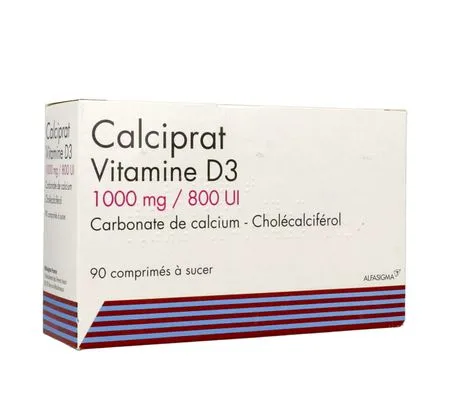
CALCIPRAT® vitamin D3 1000 mg/800 IU
calcium, cholecalciferol
Forms and presentations
Lozenge (slightly domed; mint-scented; white): Pill organizers of 30 or 90.Composition
| per tablet | |
| Calcium
|
1000 mg |
| (as calcium carbonate: 2500 mg/tab) | |
| Cholecalciferol* or vitamin D3
|
800 IU |
Excipients: xylitol, povidone (K30), aspartame, levomenthol, mint flavouring (peppermint essential oil, gum arabic, maltodextrin, sorbitol), talc, magnesium stearate, lactose monohydrate.
Indications
- Correction of vitamin-calcium deficiencies in the elderly.
- Vitamin-calcium supplementation associated with specific osteoporosis treatments, in patients who are deficient or at high risk of vitamin D-calcium deficiency.
Dosage and administration
DosageOne tablet per day.
Method of administration:
Suck one tablet, then drink a glass of water.
Contraindications
- Hypercalcaemia, hypercalciuria, calcium lithiasis.
- Prolonged immobilisation accompanied by hypercalciuria and/or hypercalcaemia: vitamin-calcium treatment should only be used when mobilisation resumes.
- Hypersensitivity to any of the constituents.
- Phenylketonuria (presence of aspartame).
- Children under 15 years of age.
Warnings and precautions
- During long-term treatment, it is justified to monitor urinary calcium excretion and to reduce or temporarily interrupt treatment if it exceeds 7,5 mmol/24 h (300 mg/24 h).
- In case of concomitant treatment based on digitalis glycosides, bisphosphonates, sodium fluoride, thiazide diuretics, tetracyclines: see Interactions.
- Take into account the vitamin D dose per intake unit (800 IU) and any possible other vitamin D prescription. Calciprat Vitamin D3 1000 mg/800 IU already contains vitamin D; additional administration of vitamin D or calcium must be carried out under strict medical supervision, with weekly monitoring of calcaemia and calciuria.
- The product should be prescribed with caution in patients with sarcoidosis, due to a possible increase in the metabolism of vitamin D to its active form. In these patients, serum calcium and urinary calcium should be monitored.
- The product should be used with caution in patients with renal insufficiency, with monitoring of the calcium-phosphorus balance.
- Due to the presence of lactose, this medicine is contraindicated in cases of congenital galactosemia, glucose-galactose malabsorption syndrome, or lactase deficiency.
Interactions
Associations subject to precautions for use:
- Digitalis glycosides: oral administration of calcium combined with vitamin D increases the toxicity of digitalis glycosides (risk of arrhythmias). Strict clinical monitoring and, if necessary, ECG and serum calcium monitoring are required.
- Bisphosphonate, sodium fluoride: it is advised to respect a minimum interval of 2 hours before taking calcium (risk of decreased digestive absorption of the bisphosphonate and sodium fluoride).
- Thiazide diuretics: monitoring of serum calcium is recommended (decreased urinary calcium excretion).
- Oral tetracyclines: it is recommended to separate calcium intake by at least 3 hours (possible decrease in tetracycline absorption).
- Phenytoin, barbiturates: possible decrease in the effect of vitamin D3 through inhibition of its metabolism.
- Glucocorticoids: possible decrease in the effect of vitamin D3.
- High-dose vitamin D: if additional high-dose vitamin D is administered, weekly monitoring of urinary calcium and serum calcium is essential.
- Food: possible interactions with foods (for example those containing oxalic acid, phosphates or phytic acid).
Fertility, pregnancy and breastfeeding
Due to its high vitamin D3 content, this medicine is not indicated during pregnancy and breastfeeding.
During pregnancy, overdosage with cholecalciferol should be avoided:- vitamin D overdoses during gestation have had teratogenic effects in animals;
- in pregnant women, vitamin D overdoses should be avoided because persistent hypercalcemia may cause physical and mental retardation, supravalvular aortic stenosis or retinopathy in the child. However, several children were born without malformation after administration of very high doses of vitamin D3 for hypoparathyroidism in the mother.
Vitamin D and its metabolites pass into breast milk.
Driving and using machines
No known or expected effects.Adverse effects
- Constipation, flatulence, nausea, epigastric pain, diarrhea.
- Hypercalciuria and, exceptionally, hypercalcemia in cases of prolonged treatment at high doses.
- Allergic skin reactions such as pruritus, rash, urticaria have been reported.
Reporting suspected adverse reactions after authorisation of the medicinal product is important. It allows continuous monitoring of the benefit/risk balance of the medicinal product. Healthcare professionals should report any suspected adverse reaction via the national reporting system: National Agency for the Safety of Medicines and Health Products (ANSM) and the network of Regional Pharmacovigilance Centres. Website: https://signalement.social-sante.gouv.fr.
Overdose
- Overdose results in hypercalciuria and hypercalcemia, the symptoms of which are as follows: nausea, vomiting, polydipsia, polyuria, constipation.
- Chronic overdose of vitamin D3 may cause vascular and tissue calcifications due to hypercalcemia.
Treatment:
Stop all calcium and vitamin D intake, rehydration.
Pharmacodynamics
Calcium in combination with other substances (ATC code: A12AX).
Vitamin D corrects inadequate vitamin D intake.
It increases intestinal absorption of calcium and its fixation on osteoid tissue.
Calcium supplementation corrects dietary calcium deficiency.
The needs of elderly people are estimated at 1500 mg/day of calcium and 500 to 1000 IU/day of vitamin D.
Vitamin D and calcium correct secondary senile hyperparathyroidism.
In a double-blind, placebo-controlled study of 18 months, 3270 women aged 84 years ± 6, with a diet poor in calcium and living in care centres, received an additional intake of vitamin D (800 IU/day) and calcium (1,2 g/day). A significant decrease in PTH secretion was observed.
After 18 months, the results of the intention-to-treat analysis revealed 80 hip fractures (5,7%) in the calcium-vitamin D group, and 110 hip fractures (7,9%) in the placebo group (p = 0,004). Thus, under the conditions of this study, the treatment of 1387 women prevented 30 hip fractures. After 36 months of follow-up, 137 women had at least one hip fracture (11,6%) in the calcium-vitamin D group (n = 1176) and 178 (15,8%) in the placebo group (n = 1127; p ≤ 0,02).
Pharmacokinetics
During dissolution, the calcium salt contained in Calciprat vitamin D3 1000 mg/800 IU is converted into calcium citrate.
Calcium citrate is well absorbed, on the order of 30 to 40% of the ingested dose.
Calcium is eliminated in the urine, feces and sweat secretions.
Vitamin D is absorbed in the intestine and transported bound to proteins in the blood to the liver (first hydroxylation) and then to the kidney (second hydroxylation).
Non-hydroxylated vitamin D is stored in reserve compartments such as adipose and muscle tissue. Its plasma half-life is on the order of a few days, and it is eliminated in the feces and urine.
Storage conditions
- Shelf life
- 3 years.
No special precautions for storage.
Prescription, supply and reimbursement
| Marketing authorisation (AMM) | 3400936012431 (2002, SmPC rev 11.01.2024) 30 tab. |
| 3400937389532 (2006, SmPC rev 11.01.2024) 90 tab. |
| Price: | 5,29 euros (30 tablets). |
| 14,98 euros (90 tablets). | |
| Reimbursed by Social Security at 65 %. Collective. | |
ALFASIGMA FRANCE
Bords de Seine 1
3, esplanade du Foncet, 92130 Issy-les-Moulineaux
Tel: 01 45 21 02 69. Fax: 01 41 90 69 76
E-mail: info.fr@alfasigma.com
www.alfasigma.fr
Source: VIDAL · Updated on 10/11/2026. This information does not replace advice from a healthcare professional.