

Medicines
SmPC of 02/01/2025
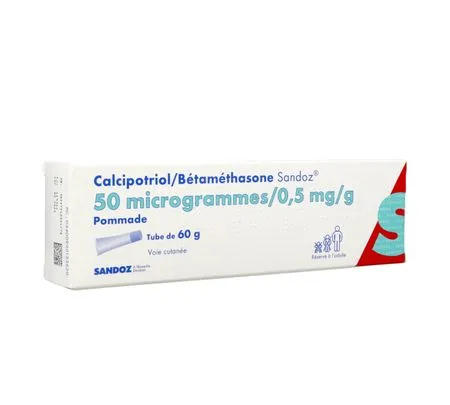
CALCIPOTRIOL/BETAMETHASONE SANDOZ 50 micrograms/0,5 mg/g, ointment
Composition
One gram of ointment contains 50 micrograms of calcipotriol (as monohydrate) and 0,5 mg of betamethasone (as dipropionate).
All-rac-α-tocopherol (E307), oleyl alcohol, light liquid paraffin, white soft paraffin.
Indications
Topical treatment of plaque psoriasis (psoriasis vulgaris), suitable for topical treatment in adults.
Dosage and administration
Dosage
CALCIPOTRIOL/BETAMETHASONE SANDOZ 50 micrograms/0,5 mg/g, ointment should be applied once daily to the lesions.
The recommended duration of treatment is 4 weeks. There are data on the use of repeated courses of CALCIPOTRIOL/BETAMETHASONE SANDOZ 50 micrograms/0,5 mg/g, ointment for up to 52 weeks. If it is necessary to continue or resume treatment after 4 weeks, treatment should be continued after medical advice and under regular medical supervision.
When using products containing calcipotriol, the maximum daily dose must not exceed 15 g. The body surface area treated with products containing calcipotriol must not exceed 30 % (see section Warnings and precautions).
Special populations
Renal and hepatic impairment
The safety and efficacy of CALCIPOTRIOL/BETAMETHASONE SANDOZ 50 micrograms/ 0,5 mg/g, ointment in patients with severe renal impairment or severe hepatic disorders have not been evaluated.
Paediatric population
The safety and efficacy of CALCIPOTRIOL/BETAMETHASONE SANDOZ 50 micrograms/ 0,5 mg/g, ointment in children aged less than 18 years have not been established.
The data currently available in children aged 12 to 17 years are described in sections Adverse effects, Pharmacodynamics and Pharmacokinetics but no dosage recommendation can be given.
Method of administration
CALCIPOTRIOL/BETAMETHASONE SANDOZ 50 micrograms/0,5 mg/g, ointment should be applied to the lesions. For optimal effect, it is not recommended to shower or bathe immediately after application of CALCIPOTRIOL/BETAMETHASONE SANDOZ 50 micrograms/0,5 mg/g, ointment.
Contraindications
Hypersensitivity to the active substances or to any of the excipients listed in section Composition.
CALCIPOTRIOL/BETAMETHASONE SANDOZ 50 micrograms/0,5 mg/g, ointment is contraindicated in erythrodermic, exfoliative and pustular psoriasis.
Due to the presence of calcipotriol, CALCIPOTRIOL/BETAMETHASONE SANDOZ 50 micrograms/0,5 mg/g, ointment is contraindicated in patients with a history of calcium metabolism disorders (see section Warnings and precautions).
Due to the presence of corticosteroids, CALCIPOTRIOL/BETAMETHASONE SANDOZ 50 micrograms/0,5 mg/g, ointment is contraindicated in the following cases: skin lesions of viral origin (for example herpes or varicella), skin infections of fungal or bacterial origin, parasitic infections, skin involvement related to tuberculosis or perioral dermatitis, skin atrophy, striae, fragility of the cutaneous venous network, ichthyosis, acne vulgaris, acne rosacea, rosacea, ulcers and wounds (see section Warnings and precautions).
Warnings and precautions
Effect on the endocrine system
CALCIPOTRIOL/BETAMETHASONE SANDOZ 50 micrograms/0,5 mg/g, ointment contains a class III strong group corticosteroid and the simultaneous use of other corticosteroids should be avoided.
The adverse effects observed with systemic corticosteroid treatment, such as suppression of the hypothalamic-pituitary axis or the effect on glycaemic control in diabetes mellitus, may also occur during topical corticosteroid treatment due to systemic absorption.
Application under occlusive dressing should be avoided as it increases systemic absorption of corticosteroids. Application over large areas of damaged skin, on mucous membranes or in skin folds should be avoided as it increases systemic absorption of corticosteroids (see section Adverse effects).
In a study in patients with psoriasis extending to both the scalp and the body, using in combination high doses of a calcipotriol and betamethasone gel (applied to the scalp) and high doses of a calcipotriol and betamethasone ointment (applied to the body), 5 patients out of 32 showed a borderline decrease in their cortisol level in response to adrenocorticotropic hormone (ACTH) stimulation after 4 weeks of treatment (see section Pharmacodynamics).
Effects on calcium metabolism
Due to the presence of calcipotriol, hypercalcaemia may occur if the maximum daily dose (15 g) is exceeded. However, serum calcium normalises rapidly upon discontinuation of treatment. The risk of hypercalcaemia is minimal when the recommendations regarding calcipotriol are followed. Treatment of more than 30 % of body surface area should be avoided (see section Dosage and administration).
Local adverse effects
CALCIPOTRIOL/BETAMETHASONE SANDOZ 50 micrograms/0,5 mg/g, ointment contains a class III strong corticosteroid and the simultaneous use of other corticosteroids on the same lesion should be avoided. Facial and genital skin is very sensitive to corticosteroids. The product should not be used on these areas. The patient must be trained in the correct use of the product in order to avoid accidental application and transfer to the face, mouth and eyes. Wash hands after each application in order to avoid accidental transfer to these areas.
Concomitant skin infections
When lesions become superinfected, they should be treated with antibiotics.
However, if the infection worsens, corticosteroid treatment should be discontinued (see section Contraindications).
Discontinuation of treatment
When treating psoriasis with topical corticosteroids, there may be a risk of generalised pustular psoriasis or rebound upon discontinuation of treatment. Medical monitoring should therefore continue after treatment is stopped.
Prolonged treatment
During prolonged treatment, the risk of local or systemic adverse effects of corticosteroids is increased. Treatment should be discontinued in the event of adverse effects related to long-term use of corticosteroids (see section Adverse effects).
Unevaluated uses
No data are available concerning the use of CALCIPOTRIOL/BETAMETHASONE SANDOZ 50 micrograms/0,5 mg/g, ointment in guttate psoriasis.
Concomitant treatment and UV exposure
Limited data are available concerning the use of this product on the scalp. An ointment containing calcipotriol and betamethasone for psoriatic lesions of the body has been used in combination with a gel containing calcipotriol and betamethasone for psoriatic lesions of the scalp, but experience is limited regarding the combination of a calcipotriol and betamethasone ointment with other topical anti-psoriatic products applied to the same areas, with other systemically administered anti-psoriatic products, or with phototherapy.
During treatment with CALCIPOTRIOL/BETAMETHASONE SANDOZ 50 micrograms/0,5 mg/g, ointment, it is recommended that the physician advise patients to limit or avoid excessive exposure to natural or artificial light. Topically applied calcipotriol should be combined with UV only if the physician and patient consider that the potential benefits outweigh the potential risks (see section Preclinical safety).
Visual disorders
Visual disturbances have been reported during systemic or topical corticosteroid therapy. If a patient presents with symptoms such as blurred vision or other visual disturbances, they should be referred to an ophthalmologist to investigate possible causes, which may include cataract, glaucoma or a rarer condition such as central serous chorioretinopathy (CSCR), already described after systemic or topical corticosteroid use.
Fertility, pregnancy and breastfeeding
Pregnancy
There are no relevant data on the use of a calcipotriol and betamethasone ointment in pregnant women. Animal studies with glucocorticoids have shown reproductive toxicity (see section Preclinical safety) however, a large number of epidemiological studies (fewer than 300 pregnancies) have not shown congenital abnormalities in children born to mothers treated with corticosteroids during pregnancy. The potential risk in humans is not known with certainty. Consequently, during pregnancy, CALCIPOTRIOL/BETAMETHASONE SANDOZ 50 micrograms/0,5 mg/g, ointment should only be used when the potential benefit justifies the potential risk.
Breast-feeding
Betamethasone passes into breast milk, but the risk of an adverse effect in the infant appears unlikely at therapeutic doses. No data are available on the excretion of calcipotriol into breast milk. Caution is required when prescribing CALCIPOTRIOL/BETAMETHASONE SANDOZ 50 micrograms/0,5 mg/g, ointment to breastfeeding women. Do not use CALCIPOTRIOL/BETAMETHASONE SANDOZ 50 micrograms/0,5 mg/g, ointment on the breasts during breastfeeding.
Fertility
Studies in rats following oral administration of calcipotriol or betamethasone dipropionate have shown no impairment of male or female fertility (see section Preclinical safety).
Driving and using machines
CALCIPOTRIOL/BETAMETHASONE SANDOZ 50 micrograms/0,5 mg/g, ointment has no or negligible influence on the ability to drive and use machines.
Adverse effects
The estimate of the frequency of adverse effects is based on an analysis of all data from clinical studies, including post-authorisation safety studies, and spontaneous reports.
The adverse effects most frequently reported during treatment are skin reactions such as pruritus and skin exfoliation.
Pustular psoriasis and hypercalcaemia have also been reported.
Adverse effects are listed by MedDRA system organ class, and individual adverse effects are listed starting with the most frequently reported. Within each frequency group, adverse effects are listed in decreasing order of seriousness.
Very common ≥ 1/10
Frequent ≥ 1/100 and < 1/10
Uncommon ≥ 1/1 000 and < 1/100
Rare ≥ 1/10 000 and < 1/1 000
Very rare < 1/10 000
|
Infections and infestations |
|
|
Uncommon ≥ 1/1 000 and < 1/100 |
Skin infection* Folliculitis |
|
Rare ≥ 1/10 000 and < 1/1 000 |
Furuncle |
|
Immune system disorders |
|
|
Rare ≥ 1/10 000 and < 1/1 000 |
Hypersensitivity |
|
Metabolism and nutrition disorders |
|
|
Rare ≥ 1/10 000 and < 1/1 000 |
Hypercalcemia |
|
Eye disorders |
|
|
Frequency not known |
Blurred vision (see also section Warnings and precautions), choroidal retinopathy |
|
Skin and subcutaneous tissue disorders |
|
|
Frequent ≥ 1/100 and < 1/10 |
Skin exfoliation Pruritus |
|
Uncommon ≥ 1/1 000 and < 1/100 |
Skin atrophy Exacerbation of psoriasis Dermatitis Erythema Skin rash** Purpura or ecchymosis Skin burning sensation Skin irritation |
|
Rare ≥ 1/10 000 and < 1/1 000 |
Pustular psoriasis Striae Photosensitivity reactions Acne Dry skin |
|
General disorders and administration site conditions |
|
|
Uncommon ≥ 1/1 000 and < 1/100 |
Change in pigmentation at the application site Pain at the application site*** |
|
Rare ≥ 1/10 000 and < 1/1 000 |
Rebound effect |
* Skin infections, including infections of bacterial, fungal or viral origin, have been reported.
** Different types of skin reactions have been reported, such as exfoliative, papular and pustular eruptions.
*** The burning sensation at the application site is included among the pain experienced at the application site.
Paediatric population
In an uncontrolled open study, 33 adolescents aged 12 to 17 years with plaque psoriasis were treated with an ointment containing calcipotriol and betamethasone for 4 weeks with a maximum of 56 g per week. No new adverse events were observed and no concerning data regarding the systemic effect of the topical corticosteroid were identified. However, the size of the study does not allow conclusions to be drawn regarding the safety profile of an ointment containing calcipotriol and betamethasone in children and adolescents.
In another uncontrolled clinical trial involving 7 adolescents aged 12 to 17 years, no adverse effects were reported. See section Pharmacodynamics for further details concerning the trial.
In this limited sample, no clinically relevant difference was observed between the safety profiles of a cream containing calcipotriol and betamethasone in adults and adolescents.
The following adverse effects are considered related to the pharmacological classes of calcipotriol and betamethasone, respectively:
Calcipotriol
Adverse effects include the following: reactions at the application site, pruritus, skin irritation, burning and tingling sensation, dry skin, erythema, skin eruptions, dermatitis, eczema, worsening of psoriasis, photosensitivity, and hypersensitivity reactions including very rare cases of angioedema and facial oedema.
Systemic effects following topical application may very rarely occur and cause hypercalcaemia or hypercalciuria (see section Warnings and precautions).
Betamethasone (dipropionate)
Local reactions may occur after topical use, especially with prolonged exposure, including skin atrophy, telangiectasia, striae, folliculitis, hypertrichosis, perioral dermatitis, allergic contact dermatitis, depigmentation and colloid milium.
During treatment of psoriasis, there may be a risk of generalised pustular psoriasis.
Systemic effects following topical application of corticosteroids are rare in adults; however, they may be severe. Suppression of the hypothalamic-pituitary-adrenal axis, cataract, infections, an impact on glycaemic control in diabetes mellitus and an increase in intraocular pressure may occur, particularly after prolonged treatment. Systemic effects occur more frequently with application under occlusion (plastic, skin folds), application over large surface areas and long-term treatment (see section Warnings and precautions).
Reporting of suspected adverse reactions
Reporting suspected adverse reactions after authorisation of the medicinal product is important. It allows continued monitoring of the benefit/risk balance of the medicinal product. Healthcare professionals are asked to report any suspected adverse reaction via the national reporting system: National Agency for the Safety of Medicines and Health Products (ANSM) and the network of Regional Centres of Pharmacovigilance - Website: https://signalement.social-sante.gouv.fr.
Overdose
The use of doses higher than the recommended dose may lead to an increase in blood calcium, which should be rapidly reversible upon discontinuation of treatment. Symptoms of hypercalcaemia include polyuria, constipation, muscle weakness, confusion and coma.
Prolonged excessive use of topical corticosteroids may lead to suppression of the hypothalamic-pituitary-adrenal axis, resulting in secondary adrenal insufficiency, usually reversible. In such cases, symptomatic treatment is indicated.
In case of chronic toxicity, corticosteroid treatment should be discontinued gradually.
One case of misuse has been reported in a patient treated for extensive erythrodermic psoriasis with 240 g per week of an ointment containing calcipotriol and betamethasone (corresponding to a daily dose of approximately 34 g) for 5 months (maximum recommended dose 15 g per day); the patient developed Cushing's syndrome and pustular psoriasis after abrupt cessation of treatment.
Pharmacodynamics
Pharmacotherapeutic class: Antipsoriatics. Other antipsoriatics for topical use, calcipotriol, combinations, ATC code: D05AX52
Calcipotriol is a vitamin D analogue. Data in vitro suggest that calcipotriol induces differentiation and inhibits proliferation of keratinocytes. This is the proposed mechanism to explain its effects in psoriasis.
Like other topical corticosteroids, betamethasone dipropionate has anti-inflammatory, anti-pruritic, vasoconstrictive, and immunosuppressive properties, without demonstrated curative action. Treatment under occlusion may increase the effect due to greater penetration into the stratum corneum. The incidence of adverse effects will therefore be increased. The mechanism of action of the anti-inflammatory activity of topical corticosteroids is not fully established.
A multicentre, randomised, double-blind, parallel-group phase III study was conducted to investigate the efficacy, safety and tolerability of a generic of an ointment based on calcipotriol and betamethasone compared with the reference product and a placebo in the treatment of adult patients with chronic plaque psoriasis. A total of 444 patients began double-blind treatment. Patients were randomised to receive either a generic of an ointment based on calcipotriol and betamethasone (test product), the reference product, or another ointment formulation (placebo) in a ratio of 4:4:1. The study drug was used by the patient himself or herself once daily for 4 weeks.
The primary efficacy criterion was defined as the mean percentage change in the PASI (Psoriasis Area and Severity Index) score between the start of treatment and the end of the 4 weeks of treatment. Analysis of results between patients treated with the test product compared with those treated with the reference product showed that the test product was equivalent to the reference product.
Analysis of results between patients treated with the test product compared with those treated with placebo showed that the test product was more effective than placebo.
The results obtained on the secondary criteria confirmed the results obtained for the primary efficacy criterion. After 4 weeks of treatment, the test product was significantly more effective than placebo according to the secondary efficacy criteria.
Local tolerability was assessed by comparing the type, number and severity of lesional/perilesional adverse effects. 12 patients experienced 17 cutaneous adverse effects possibly related to the study drug (5 adverse effects in 4 patients treated with the test drug, 6 adverse effects in 4 patients treated with the reference drug, and 6 adverse effects in 4 patients treated with placebo). All patients with cutaneous adverse effects possibly related to the study drug fully recovered. The overall tolerability of the test drug was comparable to the reference drug.
Assessment of safety parameters (change in albumin-corrected serum calcium concentration, change in the amount of cortisol excreted in urine over 24 hours, clinical examination and laboratory test results, and observation of vital signs) raised no safety concerns.
The study demonstrated therapeutic equivalence between the test product (CALCIPOTRIOL/BETAMETHASONE SANDOZ) and the reference drug (DAIVOBET), and the superiority of the test product over placebo, while raising no safety concerns.
The confirmatory analysis of the primary criterion comparing the test product and the reference treatment showed that the test product is therapeutically equivalent to the reference.
A safety study in 634 psoriasis patients investigated the effects of repeated courses of an ointment based on calcipotriol and betamethasone used once daily as needed, either alone or alternating with an ointment based on calcipotriol, for up to 52 weeks, compared with an ointment based on calcipotriol used alone for 48 weeks after an initial treatment with an ointment based on calcipotriol and betamethasone.
Adverse effects were reported by 21,7% of patients in the group treated with an ointment based on calcipotriol and betamethasone, 29,6% in the group treated with alternating ointment based on calcipotriol and betamethasone and an ointment based on calcipotriol, and 37,9% in the group treated with an ointment based on calcipotriol. The adverse effects reported by more than 2% of patients in the calcipotriol and betamethasone ointment group were pruritus (5,8%) and psoriasis (5,3%). Adverse effects that could be related to long-term corticosteroid treatment (for example skin atrophy, folliculitis, depigmentation, furunculosis and purpura) were reported by 4,8% of patients in the calcipotriol and betamethasone ointment group, 2,8% in the group alternating a calcipotriol and betamethasone ointment and a calcipotriol ointment, and 2,9% in the calcipotriol-alone ointment group.
The adrenal response to ACTH was determined by measuring cortisol levels in patients with extensive psoriasis of both the scalp and body who used up to 106 g per week of a gel based on calcipotriol and betamethasone combined with a betamethasone ointment. A borderline decrease in cortisol level, 30 minutes after ACTH administration, was observed in 5 of 32 patients (15,6%) after 4 weeks of treatment, and in 2 of 11 patients (18,2%) who extended treatment up to 8 weeks. In all cases, cortisol levels were at a normal level 60 minutes after ACTH administration. No change in calcium metabolism was observed in these patients. Regarding hypothalamic-pituitary suppression, this study shows that at very high doses the gel and ointment containing calcipotriol and betamethasone may have a weak effect on the hypothalamic-pituitary axis.
Paediatric population
The adrenal response to ACTH administration was measured in an uncontrolled study of 4 weeks in 33 adolescents aged 12 to 17 years with body psoriasis who used up to 56 g per week of an ointment containing calcipotriol and betamethasone. No cases of suppression of the hypothalamic-pituitary axis were reported. No hypercalcaemia was reported, but one patient showed an increase in urinary calcium possibly related to treatment.
The results of this trial were also confirmed in another trial including 7 adolescents aged 12 to 17 years with extensive psoriasis covering 10,5 to 16 % of body surface area (including the scalp). Treatment consisted of a daily application of a calcipotriol and betamethasone cream to the body and scalp for a period of up to 8 weeks. The mean weekly dose up to week 8 was 27,2 g. No adrenal suppression was observed in any subject (N=6) after 4 or 8 weeks of treatment (one subject initially had an abnormal ACTH-stimulated cortisol and discontinued the trial early). There was no change in calcium metabolism.
Pharmacokinetics
Clinical studies with a labelled ointment have shown that the systemic absorption of calcipotriol and betamethasone from an ointment containing calcipotriol and betamethasone is less than 1 % of the dose (2,5 g) when applied to healthy skin (625 cm2) for 12 hours. Application to psoriatic plaques and under occlusive dressing may increase the absorption of topical corticosteroids. Absorption through damaged skin is approximately 24 %.
Following systemic exposure, both active substances - calcipotriol and betamethasone dipropionate - are rapidly and extensively metabolised. Protein binding is approximately 64 %. The plasma elimination half-life after intravenous administration is 5-6 hours. Due to the formation of a depot in the skin, elimination after cutaneous application is on the order of a few days.
Betamethasone is metabolised mainly by the liver, but also by the kidneys into sulfate esters and glucuronides. The main route of excretion of calcipotriol is via the faeces (rats and guinea pigs) and for betamethasone dipropionate via the urine (rats and mice). In rats, tissue distribution studies of radiolabelled calcipotriol and betamethasone dipropionate showed that the kidney and liver had, respectively, the highest level of radioactivity.
Calcipotriol and betamethasone dipropionate were below the lower limit of quantification in all blood samples from 34 patients treated for 4 or 8 weeks with both a gel containing calcipotriol and betamethasone and an ointment containing calcipotriol and betamethasone for extensive body and scalp psoriasis. A calcipotriol metabolite and a betamethasone dipropionate metabolite were quantifiable in some of the patients.
Paediatric population
In a study including 7 adolescents (of whom 6 provided pharmacokinetic data) treated with a calcipotriol and betamethasone cream, calcipotriol and its metabolite MC1080 were below the lower limit of quantification in all plasma samples at week 4. Betamethasone dipropionate was below the lower limit of quantification in all plasma samples at week 4. Its metabolite, betamethasone 17-propionate (B17P), was quantifiable in 3 of 6 subjects (50 %).
Preclinical safety
Studies performed with corticosteroids in animals have shown embryotoxicity (cleft palate, skeletal malformations). In reproductive function studies performed in rats after long-term oral administration, prolongation of gestation time as well as prolonged and difficult labour were observed. In addition, a decrease in survival, body weight and weight gain of the offspring was observed. There was no impairment of fertility. The relevance of these data to humans is not known.
A dermal carcinogenicity study with calcipotriol in mice did not show any particular risk for humans.
Photocarcinogenicity studies in mice suggest that calcipotriol may increase the skin tumour-inducing effect of UV radiation.
A dermal carcinogenicity study in mice and an oral carcinogenicity study in rats did not reveal any particular risk of betamethasone dipropionate for humans.
No photocarcinogenicity study has been performed with betamethasone dipropionate.
Special storage precautions
Store at a temperature not exceeding 25°C. Do not refrigerate and do not freeze.
For storage conditions of the medicine after first opening, see section Shelf life.
Prescription, supply and reimbursement
| Marketing authorisation (AMM) |
|
| Price: |
|
- Indication(s) appearing in the marketing authorisation at the date of publication of this decree
Collection.
9 PLACE MARIE-JEANNE BASSOT
92300 LEVALLOIS-PERRET
Tel: 01 49 64 48 00 Tel (Green number): 0800 455 799
serviceclient.pharmacie@sc-sandoz.com
https://www.sandoz.fr/contactez-nous/
Source: VIDAL · Updated on 10/11/2026. This information does not replace advice from a healthcare professional.