
Medicines
SmPC of 04/08/2026
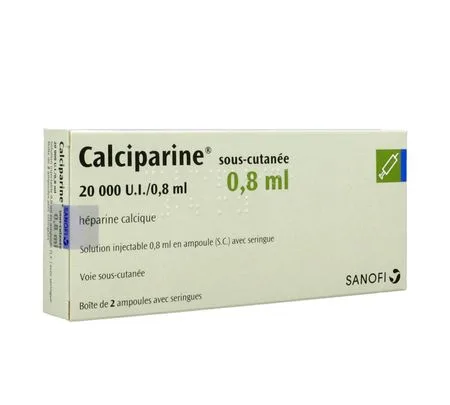
CALCIPARINE SUBCUTANEOUS 20 000 IU/0,8 ml, injectable solution
Forms and presentations
Solution for injection.
Box of 2 ampoules containing 0,8 mL of solution + 2 graduated syringes, with needles.
Box of 50 ampoules containing 0,8 mL of solution.
Composition
Each ampoule contains 20 000 IU of calcium heparin* in 0,8 mL of injectable solution, corresponding to 25 000 IU/mL.
* product derived from porcine intestinal mucosa.
Concentrated hydrochloric acid or calcium (hydroxide of), water for injectable preparations.
Indications
This heparin is a classic heparin, called unfractionated. Its indications are as follows:
- Treatment:
- Established deep vein thromboses and pulmonary embolism, in the acute phase,
- Myocardial infarction with or without Q wave and unstable angina, in the acute phase,
- Extracerebral arterial embolisms.
- Prevention of venous thromboembolic events:
- In a surgical setting,
- In bedridden patients presenting with an acute medical condition (notably post-infarction, in cases of heart failure, after an ischemic stroke with paralysis of the lower limbs). Use is in this case reserved for severe renal insufficiency (creatinine clearance of the order of less than 30 mL/min according to the estimate from the Cockcroft formula) as a possible alternative to the prescription of a low molecular weight heparin.
Dosage and administration
Dosage
The concentration of this heparin is 25 000 UI/mL. As not all heparins are at the same concentration, prescriptions must be written in UI.
a) Curative treatment
Dosing regimen
This heparin must be administered subcutaneously.
A bolus of 50 to 100 UI/kg IV of sodium heparin may be administered at the same time as the first subcutaneous injection, by direct intravenous route, to achieve an effective heparinemia from the start of treatment.
The initial dose is 500 UI/kg every 24 hours subcutaneously, divided into two (every 12 h) or three (every 8 h) injections per day, depending on the volume to be injected. Indeed, subcutaneous injection of an amount greater than 15 000 UI (i.e. 0,6 mL) could decrease the absorption of heparin.
The heparin dose will then be adjusted according to the results of biological monitoring.
Biological monitoring
It must be at least daily, the first sample must be taken exactly between the first two injections (i.e. 6 or 4 hours after the first, depending on whether 2 or 3 injections are planned during the day). A sample must be taken after each dose change.
Depending on the case, the following may be used:
- The activated partial thromboplastin time (aPTT), which should be between 1 times and three times the control depending on the sensitivity of the reagent used (to be defined by the laboratory).
- The anti-Xa activity (heparinemia), which is a specific test. It should be between 0,2 and 0,6 UI/mL. This test will be preferred in cases of pre-existing aPTT abnormalities, in intensive care patients and in cases of marked inflammatory syndrome.
Bridging from heparin to oral anticoagulants (VKA)
Whenever possible, VKAs (Vitamin K Antagonists) will be introduced between the first and third day of treatment, so that the total duration of heparin therapy does not exceed 7 to 10 days.
Due to the latency period preceding the full effect of the VKA used, heparin will only be discontinued when the INR (International Normalized Ratio) has been within the desirable therapeutic range for 2 consecutive days. This range varies depending on the condition being treated.
During this period, aPTT monitoring will be particularly careful to avoid a risk of haemorrhage.
b) Prevention of venous thromboembolic events
In surgical settings
A standard therapeutic regimen may be proposed for patients undergoing general, digestive, urological or gynaecological surgery: 5 000 IU of subcutaneous heparin 2 hours before the procedure, then 5 000 IU every 12 hours for at least 10 days after the procedure. Monitoring of aPTT and/or anti-Xa activity is not essential, but monitoring of platelet count is necessary (see section Warnings and precautions).
In certain medical situations
The usual dosage is 5 000 IU every 12 hours.
In case of high thromboembolic risk in surgical or medical settings, the dosage may possibly be increased to 5 000 IU 3 times daily and adjusted so as to generate a moderate prolongation of aPTT (1,2 to 1,3 times the control time), when the sample is taken midway between two injections. In practice, it is recommended to prefer the use of a LMWH over this complex regimen.
Heparin resistance
Some patients exhibit heparin resistance, i.e. an alteration of the response to heparin, requiring abnormally high doses of heparin to achieve the desired anticoagulant effect (see section Warnings and precautions).
Method of administration
STRICTLY SUBCUTANEOUS ROUTE.
Do not inject intramuscularly.
For reference:
- 2 500 IU corresponds to 0,1 mL
- 5 000 IU corresponds to 0,2 mL
- 7 500 IU corresponds to 0,3 mL
- 10 000 IU corresponds to 0,4 mL
- 12 500 IU corresponds to 0,5 mL
- 15 000 IU corresponds to 0,6 mL
- 17 500 IU corresponds to 0,7 mL
- 20 000 IU corresponds to 0,8 mL
- 22 500 IU corresponds to 0,9 mL
- 25 000 IU corresponds to 1 mL
Injection technique
The injection must be performed into the subcutaneous cellular tissue of the antero-lateral and postero-lateral abdominal belt, alternating between the right and left sides.
The needle must be inserted perpendicularly and not tangentially, into a skin fold formed between the operator's thumb and index finger. The fold must be maintained throughout the duration of the injection.
Contraindications
- Regardless of dose (therapeutic or prophylactic), this medicine MUST NOT BE PRESCRIBED in the following situations:
- Hypersensitivity to heparin or to any of the excipients listed in section Composition.
- History of severe type II thrombocytopenia (heparin-induced thrombocytopenia or HIT), under unfractionated heparin or low molecular weight heparin (see section - HIT). Warnings and precautions - HIT).
- Constitutional haemorrhagic diseases.
- In case of treatment with direct-acting oral anticoagulants DOACs (apixaban, edoxaban, rivaroxaban, etc.) (see section at a curative dose, in the following situations: Interactions).
- At a curative dose, in the following situations:
- Organic lesion likely to bleed.
- Haemorrhagic manifestations or tendencies related to haemostasis disorders.
- Intracerebral haemorrhage.
- In addition, epidural or spinal anaesthesia must never be performed during treatment with heparin at a curative dose.
- At a curative dose, this medicine is GENERALLY NOT RECOMMENDED in cases of:
- Extensive acute-phase ischaemic stroke, with or without impaired consciousness. When the stroke is of embolic origin, the delay is 72 hours. Evidence of the efficacy of heparin at a curative dose has not been established to date, regardless of the cause, extent and clinical severity of the cerebral infarction.
- Acute infectious endocarditis (other than that occurring on a mechanical prosthesis).
- Uncontrolled arterial hypertension.
- At a preventive dose this medicine is GENERALLY NOT RECOMMENDED, within the first 24 hours following an intracerebral haemorrhage.
- Regardless of the doses, the following medicines are GENERALLY NOT RECOMMENDED in combination with heparin (see section Interactions) :
- defibrotide
- acetylsalicylic acid (as an analgesic and antipyretic),
- NSAIDs,
- dextran.
Warnings and precautions
Warnings
When a patient on heparin (at a curative or preventive dose) presents with a thrombotic event, such as:
- An ischaemic stroke,
- A myocardial infarction,
- Acute ischaemia of the lower limbs,
- A pulmonary embolism,
- Phlebitis,
- A worsening of the thrombosis for which it is being treated,
heparin-induced thrombocytopenia (HIT) must systematically be considered and an urgent platelet count must be performed (see section "Special warnings and precautions for use").
In case of spinal anaesthesia, the injection of the preventive dose of heparin must be given 6 hours after the intraspinal catheters have been removed.
The benefit/risk ratio of administering a low dose of heparin before intrathecal or epidural loco-regional anaesthesia must be assessed for each patient. The risk of occurrence of a spinal/epidural haematoma depends on the technique used and the experience of the operator. It increases in the following order:
- Spinal anaesthesia without catheter.
- Spinal anesthesia with catheter placement.
- Epidural anesthesia.
- Epidural anesthesia with catheter placement.
A higher incidence of bleeding has been reported in patients, particularly in elderly women.
Precautions for use
Risk situations
Treatment monitoring will be reinforced in cases of a history of digestive ulcers, vascular diseases of the choroid and retina, or in the postoperative period following surgery of the brain and spinal cord.
Lumbar puncture should be discussed taking into account the risk of intraspinal bleeding. It should be deferred whenever possible.
Heparin may inhibit aldosterone secretion and lead to rare cases of hypoaldosteronism with hyperkalemia and/or metabolic acidosis. This has been observed particularly in patients with elevated potassium levels and in patients at risk (diabetics, patients with chronic renal insufficiency, pre-existing metabolic acidosis, treatment with medicinal products likely to increase potassium levels such as ACE inhibitors and NSAIDs).
The risk of hyperkalemia increases with the duration of treatment and is usually reversible. In cases of prolonged treatment, monitoring of potassium levels may be performed in patients at risk.
Platelet monitoring
Due to the risk of HIT, platelet count monitoring is necessary, regardless of the indication for treatment and the dose administered.
Perform a platelet count before treatment, then twice a week during the first month. Beyond this period, if prolonged treatment proves necessary in certain particular cases, the monitoring frequency may be reduced to once a week, until treatment is discontinued.
Heparin-induced thrombocytopenia or HIT
There is a risk of severe thrombocytopenia, which may be fatal in outcome and sometimes thrombotic, induced by heparin (unfractionated heparin and less frequently low molecular weight heparins), of immunological origin known as type II (see section Adverse effects). HIT is defined by a platelet count < 100 000 and/or a relative fall in platelets of 30 to 50 % over 2 successive counts. These effects are caused by platelet-activating antibodies and occur essentially between day 5th and the 21th day after initiation of heparin treatment (with a peak frequency around day 10th day), but may occur much earlier when there is a history of heparin-induced thrombocytopenia. For this reason, such a history will be systematically sought during a thorough interview before treatment begins. Furthermore, the risk of recurrence upon reintroduction of heparin may persist for several years, or even indefinitely (see section Contraindications).
In rare cases, delayed heparin-induced thrombocytopenia (HIT), possibly associated with thrombosis, may occur after discontinuation of heparin treatment and persist despite alternative anticoagulation.
In all cases, the occurrence of HIT constitutes an emergency situation and requires specialist advice.
Any significant drop (30 to 50 % of the initial value) in the platelet count should raise an alert, even before this value reaches a critical threshold. Observation of a decrease in platelet number requires in all cases:
- An immediate check of the count by performing HIT probability tests (for example, the 4 T score).
- Discontinuation of heparin treatment, if the drop is confirmed or worsens on this check.
Under the conditions described above, the immediate course of action does not rely on the result of platelet aggregation tests in vitro or immunological tests; indeed, the result is obtained at best only after several hours. These tests must nevertheless be performed to aid in the diagnosis of this complication. If heparin treatment is continued, the risk of thrombosis is major.
- Perform laboratory tests specific to HIT in order to rule out or confirm HIT
- The prevention or treatment of thrombotic complications of HIT.
If continuation of anticoagulation seems essential, heparin must be replaced by another class of antithrombotic: danaparoid sodium or hirudin, prescribed depending on the case at a prophylactic or curative dose.
Transition to VKAs will only be made after normalisation of the platelet count, due to the risk of worsening the thrombotic phenomenon with VKAs.
Therapy must be adapted according to the results.
Heparin resistance
Inter-individual variability in the anticoagulant response to heparin has been demonstrated. The phenomenon termed "heparin resistance" or "relative heparin ineffectiveness" defines an inadequate response to heparin administered at a standard dose to achieve the desired therapeutic anticoagulation target.
This resistance is mainly related to antithrombin (AT) activity below 60% of normal, and/or to a decrease in heparin availability due to increased protein binding, making it unavailable to bind AT and consequently reducing its anticoagulant activity.
Factors predisposing to AT levels below 60% are:
- congenital deficiency
- acquired deficiency, notably in cases of:
- hepatic insufficiency
- consumption of antithrombin due to previous heparin injections
- induction by treatment with nitroglycerin
Factors predisposing to an increase in protein binding of heparin are:
- any inflammatory syndrome (infection, surgical trauma, surgery, extracorporeal circulation, uncontrolled chronic disease, cancer) / increase in inflammatory proteins binding heparin)
- any situation leading to an increase in platelets and fibrinogen (thromboembolic disorders)
- volume of distribution higher than standards in cases of obesity
- hypersplenism
- hepatic insufficiency
Heparin resistance may also be encountered during pregnancy or the postpartum period, in elderly subjects (over 65 years), in cases of hypoalbuminaemia or in cases of thrombocytosis.
To help the practitioner manage this resistance, the activated Partial Thromboplastin Time (aPTT) measurement and the anti-Xa assay must be performed on the same sample. In addition, the anti-Xa assay must be performed with plasma not enriched in AT. To avoid a potentially dangerous escalation of heparin doses, particularly in the absence of an aPTT increase, heparin dose adjustments will be made according to anti-Xa levels.
Finally, close patient monitoring is essential in order to anticipate a risk of sudden hypocoagulation, as this resistance is temporary and may suddenly resolve, notably through desaturation of all heparin binding sites or decrease thereof, i.e. regression of the inflammatory syndrome.
Concomitant use of this medicinal product is not recommended with defibrotide, acetylsalicylic acid at analgesic, antipyretic and anti-inflammatory doses, NSAIDs, dextran (see section Interactions).
Interactions
Contraindicated combination
Whatever the dose of heparin:
+ Oral anticoagulants of the DOAC type (apixaban, edoxaban, rivaroxaban, etc.)
Increased risk of bleeding.
Direct-acting oral anticoagulants must not be administered concomitantly with heparin.
When switching from one to the other, respect the interval between doses.
Combinations not recommended
Whatever the dose of heparin:
+ Defibrotide
Increased bleeding risk.
With curative doses of heparin and/or in the elderly subject :
+ Acetylsalicylic acid as an anti-inflammatory (doses ≥ 1 g per dose and/or ≥ 3 g per day) or as an analgesic or antipyretic (doses ≥ 500 mg per dose and/or < 3 g per day)
Increased bleeding risk (inhibition of platelet functions and damage to the gastroduodenal mucosa by acetylsalicylic acid).
Use another anti-inflammatory or another analgesic or antipyretic.
+ Non-steroidal anti-inflammatory drugs (NSAIDs)
Increased bleeding risk (damage to the gastroduodenal mucosa by non-steroidal anti-inflammatory drugs).
If the combination cannot be avoided, close clinical monitoring.
+ Dextran
Increased bleeding risk (inhibition of platelet functions by dextran 40).
Associations requiring precautions for use
Whatever the dose of heparin:
+ Oral anticoagulants of the vitamin K antagonist type
Increased risk of bleeding.
During the heparin/vitamin K antagonist transition (requiring several days), reinforce clinical and biological monitoring.
+ Cobimetinib
Increased risk of bleeding. Clinical monitoring.
Associations to be taken into account
With preventive doses of heparin:
+ Acetylsalicylic acid
The concomitant use of medicinal products acting at various levels of haemostasis increases the risk of bleeding. Thus, in subjects under 65 years of age, the combination of heparins at preventive doses with acetylsalicylic acid, whatever the dose, must be taken into account, maintaining clinical and possibly biological monitoring.
+ NSAIDs
Increased risk of bleeding.
With curative doses of heparin:
+ Acetylsalicylic acid at antiplatelet doses (from 50 mg to 375 mg per day)
Increased risk of bleeding (inhibition of platelet function and irritation of the gastroduodenal mucosa by acetylsalicylic acid).
+ Thrombolytics
Increased risk of bleeding.
Whatever the dose of heparin:
+ Antiplatelet agents
Increased risk of bleeding.
+ Other potassium-raising agents
Risk of increased hyperkalaemia, potentially fatal.
+ Corticosteroids (gluco-) (except hydrocortisone)
Increased risk of bleeding.
Fertility, pregnancy and breastfeeding
Pregnancy
Heparin does not cross the placenta.
No malformation or foetotoxicity of heparin has been described in animals, nor to date in humans.
When used in pregnant women, particular caution is required because of the risk of uteroplacental haemorrhage, particularly at the time of delivery.
If epidural anaesthesia is considered, it is necessary to suspend heparin (see sections Contraindications and Warnings and precautions).
Breast-feeding
Heparin is not excreted into breast milk and does not cross the digestive barrier, so breastfeeding is possible.
Adverse effects
As with all medicines, CALCIPARINE may cause adverse effects, but they do not occur systematically in everyone. The frequencies of adverse effects have been defined according to the following convention:
|
Very common |
≥ 1/10 |
|
Common |
≥ 1/100 to < 1/10 |
|
Uncommon |
≥ 1/1 000 to < 1/100 |
|
Rare |
≥ 1/10 000 to < 1/1 000 |
|
Very rare |
< 1/10 000 |
|
Frequency not known |
cannot be estimated from the available data |
|
System organ class |
Frequency |
Undesirable effect(s) |
|
Blood and lymphatic system disorders |
very common |
Haemorrhagic manifestations at various sites, including some fatal cases. Risk factors such as organic lesions liable to bleed, renal insufficiency, and certain drug associations (see sections Contraindications and Interactions) may increase these manifestations. |
|
frequent |
Thrombocytopenias |
|
|
rare |
Eosinophilia |
|
|
Immune system disorders |
uncommon |
Hypersensitivity (localised or generalised) |
|
frequency not known |
Anaphylactic/anaphylactoid shock |
|
|
Metabolism and nutrition disorders |
very rare |
Hypoaldosteronism with hyperkalaemia and/or metabolic acidosis, particularly in patients at risk (diabetes, renal insufficiency) (see section Warnings and precautions). |
|
Vascular disorders |
very common |
Subcutaneous administration may very frequently result in haematomas at injection sites. They are increased by failure to follow the injection technique or by use of inadequate injection equipment. |
|
very rare |
Spinal haematomas in the context of epidural or spinal anaesthesia and lumbar punctures (see sections Contraindications and Warnings and precautions) |
|
|
Skin and subcutaneous tissue disorders |
uncommon |
Hypersensitivity (localised or generalised), in particular angio-oedema, erythema, rash, urticaria, pruritus, conjunctivitis, rhinitis, asthma, cyanosis, tachypnoea, sensations of oppression, fever, chills. In some cases their occurrence should lead to discontinuation of treatment. |
|
Rare |
Skin necrosis (which may occur at the injection site or at a distance from the injection site). These reactions may be preceded by purpura or erythematous, infiltrated and painful plaques, with or without systemic effects. Treatment must be stopped immediately. |
|
|
very rare |
Alopecia |
|
|
frequency not known |
Bullous haemorrhagic dermatosis |
|
|
Musculoskeletal and connective tissue disorders |
frequency not known |
Osteoporosis during long-term treatment. |
|
Disorders of the reproductive system and breast |
very rare |
Priapism |
|
General disorders and administration site conditions |
very common |
Firm nodules disappearing within a few days reflect an inflammatory process and are not a reason to discontinue treatment. |
|
very rare |
Calcinosis at the injection site, mainly in patients with severe renal insufficiency. |
|
|
Investigations |
frequent |
Increase in transaminases, generally transient
|
Description of selected adverse reactions
Thrombocytopenia
Two types of thrombocytopenia have been described:
- The more common type I is generally moderate (> 100 000), of early onset (before the 5th day) and does not require discontinuation of heparin.
- Rarely, severe type II thrombocytopenia (HIT), with a possible fatal outcome.
Their prevalence has not yet been properly assessed (see sections Contraindications and Warnings and precautions).
Reporting of suspected adverse reactions
Reporting suspected adverse reactions after authorisation of the medicinal product is important. It allows continued monitoring of the benefit/risk balance of the medicinal product. Healthcare professionals are asked to report any suspected adverse reactions via the national reporting system: National Agency for the Safety of Medicines and Health Products (ANSM) and the network of Regional Pharmacovigilance Centres - Website: https://signalement.social-sante.gouv.fr/.
Overdose
- Accidental overdose following administration of massive doses of heparin may lead to haemorrhagic complications. The haemorrhagic risk is proportional to the level of hypocoagulability and to the vascular integrity of each patient.
An antidote exists: protamine sulfate, which neutralises heparin by forming an inactive complex with heparin.
100 UAH of protamine neutralises the activity of 100 IU of heparin.
The useful dose of protamine depends on:
- From the dose of heparin injected.
- From the time elapsed since the heparin injection, with possibly a reduction in the doses of the antidote.
However, the use of this antidote must take into account its potential adverse effects.
- In the event of a massive oral ingestion of heparin, no serious consequence is, a priori, to be feared, given the very low absorption of the product at the gastric and intestinal levels.
Pharmacodynamics
Pharmacotherapeutic class: Antithrombotics, ATC code: B01AB01.
This medicine is an unfractionated heparin, an immediate-acting anticoagulant.
The binding of heparin to antithrombin (formerly antithrombin III) considerably increases (x 1 000) the natural activation of the inhibitor against thrombin, factor Xa and all activated coagulation factors. This results in a potent anticoagulant activity that depends on the heparin concentration, the antithrombin concentration and those of the coagulation factors. The term heparinaemia is used to measure the activity of heparin resulting from these complex interactions.
Pharmacokinetics
When injected subcutaneously, the concentrated calcium heparin solution diffuses slowly into the bloodstream.
After entering the circulation, part of the administered heparin molecules is neutralised by numerous factors (platelet factor 4, blood proteins including fibrinogen, reticuloendothelial system) and eliminated by cellular uptake. The excess is eliminated by the kidneys. At normal doses of use, the kidneys do not play a role in the elimination of heparin. The remaining portion undergoes dilution, the value of which varies according to the plasma volume and in particular the haematocrit, and associates with the cofactor of heparin (antithrombin).
After injection of an effective dose subcutaneously, heparin activity appears after a delay of the order of 30 to 60 min, reaches a maximum level between 120 and 150 min and disappears after a duration of 8 to 14 hours depending on the subject. The apparent half-life is approximately 4 hours.
These different parameters of neutralisation, elimination and association with cofactors vary from one subject to another and in the same subject from one moment to another.
INCOMPATIBILITIES
In the absence of compatibility studies, this medicinal product must not be mixed with other medicinal products.
SPECIAL PRECAUTIONS FOR DISPOSAL AND OTHER HANDLING
To open the ampoule:
Hold the ampoule firmly, with the coloured dot facing you (diagram 1).
Grasp the head of the ampoule between the thumb and index finger (thumb on the coloured dot), then apply pressure backwards (diagrams 2 and 3).
Prescription, supply and reimbursement
| Marketing authorisation (AMM) |
|
| Price: |
|
CHEPLAPHARM France
68, rue Marjolin. 92300 Levallois-Perret
Tel: 08 09 54 20 23
https://www.cheplapharm.fr
Source: VIDAL · Updated on 10/11/2026. This information does not replace advice from a healthcare professional.