
Medicines
Update of 18/02/2025
BURINEX®
bumetanide
Forms and presentations
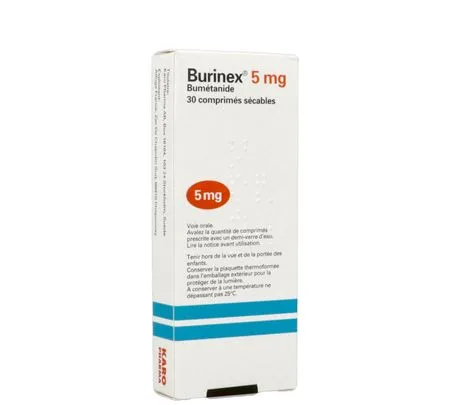
Scored tablet at 1 mg (white): Box of 30, under blister.Scored tablet at 5 mg (white): Box of 30, under heat-sealed film.
Injectable solution IV at 2 mg/4 mL: Self-breaking ampoules of 4 mL, box of 5.
Composition
| Lozenge: | p tab |
| Bumetanide
|
1 mg |
| or | 5 mg |
| Injectable solution: | p amp |
| Bumetanide
|
2 mg |
Indications
- Tablet at 1 mg:
-
- Edema of renal and hepatic origin, in adults.
- Heart failure, in adults.
- Edema of renal and hepatic origin, in adults.
- For use in pregnant women: see Fertility/Pregnancy/Breastfeeding.
- Tablet at 5 mg:
-
- Acute and chronic renal failure in adults.
- Severe heart failure not controlled by the initial prescription of bumetanide in tablets dosed at 1 mg, in adults.
- Acute and chronic renal failure in adults.
- Solution for injection IV:
-
- Severe heart failure, including acute pulmonary edema, in adults.
- Hypertension, in adults, accompanied by visceral involvement threatening the vital prognosis in the very short term (hypertensive emergency), particularly during:
- hypertensive encephalopathy,
- left ventricular decompensation with pulmonary edema.
- hypertensive encephalopathy,
- Severe sodium retention of cardiac, renal or cirrhotic origin, in adults.
- Severe heart failure, including acute pulmonary edema, in adults.
Dosage and administration
Burinex may be used orally or parenterally (IV administration or by infusion).
The oral route is chosen for outpatient and long-term treatments.
The parenteral route is chosen in emergency cases when an intense and rapid effect is sought or when the possibility of gastrointestinal absorption is reduced.
- Tablet at 1 mg:
-
- Edema of renal and hepatic origin, heart failure: 1 to 3 tablets at 1 mg per day.
- Edema of renal and hepatic origin, heart failure: 1 to 3 tablets at 1 mg per day.
- Tablet at 5 mg:
-
- acute and chronic renal failure: 1 to 4 tablets at 5 mg per day;
- severe heart failure not controlled by the initial prescription of bumetanide in tablets dosed at 1 mg: 1 to 2 tablets at 5 mg per day in a single intake.
- acute and chronic renal failure: 1 to 4 tablets at 5 mg per day;
- Swallow the tablets with half a glass of water.
- Solution for injection IV:
-
- severe heart failure: 0,5 to 2 mg/day and more if necessary by IV route;
- acute pulmonary edema: initial treatment (first hour): 2 mg by intravenous route, possibly repeated every 20 minutes depending on the patient's clinical condition up to 30 mg/day;
- severe sodium retention of cardiac, renal or cirrhotic origin, hypertension accompanied by visceral involvement threatening the vital prognosis: 0,5 to 30 mg/day by IV route.
- severe heart failure: 0,5 to 2 mg/day and more if necessary by IV route;
- In the treatment of hypertensive emergency, the dose will be adjusted so that the drop in blood pressure does not exceed 25% of the initial level within the hour following initiation of injectable treatment; indeed, too abrupt a fall in pressure may lead to myocardial, cerebral or renal ischemia.
- Paediatric population:
- Burinex is not recommended in children and adolescents due to limited data on safety of use, efficacy and dosage in this population.
Contraindications
- Tablets:
- This medicine must not be used in the following cases:
-
- Hypersensitivity to the active substance or to any of the excipients listed in section Composition.
- Severe electrolyte depletion.
- Persistent anuria.
- Hepatic encephalopathy, including coma.
- Hypersensitivity to the active substance or to any of the excipients listed in section Composition.
- Solution for injection IV:
- This medicine must not be used in the following cases:
-
- Hypersensitivity to the active substance, to formaldehyde (see Warnings and Precautions for Use) or to any of the excipients listed in section Composition.
- Severe electrolyte depletion.
- Persistent anuria.
- Hepatic encephalopathy, including coma.
- Hypersensitivity to the active substance, to formaldehyde (see Warnings and Precautions for Use) or to any of the excipients listed in section Composition.
Warnings and precautions
Warnings:
- Cases of Lyell's syndrome and Stevens-Johnson syndrome (SJS), which can be life-threatening or cause death, have been reported in association with products containing non-antibiotic sulfonamides, including bumetanide. Patients must be informed of the signs and symptoms of SJS and Lyell's syndrome and be closely monitored in this regard. If signs and symptoms suggestive of either of these reactions appear, bumetanide must be discontinued and an alternative treatment should be considered. If the patient has experienced a serious reaction to bumetanide such as SJS or Lyell's, the treatment must never be administered to this patient again.
- When administering bumetanide to patients with severe hepatic impairment, caution is recommended.
- In patients with hypotension, bumetanide should be used with caution.
- A fluid and electrolyte imbalance may occur (see Undesirable effects) and compensatory treatment should be initiated if appropriate. Regular monitoring of serum potassium must be performed.
- As with other diuretics, bumetanide may cause an increase in blood uric acid levels.
- In patients with overt or latent diabetes mellitus, regular monitoring of blood glucose and glycosuria must be performed.
- Cases of hypomagnesaemia have been reported in patients treated with a proton pump inhibitor. Since hypomagnesaemia may be worsened when this treatment is combined with Burinex, serum magnesium should be monitored as a precaution with this combination.
- Bumetanide should be used with caution in patients at risk of urinary tract obstruction.
- Caution is recommended when administering bumetanide to patients with severe or progressive renal impairment or to patients with elevated blood urea/blood urea nitrogen (BUN) or serum creatinine levels.
- In case of known hypersensitivity to sulfonamides, there may be a risk of hypersensitivity to bumetanide.
- Tablets: effects related to excipients: this medicine contains lactose. Its use is not recommended in patients with galactose intolerance, Lapp lactase deficiency or glucose-galactose malabsorption syndrome (rare hereditary diseases).
- Solution for injection: formaldehyde is a degradation product that appears in trace amounts in the product during storage. Due to the anaphylactic potential of formaldehyde, precautions must be taken.
- Athletes:
- Athletes are advised that this specialty contains an active substance that may induce a positive reaction in tests carried out during anti-doping controls.
Interactions
- Associations subject to precautions for use:
-
- Lithium: bumetanide decreases the clearance of lithium, resulting in increased blood lithium levels; therefore concomitant treatment requires close monitoring of blood lithium levels. A reduction in lithium doses may be necessary.
- Digitalis glycosides: hypokalaemia increases sensitivity to digitalis glycosides, which may cause digitalis toxicity (nausea, vomiting and arrhythmias). Serum potassium should be checked regularly and signs of digitalis toxicity should be looked for. Potassium supplementation and a reduction in the digitalis glycoside dose should be considered if appropriate.
- Non-depolarising neuromuscular blockers: hypokalaemia increases sensitivity to non-depolarising neuromuscular blockers.
- Antiarrhythmics: concomitant use of bumetanide and class III antiarrhythmics may be associated with an increased risk of electrolyte imbalance and result in cardiotoxicity (QT interval prolongation, torsades de pointes, cardiac arrest). Regular monitoring of electrolyte levels should be performed in these patients and symptoms of arrhythmia should be looked for.
- NSAIDs: non-steroidal anti-inflammatory drugs (NSAIDs) inhibit the effect of bumetanide. The efficacy of bumetanide treatment should be monitored in case of concomitant NSAID treatment (for example monitoring of blood pressure and renal function). It should also be noted that diuretics may increase the nephrotoxicity of NSAIDs.
- Antihypertensives and medicines that may induce orthostatic hypotension: bumetanide may increase the effects of antihypertensives, such as diuretics, and of medicines that may induce orthostatic hypotension (for example tricyclic antidepressants). Hypotension may occur from the first administration.
- Potassium-depleting medicines: potassium depletion caused by bumetanide may be potentiated by the administration of other medicines causing potassium depletion.
- Aminoglycosides: the ototoxic effects of aminoglycosides may be increased by concomitant administration of potent diuretics such as bumetanide.
- Probenecid: probenecid inhibits the renal tubular secretion of bumetanide, resulting in a decrease in natriuresis.
- Lithium: bumetanide decreases the clearance of lithium, resulting in increased blood lithium levels; therefore concomitant treatment requires close monitoring of blood lithium levels. A reduction in lithium doses may be necessary.
Fertility, pregnancy and breastfeeding
Pregnancy:Bumetanide may cause harmful pharmacological effects on pregnancy, the foetus or the newborn. Burinex must not be used during pregnancy unless the clinical condition of the woman requires treatment with bumetanide. It may only be used in cases of heart failure, when the potential benefit justifies the potential risk to the foetus.
Breastfeeding:
Bumetanide must not be used during breast-feeding.
Fertility:There are no data on the consequences of bumetanide on fertility.
Driving and using machines
Bumetanide has no or negligible effect on the ability to drive vehicles or use machines. However, the patient must be informed that dizziness/vertigo may occur during treatment and that they must be vigilant if driving or using machines.Adverse effects
The estimate of the frequency of adverse reactions is based on a pooled analysis of data from clinical studies and spontaneous reports.
According to pooled data from clinical studies conducted in more than 1000 patients treated with bumetanide, adverse reactions are expected in approximately 12 % of patients.
The adverse reactions most frequently reported during treatment are headache and electrolyte imbalances (including hypokalaemia, hyponatraemia, hypochloraemia and hyperkalaemia) occurring in approximately 4 % of patients, followed by dizziness (including orthostatic hypotension and vertigo) and fatigue occurring in approximately 3 % of patients.
Electrolyte disturbances may occur, particularly during long-term treatment.
Renal failure has been reported in post-marketing safety studies.
Severe cutaneous adverse reactions (SCARs), including Stevens-Johnson syndrome (SJS) and Lyell's syndrome, have been reported in association with bumetanide (see Warnings and Precautions for Use).
Adverse reactions are presented by MedDRA system organ class (SOC), and individual adverse reactions are presented within each SOC in order of decreasing frequency. Within each frequency category, adverse reactions are presented in order of decreasing seriousness.
Very common (≥ 1/10), common (≥ 1/100 and < 1/10), uncommon (≥ 1/1000 and < 1/100), rare (≥ 1/10 000 and < 1/1000), very rare (< 1/10 000) and frequency not known (cannot be estimated from the available data).
| Blood and lymphatic system disorders | |
| Uncommon | Bone marrow failure and pancytopenia, thrombocytopenia, leukopenia including neutropenia, anaemia |
| Metabolism and nutrition disorders | |
| Common | Electrolyte imbalance (including hypokalaemia, hyponatraemia, hypochloraemia and hyperkalaemia) |
| Uncommon | Dehydration, glucose metabolism disorder, hyperuricaemia and gout |
| Nervous system disorders | |
| Common | Dizziness (including orthostatic hypotension and vertigo), fatigue (including lethargy, somnolence, asthenia and malaise), headache |
| Uncommon | Syncope |
| Ear and labyrinth disorders | |
| Uncommon | Hearing disorders |
| Cardiac disorders | |
| Uncommon | Chest pain and discomfort |
| Vascular disorders | |
| Uncommon | Hypotension |
| Respiratory, thoracic and mediastinal disorders | |
| Uncommon | Dyspnea, cough |
| Gastrointestinal disorders | |
| Common | Abdominal pain and discomfort, nausea |
| Uncommon | Vomiting, diarrhoea, constipation, dry mouth and thirst |
| Skin and subcutaneous tissue disorders | |
| Uncommon | Skin rash*, dermatitis and eczema, urticaria, pruritus, photosensitivity
* Different types of skin eruptions have been reported, such as erythematous eruptions, maculopapular eruptions and pustular eruptions. |
| Frequency not known | Stevens-Johnson syndrome (SJS), Lyell |
| Musculoskeletal and systemic disorders | |
| Common | Muscle spasms, pain and myalgia |
| Renal and urinary disorders | |
| Common | Micturition disorder |
| Uncommon | Renal function disorder (including renal failure) |
| General disorders and administration site conditions | |
| Uncommon | Peripheral oedema |
- Paediatric population:
- The tolerability profile of Burinex in the pediatric population has not been established.
Reporting suspected adverse reactions after authorisation of the medicinal product is important. It allows continuous monitoring of the benefit/risk balance of the medicinal product. Healthcare professionals should report any suspected adverse reaction via the national reporting system: National Agency for the Safety of Medicines and Health Products (ANSM) and the network of Regional Pharmacovigilance Centres. Website: https://signalement.social-sante.gouv.fr.
Overdose
At high and prolonged doses, loop diuretics may cause electrolyte imbalance, dehydration or polyuria.
Symptoms of electrolyte imbalance include dry mouth, thirst, weakness, lethargy, drowsiness, confusion, gastrointestinal disorders, agitation, muscle pain and cramps, convulsions. Treatment consists of restoring the fluid and electrolyte balance.
Pharmacodynamics
Pharmacotherapeutic class: Loop diuretic, ATC code: C03CA02 (C: cardiovascular system).
Bumetanide belongs to the group of "loop diuretics". It exerts an action:
- diuretic at the level of the ascending limb of the loop of Henle, where it inhibits the active reabsorption of chloride.
Its diuretic action results in significant sodium and chloride elimination, and proportionally less potassium elimination.
By oral route, the natriuretic effect obtained, proportional to the dose, is rapid (it begins at approximately the 30e minute; peak natriuresis occurs at 1 or 2 hours), intense and of short duration (the response is exhausted within 6 hours).
When administered parenterally, the natriuretic effect begins as early as the 2e or 3e minute following injection; the peak natriuretic effect occurs between the 30e and the 45e minute. The effect ceases within 2 hours. - intrarenal hemodynamics: it increases renal blood flow and causes a redistribution of intrarenal flows in favor of the deep zones of the cortex. This property is of particular interest when combined with beta-blockers, which may have the opposite effect.
- pulmonary haemodynamics: loop diuretics have haemodynamic properties independent of renal action, as shown by:
- the decrease in pulmonary capillary pressure that follows intravenous injection, even before any diuresis appears;
- the increase in storage capacity of the venous vascular bed.
- the decrease in pulmonary capillary pressure that follows intravenous injection, even before any diuresis appears;
Pharmacokinetics
After oral administration, bumetanide is absorbed rapidly and to more than 95 %. Serum protein binding is 95 to 98 %. Peak serum concentration is reached at about 30e minutes. The half-life is approximately 1 h 30. Elimination occurs mainly via the kidney.
Studies carried out with bumetanide labelled with 14C showed that 65 % of the administered dose is eliminated unchanged in the urine and 18 % in the faeces.
Bumetanide passes into breast milk.
- Paediatric population:
- In newborns and infants, elimination is slower than in older children and adults, presumably due to immaturity of renal and hepato-biliary function. The mean elimination half-life decreases during the first 1er months of life, falling from 6 hours in the newborn to 2,4 hours in infants aged 1 month.
- The mean elimination half-life is 2,5 hours and 1,5 hours, respectively, in infants under 2 months and in infants aged 2 to 6 months. The apparent elimination half-life may be prolonged to approximately 6 hours (with values up to 15 hours) after IV administration in newborns, premature or full-term, with respiratory disorders.
- The data available in young children, including newborns and infants, are not sufficient to allow dosage recommendations (see Posology and Method of administration).
INCOMPATIBILITIES
Solution for injection IV:
Do not administer with a hypertonic sodium chloride solution (risk of precipitation).
The solution is compatible with an isotonic sodium chloride solution at 0,9 %.
Storage conditions
- Lozenge:
-
- Shelf life
- 3 years.
- Store the thermoformed blister in the outer packaging to protect it from light.
- Store at a temperature not exceeding 30 °C (1 mg tablet) or 25 °C (5 mg tablet).
- Injectable solution:
-
- Shelf life
- 3 years.
- Store at a temperature not exceeding 25 °C.
- Store in the original packaging, protected from light.
- After opening: the product must be used immediately.
HANDLING/DISPOSAL INSTRUCTIONS
No special requirements.
Prescription, supply and reimbursement
LIST II| Marketing authorisation (AMM) | 3400932939657 (1975/89, SPC rev 14.11.2024) 1 mg tab. |
| 3400934521393 (1976/89, SPC rev 14.11.2024) 5 mg tab. | |
| 3400932858422 (1986/89, SPC rev 14.11.2024) inj sol IV. |
| Price: | 3,62 euros (box of 30 tablets at 1 mg). |
| 15,15 euros (box of 30 tablets at 5 mg). | |
| 6,49 euros (box of 5 ampoules of solution for IV injection at 2 mg/4 mL). | |
| Reimbursed by Social Security at 65 %. Collective. | |
Marketing authorisation holder: Karo Pharma AB, Box 16184, 103 24 Stockholm, Sweden.
ALLOGA FRANCE
ZAC de Chapotin Sud
Rue du Professeur-Dargent. 69970 Chaponnay
Medical Information:
Tel: 01 81 79 38 34
www.alloga.fr
Source: VIDAL · Updated on 10/11/2026. This information does not replace advice from a healthcare professional.