
Medicines
SmPC of 17/11/2021
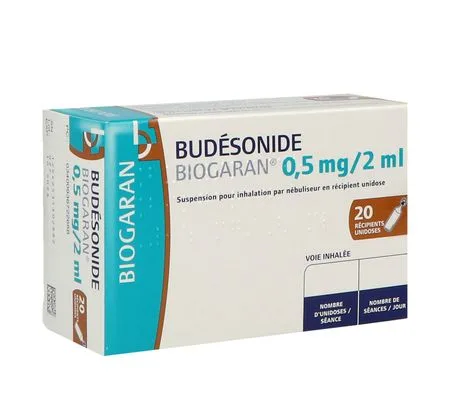
BUDESONIDE BIOGARAN 0,5mg/2 ml, suspension for inhalation by nebuliser in single-dose container
Composition
Budesonide................................................................................................................................................ 0,50 mg
For a single-dose container of 2 ml.
Polysorbate 80, disodium edetate, sodium chloride, sodium citrate, anhydrous citric acid, water for injections.
Indications
BUDESONIDE BIOGARAN is indicated:
- as maintenance treatment of asthma in adults, adolescents and children when pressurised or dry powder inhalers cannot be used or are unsuitable.
Dosage and administration
Dosage
The initial dose will be determined according to the severity of the asthma before treatment and will then be adjusted according to individual results.
Adult : 0,5 mg to 4 mg per day
Child : 0,25 mg to 2 mg per day. The dose of 2 mg is reserved for the treatment of severe asthma.
Administrations are usually divided into 2 nebulisation sessions per day. A daily dose of up to 1 mg may be administered in a single nebulisation session per day.
After several days (or weeks) of initial treatment, when the clinical condition has improved, symptoms have subsided and asthma is controlled, the minimum effective dose should be sought. For this purpose, the daily dose may be administered in a single nebulisation session per day, if this administration schedule favours treatment compliance.
In case of destabilisation of the asthma, the dose and number of doses should be increased again.
In children under 5 years presenting with recurrent episodes of bronchial wheezing, a course of inhaled budesonide of 2 to 3 months may be considered in order to determine whether it is asthma. A significant improvement in symptoms under corticosteroid treatment and their reappearance upon discontinuation of treatment should suggest the diagnosis of asthma. Treatment with BUDESONIDE BIOGARAN should be stopped if no clinical benefit is observed within 2-3 months. Unless the diagnosis of asthma is confirmed, budesonide treatment should not be continued for more than 3 months to avoid unjustified prolonged exposure (see section Warnings and precautions.and 4.8).
Method of administration
This budesonide suspension must be administered by inhalation using a compressed air (or pneumatic) nebuliser device. Ultrasonic generators are not recommended as they may not be suitable for correct administration of BUDESONIDE BIOGARAN.
NOT FOR INJECTION - NOT TO BE SWALLOWED.
The BUDESONIDE BIOGARAN suspension is ready to use.
Patients should be informed that they must carefully follow the manufacturer's instructions for the use and maintenance of the nebulisation device.
A filling volume of 2 to 4 ml is suitable for most nebulisers. If necessary, top up to the recommended volume with sterile saline.
The resulting mixture is delivered by a pulsed flow of air or oxygen (6 to 8 litres per minute) for approximately 10 to 15 minutes, during which the patient breathes at their usual rate.
The technique of use by the patient must be checked regularly.
After inhalation, the unused suspension remaining in the opened single-dose container or in the device chamber must be discarded.
The patient should be advised to rinse their mouth after each nebulisation session in order to reduce the risk of oropharyngeal candidiasis, and to rinse their face with water when using a face mask in order to reduce the risk of local skin irritation on the face.
Contraindications
Hypersensitivity to the active substance or to any of the excipients listed in section Composition.
Warnings and precautions
Inform the patient that this medicine is not intended to abort an established asthma attack, but is a continuous maintenance treatment of asthma to be continued regularly, daily and at the prescribed doses, and whose effects on asthma symptoms will only be felt after a few days to a few weeks.
If, despite well-conducted treatment, paroxysmal dyspnoea occurs, a fast-acting and short-acting inhaled beta2 mimetic bronchodilator to treat acute symptoms. The patient should be informed of this and told that an immediate medical consultation is necessary if, in this case, the relief usually obtained is not rapidly observed after inhalation of the beta2 mimetic bronchodilator.
If a patient develops, over a few days, a rapid increase in their consumption of short-acting, short-duration inhaled beta2 mimetic bronchodilators, one must fear (especially if peak flow meter values decrease and/or become irregular) a decompensation of their disease and the possibility of progression to severe acute asthma (status asthmaticus). The physician should also warn the patient of the need, in this case, for immediate consultation. The therapeutic management should then be reassessed.
The patient must be warned that improvement in their clinical condition must not lead to a change in their treatment, in particular stopping inhaled corticosteroid therapy, without medical advice.
In case of bronchial infection or abundant bronchorrhea, appropriate treatment is necessary in order to promote optimal distribution of the product in the airways.
In case of destabilisation of asthma, or insufficient control of asthma exacerbations despite maximum doses of inhaled corticosteroids, a short course of systemic corticosteroid therapy should be considered. It is then necessary to maintain inhaled corticosteroid therapy in association with the systemic treatment.
Inhaled corticosteroid therapy may cause systemic effects, particularly during high-dose or prolonged treatment. The occurrence of these effects with the inhaled route is much less likely than during oral corticosteroid therapy. Possible systemic effects are Cushing's syndrome or Cushingoid features, skin thinning, subcutaneous bruising, adrenal insufficiency, growth retardation in children and adolescents, decreased bone mineral density, cataract and glaucoma, and more rarely, psychological and behavioural disorders including psychomotor hyperactivity, sleep disorders, anxiety, depression or aggressiveness (particularly in children). It is important to always seek the lowest effective dose of inhaled corticosteroids that achieves control of asthma symptoms.
Potential effects on bone mineral density should be kept in mind, particularly in patients receiving high doses of inhaled corticosteroids over the long term and presenting risk factors for osteoporosis. No significant effects on bone mineral density have been demonstrated in long-term clinical studies conducted in children receiving on average 400 µg/day (nominal dose) of budesonide or in adults receiving 800 µg/day (nominal dose) of budesonide. No data are available regarding the effect at higher doses.
The concomitant administration of inhaled corticosteroids in patients on oral corticosteroid therapy at long-term (corticosteroid-dependent patients) does not exempt from the necessary precautions when reducing oral corticosteroid doses. These will be reduced very gradually and withdrawal must be carried out under careful medical supervision (watching for signs of acute or subacute adrenal insufficiency), which may persist for a prolonged period after discontinuation of systemic corticosteroid therapy.
Patients who have required high doses of corticosteroids in emergency situations or who have received long-term inhaled corticosteroid therapy at the maximum recommended doses may develop adrenal insufficiency. These patients may show signs and symptoms of adrenal insufficiency during situations of severe stress. Signs of acute adrenal insufficiency may be non-specific: anorexia, abdominal pain, weight loss, fatigue, headache, nausea, vomiting, loss of consciousness, convulsions, hypotension and hypoglycaemia. Supplementary corticosteroid therapy should be considered in situations likely to trigger stress or in the case of scheduled surgery.
When replacing oral corticosteroid therapy with inhaled corticosteroid therapy, the systemic effect of the corticosteroid is reduced, which may lead to the reappearance of allergic symptoms (such as rhinitis, eczema) and/or rheumatological symptoms (such as muscle and joint pain). Specific treatment should be instituted. Corticosteroid-adrenal insufficiency should be suspected if, in rare cases, the following symptoms occur: fatigue, headache, nausea and vomiting. A temporary increase in oral corticosteroid doses may then sometimes be necessary.
In cases of active or quiescent pulmonary tuberculosis or pulmonary fungal infection, close monitoring and appropriate treatment are essential.
Inhaled corticosteroid therapy may cause oropharyngeal candidiasis, which may require antifungal treatment and discontinuation of inhaled corticosteroid therapy (see also section Dosage and administration).
As with other inhaled products, bronchospasm may occur, manifesting as increased wheezing, dyspnoea and cough immediately after taking the medicine. Bronchospasm will be treated with a short-acting bronchodilator that must be administered immediately. Treatment with BUDESONIDE BIOGARAN must be stopped immediately and the therapeutic management will be reassessed to consider, if necessary, therapeutic alternatives.
Visual disturbances may occur with systemic or local corticosteroid therapy. In case of blurred vision or the appearance of any other visual symptom during corticosteroid therapy, an ophthalmological examination is required to look for cataract, glaucoma, or rarer lesions such as central serous chorioretinopathy, as described with systemic or local administration of corticosteroids.
In case of hepatic impairment, the elimination of corticosteroids is reduced and consequently exposes patients to higher systemic concentrations and an increased risk of systemic effects. Caution is required in cases of hepatic impairment.
Paediatric population
There has been observed a slight but generally transient initial slowing of growth (approximately 1 cm), which usually occurs during the 1st year of treatment. Long-term studies in clinical practice suggest that children and adolescents treated with inhaled budesonide reach on average their predicted adult height. However, in a long-term, double-blind clinical study in which the administered dose of inhaled budesonide was generally not adjusted to the minimum effective dose, children and adolescents treated with inhaled budesonide reached an adult height on average 1,2 cm less than those randomised to placebo.
The growth of children receiving long-term inhaled corticosteroid therapy must be monitored regularly. In case of growth slowing, treatment should be re-evaluated with a view to reducing the doses of the inhaled corticosteroid.
The expected benefits of corticosteroid therapy must be carefully weighed against the possible risks of growth retardation. The opinion of a paediatric pulmonology specialist may be required.
The decision to start inhaled budesonide treatment in children up to 5 years of age with recurrent episodes of bronchial wheezing must take into account the severity and frequency of wheezing episodes. Regular follow-up is essential in order to reassess the response to treatment. If no clinical benefit is observed under treatment within 2-3 months, or if the diagnosis of asthma is not confirmed, budesonide treatment must be stopped in order to avoid unjustified prolonged exposure to inhaled corticosteroids and the associated risks of growth retardation (see section Dosage and administration and section Adverse effects.).
Interactions
As adrenal function may be inhibited, an ACTH stimulation test to diagnose pituitary insufficiency is likely to give false results (low values).
- Associations to take into account Ketoconazole, itraconazole, voriconazole, protease inhibitors boosted by ritonavir
Increased plasma concentrations of budesonide due to decreased hepatic metabolism by the enzyme inhibitor, with risk of onset of Cushing's syndrome.
Budesonide is mainly metabolised by cytochrome CYP P450 3A4. A significant increase in blood budesonide levels may be observed with potent CYP3A4 inhibitors (e.g. ketoconazole, itraconazole, voriconazole, posaconazole, clarithromycin, telithromycin, nefazodone and HIV protease inhibitors). Concomitant use of these medicines should be avoided. If this combination cannot be avoided, a sufficiently long interval must be respected between administration of the CYP3A4 inhibitor and budesonide (see section Pharmacokinetics.).
Concomitant administration of CYP3A inhibitors, including products containing cobicistat, is expected to increase the risk of systemic side effects. The combination should be avoided, unless the benefits outweigh the increased risk of systemic side effects of corticosteroids; in this case, patients should be monitored for possible systemic side effects of corticosteroids.
Fertility, pregnancy and breastfeeding
Pregnancy
Available data from a large number of pregnancies have not revealed an increased teratogenic risk associated with the use of inhaled budesonide. In animals, glucocorticoids induce malformations (see section Preclinical safety). However, these observations do not appear relevant in pregnant women at therapeutic doses. It is important for the foetus and the mother to maintain adequate treatment of asthma during pregnancy. As with other medicines administered during pregnancy, the benefit of administering budesonide to the mother must be weighed against the risks to the foetus.
This medicinal product may be prescribed during pregnancy if needed, regardless of the stage of pregnancy.
Breast-feeding
Budesonide is excreted in breast milk. However, a pharmacokinetic study showed that after administration of inhaled budesonide at doses of 200 or 400 µg twice daily, systemic exposure to budesonide in breastfed children was negligible. At therapeutic doses, no effect on the breastfed child is expected.
Budesonide may be used during breastfeeding if necessary.
Driving and using machines
Inhaled budesonide has no effect on the ability to drive vehicles and use machines.
Adverse effects
Adverse events attributable to budesonide are presented below by system organ class and by frequency. Frequencies are defined as: very common (≥ 1/10), common (≥ 1/100 and < 1/10), uncommon (≥ 1/1000 and < 1/100), rare (≥ 1/10 000 and < 1/1000) and very rare (< 1/10 000) and not known (frequency cannot be estimated from the available data).
|
Organ class |
Frequency |
Adverse event |
|
Infections and infestations |
Common |
Oropharyngeal candidiasis |
|
Immune system disorders |
Rare
|
Immediate and delayed hypersensitivity reactions, such as: skin rash, contact dermatitis, urticaria, angioedema and anaphylactic reaction |
|
Endocrine disorders |
Rare |
Inhibition of adrenal function, Growth retardation* |
|
Eye disorders |
Uncommon Uncommon Unknown |
Cataract Blurred vision (see section Warnings and precautions) Glaucoma |
|
Psychiatric disorders |
Uncommon Rare Unknown |
Anxiety, depression Restlessness, nervousness, Behavioural disorders (mainly in children) Sleep disorders, psychomotor hyperactivity, aggressiveness |
|
Nervous system disorders |
Uncommon |
Tremors |
|
Respiratory, thoracic and mediastinal disorders |
Common
|
Cough, hoarseness of voice, pharyngeal irritation Bronchospasm |
|
Skin and subcutaneous tissue disorders |
Rare |
Ecchymoses |
|
Musculoskeletal and connective tissue disorders |
Uncommon |
Muscle contractures |
Clinical trials involving 13119 patients receiving inhaled budesonide and 7278 patients receiving a placebo were pooled. The frequency of anxiety was 0,52% with inhaled budesonide and 0,63% with placebo; that of depression was 0,67% with inhaled budesonide and 1,15% with placebo.
Description of adverse effect: skin irritation on the face
Cases of facial irritation have been reported with use of a facial mask for nebulisation. It is recommended to rinse the face with water after a nebulisation session using a facial mask.
Systemic effects
Occasionally, signs and symptoms of systemic side effects related to glucocorticoids may occur when using inhaled glucocorticoids (see section Warnings and precautions).
Paediatric population
Given the risk of growth slowdown in the paediatric population, the growth of children and adolescents should be monitored regularly (see section Warnings and precautions).
Reporting of suspected adverse reactions
Reporting suspected adverse reactions after authorisation of the medicinal product is important. It allows continued monitoring of the benefit/risk balance of the medicinal product. Healthcare professionals are asked to report any suspected adverse reaction via the national reporting system: National Agency for the Safety of Medicines and Health Products (ANSM) and the network of Regional Centres of Pharmacovigilance - Website:www.signalement-sante.gouv.fr
Overdose
Use of this medicine at doses far above the recommended doses reflects a worsening of the respiratory condition requiring prompt consultation for therapeutic reassessment.
An acute overdose of inhaled budesonide should not have any clinical impact.
Pharmacodynamics
Pharmacotherapeutic class: Inhaled glucocorticoid, anti-asthmatic, ATC code: R03BA02.
Budesonide, by inhalation, exerts a marked anti-inflammatory action on the bronchial mucosa.
In adults, the suppressive effect of budesonide on the hypothalamic-pituitary-adrenal axis only occurs at a dose greater than or equal to 1600 µg/24 hours.
Studies in healthy volunteers with budesonide have shown a dose-dependent effect on plasma and urinary cortisol concentrations. At recommended doses, after an ACTH test, budesonide causes significantly fewer effects on adrenal function than 10 mg of prednisolone.
Pharmacokinetics
Absorption
In adults, the systemic bioavailability of budesonide after administration of budesonide suspension for inhalation by nebulizer using a compressed air nebulizer is approximately 15% of the nominal dose and 40 to 70% of the dose actually delivered to patients. A small fraction of the circulating budesonide quantity originates from swallowed medication. The maximum concentration reached approximately 10 to 30 minutes after the start of nebulization is approximately 4 nmol/L for an administered dose of 2 mg.
Distribution
Budesonide has a volume of distribution of 3 litres/kg. Binding to plasma proteins is approximately 85 to 90%.
Biotransformation
Budesonide undergoes a significant hepatic first-pass effect (90%) with transformation into metabolites that have practically no glucocorticoid activity. The glucocorticoid activity of the main metabolites, 6β-hydroxybudesonide and 16α-hydroxyprednisolone, is less than 1%.
Budesonide is mainly metabolized by cytochrome CYP450 3A.
Elimination
The metabolites of budesonide are excreted in the urine, partly in conjugated form. Budesonide is found in negligible quantity in unchanged form. The plasma clearance of budesonide is high (approximately 1,2 L/min) and the plasma half-life after intravenous administration is 2 to 3 hours.
Linearity/non-linearity
The kinetics of budesonide are linear at the recommended therapeutic doses.
Paediatric population
The plasma clearance of budesonide is approximately 0,5 L/min in asthmatic children aged 4 to 6 years. It is approximately 50% higher than in adults. The terminal half-life of budesonide after inhalation is approximately 2,3 hours in asthmatic children. It is approximately the same in healthy adults.
After administration of budesonide suspension for inhalation by nebulizer using a compressed air nebulizer (Pari LC Jet Plus fitted with a Pari Master compressor), the systemic bioavailability in asthmatic children aged 4 to 6 years is approximately 6% of the nominal dose and 26% of the delivered dose, i.e. a systemic bioavailability approximately 50% of that observed in healthy adults. The systemic exposure to budesonide (Cmax and AUC) after nebulisation of a single dose of 1 mg in children aged 4 to 6 years is comparable to that observed in healthy adults.
Pharmacokinetic interaction with CYP450 3A4 inhibitors:
Plasma concentrations of budesonide were 6 times higher when oral budesonide (single dose of 3 mg) was co-administered with ketoconazole 200 mg once daily. When ketoconazole was administered 12 hours after budesonide, plasma budesonide concentrations were only increased by a factor of 3, reflecting a smaller pharmacokinetic interaction when the products are administered at a distance. Limited data with high-dose budesonide also indicate a significant increase in plasma budesonide levels (on average by a factor of 4) when itraconazole 200 mg once daily is co-administered with inhaled budesonide (single dose of 1000 µg).
Preclinical safety
In animals, the toxicity of budesonide is related to an exacerbation of the pharmacological glucocorticoid effect.
Malformations were observed in animal reproduction studies with glucocorticoids such as budesonide (cleft palate, skeletal malformation). However, these experimental findings in animals are not extrapolable to humans at the recommended doses.
Special storage precautions
To be stored at a temperature not exceeding 30°C.
Store the single-dose containers in the outer packaging, protected from light.
Do not freeze.
Prescription, supply and reimbursement
| Marketing authorisation (AMM) |
|
| Price: |
|
Collection.
15 BOULEVARD CHARLES DE GAULLE
92707 COLOMBES CEDEX
Tel: 01 55 72 41 00 contact@biogaran.fr
https://www.biogaran.fr
Source: VIDAL · Updated on 10/11/2026. This information does not replace advice from a healthcare professional.