
Medicines
SPC of 11/01/2024
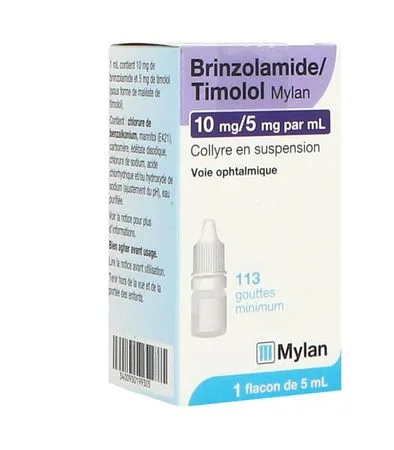
BRINZOLAMIDE/TIMOLOL VIATRIS 10 mg/5 mg per mL, eye drops in suspension
Forms and presentations
Eye drops in suspension (eye drops).
Uniform white to off-white suspension, pH 7,2 (approximately).
Composition
One mL of suspension contains 10 mg of brinzolamide and timolol maleate, corresponding to 5 mg of timolol.
Excipient with known effect : One mL of suspension contains 0,10 mg of benzalkonium chloride.
Benzalkonium chloride, mannitol (E421), carbomer, disodium edetate, sodium chloride, hydrochloric acid (pH adjustment), sodium hydroxide (pH adjustment), purified water
Indications
Reduction of intraocular pressure (IOP) in adult patients with open-angle glaucoma or ocular hypertension, for whom monotherapy reduction of IOP is insufficient (see section Pharmacodynamics).
Dosage and administration
Dosage
Use in adults and the elderly
The dosage is one drop of BRINZOLAMIDE/TIMOLOL VIATRIS in the conjunctival sac of the affected eye or eyes twice daily.
Systemic absorption may be reduced by nasolacrimal occlusion or closure of the eyelids. This method may help reduce systemic adverse effects and increase local efficacy (see section Warnings and precautions).
If a dose is missed, treatment should be continued with the next instillation as scheduled. The dosage must not exceed one drop twice daily in the affected eye(s).
When replacing another ophthalmic antiglaucoma medicinal product with BRINZOLAMIDE/TIMOLOL VIATRIS, stop the other medicinal product and start BRINZOLAMIDE/TIMOLOL VIATRIS the following day.
Specific populations
Paediatric population
The safety and efficacy of BRINZOLAMIDE/TIMOLOL VIATRIS in children and adolescents aged 0 to 18 years have not yet been established. No data are available.
Hepatic and renal impairment
No study has been carried out with brinzolamide/timolol or with timolol 5 mg/mL eye drops in patients with hepatic or renal impairment. No dose adjustment is necessary in patients with hepatic impairment or in patients with mild to moderate renal impairment.
Brinzolamide/timolol has not been studied in patients with severe renal impairment (creatinine clearance < 30 mL/min) or in patients with hyperchloraemic acidosis (see section Contraindications). Since brinzolamide and its main metabolite are excreted predominantly by the kidney, BRINZOLAMIDE/TIMOLOL VIATRIS is therefore contraindicated in patients with severe renal impairment (see section Contraindications).
BRINZOLAMIDE/TIMOLOL VIATRIS should be used with caution in patients with severe hepatic impairment (see section Warnings and precautions).
Method of administration
Ophthalmic use.
Patients must be informed of the need to shake the bottle well before use. After opening the cap, if the safety device on the bottle neck is loose, remove it before using this product.
To avoid contamination of the dropper tip and the suspension, care must be taken not to touch the eyelids, surrounding surfaces or other surfaces with the bottle's dropper tip. Patients must be informed of the need to keep the bottle tightly closed when not in use.
When several topical ophthalmic medicinal products are used, the administrations of medicinal products should be separated by at least 5 minutes. Ophthalmic ointments should be administered last.
Contraindications
• Hypersensitivity to the active substances or to any of the excipients listed in section Composition.
• Hypersensitivity to other beta-blockers.
• Hypersensitivity to sulfonamides (see section Warnings and precautions).
• Conditions associated with bronchial hyperreactivity, in particular bronchial asthma or a history of bronchial asthma, or severe chronic obstructive pulmonary disease.
• Sinus bradycardia, sick sinus syndrome, sinoatrial block, second- or third-degree atrioventricular block not controlled by a pacemaker, confirmed heart failure or cardiogenic shock.
• Severe allergic rhinitis
• Hyperchloraemic acidosis (see section Dosage and administration).
• Severe renal impairment.
Warnings and precautions
Systemic effects
• Brinzolamide and timolol pass into the general circulation. Due to the presence of a beta-blocker, timolol, cardiovascular and pulmonary adverse reactions and other adverse reactions identical to those seen with systemically administered beta-blocking agents may occur. The frequency of systemic adverse reactions after topical ocular administration is lower than after systemic administration. To reduce systemic absorption, see section Dosage and administration.
• Hypersensitivity reactions common to all sulfonamide derivatives may occur in patients receiving BRINZOLAMIDE/TIMOLOL VIATRIS, as it passes into the general circulation.
• Brinzolamide is a sulfonamide carbonic anhydrase inhibitor which, even when administered locally, is absorbed systemically. Adverse reactions of sulfonamides may also be observed with the topical route, including Stevens-Johnson syndrome (SJS) and toxic epidermal necrolysis (TEN). When prescribing, patients must be informed of the signs and symptoms and dermal reactions must be closely monitored. If signs of serious reactions or hypersensitivity appear, brinzolamide must be stopped immediately.
Cardiac disorders
In patients with cardiovascular diseases (for example: coronary artery disease, Prinzmetal's angina and heart failure) and hypotension, treatment with beta-blockers must be carefully evaluated and treatment with other active substances should be considered. In these patients, monitoring must be carried out to look for signs of worsening of these conditions or adverse reactions.
Due to their negative dromotropic effect, beta-blockers should only be prescribed with caution to patients with first-degree heart block.
Vascular disorders
Patients with severe peripheral circulatory disorders (i.e., severe forms of Raynaud's disease or Raynaud's syndrome) must be treated with caution.
Hyperthyroidism
Beta-blockers may also mask the signs of hyperthyroidism.
Muscle weakness
Beta-blocking medicinal products have been reported to aggravate the muscle weakness accompanying certain symptoms of myasthenia (e.g., diplopia, ptosis and general weakness).
Respiratory disorders
In asthmatic patients, respiratory manifestations, including death from bronchospasm, have been reported following administration of certain ophthalmic beta-blockers.
BRINZOLAMIDE/TIMOLOL VIATRIS must be administered with caution in patients suffering from mild to moderate chronic obstructive pulmonary disease (COPD) and only if the potential benefit appears greater than the potential risk.
Hypoglycaemia / diabetes
Beta-blockers should be administered with caution in patients prone to spontaneous hypoglycemia or in patients with unstable diabetes, as beta-blockers may mask the signs and symptoms of acute hypoglycemia.
Acid-base disorders
BRINZOLAMIDE/TIMOLOL VIATRIS contains brinzolamide, which is a sulfonamide. Adverse reactions attributable to sulfonamides may be observed with the topical route. Acid-base imbalances have been reported with oral carbonic anhydrase inhibitors. This medicine must be used with caution in patients at risk of renal failure due to the possible risk of metabolic acidosis. If signs of serious reactions or hypersensitivity appear, this medicine must be stopped.
Mental alertness
Oral carbonic anhydrase inhibitors may reduce the ability to perform tasks requiring mental alertness and/or physical coordination. BRINZOLAMIDE/TIMOLOL VIATRIS, which has systemic absorption, may also do so after topical administration.
Anaphylactic reactions
Patients treated with beta-blockers who have a history of atopy or severe anaphylactic reactions to various allergens may be more reactive to repeated administration of such allergens and may not respond to the doses of adrenaline usually used to treat anaphylactic reactions.
Choroidal detachment
Choroidal detachments have been observed after filtering surgery when treatments reducing aqueous humour secretion (e.g. timolol, acetazolamide) were administered.
Surgical anesthesia
Ophthalmic preparations based on beta-blockers may block the effects of systemic beta-agonists such as adrenaline. The anaesthetist must be informed when the patient is receiving timolol.
Concomitant treatment
The effect on intraocular pressure or the known effects of systemic beta-blockers may be potentiated when timolol is administered to patients already receiving a systemic beta-blocker. The response of these patients should be closely monitored. The use of two topical beta-blockers or two local carbonic anhydrase inhibitors is not recommended (see section Interactions).
There are additional effects compared with the known systemic effects of carbonic anhydrase inhibition in patients taking an oral carbonic anhydrase inhibitor and BRINZOLAMIDE/TIMOLOL VIATRIS.
The concomitant administration of BRINZOLAMIDE/TIMOLOL VIATRIS and oral carbonic anhydrase inhibitors has not been studied and is not recommended (see section Interactions).
Ocular effects
Experience with treatment with brinzolamide/timolol in patients with pseudoexfoliative glaucoma or pigmentary glaucoma is limited. Particular care should be taken when treating these patients, and close monitoring of IOP is recommended.
Brinzolamide/timolol has not been evaluated in patients with narrow-angle glaucoma and its use is not recommended in these patients.
Ophthalmic beta-blockers may cause ocular dryness. Patients with corneal diseases should be treated with caution.
The possible role of brinzolamide on corneal endothelial function has not been studied in patients with a compromised cornea (in particular in patients with a low number of endothelial cells). In particular, patients wearing contact lenses have not been studied and careful monitoring is recommended in these patients under brinzolamide since carbonic anhydrase inhibitors may affect corneal hydration. This may lead to corneal decompensation and oedema, and wearing contact lenses may increase the risk to the cornea. Careful monitoring is recommended in patients with a compromised cornea, such as patients with diabetes mellitus or corneal dystrophies.
Wearing contact lenses is possible while using BRINZOLAMIDE/TIMOLOL VIATRIS, but under close supervision (see below under "Benzalkonium chloride").
Benzalkonium chloride
BRINZOLAMIDE/TIMOLOL VIATRIS contains benzalkonium chloride. Benzalkonium chloride is known to cause eye irritation and symptoms of dry eye syndrome, and may affect the tear film and the surface of the cornea. It should be used with caution in patients with dry eye and those at risk of corneal damage. Patients should be monitored during prolonged use.
It is also known to discolour soft contact lenses. Contact with soft contact lenses should be avoided. Patients should be instructed to remove their contact lenses before applying BRINZOLAMIDE/TIMOLOL VIATRIS and to wait 15 minutes after instilling the dose before reinserting them.
Punctate keratopathies and/or toxic ulcerative keratopathies have also been reported with benzalkonium chloride. Close monitoring is necessary during frequent or prolonged use.
Hepatic impairment
BRINZOLAMIDE/TIMOLOL VIATRIS should be used with caution in patients with severe hepatic impairment.
Interactions
No specific drug interaction study has been carried out with brinzolamide/timolol.
BRINZOLAMIDE/TIMOLOL VIATRIS contains a carbonic anhydrase inhibitor, brinzolamide, which, although administered topically, is absorbed systemically. Acid-base imbalances have been reported with oral carbonic anhydrase inhibitors. The possibility of interactions should be considered in patients treated with BRINZOLAMIDE/TIMOLOL VIATRIS.
In patients receiving an oral carbonic anhydrase inhibitor and brinzolamide eye drops, there is a risk of potentiation of the known systemic effects of carbonic anhydrase inhibition. Concomitant administration of a brinzolamide-containing eye drop and an oral carbonic anhydrase inhibitor is not recommended.
The cytochrome P-450 isoenzymes responsible for brinzolamide metabolism include CYP3A4 (main), CYP2A6, CYP2B6, CYP2C8 and CYP2C9. It is therefore expected that CYP3A4 inhibitors such as ketoconazole, itraconazole, clotrimazole, ritonavir and troleandomycin may inhibit brinzolamide metabolism via CYP3A4. Caution is advised when CYP3A4 inhibitors are given simultaneously.
However, as renal elimination is the main route, accumulation of brinzolamide is unlikely. Brinzolamide is not an inhibitor of the cytochrome P-450 iso-enzymes.
An additive effect, resulting in hypotension and/or marked bradycardia, may be observed when ophthalmic beta-blocker solution is administered concomitantly with calcium channel inhibitors, beta-adrenergic blocking agents, antiarrhythmics (notably amiodarone), digitalis glycosides, parasympathomimetics, and orally administered guanethidine.
Beta-blockers may reduce the response to adrenaline used to treat anaphylactic reactions. Particular attention should be paid to patients with a history of atopy or anaphylaxis (see section Warnings and precautions).
The rebound hypertensive reaction occurring on abrupt withdrawal of clonidine may be increased when beta-blockers are administered. Particular attention is recommended when this medicinal product is used concomitantly with clonidine.
Potentiation of the systemic beta-blocking effect (for example: decreased heart rate, depression) has been reported when CYP2D6 inhibitor treatments (for example: quinidine, fluoxetine and paroxetine) are combined with timolol.
Particular attention is recommended.
Beta-blockers may potentiate the hypoglycaemic effect of antidiabetic agents. Beta-blockers may mask the signs and symptoms of hypoglycaemia (see section Warnings and precautions).
Mydriasis has occasionally been reported when ophthalmic beta-blockers and adrenaline (epinephrine) were used concomitantly.
Fertility, pregnancy and breastfeeding
Pregnancy
There are no relevant data on the use of ocular brinzolamide or timolol in pregnant women. Animal studies with brinzolamide have shown reproductive toxicity following systemic administration, see section Preclinical safety. BRINZOLAMIDE/TIMOLOL VIATRIS must not be used during pregnancy except in cases of absolute necessity. To reduce systemic absorption, see section Dosage and administration.
Epidemiological studies have not revealed a malformative effect but have shown a risk of intrauterine growth retardation when beta-blockers are administered orally. In addition, signs and symptoms of a beta-blocking effect (for example: bradycardia, hypotension, respiratory distress and hypoglycaemia) have been observed in the newborn when beta-blockers were administered up to delivery. If BRINZOLAMIDE/TIMOLOL VIATRIS is administered up to delivery, the newborn must be carefully monitored during the first days of its life.
Breast-feeding
It has not been established that brinzolamide administered ocularly is excreted in human breast milk. Animal studies after oral administration have shown that brinzolamide is excreted in breast milk, see section Preclinical safety.
Beta-blockers are excreted in human milk. However, at therapeutic doses of timolol in eye drops, the amount passing into breast milk is unlikely to be sufficient to produce clinical symptoms of beta-blockers in the infant. To reduce systemic absorption, see section Dosage and administration.
However, a risk to the breastfed child cannot be excluded. A decision must be made either to discontinue breastfeeding or to discontinue/refrain from treatment with BRINZOLAMIDE/TIMOLOL VIATRIS, taking into account the benefit of breastfeeding for the child against the benefit of the treatment for the woman.
Fertility
No study has been carried out to evaluate the effect of topical ocular administration of brinzolamide/timolol on human fertility.
Non-clinical studies have not demonstrated any effect of brinzolamide or timolol on male or female fertility following oral administration. No effect of the use of brinzolamide/timolol on male or female fertility is anticipated.
Driving and using machines
Brinzolamide/timolol has a minor influence on the ability to drive and use machines.
Transient blurred vision or other visual disturbances may reduce the ability to drive vehicles or use machines. If blurred vision occurs upon instillation, the patient must wait until their vision returns to normal before driving a vehicle or using a machine.
Carbonic anhydrase inhibitors may reduce the ability for tasks requiring mental alertness and/or physical coordination (see section Warnings and precautions).
Adverse effects
Summary of the safety profile
In clinical studies, the most frequently encountered adverse reactions were blurred vision, eye irritation and eye pain, occurring in approximately 2 % to 7 % of patients.
Tabulated summary of adverse reactions
The following undesirable effects have been reported during clinical trials and post-marketing surveillance of brinzolamide/timolol and its components, brinzolamide and timolol, taken individually. They have been classified as follows: very common (≥ 1/10), common (≥ 1/100, < 1/10), uncommon (≥ 1/1 000, < 1/100), rare (≥ 1/10 000, < 1/1 000), very rare (< 1/10 000) or not known (cannot be estimated from the available data). Within each frequency grouping, undesirable effects are presented in order of decreasing seriousness.
|
System organ class |
MedDRA Preferred Term (v. 18.0) |
|
Infections and infestations |
Frequency not known : rhinopharyngitis3, pharyngitis3, sinusitis3, rhinitis3 |
|
Blood and lymphatic system disorders |
Uncommon : decrease in white blood cell count1 Frequency not known : decrease in the number of red blood cells3, increased blood chloride level3 |
|
Immune system disorders |
Frequency not known : anaphylaxis2, anaphylactic shock1, systemic allergic reaction including angioedema2, localized and generalized rash2, hypersensitivity1, urticaria2, pruritus2 |
|
Metabolic and nutritional disorders |
Frequency not known : hypoglycaemia2 |
|
Psychiatric disorders |
Rare : insomnia1 Frequency not known : depression1, memory loss2, apathy3, depressed mood3, decreased libido3, nightmare2, 3, nervousness3, hallucination2 |
|
Nervous system disorders |
Common : dysgeusia1 Frequency not known : cerebral ischaemia2, cerebrovascular accident2, syncope2, increase in the signs and symptoms of myasthenia gravis2, somnolence3, motor dysfunction3, amnesia3, memory impairment3, paraesthesia2,3, tremor3, hypoaesthesia3, ageusia3, vertigo1, headache1 |
|
Eye disorders |
Common : punctate keratitis1, blurred vision1, eye pain1, eye irritation1 Uncommon : keratitis1,2,3, dry eye1, presence of a natural coloration of the cornea1, eye discharge1, ocular pruritus1, sensation of foreign body in the eyes1, ocular hyperaemia1, conjunctival hyperaemia1 Rare : corneal erosion1, inflammation of the anterior chamber of the eye1, photophobia1, increased tearing1, scleral hyperaemia1, erythema of the eyelid1, crusting on the eyelid margins1 Frequency not known : increased cup-to-disc ratio of the optic nerve3, choroidal detachment after filtering surgery2 (see section 4), keratopathy3, abnormality of the corneal epithelium3, disorder of the corneal epithelium3, increased intraocular pressure3, ocular deposit3, corneal staining3, corneal edema3, decreased corneal sensitivity2, conjunctivitis3, meibomitis3, diplopia2,3, dazzling3, photopsia3, decreased visual acuity3, visual impairment1, pterygium3, ocular discomfort3, dry keratoconjunctivitis3, ocular hypoesthesia3, scleral pigmentation3, subconjunctival cyst3, visual disturbance3, eye swelling3, ocular allergy3, madarosis3, eyelid disorder3, eyelid edema1, ptosis2 |
|
Ear and labyrinth disorders |
Frequency not known : vertigo3, tinnitus3 |
|
Cardiac disorders |
Common : decreased heart rate1 Frequency not known : cardiac arrest2, heart failure2, congestive heart failure2, atrioventricular block2, cardiorespiratory distress3, angina pectoris3, bradycardia2, 3, irregular heart rate3, arrhythmia2,3, palpitations2,3, tachycardia3, increased heart rate3, chest pain2, edema2 |
|
Vascular disorders |
Uncommon : decreased blood pressure1 Frequency not known : hypotension2, hypertension3, increased blood pressure1, Raynaud's syndrome2, cold hands and feet2 |
|
Respiratory, thoracic and mediastinal disorders |
Uncommon : cough1 Rare : oropharyngeal pain1, rhinorrhoea1 Frequency not known : bronchospasm2 (predominantly in patients with bronchospastic disease), dyspnoea1, asthma3, epistaxis1, bronchial hyperreactivity3, throat irritation3, nasal congestion3, upper airway congestion3, posterior rhinorrhoea3, sneezing3, nasal dryness3 |
|
Gastrointestinal disorders |
Frequency not known : vomiting2,3, upper abdominal pain1, abdominal pain2, diarrhoea1, dry mouth1, nausea1, oesophagitis3, dyspepsia2,3, abdominal discomfort3, discomfort in the stomach area3, frequent bowel movements3, gastrointestinal disorder3, oral hypoaesthesia3, oral paraesthesia3, flatulence3 |
|
Hepato-biliary disorders |
Frequency not known : abnormal liver function tests3 |
|
Skin and subcutaneous tissue disorders |
Frequency not known : urticaria3, maculopapular rash3, generalised pruritus3, skin tightness3, dermatitis3, alopecia1, psoriasiform rash or aggravation of psoriasis2, skin rash1, erythema1 Stevens-Johnson syndrome (SJS)/ toxic epidermal necrolysis (TEN)3 |
|
Musculoskeletal and systemic disorders |
Frequency not known : myalgia1, muscle spasms3, arthralgia3, back pain3, pain in the extremities3 |
|
Renal and urinary disorders |
Uncommon : presence of blood in the urine1 Frequency not known : renal pain3, pollakiuria3 |
|
Disorders of reproductive organs and breast disorders |
Frequency not known : erectile dysfunction3, sexual dysfunction2, decreased libido2 |
|
General disorders and administration site conditions |
Uncommon : malaise1, 3 Frequency not known : chest pain1, pain3, fatigue1, asthenia2,3, chest discomfort3, feeling of nervousness3, irritability3, peripheral oedema3, drug residue3 |
|
Investigations |
Uncommon : increased blood potassium1, increased blood lactate dehydrogenase1 |
1 adverse reactions encountered with the brinzolamide/timolol combination
2 additional adverse reactions observed with timolol monotherapy
3 additional adverse reactions observed with brinzolamide monotherapy
Description of selected adverse reactions
A frequently reported systemic adverse effect associated with the use of brinzolamide/timolol during clinical studies was dysgeusia (bitter or unusual taste in the mouth after instillation). It is probably due to the passage of the eye drops into the nasopharynx via the nasolacrimal duct and is attributable to brinzolamide.
Nasolacrimal occlusion or gentle closure of the eyelids after instillation may help reduce the frequency of this effect (see section Dosage and administration).
BRINZOLAMIDE/TIMOLOL VIATRIS contains brinzolamide, which is a sulfonamide carbonic anhydrase inhibitor absorbed systemically. Gastrointestinal, nervous system, haematological, renal and metabolic effects are generally associated with systemic carbonic anhydrase inhibitors. Adverse effects of oral carbonic anhydrase inhibitors may be observed with topical administration.
Timolol passes into the general circulation. This may cause adverse reactions similar to those of beta-blockers administered systemically. The adverse reactions mentioned include reactions encountered within the class of ophthalmic beta-blockers.
Other adverse effects related to the use of one of the components, which may possibly occur with brinzolamide/timolol, are mentioned in the table above. The incidence of systemic adverse reactions following topical ophthalmic administration is lower than with systemic administration. To reduce systemic absorption, see section Dosage and administration.
Paediatric population
BRINZOLAMIDE/TIMOLOL VIATRIS is not recommended in children and adolescents under 18 years of age due to the absence of tolerance and efficacy data.
Reporting of suspected adverse reactions
Reporting suspected adverse reactions after authorisation of the medicinal product is important. It allows continued monitoring of the benefit/risk balance of the medicinal product. Healthcare professionals are asked to report any suspected adverse reaction via the national reporting system: National Agency for the Safety of Medicines and Health Products (ANSM) and the network of Regional Centres of Pharmacovigilance - Website: https://signalement.social-sante.gouv.fr.
Overdose
In case of accidental ingestion, symptoms of beta-blocker overdose may include bradycardia, hypotension, heart failure and bronchospasm.
In case of overdose with BRINZOLAMIDE/TIMOLOL VIATRIS eye drops, treatment should be symptomatic and supportive. Due to brinzolamide, a hydro-electrolytic imbalance, development of an acidosis state and possible effects on the central nervous system may occur. Electrolytes (in particular potassium) and blood pH should be monitored. Studies have shown that timolol is not rapidly dialysed.
Pharmacodynamics
Pharmacotherapeutic class: Ophthalmological drugs, anti-glaucoma and miotic preparations, ATC code: S01ED51.
Mechanism of action
BRINZOLAMIDE/TIMOLOL VIATRIS combines two active substances: brinzolamide and timolol maleate. These two components reduce elevated IOP mainly by decreasing aqueous humour secretion, through different mechanisms of action. The combined effect of these two active substances provides an additional reduction in intraocular pressure compared with each component taken alone.
Brinzolamide is a potent inhibitor of carbonic anhydrase II (CA-II), the predominant iso-enzyme in the eye. Inhibition of carbonic anhydrase in the ciliary processes of the eye decreases aqueous humour secretion, probably by slowing the formation of bicarbonate ions, which leads to a reduction in sodium and water transport.
Timolol is a non-selective adrenergic receptor blocking agent, having neither intrinsic sympathomimetic activity, nor direct myocardial depressant effect, nor membrane stabilising effect. Tonographic and fluorophotometric studies in humans suggest that its predominant action is related to a reduction in aqueous humour formation and a slight increase in outflow.
Pharmacodynamic effects
Clinical effects:
In a controlled study over 12 months conducted in patients with open-angle glaucoma or ocular hypertension who had a mean baseline IOP of 25 to 27 mmHg, and for whom the investigator considered a combined treatment would be beneficial, the mean IOP reduction with brinzolamide/timolol 10 mg/mL + 5 mg/mL, eye drops in suspension administered twice daily was 7 to 9 mmHg. The non-inferiority of brinzolamide/timolol 10 mg/mL + 5 mg/mL, eye drops in suspension compared with dorzolamide 20 mg/mL + timolol 5 mg/mL for the reduction of mean IOP was demonstrated at all times for all visits.
In a controlled study of 6 months conducted in patients with open-angle glaucoma or ocular hypertension, and presenting a mean baseline IOP of 25 to 27 mmHg, the mean IOP reduction with brinzolamide/timolol 10 mg/mL + 5 mg/mL, eye drops in suspension administered twice daily was 7 to 9 mmHg and could reach 3 mmHg more than with brinzolamide 10 mg/mL administered 2 times daily and 2 mmHg more than with timolol 5 mg/mL administered twice daily. The mean IOP reduction was statistically superior to that obtained with brinzolamide and timolol at all times and for all study visits.
In three controlled clinical studies, ocular discomfort on instillation of brinzolamide/timolol 10 mg/mL + 5 mg/mL, eye drops in suspension was significantly lower than on instillation of dorzolamide 20 mg/mL + timolol 5 mg/mL.
Pharmacokinetics
Absorption
Following topical ocular administration, brinzolamide and timolol are absorbed through the cornea and into the systemic circulation. In a pharmacokinetic study, healthy volunteers received oral brinzolamide (1 mg) twice daily for 2 weeks before starting administration of brinzolamide/timolol 10 mg/mL + 5 mg/mL, eye drops in suspension, in order to reduce the time needed to reach steady state. After two daily administrations of brinzolamide/timolol 10 mg/mL + 5 mg/mL, eye drops in suspension for 13 weeks, erythrocyte brinzolamide concentrations were approximately 18,8 ± 3,29 μM, 18,1 ± 2,68 μM and 18,4 ± 3,01 μM at weeks 4, 10 and 15 respectively, indicating that erythrocyte brinzolamide concentrations at steady state were maintained.
At steady state, following administration of brinzolamide/timolol 10 mg/mL + 5 mg/mL, eye drops in suspension, the mean plasma values Cmax and the AUC0-12h of timolol were respectively 27% and 28% lower (Cmax : 0,824 ± 0,453 ng/mL; AUC0-12h : 4,71 ± 4,29 ng h/mL) than those obtained following administration of timolol 5 mg/mL (Cmax : 1,13 ± 0,494 ng/mL; AUC0-12h : 6,58 ± 3,18 ng h/mL). The lower systemic exposure to timolol following administration of brinzolamide/timolol 10 mg/mL + 5 mg/mL, eye drops in suspension is not clinically relevant. Following administration of brinzolamide/timolol 10 mg/mL + 5 mg/mL, eye drops in suspension, the Cmax mean of timolol was reached at 0,79 ± 0,45 hours.
Distribution
Plasma protein binding of brinzolamide is moderate (approximately 60%). Brinzolamide is sequestered in red blood cells due to its high affinity for CA-II and, to a lesser extent, for CA-I. The active metabolite N-desethyl brinzolamide also accumulates in red blood cells, where it binds mainly to CA-I. The affinity of brinzolamide and its metabolite for red blood cells and tissue CA leads to low plasma concentrations.
In rabbits, data on distribution in ocular tissues showed that timolol can be measured in the aqueous humour up to 48 hours after administration of brinzolamide/timolol 10 mg/mL + 5 mg/mL, eye drops, suspension. At steady state, timolol is detected in human plasma up to 12 hours after administration of brinzolamide/timolol 10 mg/mL + 5 mg/mL, eye drops, suspension.
Biotransformation
The metabolic pathways of brinzolamide involve N-dealkylation, O-dealkylation and oxidation of its N-propyl chain. N-desethyl brinzolamide is one of the main metabolites of brinzolamide formed in humans, which also binds to CA-I in the presence of brinzolamide and accumulates in red blood cells. Studies in vitro show that the metabolism of brinzolamide mainly involves CYP3A4 as well as at least four other isoenzymes (CYP2A6, CYP2B6, CYP2C8 and CYP2C9).
Timolol is metabolised via 2 pathways. The first leads to an ethanolamine chain on the thiadiazole ring and the second leads to an ethanol chain on the morpholine nitrogen and a second similar chain with a carbonyl group adjacent to the nitrogen. Metabolism of timolol is mainly carried out by CYP2D6.
Elimination
Brinzolamide is mainly eliminated by renal excretion (approximately 60 %). Approximately 20 % of the dose was recovered in the urine as metabolite. Brinzolamide and N-desethyl brinzolamide are the main components found in the urine, accompanied by the N-desmethoxypropyl and O-desmethyl metabolites in trace amounts (< 1 %).
Timolol and its metabolites are mainly excreted by the kidneys. Approximately 20% of a timolol dose is excreted in urine unchanged and the remainder is excreted in urine as metabolites. After administration of brinzolamide/timolol 10 mg/mL + 5 mg/mL, eye drops, suspension, the plasma half-life of timolol is 4,8 hours.
Preclinical safety
Brinzolamide
Non-clinical data from conventional safety pharmacology, repeated-dose toxicity, genotoxicity and carcinogenicity studies did not reveal any particular risk of brinzolamide for humans.
Developmental toxicity studies in rabbits receiving oral doses of brinzolamide up to 6 mg/kg/day (214 times the recommended daily therapeutic dose of 28 μg/kg/day) did not reveal any effect on foetal development despite significant maternal toxicity. Similar studies in rats led to slight reductions in skull and sternal bar ossification of foetuses from mothers receiving brinzolamide at doses of 18 mg/kg/day (642 times the recommended daily therapeutic dose); these reductions were not observed at 6 mg/kg/day. These results appeared at doses causing metabolic acidoses with decreased maternal body weight gain and decreased foetal weights. In offspring of mothers receiving oral brinzolamide, dose-dependent decreases in foetal weights were observed, ranging from a slight decrease (approximately 5-6%) at a dose of 2 mg/kg/day to nearly 14% at a dose of 18 mg/kg/day. During lactation, the dose without effect on litter was 5 mg/kg/day.
Timolol
Non-clinical data from conventional safety pharmacology, repeated-dose toxicity, genotoxicity and carcinogenicity studies did not reveal any particular risk of timolol for humans. Reproductive toxicity studies with timolol revealed delayed foetal ossification without effect on post-natal development in rats (at 50 mg/kg/day or 3 500 times the daily therapeutic dose of 14 µg/kg/day) and increased foetal resorptions in rabbits (at 90 mg/kg/day or 6 400 times the daily therapeutic dose).
Prescription, supply and reimbursement
| Marketing authorisation (AMM) |
|
| Price: |
|
- Indication(s) appearing in the marketing authorisation at the date of publication of this decree
Collection.
1 RUE DE TURIN
69007 LYON
Tel: 04 37 25 75 00 https://www.viatris.fr/
Source: VIDAL · Updated on 10/11/2026. This information does not replace advice from a healthcare professional.