
Medicines
SmPC of 16/11/2023
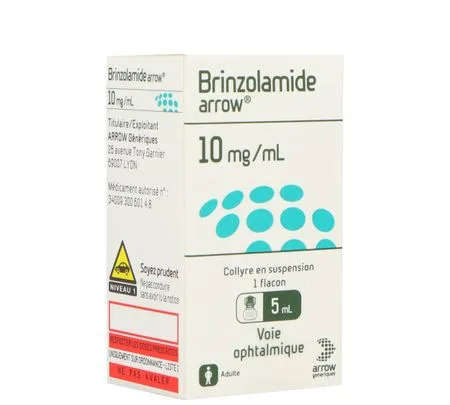
BRINZOLAMIDE ARROW 10 mg/mL, eye drops, suspension
Composition
Brinzolamide...................................................................................................................................................10 mg
For 1 mL of eye drops, suspension
Excipient with known effect: each mL of eye drops, suspension contains 0,15 mg of benzalkonium chloride.
Benzalkonium chloride, mannitol (E421), carbomer 974P, disodium edetate, sodium chloride, purified water, hydrochloric acid/sodium hydroxide (pH adjustment).
Indications
BRINZOLAMIDE ARROW is indicated for lowering elevated intraocular pressure in cases of:
• intraocular hypertension,
• open-angle glaucoma,
as monotherapy in adult patients not responding to beta-blockers or in adult patients for whom beta-blockers are contraindicated, or in combination with beta-blockers or prostaglandin analogues (see also section Pharmacodynamics).
Dosage and administration
Dosage
As monotherapy or in combination, the dose is one drop of BRINZOLAMIDE ARROW in the conjunctival sac of the affected eye(s) twice daily. Some patients may have a better response with one drop three times daily.
Special populations
Elderly patients
No dose adjustment is necessary in elderly patients.
Hepatic and renal impairment
Brinzolamide has not been studied in patients with hepatic impairment and therefore is not recommended in these patients.
Brinzolamide has not been studied in patients with severe renal impairment (creatinine clearance < 30 mL/min) or in patients with hyperchloraemic acidosis. Since brinzolamide and its main metabolites are predominantly excreted by the kidney, BRINZOLAMIDE ARROW is therefore contraindicated in these patients (see section Contraindications).
Paediatric population
The safety and efficacy of brinzolamide in infants, children and adolescents aged 0 to 17 years have not been established. The data currently available are described in sections Adverse effects and Pharmacodynamics. The use of BRINZOLAMIDE ARROW is not recommended in infants, children and adolescents.
Method of administration
Ophthalmic use.
Nasolacrimal occlusion or gentle closure of the eyelids after instillation is recommended. This may reduce systemic absorption of ocularly administered medicinal products and lead to a reduction in systemic side effects.
Patients should be instructed to shake the bottle well before use. After removing the cap, if the safety ring is too loose, remove it before using the product.
To avoid contamination of the dropper tip and the suspension, care should be taken not to touch the eyelids, surrounding areas or other surfaces with the dropper tip of the bottle. Patients should be instructed to keep the bottle tightly closed when not in use.
When replacing another ophthalmic anti-glaucoma treatment with BRINZOLAMIDE ARROW, stop the other medicinal product and start BRINZOLAMIDE ARROW the following day.
When several medicinal products administered by the ocular route are used, instillations must be spaced at least 5 minutes apart. Ophthalmic ointments must be administered last.
If an instillation is forgotten, treatment must be continued with the next instillation as planned. The dose must not exceed one drop three times a day in the affected eye(s).
Contraindications
• Hypersensitivity to the active substance or to any of the excipients listed in section Composition.
• Known hypersensitivity to sulfonamides (see also section Warnings and precautions).
• Severe renal impairment.
• Hyperchloraemic acidosis.
Warnings and precautions
Systemic effects
BRINZOLAMIDE ARROW is a sulfonamide carbonic anhydrase inhibitor which, even when administered locally, is absorbed systemically. Undesirable effects of sulfonamides may also be observed with the local route, including Stevens-Johnson syndrome (SJS) and toxic epidermal necrolysis (TEN). When prescribing, patients must be informed of the signs and symptoms and skin reactions must be closely monitored. If signs of serious reactions or hypersensitivity appear, BRINZOLAMIDE ARROW must be stopped immediately.
Acid-base disturbances have been reported following oral administration of carbonic anhydrase inhibitors. Use with caution in patients at risk of renal insufficiency due to the potential risk of metabolic acidosis (see section Dosage and administration).
Brinzolamide has been studied neither in premature infants (less than 36 weeks of gestational age) nor in children less than one week old.
Due to the possible risk of metabolic acidosis, patients with immaturity or significant renal tubular abnormalities may only be treated with brinzolamide after a thorough assessment of the benefit-risk ratio.
Oral carbonic anhydrase inhibitors may reduce the ability to perform tasks requiring mental alertness and/or physical coordination. These effects may also occur after topical administration since BRINZOLAMIDE ARROW has systemic absorption.
Concomitant treatment
In patients receiving an oral carbonic anhydrase inhibitor and BRINZOLAMIDE ARROW, there is a possibility of additive systemic effects inherent to carbonic anhydrase inhibition. Concomitant administration of BRINZOLAMIDE ARROW and oral carbonic anhydrase inhibitors has not been studied and is not recommended (see also section Interactions).
In combination, brinzolamide has been evaluated mainly with timolol in the treatment of glaucoma. In addition, the effect of brinzolamide combined with the prostaglandin analogue travoprost on IOP reduction has been studied. There are no long-term data on the concomitant combination of brinzolamide and travoprost (see also section Pharmacodynamics).
Experience with brinzolamide treatment in patients with pseudoexfoliative glaucoma or pigmentary glaucoma is limited. Particular care should be taken when treating these patients and close monitoring of intraocular pressure (IOP) is recommended. Brinzolamide has not been evaluated in patients with narrow-angle glaucoma and its use is not recommended in these patients.
The possible effect of brinzolamide on corneal endothelial function has not been studied in patients with compromised corneas (in particular patients with a low endothelial cell count). In particular, patients wearing contact lenses have not been studied, and careful monitoring is recommended in these patients on brinzolamide, since carbonic anhydrase inhibitors may affect corneal hydration and wearing contact lenses may increase the risk to the cornea. Likewise, careful monitoring is recommended in patients with compromised corneas, such as patients with diabetes mellitus or corneal dystrophies.
Punctate keratopathies and/or toxic ulcerative keratopathies have been reported with benzalkonium chloride, which is commonly used as a preservative in ophthalmic products. As BRINZOLAMIDE ARROW contains benzalkonium chloride, close monitoring is necessary during frequent or prolonged use in patients with dry eyes or a compromised cornea.
Brinzolamide has not been studied in patients wearing contact lenses. BRINZOLAMIDE ARROW contains benzalkonium chloride, which may cause eye irritation and is known to discolour soft contact lenses. Contact with soft contact lenses should be avoided. Patients should be advised to remove their contact lenses before instilling BRINZOLAMIDE ARROW and to wait at least 15 minutes after instillation before reinserting contact lenses.
Potential rebound effects on stopping treatment with brinzolamide have not been studied; the IOP-lowering effect is assumed to last 5 to 7 days.
Paediatric population
The safety and efficacy of brinzolamide in infants, children and adolescents aged 0 to 17 years have not been established and its use is not recommended in infants, children and adolescents.
Interactions
No specific studies of interactions with other medicinal products have been performed with brinzolamide. In clinical studies, brinzolamide was used with ophthalmic preparations of prostaglandin analogues and timolol without evidence of drug interactions. The combination of brinzolamide with miotics or adrenergic agonists has not been evaluated during glaucoma treatment.
BRINZOLAMIDE ARROW is a carbonic anhydrase inhibitor which, although administered locally, has systemic absorption. Acid-base disturbances have been reported with oral carbonic anhydrase inhibitors. The possibility of interactions should be considered in patients treated with BRINZOLAMIDE ARROW.
The cytochrome P-450 iso-enzymes responsible for the metabolism of brinzolamide include CYP3A4 (main), CYP2A6, CYP2C8 and CYP2C9. It is assumed that CYP3A4 inhibitors such as ketoconazole, itraconazole, clotrimazole, ritonavir and troleandomycin will inhibit the metabolism of brinzolamide by CYP3A4. Caution is advised when CYP3A4 inhibitors are given concomitantly. However, as renal elimination is the main route, accumulation of brinzolamide is unlikely. Brinzolamide is not an inhibitor of cytochrome P-450 iso-enzymes.
Fertility, pregnancy and breastfeeding
Pregnancy
There are no or limited data on the ophthalmic use of brinzolamide in pregnant women. Animal studies have shown reproductive toxicity following systemic administration (see also section Preclinical safety).
BRINZOLAMIDE ARROW is not recommended during pregnancy and in women of childbearing potential not using contraception.
Breast-feeding
The excretion of brinzolamide and its metabolites into breast milk after topical ocular administration is not known. Studies in animals have shown a low level of excretion of brinzolamide into breast milk after oral administration.
The existence of a risk for newborns/infants cannot be excluded. The decision to stop breastfeeding or to stop/suspend treatment with BRINZOLAMIDE ARROW must take into account the benefit of breastfeeding for the child as well as the benefit of treatment for the woman.
Fertility
Studies in animals have shown no effect on fertility. Studies have not allowed evaluation of the effect of topical ocular administration of brinzolamide on human fertility.
Driving and using machines
Brinzolamide has a minor influence on the ability to drive and use machines.
Temporary blurred vision or other visual disturbances may reduce the ability to drive vehicles or use machines (see also section Adverse effects). If blurred vision occurs upon instillation, the patient must wait for their vision to return to normal before driving a vehicle or using a machine.
Oral carbonic anhydrase inhibitors may reduce the ability to perform tasks requiring mental alertness and/or physical coordination (see also section Warnings and precautions and section Adverse effects).
Adverse effects
Summary of the safety profile
The treatment-related adverse reactions most frequently reported in clinical studies including more than 2732 patients treated with brinzolamide as monotherapy or in combination with timolol maleate 5 mg/mL were: dysgeusia (6,0 %) (bitter or unusual taste, see description below) and vision disorders, occurring transiently upon instillation and lasting from a few seconds to a few minutes (5,4 %) (see also section Driving and using machines).
Summary table of undesirable effects
The following adverse reactions have been reported with brinzolamide 10 mg/mL eye drops, suspension, and are classified as follows: very common (≥1/10), common (≥1/100 to < 1/10), uncommon (≥1/1000 to <1/100), rare (≥1/10000 to <1/1000), very rare (<1/10000), or not known (cannot be estimated from the available data). Within each frequency grouping, adverse reactions are presented in order of decreasing seriousness. These adverse reactions were obtained from clinical studies or spontaneous reports after marketing.
|
System organ class |
MedDRA preferred term (v15.1) |
|
|
Infections and infestations |
Uncommon : nasopharyngitis, pharyngitis, sinusitis. |
|
|
|
Frequency not known : rhinitis. |
|
|
Blood and lymphatic system disorders |
Uncommon : decreased red blood cell count, increased blood chloride level. |
|
|
Immune system disorders |
Frequency not known : hypersensitivity. |
|
|
Metabolism and nutrition disorders |
Frequency not known : decreased appetite. |
|
|
Psychiatric disorders |
Uncommon : apathy, depression, mood disorders, decreased libido, nightmares, nervousness. Rare : insomnia. |
|
|
Nervous system disorders |
Uncommon : musculoskeletal disorders, amnesia, vertigo, paraesthesia, headaches. Rare : memory impairment, somnolence. Frequency not known : tremors, hypoaesthesia, ageusia. |
|
|
Eye disorders |
Common : blurred vision, eye irritation, eye pain, sensation of foreign body in the eyes, ocular hyperaemia. Uncommon : corneal erosion, keratitis, punctate keratitis, keratopathy, ocular deposit, corneal staining, involvement of the corneal epithelium, blepharitis, ocular pruritus, conjunctivitis, eye swelling, meibomitis, glare, photophobia, dry eye, allergic conjunctivitis, pterygium, scleral pigmentation, asthenopia, eye discomfort, abnormal sensation in the eye, keratoconjunctivitis sicca, subconjunctival cyst, conjunctival hyperaemia, eyelid pruritus, eye discharge, crusting on the eyelid margin, increased lacrimation. Rare : corneal oedema, diplopia, decreased visual acuity, photopsia, ocular hypoaesthesia, periorbital oedema, increased intraocular pressure, increased optic nerve cup/disc ratio. Frequency not known : corneal disorder, visual disturbance, ocular allergy, madarosis, eyelid disorder, eyelid erythema. |
|
|
Ear and labyrinth disorders |
Rare : tinnitus. Frequency not known : vertigo. |
|
|
Cardiac disorders |
Uncommon : respiratory distress, bradycardia, palpitations. Rare : angina pectoris, irregular heart rhythm. Frequency not known : arrhythmia, tachycardia, hypertension, increased blood pressure, decreased blood pressure, accelerated heart rate. |
|
|
Respiratory, thoracic and mediastinal disorders |
Uncommon : dyspnoea, epistaxis, oropharyngeal pain, pharyngolaryngeal pain, throat irritation, upper airway cough syndrome, rhinorrhoea, sneezing. Rare : bronchial hyperreactivity, upper respiratory tract congestion, sinus congestion, nasal congestion, cough, nasal dryness. Frequency not known : asthma. |
|
|
Gastrointestinal disorders |
Common : dysgeusia. Uncommon : oesophagitis, diarrhoea, nausea, vomiting, dyspepsia, upper abdominal pain, abdominal discomfort, stomach ache, flatulence, frequent stools, gastrointestinal disorders, oral hypoaesthesia, oral paraesthesia, dry mouth. |
|
|
Hepato-biliary disorders |
Frequency not known : abnormal liver function test. |
|
|
Skin and subcutaneous tissue disorders |
Uncommon : rash, maculopapular rash, skin tightness. Rare : urticaria, alopecia, generalised pruritus. Frequency not known : dermatitis, erythema, Stevens-Johnson syndrome (SJS) / toxic epidermal necrolysis (TEN) (see section Warnings and precautions). |
|
|
Musculoskeletal and systemic disorders |
Uncommon : back pain, muscle spasms, myalgia. Frequency not known : arthralgia, pain in extremities. |
|
|
Renal and urinary disorders |
Uncommon : renal pain. Frequency not known : pollakiuria. |
|
|
Disorders of the reproductive system and breast |
Uncommon : erectile dysfunction. |
|
|
General disorders and administration site conditions |
Uncommon : pain, chest discomfort, fatigue, feeling of malaise. Rare : chest pain, feeling of nervousness, irritability. Frequency not known : peripheral oedema, malaise. |
|
|
Injury, poisoning and procedural complications |
Uncommon : foreign body sensation in the eye. |
|
Description of selected adverse reactions
The systemic adverse reaction most frequently reported during clinical trials with brinzolamide was dysgeusia (bitter or unusual taste in the mouth after instillation). It is probably due to passage of the eye drops into the nasopharynx through the nasolacrimal duct. Nasolacrimal occlusion or gentle closure of the eyelids after instillation may help reduce the incidence of this effect (see also section Dosage and administration).
BRINZOLAMIDE ARROW is a sulfonamide carbonic anhydrase inhibitor absorbed systemically. Gastrointestinal, nervous system, haematological, renal and metabolic effects are generally associated with systemic carbonic anhydrase inhibitors. Adverse effects of oral carbonic anhydrase inhibitors may be observed with topical administration.
No unexpected adverse reactions were observed with BRINZOLAMIDE ARROW used in combination with travoprost. The adverse reactions observed with concomitant treatment were those reported with each active substance taken separately.
Paediatric population
In small short-term clinical studies, approximately 12,5 % of paediatric patients experienced adverse reactions, the majority of which were local, non-serious ocular effects such as conjunctival hyperaemia, eye irritation, eye discharge and increased lacrimation (see also section Pharmacodynamics).
Reporting of suspected adverse reactions
Reporting suspected adverse reactions after authorisation of the medicinal product is important. It allows continued monitoring of the benefit/risk balance of the medicinal product. Healthcare professionals are asked to report any suspected adverse reaction via the national reporting system: National Agency for the Safety of Medicines and Health Products (ANSM) and the network of Regional Centres of Pharmacovigilance - Website: https://signalement.social-sante.gouv.fr/
Overdose
No cases of overdose have been reported.
Treatment should be symptomatic and general. Fluid and electrolyte imbalance, development of an acidosis state and possible effects on the nervous system may occur. The electrolyte balance (in particular potassium) and blood pH should be monitored.
Pharmacodynamics
Pharmacotherapeutic class: antiglaucoma and miotic agents, carbonic anhydrase inhibitors, ATC code: S01EC04.
Mechanism of action
Carbonic anhydrase (CA) is an enzyme found in many tissues of the body, including the eye. Carbonic anhydrase catalyses the reversible reaction of hydration of carbon dioxide and dehydration of carbonic acid.
Inhibition of carbonic anhydrase in the ciliary processes of the eye decreases aqueous humour secretion, probably by slowing the formation of bicarbonate ions, which leads to reduced sodium and water transport. The result is a reduction in intraocular pressure (IOP), which is a major risk factor in the pathogenesis of optic nerve damage and glaucomatous visual field loss. Brinzolamide, an inhibitor of carbonic anhydrase II (CA-II), the predominant iso-enzyme in the eye, with an CI50 in vitro of 3,2 nM and a Ki of 0,13 nM versus CA-II.
Clinical efficacy and safety
The effect of brinzolamide combined with the prostaglandin analogue travoprost on the reduction of IOP was studied. After a period of 4 weeks of treatment with travoprost, patients who had an IOP ≥ 19 mmHg were randomised to receive additional treatment with brinzolamide or timolol. Additional decreases in mean diurnal IOP, ranging from 3,2 to 3,4 mmHg in the brinzolamide group and from 3,2 to 4,2 mmHg in the timolol group, were observed. The overall incidence of non-serious ocular adverse events, consisting essentially of signs of local irritation, was higher in the brinzolamide/travoprost groups. The effects were moderate and did not change study discontinuation rates (see also section Adverse effects).
A clinical study was conducted with brinzolamide in 32 paediatric patients aged less than 6 years, in whom glaucoma or ocular hypertension had been diagnosed. Some patients had never received antiglaucoma medication whereas others were already taking it. For patients already treated, there was no washout period before initiation of monotherapy with brinzolamide.
In treatment-naive patients (10 patients), the efficacy of brinzolamide was similar to that previously observed in adults, with mean IOP reductions of up to 5 mmHg. In patients already on antiglaucoma medications (22 patients), mean IOP increased slightly from baseline in the brinzolamide group.
Pharmacokinetics
After ocular instillation, brinzolamide is absorbed into the systemic circulation. Due to its high affinity for CA-II, brinzolamide is distributed extensively into red blood cells and has a prolonged half-life in whole blood (mean approximately 24 weeks). In humans, the metabolite N-desethylbrinzolamide is formed, which also binds carbonic anhydrase and accumulates in red blood cells. This metabolite binds mainly to CA-I in the presence of brinzolamide. In plasma, concentrations of brinzolamide and N-desethylbrinzolamide are low and generally below the limit of quantification of the assay (<7,5 ng/mL).
Plasma protein binding is low (approximately 60%). Brinzolamide is mainly eliminated by renal excretion (approximately 60%). Approximately 20% of the dose was recovered in urine as metabolite. Brinzolamide and N-desethylbrinzolamide are the main components found in urine, with traces (<1%) of N-desmethoxypropyl and O-desmethyl metabolites.
In a pharmacokinetic study by oral administration, healthy volunteers received brinzolamide capsules at 1 mg twice daily for a duration of up to 32 weeks, and carbonic anhydrase activity was determined in red blood cells to assess the degree of systemic carbonic anhydrase inhibition.
Saturation of erythrocyte CA-II by brinzolamide was achieved in 4 weeks (intra-erythrocyte concentrations of approximately 20 μM). N-desethylbrinzolamide accumulated in red blood cells to reach steady state in 20-28 weeks, up to concentrations of 6 to 30 μM. At steady state, inhibition of total erythrocyte CA activity was approximately 70-75%.
Subjects with moderate renal impairment (creatinine clearance of 30 to 60 mL/minute) received 1 mg of brinzolamide orally twice daily for a duration of up to 54 weeks. Erythrocyte concentrations of brinzolamide were between 20 and 40 μM at the fourth week of treatment.
At steady state, erythrocyte concentrations of brinzolamide and its metabolite were between 22,0 and 46,1 μM and between 17,1 and 88,6 μM, respectively.
Erythrocyte concentrations of N-desethylbrinzolamide were increased and total erythrocyte CA activity was decreased as creatinine clearance decreased, but erythrocyte concentrations of brinzolamide and CA-II activity remained unchanged. In subjects with the most severe renal impairment, inhibition of total carbonic anhydrase activity was greater, although below 90% at steady state.
In a study using the ocular route, at steady state, erythrocyte concentrations of brinzolamide were similar to those observed in the oral study, but concentrations of N-desethylbrinzolamide were lower. Carbonic anhydrase activity was approximately 40 to 70% of its pre-treatment value.
Preclinical safety
Non-clinical data from conventional studies of safety pharmacology, single-dose toxicity, repeated-dose toxicity, genotoxicity, carcinogenesis revealed no particular risk for humans.
Toxicity studies in rabbits receiving doses of brinzolamide up to 6 mg/kg/day (125 times the recommended human daily ophthalmic therapeutic dose) revealed no effect on foetal development despite significant maternal toxicity. Similar studies in rats led to slight reductions in skull and sternal bar ossification in foetuses of mothers receiving brinzolamide at doses of 18 mg/kg/day (375 times the recommended human ophthalmic dose); these reductions were not observed at 6 mg/kg/day. These findings occurred at doses causing metabolic acidosis with decreased maternal body weight gain and decreased foetal weights. In offspring of mothers receiving brinzolamide orally, dose-dependent decreases in foetal weights were observed, ranging from a slight decrease (approximately 5-6%) at 2 mg/kg/day to nearly 14% at 18 mg/kg/day. During lactation, the no-effect dose on litter was 5 mg/kg/day.
Prescription, supply and reimbursement
| Marketing authorisation (AMM) |
|
| Price: |
|
- Indication(s) appearing in the marketing authorisation at the date of publication of this decree
Collection.
26 AVENUE TONY GARNIER
69007 LYON
Tel: 04 72 72 60 72 Tel (toll-free): 0811 65 27 76
contact@laboratoire-arrow.com
http://www.laboratoire-arrow.com/
Source: VIDAL · Updated on 10/11/2026. This information does not replace advice from a healthcare professional.