
Medicines
SmPC of 06/10/2026
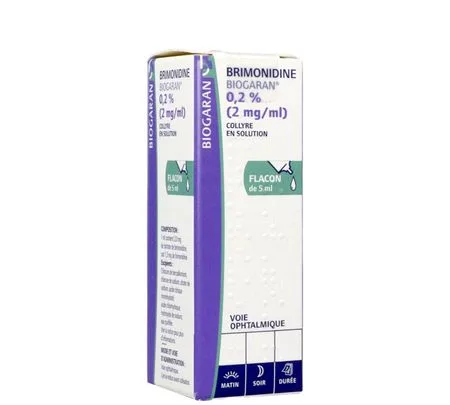
BRIMONIDINE BIOGARAN 0,2 % (2 mg/ml), eye drops, solution
Forms and presentations
Eye drops in solution.
Clear, slightly yellow-greenish solution, pH 5,5-6,5 and osmolality 275-350 mOsm/kg.
Composition
One millilitre of solution contains 2 mg of brimonidine tartrate, equivalent to 1,3 mg of brimonidine.
Excipient with known effect: benzalkonium chloride (0,05 mg/ml)
Benzalkonium chloride
Polyvinyl alcohol
Sodium chloride
Sodium citrate
Citric acid monohydrate
Hydrochloric acid (for pH adjustment)
Sodium hydroxide (for pH adjustment)
Purified water
Indications
Reduction of elevated intraocular pressure (IOP) in patients with open-angle glaucoma or ocular hypertension.
• As monotherapy in patients with a contraindication to topical beta-blockers.
• In combination with other intraocular pressure-lowering treatments in cases where monotherapy does not achieve the target IOP (see section Pharmacodynamics).
Dosage and administration
Dosage
Recommended dose in adults (including elderly patients)
The recommended dose is one drop of BRIMONIDINE BIOGARAN twice daily in the affected eye or eyes, the two instillations being spaced approximately 12 hours apart. Use of the eye drops in elderly patients does not require any dose adjustment.
Use in renal or hepatic impairment:
BRIMONIDINE BIOGARAN has not been studied in patients with renal or hepatic impairment (see section Warnings and precautions).
Paediatric population
No clinical studies have been conducted in adolescents (12 to 17 years).
BRIMONIDINE BIOGARAN is not recommended in children under 12 years and is contraindicated in newborns and infants (under 2 years) (see sections Contraindications, Warnings and precautions and Overdose). Serious adverse effects have been reported in newborns. In children aged 2 to 12 years, the safety and efficacy of BRIMONIDINE BIOGARAN have not been established
Method of administration
As with all eye drops, to reduce possible systemic absorption, it is recommended to press the lacrimal sac at the inner canthus (occlusion point) for one minute. This should be done immediately after the instillation of each drop. This may result in a decrease in systemic adverse effects and an increase in local activity. To avoid contamination of the eye or the eye drops, do not allow the tip of the bottle to come into contact with any surface.
When several topical ophthalmic products are used, the instillations of the different products should be spaced 5 to 15 minutes apart.
Contraindications
• Hypersensitivity to the active substance or to any of the excipients listed in section Composition.
• Newborns and infants (under 2 years) (see section Adverse effects).
• Patients receiving treatment with monoamine oxidase inhibitors (MAOIs) and patients on antidepressants affecting noradrenergic transmission (for example tricyclic antidepressants and mianserin).
Warnings and precautions
Cardiac disorders
Particular caution is required in patients with severe or unstable and uncontrolled cardiovascular disease.
Eye disorders
During clinical trials, some patients (12,7 %) experienced an ocular allergic-type reaction with brimonidine (see section Adverse effects). In the event of allergic reactions, treatment with BRIMONIDINE BIOGARAN must be discontinued.
Delayed ocular hypersensitivity reactions have been reported with brimonidine, some of which were associated with an increase in intraocular pressure.
Vascular disorders
BRIMONIDINE BIOGARAN should be used with caution in patients suffering from depression, cerebral or coronary insufficiency, Raynaud's phenomenon, orthostatic hypotension or thromboangiitis obliterans.
Renal and hepatic impairment
BRIMONIDINE BIOGARAN has not been studied in patients with hepatic or renal impairment. Particular caution is required when treating these patients.
Excipient
Benzalkonium chloride may be absorbed by soft contact lenses and change their colour. Remove contact lenses before application and wait at least 15 minutes before reinserting them.
Benzalkonium chloride is known to cause eye irritation, symptoms of dry eye syndrome, and may affect the tear film and corneal surface. Should be used with caution in patients with dry eye or those at risk of corneal damage. Patients should be monitored in case of prolonged use.
Paediatric population
Children aged 2 years or older, in particular those aged 2 to 7 years and/or weighing less than or equal to 20 kg, should be treated with caution and closely monitored because of the high incidence and severity of somnolence (see section Adverse effects).
Interactions
Brimonidine is contraindicated in patients treated with monoamine oxidase inhibitors (MAOIs) and in patients treated with antidepressants affecting noradrenergic transmission (for example tricyclic antidepressants and mianserin) (see section Contraindications).
Although no specific study of drug interactions with brimonidine has been conducted, the possibility of an additive or potentiating effect when taking central nervous system depressants (alcohol, barbiturates, opiates, sedatives or anaesthetics) must be considered.
No information is available regarding the level of circulating catecholamines after instillation of brimonidine. Consequently, vigilance is required in patients taking medicinal products that may affect the metabolism and uptake of circulating amines (for example: chlorpromazine, methylphenidate, reserpine).
Following instillation of brimonidine, clinically non-significant decreases in blood pressure have been observed in a few patients. Vigilance is required when BRIMONIDINE BIOGARAN is taken concomitantly with antihypertensives and/or cardiac glycosides.
Particular attention is recommended when initiating (or changing the dose of) concomitant systemic treatment (whatever the pharmaceutical form) that may interact with α-adrenergic agonists or interfere with their activity, such as adrenergic receptor agonists or antagonists (for example: isoprenaline, prazosin).
Fertility, pregnancy and breastfeeding
Pregnancy
The safety of use in pregnant women has not been established. In animal studies, brimonidine tartrate did not produce a teratogenic effect. In rabbits, brimonidine tartrate, at plasma concentrations higher than those obtained with treatment in humans, caused greater losses during the pre-implantation period and a reduction in postnatal growth. Brimonidine should only be used when the potential benefit to the mother outweighs the potential risk to the foetus. To reduce systemic absorption, see section Dosage and administration.
Breast-feeding
It has not been established whether brimonidine is excreted in human milk. The product is excreted in the milk of lactating rats. BRIMONIDINE BIOGARAN must not be used during breast-feeding.
Driving and using machines
Brimonidine may cause some tiredness and/or drowsiness that may impair the ability to drive or use machines. Brimonidine may cause blurred or abnormal vision that may impair the ability to drive or use machines, particularly at night or in reduced light. Patients should wait until these symptoms disappear before driving or using machines.
Adverse effects
The most commonly reported adverse events are: dry mouth, ocular hyperaemia, burning or stinging sensations, occurring in 25,9 to 31,2 % of patients. They are generally transient and rarely severe enough to require discontinuation of treatment.
In clinical studies, symptoms of ocular allergic reactions appeared in 12,7 % of patients (leading to treatment discontinuation in 11,5 % of patients) and occurred within 3 to 9 months of treatment in the majority of patients.
Within each category, adverse effects are presented in order of decreasing seriousness. The following terminology has been used to classify the frequency of adverse effects: very common (≥1/10); common (≥1/100 to <1/10); uncommon (≥1/1 000 to <1/100); rare (≥1/10 000 to <1/1 000); very rare (<1/10 000); frequency not known (cannot be estimated from the available data).
Table 1: Tabulation of the list of adverse effects
|
System organ class |
Frequency |
Adverse effects |
|
Immune system disorders |
Uncommon |
Systemic allergic reactions |
|
Psychiatric disorders |
Uncommon |
Depression |
|
Very rare |
Insomnia |
|
|
Nervous system disorders |
Very common |
Headache |
|
Common |
Vertigo Abnormal taste |
|
|
Eye disorders |
Very common |
Ocular hyperaemia Burning and stinging of the eyes Blurred vision Foreign body sensation Conjunctival follicles Pruritus Allergic eye reactions (including allergic blepharitis, allergic blepharoconjunctivitis, allergic conjunctivitis, allergic reaction and follicular conjunctivitis) |
|
Common |
Eyelid hyperaemia Eyelid oedema Blepharitis Conjunctival oedema Conjunctival discharge Ocular pain Lacrimation Photophobia Eyelid erythema Corneal erosion and staining Dry eye Conjunctival blanching Abnormal vision Conjunctivitis Eye irritation Conjunctival papillae |
|
|
Very rare |
Iritis Miosis |
|
|
Cardiac disorders |
Uncommon |
Palpitations/arrhythmias (including bradycardia and tachycardia) |
|
Vascular disorders |
Very rare |
Hypertension Hypotension |
|
Respiratory, thoracic and mediastinal disorders |
Common |
Upper respiratory tract symptoms |
|
Uncommon |
Nasal dryness |
|
|
Rare |
Dyspnoea |
|
|
Gastrointestinal disorders |
Very common |
Dry mouth |
|
Common |
Gastrointestinal symptoms |
|
|
General disorders and administration site conditions |
Very common |
Fatigue/somnolence |
|
Common |
Asthenia |
The following adverse reactions have been reported after marketing of brimonidine. As they were reported on the basis of spontaneous notifications in a population of unknown size, an estimate of their frequency could not be made.
Table 2: Adverse reactions identified during post-marketing surveillance
|
System organ class |
Adverse effects |
|
Eye disorders |
Iritis Iridocyclitis (anterior uveitis) Miosis Conjunctivitis Eyelid pruritus |
|
Skin and subcutaneous tissue disorders
|
Hypersensitivity Skin reaction including erythema, facial edema, pruritus, rash and vasodilatation |
|
Cardiac disorders |
Palpitations/arrhythmias (including bradycardia or tachycardia) |
|
Psychiatric disorders |
Depression |
|
Vascular disorders |
Hypotension Syncope |
Paediatric population
In cases where brimonidine was used as part of the medical treatment of congenital glaucoma, symptoms of brimonidine overdose such as loss of consciousness, lethargy, somnolence, hypotension, hypotonia, bradycardia, hypothermia, cyanosis, pallor, respiratory depression and apnoea have been reported in newborns and infants who had received brimonidine (see section Contraindications).
In a phase III study lasting 3 months, in children aged 2 to 7 years, with uncontrolled glaucoma under beta-blockers, a high prevalence (55%) of somnolence was reported with ALPHAGAN used in combination. In 8% of children, this was severe and led to treatment discontinuation in 13% of cases. The incidence of somnolence decreased with increasing age, being minimal in the group of subjects aged 7 years (25%), but it was more related to weight, occurring more frequently in children weighing less than or equal to 20 kg (63%) than in those weighing more than 20 kg (25%) (See section Warnings and precautions).
Reporting of suspected adverse reactions
Reporting suspected adverse reactions after authorisation of the medicinal product is important. It allows continued monitoring of the benefit/risk balance of the medicinal product. Healthcare professionals are asked to report any suspected adverse reaction via the national reporting system: National Agency for the Safety of Medicines and Health Products (ANSM) and the network of Regional Centres of Pharmacovigilance - Website: https://signalement.social-sante.gouv.fr/.
Overdose
Ophthalmic overdose (adults):
In such cases, the reported events have generally been listed among the adverse effects.
Systemic overdose resulting from accidental ingestion (adults):
There is very little information regarding accidental ingestion of brimonidine in adults. The only undesirable effect reported to date is hypotension. This hypotensive episode was followed by reactive hypertension.
Treatment of an oral overdose relies on symptomatic and supportive measures. The respiratory tract must be monitored.
Reported cases of oral overdose with other alpha-2 stimulants have been associated with the following symptoms: hypotension, asthenia, vomiting, lethargy, sedation, bradycardia, arrhythmias, miosis, apnoea, hypotonia, hypothermia, respiratory depression and convulsions.
Paediatric population
Notifications of serious adverse effects following accidental ingestion of brimonidine by children have been published or reported. The subjects presented with symptoms of central nervous system (CNS) depression, typically temporary coma or low level of consciousness, lethargy, somnolence, hypotonia, bradycardia, hypothermia, pallor, respiratory depression and apnoea, requiring admission to intensive care with intubation if necessary. Complete recovery was reported in all subjects, generally within 6 to 24 hours.
Pharmacodynamics
Pharmacotherapeutic class: antiglaucoma sympathomimetics, ATC code: S01EA05.
Brimonidine is an alpha-2 adrenergic receptor agonist 1000 times more selective for alpha-2 adrenergic receptors than for alpha-1 adrenergic receptors. Due to this selectivity, no mydriasis or microvascular vasoconstriction is observed, associated with human retinal xenografts.
Topical administration of brimonidine tartrate reduces intraocular pressure (IOP) in humans and affects cardiovascular or pulmonary parameters only minimally.
Limited data in patients with bronchial asthma have not revealed any harmful effect.
Brimonidine has a rapid onset of action; the maximum ocular hypotensive effect is observed two hours after administration. In 2 one-year clinical studies, the mean IOP reductions obtained with brimonidine were approximately between 4 and 6 mmHg.
Fluorophotometric studies conducted in animals and humans suggest that brimonidine tartrate has a dual mechanism of action. It is thought that brimonidine lowers IOP by reducing aqueous humour formation and by increasing aqueous humour outflow via the uveoscleral pathway.
Clinical studies show that brimonidine is effective in combination with topical beta-blockers. Shorter studies also showed that brimonidine has a clinically significant additional effect on IOP reduction in combination with travoprost (6 weeks) and with latanoprost (3 months).
Pharmacokinetics
Absorption
After ocular administration of a 0,2% solution twice daily for 10 days, plasma concentrations were low (mean Cmax equal to 0,06 ng/mL). A slight accumulation in blood was observed after multiple instillations (2 times daily for 10 days). The area under the plasma concentration-time curve over 12 hours at steady state (AUC0-12h) was equal to 0,31 ng•h/mL, compared with 0,23 ng•h/mL after the first dose. The mean apparent half-life in the systemic circulation was approximately 3 hours in humans after topical administration.
Distribution
In humans, the plasma protein binding rate of brimonidine after topical administration is approximately 29%.
Brimonidine is reversibly bound to melanin in ocular tissues, in vitro and in vivo. After 2 weeks of ocular instillations, brimonidine concentrations in the iris, ciliary body and retina-choroid were 3 to 17 times higher than those observed after a single instillation. There is no accumulation in the absence of melanin.
The significance of the binding to melanin in humans is poorly understood. However, no adverse ocular effects were found on biomicroscopic examination of the eyes of patients treated with brimonidine for periods of up to one year; likewise, no significant ocular toxicity was found during a one-year ocular tolerance study in monkeys receiving approximately four times the recommended dose of brimonidine tartrate.
Biotransformation
After oral administration in humans, brimonidine is well absorbed and rapidly eliminated. The major part of the dose (approximately 75 %) was excreted in the urine as metabolites within 5 days; less than 5 % of unmetabolised drug was detected in the urine based on a semi-quantitative thin-layer chromatography analysis. In vitro studies using animal and human liver show that metabolism largely involves aldehyde oxidase and cytochrome P450. Consequently, systemic elimination appears to be due primarily to hepatic metabolism.
Linearity/non-linearity
Following a single ocular instillation of the 0,08 %, 0,2 % and 0,5 % concentrations, no significant deviation from linearity of the absorption kinetics (measured by plasma Cmax and AUC) is observed.
Elderly patients
In elderly patients (subjects aged 65 years or older), the Cmax, area under the curve (AUC) and apparent half-life of brimonidine are similar, after a single instillation, to those observed in young adults, indicating that age does not influence the systemic absorption and elimination of the product.
According to data from a 3-month clinical study that included elderly patients, systemic exposure to brimonidine was very low.
Preclinical safety
Non-clinical data from conventional safety pharmacology, repeated-dose toxicity, genotoxicity, carcinogenesis, and reproductive and developmental function studies did not reveal any particular risk for humans.
SPECIAL PRECAUTIONS FOR DISPOSAL AND OTHER HANDLING
Any unused medicinal product or waste material should be disposed of in accordance with local requirements.
Prescription, supply and reimbursement
| Marketing authorisation (AMM) |
|
| Price: |
|
- Indication(s) appearing in the marketing authorisation at the date of publication of this decree
Collection.
15 BOULEVARD CHARLES DE GAULLE
92707 COLOMBES CEDEX
Tel: 01 55 72 41 00 contact@biogaran.fr
https://www.biogaran.fr
Source: VIDAL · Updated on 10/11/2026. This information does not replace advice from a healthcare professional.