
Medicines
Update of 24/03/2023
BRICANYL 5 mg/2 ml solution for inhalation by nebulizer
terbutaline
Forms and presentations
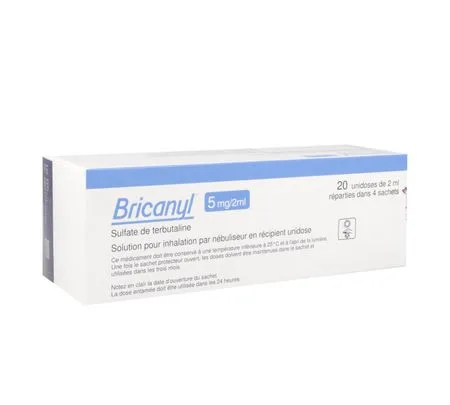
Solution for inhalation by nebulizer: Single-dose containers of 2 ml, under sachets of 5, box of 20.Composition
| per single dose | |
| Terbutaline (INN) sulfate
|
5 mg |
Indications
- Symptomatic treatment of severe acute asthma;
- Treatment of acute exacerbations of chronic obstructive pulmonary disease in adults;
Note: severe acute asthma requires hospitalization in an intensive care unit.
Oxygen therapy and systemic corticosteroid therapy must be combined with bronchodilator treatment.
Dosage and administration
Dosage- Adults:
- 5 to 10 mg, i.e. 1 to 2 doses of 2 ml per nebulization.
- Child and infant:
- 0,1 to 0,2 mg/kg per nebulization.
Any dose begun must be used within 24 hours.
The nebulization may be repeated every 20 to 30 minutes depending on the clinical result and tolerance of the treatment.
Cost of daily treatment: 0,27 to 0,54 euro(s).Method of administration:
This terbutaline solution must be administered by inhalation using a nebulization device (nebulizer).
Do not inject. Do not swallow.
Follow the instructions for use of the device used.
Dilute the required quantity of terbutaline in physiological saline so as to obtain a total volume of 4 to 5 ml.
The resulting mixture is nebulised by a flow of air or oxygen (6 to 8 litres/minute) for approximately 10 to 15 minutes during which the patient breathes at their usual rate.
The technique of use by the patient must be checked regularly.
After inhalation, the unused solution remaining in the nebuliser reservoir must be discarded.
Contraindications
- Intolerance to this medicine (occurrence of cough or bronchospasm after inhaling the product). In this case, treatment should be discontinued and other therapies or other forms of administration prescribed.
- Hypersensitivity to the active substance or to any of the excipients listed in section Composition.
Warnings and precautions
Warnings:
Administration of terbutaline via a nebuliser should be reserved for severe acute situations requiring inhalation of a high dose of the product by the inhaled route.
These situations require medical monitoring with the possibility of setting up resuscitation (venous access and respiratory assistance); oxygen therapy and systemic corticosteroid therapy should generally be associated with them.
It is necessary to combine continuous anti-inflammatory treatment such as inhaled corticosteroids or leukotriene receptor antagonists in patients with persistent asthma for whom continuous treatment with beta-2-mimetics is required.
Patients must be informed that they must continue the prescribed background anti-inflammatory treatment even if symptoms and their use of Bricanyl 5 mg/2 mL nebuliser solution for inhalation decrease. A decrease in the response usually obtained on symptoms with treatment is a sign of worsening asthma that requires medical consultation in order to reassess asthma treatment.
Excessive use of short-acting beta-agonists may mask the progression of the underlying disease and contribute to deterioration of asthma control, leading to an increased risk of severe asthma exacerbations and mortality.
If terbutaline is used as rescue treatment "on demand" more than twice a week, the background treatment must be reassessed and adjusted due to the risk of excessive use of terbutaline.
Athletes should be made aware that this product contains an active substance that may induce a positive reaction in tests carried out during anti-doping controls.
Cardiovascular effects may be observed with sympathomimetic medicines, including Bricanyl. Cases from the literature and post-marketing experience have revealed the occurrence of rare cases of myocardial ischaemia associated with the use of beta-2-mimetics. Patients treated with Bricanyl and presenting with severe cardiac conditions (ischaemic heart disease, arrhythmia or severe heart failure) must be advised to seek medical advice if they experience chest pain or any other symptom indicating worsening of their cardiac condition. Particular attention should be paid to symptoms such as dyspnoea or chest pain, as these may be of respiratory or cardiac origin.
Precautions for useIn case of bronchial infection or abundant bronchorrhea, appropriate treatment is necessary in order to promote optimal distribution of the product in the airways.
This medicine should be administered with caution in cases of hyperthyroidism, cardiovascular disorders, in particular obstructive cardiomyopathy, coronary disorders, rhythm disorders, arterial hypertension, and in cases of diabetes mellitus.
Beta-2-mimetics at high doses may cause hypokalaemia, which may favour the occurrence of cardiac rhythm disorders. Monitoring of kaliaemia is recommended where possible, in particular when hypokalaemic therapies are administered simultaneously, in cases of hypoxia or in subjects at increased risk of torsades de pointes (long QT or treatments likely to increase QTc).
Beta-blockers (including those in the form of eye drops) may partially or completely inhibit the effect of beta-2-stimulants.
Interactions
- Halothane: in case of obstetric intervention, increased uterine inertia with risk of haemorrhage; furthermore, risk of occurrence of serious ventricular rhythm disorders, due to increased cardiac reactivity. Interrupt treatment with beta-2-mimetics if anaesthesia must be performed under halothane.
- Antidiabetics: elevation of blood glucose through beta-stimulant effect. Reinforce blood and urine monitoring. Possibly switch to insulin.
- Agents causing potassium depletion: due to the hypokalaemic effect of beta-2-mimetics, concomitant administration of agents causing potassium depletion known to aggravate the risk of hypokalaemia, such as diuretics, digoxin, methylxanthines and corticosteroids, should be carried out with caution after a careful assessment of benefits and risks, with particular attention to the increased risk of cardiac arrhythmias resulting from hypokalaemia (see Warnings and Precautions for Use). Hypokalaemia also predisposes to digoxin toxicity.
Fertility, pregnancy and breastfeeding
Pregnancy:Clinically, there is substantial experience, with a sufficient number of documented pregnancies, to conclude on the safety of terbutaline during pregnancy.
Consequently, inhaled terbutaline may be administered during pregnancy.
When administered during pregnancy: an acceleration of foetal heart rate may be observed in parallel with maternal tachycardia. It is exceptional for this to persist at birth.
Similarly, post-natal blood glucose values are only exceptionally disturbed.
Bricanyl 5 mg/2 mL nebuliser solution for inhalation, used in the treatment of asthma and other pulmonary conditions, is a tocolytic agent and must therefore be used with caution at the end of pregnancy.
In case of administration before delivery, take into account the peripheral vasodilator effect of beta-2-mimetics.
Breastfeeding:
Beta-2-mimetics pass into breast milk.
Adverse effects
The severity of adverse effects depends on the dosage and route of administration. Terbutaline prescribed by inhalation is unlikely to produce significant systemic effects when administered at the recommended doses. Most of these effects are characteristic of sympathomimetic amines. The majority of these effects were spontaneously reversible during the first two weeks of treatment.
Frequencies are defined according to the following convention: very common: ≥ 1/10; common: ≥ 1/100 and < 1/10; uncommon: < 1/1000 and ≥ 1/10 000; not known: reported spontaneously in post-marketing data, the frequency is therefore considered not known.
| System Organ Class | |
| Frequency | Adverse effects |
| Nervous system disorders | |
| Very common | Headache, tremor of the extremities |
| Cardiac disorders | |
| Common | Tachycardia, palpitations |
| Not known | Heart rhythm disorders, in particular atrial fibrillation, supraventricular tachycardia and atrial or ventricular extrasystoles, myocardial ischaemia |
| Musculoskeletal and systemic disorders | |
| Common | Muscle cramps |
| Metabolism and nutrition disorders | |
| Common | Hypokalaemia, increased blood glucose |
| Rare | Lactic acidosis |
| Gastrointestinal disorders | |
| Not known | Nausea |
| Psychiatric disorders | |
| Not known | Sleep disorders and behavioural disorders: agitation, nervousness, hyperactivity |
| Respiratory, thoracic and mediastinal disorders | |
| Not known | Bronchospasm*, cough* |
| Skin and subcutaneous tissue disorders | |
| Not known | Erythematous rash, urticaria, exanthema |
Reporting of suspected adverse reactions:
Reporting suspected adverse reactions after authorisation of the medicinal product is important. It allows continuous monitoring of the benefit/risk balance of the medicinal product. Healthcare professionals should report any suspected adverse reaction via the national reporting system: National Agency for the Safety of Medicines and Health Products (ANSM) and the network of Regional Pharmacovigilance Centres. Website: https://signalement.social-sante.gouv.fr.
Overdose
In case of overdose: the risks of tachycardia and cardiac arrhythmia, changes in blood pressure, tremors, sweating, agitation, nausea, and hypokalaemia are increased.
Pharmacodynamics
Pharmacotherapeutic class: Selective beta-2-adrenergic agonists (ATC code: R03AC03).
Beta-2-mimetic bronchodilator with rapid onset and short duration of action, administered by inhalation.
Terbutaline is a selective beta-2 receptor agonist.
After inhalation, terbutaline exerts a stimulating action on the beta-2 receptors of bronchial smooth muscle, thus providing rapid bronchodilation, significant within a few minutes, lasting for 4 to 6 hours.
Pharmacokinetics
After repeated nebulisations, the plasma concentrations observed at therapeutic doses are not negligible but remain lower than those observed orally or by injection.
There is no correlation between the blood level and the efficacy curve.
After pulmonary absorption, terbutaline is weakly bound to plasma proteins.
It is metabolised in the liver into sulfoconjugated derivatives, which are eliminated in the urine.
Storage conditions
- Shelf life before opening of the sachet:
- 3 years.
Store at a temperature below 25 °C and protect from light.
- Shelf life after opening of the sachet:
- 3 months.
Once the protective sachet is opened, the doses must be kept in the sachet and used within three months. Clearly note the date the sachet was opened.
The dose that has been started must be used within 24 hours.
HANDLING/DISPOSAL INSTRUCTIONS
No special requirements.
Prescription, supply and reimbursement
LIST I| Medicinal product subject to prescription restricted to specialists in pneumology or paediatrics. Medicinal product that may be administered by any physician intervening in an emergency situation or within the framework of a mobile medical assistance or health repatriation structure (article R.5121-96 of the French Public Health Code). | |
| Marketing authorisation (AMM) | 3400936573215 (2004, SmPC rev 27.02.2023). |
| Price: | 5,40 euros (20 single-dose units). |
| Reimbursed by Social Security at 65 %. Collective. | |
AstraZeneca
Tour Carpe Diem. 31, place des Corolles
92400 Courbevoie
Tel: 01 41 29 40 00. Fax: 01 41 29 40 01
Medical Information, Pharmacovigilance, Product Quality Complaints:
https://medicalinformation.astrazeneca.com
https://www.astrazeneca.fr
To place an emergency supply order:
Email: ADV.France@astrazeneca.com
Fax: 01 41 29 40 61
Source: VIDAL · Updated on 10/11/2026. This information does not replace advice from a healthcare professional.