
Medicines
SmPC of 11/03/2026
BETASERC 24 mg, tablet
Forms and presentations
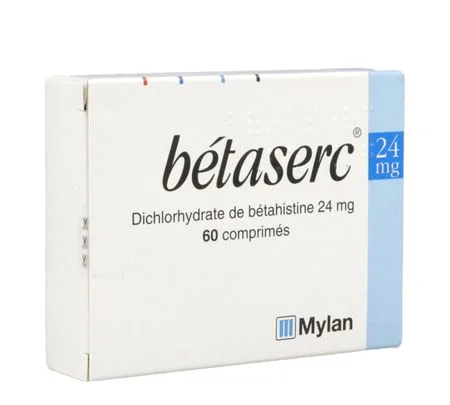
Off-white, round, biconvex, scored and bevelled tablet. Its diameter is 10 mm and its weight is 375 mg. 289 is engraved on one of the two sides of the bevel.
The break bar is only intended to make it easier to take the tablet; it does not divide it into equal doses.
Composition
Betahistine dihydrochloride................................................................................................................24,00 mg
Equivalent to 15,63 mg of betahistine
For one tablet
Microcrystalline cellulose, mannitol, citric acid monohydrate, anhydrous colloidal silica, talc, L-cysteine hydrochloride monohydrate, propyl gallate.
Dosage and administration
Dosage
This form is reserved for patients requiring a dosage of 48 mg per day of betahistine. In other cases, use a lower dosage.
BETASERC 24 mg, tablet to be administered at a dose of 1 tablet 2 times per day, preferably in the middle of a meal.
Paediatric population
The use of BETASERC 24 mg in children and adolescents under 18 years of age is not recommended due to the absence of data on safety and efficacy.
Elderly patients
As available data are limited, betahistine should be used with caution in elderly subjects.
Renal impairment
There is no data available in patients with renal impairment.
Hepatic impairment
There is no data available in patients with hepatic impairment.
Duration of treatment
The recommended duration of treatment is 2 to 3 months, to be renewed if necessary depending on the course of the disease, in continuous or discontinuous courses.
Method of administration
Tablets must be swallowed without chewing, with a glass of water.
Contraindications
• Hypersensitivity to the active substance or to any of the excipients listed in section Composition.
• Pheochromocytoma.
Warnings and precautions
In asthmatic patients, administration of betahistine requires particular monitoring (risk of bronchoconstriction).
In patients with a history of gastroduodenal ulcer, administration of betahistine requires particular monitoring throughout the duration of treatment.
Taking the medicine in the middle of meals helps to avoid gastralgia.
Betahistine is not the appropriate treatment for the following conditions:
• benign paroxysmal vertigo,
• vertigo related to a disorder of the central nervous system.
Interactions
No interaction studies in vivo was carried out. According to the data in vitro, no inhibition of the cytochrome P450 enzymes is expected in vivo.
The data in vitro show an inhibition of betahistine metabolism by monoamine oxidase inhibitors (MAOIs), including MAO-B inhibitors (such as selegiline). Particular caution is recommended when betahistine is used concomitantly with MAOIs (especially selective MAO-B inhibitors).
Since betahistine is an analogue of histamine, taking betahistine with antihistamines may theoretically affect the efficacy of one of the medicines.
Fertility, pregnancy and breastfeeding
Pregnancy
There are no sufficient data on the use of betahistine in pregnant women.
Studies performed in animals have not shown any direct or indirect harmful effects on reproduction at clinically relevant therapeutic doses. As a precaution, it is preferable to avoid the use of betahistine during pregnancy.
Breast-feeding
The excretion of betahistine in human milk is not known.
Betahistine passes into milk in rats. The effects observed post-partum in animal studies were limited to very high doses. The benefit of initiating treatment in a breastfeeding woman should be weighed against the benefits of breastfeeding and the potential risks for the child.
Fertility
Animal studies have not shown an effect on fertility in rats.
Driving and using machines
Betahistine is indicated for the symptomatic treatment of recurrent vertigo with or without cochlear signs. These symptoms may impair the ability to drive vehicles and use machines. In clinical trials specifically designed to study effects on the ability to drive vehicles and use machines, betahistine showed no effect or a negligible effect.
Adverse effects
The following adverse reactions were observed in patients treated with betahistine in placebo-controlled clinical trials with the frequencies indicated below [very common (≥ 1/10); common (≥ 1/100 to < 1/10); uncommon (≥ 1/1000 to < 1/100); rare (≥ 1/10000 to < 1/1000); very rare (< 1/10000)].
Gastrointestinal disorders
Common: nausea and dyspepsia.
Nervous system disorders
Common: headache.
In addition to these events observed during clinical trials, the following adverse reactions have been reported spontaneously during the post-marketing phase of the medicinal product and in the scientific literature. Their frequency cannot be estimated from the available data (frequency not known).
Blood and lymphatic system disorders
Thrombocytopenia.
Immune system disorders
Hypersensitivity reactions (cases of anaphylaxis have been reported).
Gastrointestinal disorders
Mild gastric disorders have been reported (such as gastralgia, vomiting, dry mouth, diarrhoea, abdominal pain, abdominal distension and bloating). These effects are generally resolved by taking the tablet during a meal or by reducing the dose.
Skin and subcutaneous tissue disorders
Cutaneous and subcutaneous hypersensitivity reactions have been observed, in particular Quincke's oedema, urticaria, rash and pruritus.
Reporting of suspected adverse reactions
Reporting suspected adverse reactions after authorisation of the medicinal product is important. It allows continued monitoring of the benefit/risk balance of the medicinal product. Healthcare professionals are asked to report any suspected adverse reaction via the national reporting system: National Agency for the Safety of Medicines and Health Products (ANSM) and the network of Regional Centres of Pharmacovigilance - Website: https://signalement.social-sante.gouv.fr/.
Overdose
Some cases of overdose have been reported. Some patients experienced mild to moderate symptoms with doses up to 640 mg (such as nausea, drowsiness, abdominal pain). More serious complications (such as convulsions, cardiac or pulmonary complications) have been observed, notably in cases of deliberate overdose of betahistine in combination with high doses of other medicinal products. Overdose should be treated with the usual corrective measures.
Pharmacodynamics
Pharmacotherapeutic group: Antivertigo preparations, ATC code: N07CA01.
Mechanism of action
The mechanism of action of betahistine is only partially known. Several hypotheses have been considered based on animal studies and data in humans:
• Betahistine modifies the histaminergic system: betahistine acts both as a partial agonist of histaminergic H1 receptors and as an antagonist of histaminergic H3 receptors, also in neuronal tissue, and has negligible action on H2 receptors. Betahistine increases the turnover and release of histamine by blocking presynaptic H3 receptors and by reducing the number of H3 receptors.
• Betahistine may increase blood flow in the cochlear region as well as throughout the brain: pharmacological tests in animals have shown that blood circulation is improved in the stria vascularis of the inner ear, probably through relaxation of the precapillary sphincters of the inner ear microcirculation. An increase in cerebral blood flow by betahistine has also been shown in humans.
• Betahistine facilitates vestibular compensation: betahistine accelerates vestibular recovery after unilateral neurectomy in animals, by promoting and facilitating central vestibular compensation; this effect, characterised by an increase in the turnover and release of histamine, is achieved via antagonism of H3 receptors. In humans, the recovery time after vestibular neurectomy has also been reduced during treatment with betahistine.
• Betahistine modifies neuronal discharges in the vestibular nuclei: betahistine has been shown to have a dose-dependent inhibitory effect on the occurrence of neuronal action potentials in the medial and lateral vestibular nuclei.
In vitro, betahistine facilitates histaminergic transmission through its partial agonist effect on H1 receptors, and an antagonist effect on H3-type receptors.
Betahistine decreases the electrical activity of polysynaptic neurons of the vestibular nuclei after intravenous administration in animals.
Betahistine has no sedative effect. The pharmacological properties demonstrated in animals may contribute to the therapeutic effect of betahistine in the vestibular system.
Clinical efficacy and safety
The efficacy of betahistine has been demonstrated in clinical studies in patients with vestibular vertigo or Ménière's disease, through improvement in the severity and frequency of vertigo attacks.
Pharmacokinetics
Absorption
When administered orally, betahistine is rapidly and almost completely absorbed throughout the gastrointestinal tract. After absorption, the substance is rapidly and almost completely metabolised to 2-pyridyl acetic acid (2-PAA). Plasma concentrations of betahistine are very low. Pharmacokinetic data are therefore based on urinary and plasma levels of 2-PAA. When betahistine is taken during a meal, the Cmax is lower than when taken fasting. However, the amounts of betahistine absorbed are similar under both conditions, indicating that food intake only slows the absorption of betahistine.
Distribution
Plasma protein binding is less than 5%.
Biotransformation
After absorption, betahistine is rapidly and almost completely metabolised to 2-PAA (which has no pharmacological activity). After oral administration of betahistine, the plasma (and urinary) concentration of 2-PAA reaches its maximum 1 hour after administration and decreases with a half-life of approximately 3,5 hours.
Elimination
2-PAA is rapidly excreted in the urine. For an oral dose between 8 and 48 mg, approximately 85% of the initial dose is recovered in the urine. Renal and faecal elimination of betahistine is minor.
Linearity/non-linearity
For an oral dose between 8 and 48 mg, the levels recovered are constant, suggesting that the pharmacokinetics of betahistine are linear and that the metabolic pathway involved is not saturated.
Preclinical safety
Chronic toxicity
Adverse effects on the central nervous system have been observed in dogs and baboons at intravenous doses greater than or equal to 120 mg/kg.
Chronic oral toxicity studies over 18 months in rats at a dose of 500 mg/kg and over 6 months in dogs at a dose of 25 mg/kg showed that betahistine is well tolerated and without definitive toxicity
Mutagenic and carcinogenic potential
Betahistine has no mutagenic potential.
In a chronic toxicity study conducted over 18 months in rats, no carcinogenic potential of betahistine was demonstrated at doses up to 500 mg/kg.
Reproductive toxicity
In reproductive toxicity studies, effects were observed only at exposures considered sufficiently greater than the maximum doses in humans, which is of little relevance in clinical use.
Prescription, supply and reimbursement
| Marketing authorisation (AMM) |
|
| Price: |
|
Collection.
1 RUE DE TURIN
69007 LYON
Tel: 04 37 25 75 00 https://www.viatris.fr/
Source: VIDAL · Updated on 10/11/2026. This information does not replace advice from a healthcare professional.