
Medicines
SmPC of 28/03/2022
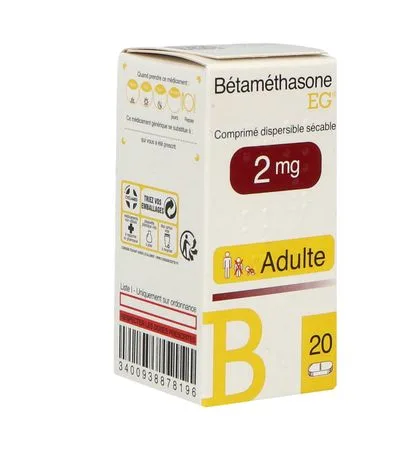
BETAMETHASONE EG 2 mg, scored dispersible tablet
Composition
Betamethasone..........................................................................................................................................2,00 mg
For a scored dispersible tablet.
Excipients with known effect: lactose monohydrate, aspartame.
Granules based on lactose monohydrate and cellulose powder 75/25, crospovidone, aspartame, magnesium stearate.
Indications
INDICATIONS OR DISEASES:
I-COLLAGENOSES - CONNECTIVE TISSUE DISEASES
Evolutive flares of systemic diseases, notably: disseminated lupus erythematosus, vasculitis, polymyositis, visceral sarcoidosis
II-DERMATOLOGICAL
a-severe autoimmune bullous dermatoses, in particular pemphigus and bullous pemphigoid
b-severe forms of infantile haemangiomas
c-certain forms of lichen planus
d-certain acute urticarias
e-severe forms of neutrophilic dermatoses
III- DIGESTIVE
a-evolutive flares of ulcerative colitis and Crohn's disease
b-chronic active autoimmune hepatitis (with or without cirrhosis)
c-severe acute alcoholic hepatitis, histologically proven
IV-ENDOCRINE
a-severe subacute De Quervain thyroiditis
b-certain hypercalcaemias
V- HAEMATOLOGICAL
a-severe immunological thrombocytopenic purpuras
b-autoimmune haemolytic anaemias
c-in association with various chemotherapies in the treatment of lymphoid malignant haemopathies
d-acquired or congenital chronic erythroblastopenias
VI-INFECTIOUS
a-tuberculous pericarditis and severe forms of tuberculosis threatening the vital prognosis
b-Pneumocystis carinii pneumonia with severe hypoxia
VII-NEOPLASTIC
a-antiemetic treatment during antineoplastic chemotherapy
b-edematous and inflammatory flare associated with antineoplastic treatments (radiotherapy and chemotherapy)
VIII-NEPHROLOGICAL
a-nephrotic syndrome with minimal change glomerular lesions
b-nephrotic syndrome of primary focal and segmental glomerulosclerosis
c-stage III and IV lupus nephropathy
d-intrarenal granulomatous sarcoidosis
e-vasculitides with renal involvement
f-primary extracapillary glomerulonephritis
IX-NEUROLOGICAL
a-myasthenia
b-cerebral edema of tumoral cause
c-chronic, idiopathic, inflammatory polyradiculoneuritis
d-infantile spasms (West syndrome) / Lennox-Gastaut syndrome
e-relapsing multiple sclerosis, following intravenous corticosteroid therapy
X-OPHTHALMOLOGICAL
a-severe anterior and posterior uveitis
b-edematous exophthalmos
c-certain optic neuropathies, following intravenous corticosteroid therapy (in this indication, oral route as first-line treatment is not recommended)
XI-ENT
a-certain serous otitis media
b-nasosinusal polyposis
c-certain acute or chronic sinusitis
d-seasonal allergic rhinitis in short courses
e-acute stridulous laryngitis (subglottic laryngitis) in children
XII-RESPIRATORY
a-persistent asthma, preferably in short courses in case of failure of high-dose inhaled treatment
b-asthma exacerbations, in particular severe acute asthma
c-chronic obstructive pulmonary disease in assessment of the reversibility of the obstructive syndrome
progressive sarcoidosis
diffuse interstitial pulmonary fibroses
XIII-RHEUMATOLOGICAL
a-rheumatoid arthritis and certain polyarthritides
b-polymyalgia rheumatica and giant cell arteritis (Horton's disease)
c-acute rheumatic fever
d-severe and refractory cervicobrachial neuralgias
XIV-ORGAN AND ALLOGENEIC HEMATOPOIETIC STEM CELL TRANSPLANTATION
a-prophylaxis or treatment of graft rejection
b-prophylaxis or treatment of graft-versus-host disease
Dosage and administration
Oral use.
- anti-inflammatory equivalence (equipotence) for 5 mg of prednisone: 0,75 mg of betamethasone;
- the tablets may be swallowed as they are with a little water or dissolved in a little water, preferably during meals.
FOR ADULTS ONLY
This medicine is more particularly suited to loading treatments or short-term treatments requiring medium or high doses in adults.
For maintenance treatment, more appropriate dosages exist.
In children, more suitable dosages and pharmaceutical forms exist.
The dosage varies depending on the diagnosis, the severity of the condition, the prognosis, the patient's response and tolerance to treatment.
Loading treatment: from 0,05 mg to 0,2 mg/kg/day (i.e. 0,35 mg to 1,2 mg/kg/day prednisone equivalent). For information only: 1,5 to 6 tablets in an adult of 60 kg.
During severe inflammatory diseases, the dosage varies from 0,1 to 0,2 mg/kg/day of betamethasone (0,75 mg/kg/day to 1,2 mg/kg/day prednisone equivalent). For information only: 3 to 6 tablets per day for an adult of 60 kg.
Some very exceptional situations may require higher doses.
IN GENERAL
The "loading dose" treatment must be continued until sustained control of the disease. The dose reduction must be slow. Achieving withdrawal is the aim sought. Maintaining a maintenance dose (minimum effective dose) is a compromise that is sometimes necessary.
For prolonged treatment and high doses, the initial doses may be divided into two daily intakes. Subsequently, the daily dose may be administered as a single intake, preferably in the morning during a meal.
Discontinuation of treatment
The pace of withdrawal depends mainly on the duration of treatment, the starting dose and the disease.
The treatment results in suppression of ACTH and cortisol secretion, sometimes with lasting adrenal insufficiency. During withdrawal, discontinuation must be gradual, in steps, due to the risk of relapse: reduction of 10% every 8 to 15 days on average.
For short courses of less than 10 days, stopping the treatment does not require tapering.
During dose reduction (prolonged course): at a dosage of 5 to 7 mg prednisone equivalent, when the underlying disease no longer requires corticosteroid therapy, it is advisable to replace the synthetic corticosteroid with 20 mg/day of hydrocortisone until recovery of corticotropic function. If corticosteroid therapy must be maintained at a dose below 5 mg prednisone equivalent per day, a small dose of hydrocortisone may be added to achieve a hydrocortisone equivalent of 20 to 30 mg per day. When the patient is only on hydrocortisone, the corticotropic axis may be tested by endocrine tests. These tests alone do not rule out the possibility of adrenal insufficiency occurring during stress.
Under hydrocortisone or even at a distance from discontinuation, the patient must be warned of the need to increase the usual dose or to resume a substitution treatment (for example 100 mg of hydrocortisone intramuscularly every 6 to 8 hours) in case of stress: surgical intervention, trauma, infection.
Contraindications
This medicine is generally contraindicated in the following situations:
(However, there is no absolute contraindication for corticosteroid therapy with a vital indication):
- any infectious state excluding the specified indications (see section Indications) ;
- certain active viral infections (notably hepatitis, herpes, chickenpox, shingles);
- psychotic states not yet controlled by treatment;
- live vaccines;
- hypersensitivity to any of the constituents;
- phenylketonuria (related to the presence of aspartame).
This medicine is generally not recommended in combination
With non-antiarrhythmic medicines causing torsades de pointes (see section Interactions).
Warnings and precautions
Special warnings
- in case of gastroduodenal ulcer, corticosteroid therapy is not contraindicated if anti-ulcer treatment is associated.
- in case of a history of ulcers, corticosteroid therapy may be prescribed, with clinical monitoring and, if necessary, after fibroscopy.
- corticosteroid therapy may promote the occurrence of various infectious complications due in particular to bacteria, yeasts and parasites. The occurrence of malignant strongyloidiasis is a significant risk.
All subjects coming from an endemic area (tropical, subtropical regions, southern Europe) must have a stool parasitological examination and systematic eradication treatment before corticosteroid therapy.
Evolving signs of infection may be masked by corticosteroid therapy.
Before starting treatment, it is important to rule out any possibility of a visceral focus, notably tuberculosis, and to monitor during treatment for the appearance of infectious pathologies.
In case of past tuberculosis, prophylactic anti-tuberculosis treatment is necessary if there are significant radiological sequelae and if one cannot ensure that a well-conducted treatment of 6 months with rifampicin has been given.
- the use of corticosteroids requires particularly appropriate monitoring, especially in elderly subjects and in cases of ulcerative colitis (risk of perforation), recent intestinal anastomoses, renal insufficiency, hepatic insufficiency, osteoporosis, myasthenia gravis.
A pheochromocytoma crisis, which may be fatal, has been reported after administration of systemic corticosteroids. Corticosteroids must not be administered to patients in whom a pheochromocytoma is suspected or confirmed until an appropriate benefit/risk assessment has been made.
Precautions for use
In case of long-term corticosteroid treatment:
- a diet low in rapidly absorbed sugars and high in protein must be associated, because of the hyperglycaemic effect and protein catabolism with a negative nitrogen balance;
- sodium and water retention is usual, partly responsible for a possible increase in blood pressure. Sodium intake will be reduced for daily doses greater than 15 or 20 mg of prednisone equivalent and moderated in long-term treatments at low doses;
- potassium supplementation is justified only for high-dose treatments, prescribed for a long duration, or in case of risk of rhythm disorders or associations with a hypokalaemic treatment;
- the patient must systematically have an intake of calcium and vitamin D;
- when corticosteroid therapy is essential, diabetes and arterial hypertension are not contraindications but the treatment may lead to their decompensation. Their management should be reassessed;
- patients must avoid contact with subjects who have chickenpox or measles.
Visual disturbances may occur during systemic or local corticosteroid therapy (notably by nasal, inhaled and intra-ocular route). In case of blurred vision or appearance of any other visual symptom during corticosteroid therapy, an ophthalmological examination is required to look for visual disorders, notably cataract, glaucoma, or a rarer lesion such as central serous chorioretinopathy, described with the administration of corticosteroids by systemic or local route.
Excipients with known effect
This medicine contains 2,00 mg of aspartame per scored dispersible tablet. Aspartame contains a source of phenylalanine. It may be harmful for people with phenylketonuria (PKU), a rare genetic disease characterised by the accumulation of phenylalanine that cannot be properly eliminated.
This medicine contains lactose. Patients with galactose intolerance, total lactase deficiency or glucose-galactose malabsorption syndrome (rare hereditary diseases) must not take this medicine.
Interactions
Combinations not recommended
+ Medicines causing torsades de pointes (astemizole, bepridil, intravenous erythromycin, halofantrine, pentamidine, sparfloxacin, sultopride, terfenadine, vincamine)
Use substances that do not carry the risk of causing torsades de pointes in cases of hypokalaemia.
+ CYP3A inhibitors
Concomitant administration of CYP3A inhibitors, including products containing cobicistat, is expected to increase the risk of systemic side effects. The combination should be avoided, unless the benefits outweigh the increased risk of systemic side effects of corticosteroids; in this case, patients should be monitored for possible systemic side effects of corticosteroids.
Associations subject to Precautions for use
+ Acetylsalicylic acid by general route and, by extrapolation, other salicylates
Decrease in salicylaemia during treatment with corticoids and risk of salicylate overdose after its discontinuation, due to increased elimination of salicylates by corticoids.
Adjust salicylate doses during the combination and after discontinuation of corticoid treatment.
+ Antiarrhythmics causing torsades de pointes (amiodarone, bretylium, disopyramide, quinidine-like agents, sotalol)
Hypokalaemia is a predisposing factor, as are bradycardia and a pre-existing long QT interval.
Prevent hypokalaemia and correct it if necessary; monitor the QT interval. In case of torsades, do not administer an antiarrhythmic (electrical overdrive pacing).
+ Oral anticoagulants
Possible impact of corticotherapy on the metabolism of oral anticoagulants and on that of coagulation factors.
Corticosteroid-specific bleeding risk (gastrointestinal mucosa, vascular fragility) at high doses or with prolonged treatment longer than 10 days.
When the combination is justified, strengthen monitoring: biological check on day 8, then every 15 days during corticosteroid treatment and after its discontinuation.
+ Other potassium-lowering agents (potassium-depleting diuretics alone or in combination, stimulant laxatives, amphotericin B (intravenous route))
Increased risk of hypokalaemia through additive effect.
Monitor serum potassium and correct if necessary, especially in cases of digitalis therapy.
+ Digitalis glycosides
Hypokalaemia favouring the toxic effects of digitalis.
Monitor serum potassium, correct if necessary, and possibly ECG.
+ Heparins by parenteral route
Increased by heparin of the corticosteroid-specific bleeding risk (gastrointestinal mucosa, vascular fragility) at high doses or with prolonged treatment longer than 10 days.
The combination must be justified; reinforce monitoring.
+ Enzyme inducers
Carbamazepine, phenobarbital, phenytoin, primidone, rifabutin, rifampicin.
Decrease in plasma levels and efficacy of corticosteroids through increased hepatic metabolism. The consequences are particularly significant in Addisonian patients and in cases of transplantation.
Clinical and biological monitoring, adjustment of the corticosteroid dosage during the combination and after discontinuation of the enzyme inducer.
+ Insulin, metformin, hypoglycaemic sulfonylureas
Elevation of blood glucose, sometimes with ketosis (decreased glucose tolerance caused by corticosteroids).
Inform the patient and reinforce blood and urine self-monitoring, especially at the start of treatment.
Possibly adjust the antidiabetic dosage during corticosteroid treatment and after its discontinuation.
+ Isoniazid (described for prednisolone)
Decrease in plasma levels of isoniazid. Proposed mechanism: increased hepatic metabolism of isoniazid and decreased metabolism of glucocorticoids.
Clinical and biological monitoring.
+ Gastrointestinal topicals
Salts, oxides and hydroxides of magnesium, aluminium and calcium (described for prednisolone and dexamethasone).
Decreased digestive absorption of glucocorticoids.
Take gastrointestinal topicals at a distance from glucocorticoids (more than 2 hours if possible).
Associations to be taken into account
+ Antihypertensives
Decreased antihypertensive effect (sodium and water retention by corticosteroids).
+ Interferon alpha
Risk of inhibition of the action of interferon.
+ Live attenuated vaccines
Risk of generalised disease, possibly fatal. This risk is increased in subjects already immunocompromised by the underlying disease.
Use an inactivated vaccine where one exists (poliomyelitis).
Fertility, pregnancy and breastfeeding
Pregnancy
In animals, experimentation shows a teratogenic effect that varies according to species.
In humans, transplacental passage occurs. However, epidemiological studies have not detected any malformation risk associated with corticosteroid use during the first trimester.
During chronic diseases requiring treatment throughout pregnancy, a slight intrauterine growth retardation is possible. Neonatal adrenal insufficiency has been exceptionally observed after high-dose corticosteroid therapy.
A period of clinical (weight, diuresis) and biological monitoring of the newborn is warranted.
Consequently, corticosteroids may be prescribed during pregnancy if necessary.
Breast-feeding
In case of treatment at high doses and chronically, breastfeeding is not recommended.
Adverse effects
They are mainly to be feared at high doses or during prolonged treatment lasting several months
- Fluid and electrolyte disorders: hypokalaemia, metabolic alkalosis, sodium and water retention, arterial hypertension, congestive heart failure;
- Endocrine and metabolic disorders: iatrogenic Cushing's syndrome, inhibition of ACTH secretion, adrenocortical atrophy sometimes permanent, decreased glucose tolerance, unmasking of latent diabetes, growth arrest in children, menstrual irregularities;
- Musculoskeletal disorders: muscle atrophy preceded by muscle weakness (increased protein catabolism), osteoporosis, pathological fractures particularly vertebral compression fractures, aseptic osteonecrosis of the femoral heads;
- Digestive disorders: hiccups, gastroduodenal ulcers, ulceration of the small intestine, perforations and digestive haemorrhage; acute pancreatitis has been reported, especially in children;
- Skin disorders: acne, purpura, ecchymosis, hypertrichosis, delayed wound healing and angioedema;
- Neuropsychiatric disorders:
- Frequently: euphoria, insomnia, excitation;
- Rarely: manic-type episodes, confusional or confusional-oneiric states, convulsions (systemic or intrathecal route);
- Depressive state on treatment withdrawal;
- Eye disorders: certain forms of glaucoma and cataract; blurred vision (see also section Warnings and precautions).
Reporting of suspected adverse reactions
Reporting suspected adverse reactions after authorisation of the medicinal product is important. It allows continued monitoring of the benefit/risk balance of the medicinal product. Healthcare professionals are asked to report any suspected adverse reaction via the national reporting system: National Agency for the Safety of Medicines and Health Products (ANSM) and the network of Regional Centres of Pharmacovigilance - Website: www.signalement-sante.gouv.fr.
Overdose
Treatment of acute overdose includes gastric lavage and induction of vomiting, followed by symptomatic treatment if necessary.
Pharmacodynamics
Pharmacotherapeutic class: GLUCOCORTICOID - SYSTEMIC USE, (H. Non-sex hormones), ATC code: H02AB01.
Physiological glucocorticoids (cortisone and hydrocortisone) are essential metabolic hormones. Synthetic corticosteroids, including this specialty, are used mainly for their anti-inflammatory effect. At high doses, they reduce the immune response. Their metabolic and sodium-retaining effect is less than that of hydrocortisone.
Pharmacokinetics
Betamethasone is absorbed from the digestive tract. Protein binding is of the order of 60%.
Betamethasone is metabolised in the liver and eliminated by the kidney. The plasma half-life of betamethasone is of the order of 5 hours. The biological half-life is 36 to 54 hours.
Prescription, supply and reimbursement
| Marketing authorisation (AMM) |
|
| Price: |
|
Collection.
CENTRAL PARK 9-15 RUE MAURICE MALLET
92130 ISSY-LES-MOULINEAUX
Tel: 01 46 94 86 86 contact@eglabo.fr
https://www.eglabo.fr/
Source: VIDAL · Updated on 10/11/2026. This information does not replace advice from a healthcare professional.