
Medicines
SmPC of 30/10/2023
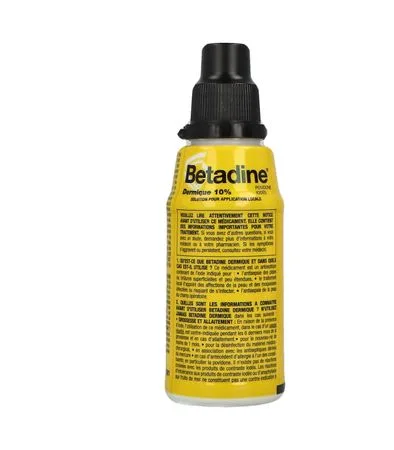
BETADINE DERMIQUE 10 PER CENT, solution for topical application
Forms and presentations
Solution for topical application.
Bottle containing 125 ml of solution. Box of 1.
Bottle containing 500 ml of solution. Box of 1 (hospital model).
Composition
For 100 ml:
Povidone iodine: 10 g
Glycerol, macrogol lauryl ether (9), disodium phosphate dihydrate, citric acid monohydrate, sodium hydroxide, purified water.
Indications
- Antisepsis of superficial and limited-extent wounds or burns.
- Adjunctive treatment of skin and mucous membrane conditions that are primarily bacterial or likely to become superinfected.
- Antisepsis of the skin of the operative field.
Note: Antiseptic agents are not sterilizing. They temporarily reduce the number of microorganisms.
Dosage and administration
Cutaneous use.
To be used neat or diluted.
- Neat use: by painting onto the skin.
- Diluted use: dilute the solution to 1/10th with water or sterile physiological saline for wound washing, and to 2 % in sterile physiological saline for wound irrigation.
Contraindications
This medicine MUST NOT BE USED in the following situations:
- History of hypersensitivity to any of the constituents, in particular povidone. There are no cross-reactions with iodinated contrast media. Intolerance reactions (anaphylactoid reactions) to iodinated contrast media or anaphylaxis to seafood do not constitute a contraindication to the use of BETADINE DERMIQUE 10 %.
- For disinfection of medico-surgical equipment.
- Child aged less than 1 year.
- Prolonged use during the 2th and the 3th trimester of pregnancy.
- Breastfeeding is contraindicated in case of prolonged treatment.
- Hyperthyroidism and other acute thyroid diseases.
- Before, during and after administration of radioactive iodine (see section Interactions).
- Use with products containing mercury (see section Interactions).
Warnings and precautions
Special warnings
- Due to transcutaneous absorption of iodine, repeated or prolonged treatment may expose to a risk of systemic effects, in particular thyroid dysfunction (see section Adverse effects).
- These systemic effects, favoured by repeated applications, are all the more to be feared when the antiseptic is used over a large surface, under an occlusive dressing, on damaged skin (in particular burned skin), a mucous membrane, or the skin of a premature infant or infant (due to the surface-to-weight ratio and the occlusive effect of nappies in the diaper area).
- Special attention is required with regular applications on damaged skin in patients with renal impairment, particularly in severely burned patients (see section Adverse effects).
- Contraindicated in children under 12 months of age; use in children under 30 months, if deemed essential, should be limited to brief application over a small area and followed by rinsing with sterile water.
- As soon as the packaging of an antiseptic preparation is opened, microbial contamination is possible.
- The volume of bottles larger than 250 ml exposes the solution to a risk of contamination if it is used for a prolonged period after opening.
Precautions for use
To be used with caution under all conditions likely to promote systemic absorption, and particularly in children under 30 months of age (see section Contraindications).
When preparing the patient for surgery, avoid runoff and pooling between the patient and the table drape. Prolonged contact with the unDried solution may cause irritation and, rarely, severe skin reactions such as burns. In case of skin irritation, contact dermatitis or hypersensitivity, discontinue use. Do not heat before application.
Interactions
Given possible interferences (antagonism, inactivation), concurrent or sequential use of antiseptics should be avoided.
Products containing mercury may react with povidone-iodine to form mercury iodide, which is highly corrosive.
Povidone-iodine may reduce iodine uptake by the thyroid. Therefore, the use of povidone-iodine may interfere with thyroid tests (scintigraphy, determination of protein-bound iodine, diagnostic tests with radioactive iodine) and make radioactive iodine treatment impossible. It is advised to wait 4 weeks after application of povidone-iodine before performing an examination or treatment with radioactive iodine.
Fertility, pregnancy and breastfeeding
Pregnancy
Animal studies have not shown any teratogenic effect. In the absence of a teratogenic effect in animals, a malformative effect in humans is not expected. Indeed, to date, substances responsible for malformations in humans have been shown to be teratogenic in animals in well-conducted studies in two species.
Clinically, there is currently no sufficiently relevant data to assess a possible malformative effect of povidone-iodine when administered in the first trimester of pregnancy.
The fetal thyroid begins to fix iodine after 14 weeks of amenorrhea; no effect on the fetal thyroid is expected in case of prior administrations.
Iodine overload, very likely with prolonged use of this product beyond this period, may lead to fetal hypothyroidism, biological or even clinical (goiter).
This is reversible if administration occurs during the 2rd trimester, but at the end of pregnancy it may give rise to goiter.
Consequently, as a precautionary measure, it is preferable not to use this medicine during the 1st trimester of pregnancy.
In case of use prolonged, its use is contraindicated from the 2rd trimester onward.
Its use on an occasional basis should only be considered if necessary.
Breast-feeding
Iodine passes into breast milk at concentrations higher than in maternal plasma. Due to the risk of hypothyroidism in the infant, breastfeeding is contraindicated during treatment prolonged with this medicine.
Fertility
Current data on the fertility effects of povidone-iodine are limited.
Adverse effects
Frequencies of undesirable effects have been classified as follows: very common (≥ 1/10), common (≥ 1/100, < 1/10), uncommon (≥ 1/1 000, < 1/100), rare (≥ 1/10 000, < 1/1 000), very rare (< 1/10 000), frequency not known (cannot be estimated from available data).
|
Immune system disorders |
|
|
Not known |
Hypersensitivity |
|
Not known |
Anaphylactic reaction: urticaria, Quincke's edema, anaphylactic shock, anaphylactoid reaction. |
|
Endocrine disorders |
|
|
Not known |
In case of repeated and prolonged administration, iodine overload may occur, which may lead to thyroid dysfunction, particularly in premature infants, infants and severely burned patients. Exceptional cases of hyperthyroidism have been reported.* |
|
Not known |
Hypothyroidism** |
|
Metabolism and nutrition disorders |
|
|
Not known |
Metabolic acidosis*** |
|
Not known |
Electrolyte imbalance |
|
Skin and subcutaneous tissue disorders |
|
|
Not known |
Contact dermatitis (with symptoms such as erythema, blisters and pruritus) of the burn type in cases of maceration |
|
Not known |
Angioedema |
|
Not known |
Cases of reversible and transient brown discolouration of the skin have been reported (this discolouration is removed with water). |
|
Renal and urinary disorders |
|
|
Not known |
Acute renal failure*** |
|
Not known |
Abnormal blood osmolarity*** |
|
Injury, poisoning and procedural complications |
|
|
Not known |
Chemical burn of the 1er to the 3th degree**** |
* In patients with a history of thyroid pathology (see section Warnings and precautions), following significant iodine absorption, for example in cases of repeated use for the treatment of wounds or burns over extensive surfaces.
** Hypothyroidism following prolonged or extensive use of povidone-iodine.
*** May occur through absorption of large volumes of povidone-iodine following exposure of large skin or mucous membrane surfaces (e.g. treatment of burns).
**** May occur in case of maceration under the patient pre-operatively.
Reporting of suspected adverse reactions
Reporting suspected adverse reactions after authorisation of the medicinal product is important. It allows continued monitoring of the benefit/risk balance of the medicinal product. Healthcare professionals are asked to report any suspected adverse reactions via the national reporting system: National Agency for the Safety of Medicines and Health Products (ANSM) and the network of Regional Pharmacovigilance Centres - Website: https://signalement.social-sante.gouv.fr/.
Overdose
Overdose is not expected under normal conditions of use.
Massive accidental ingestion or absorption of large volumes of povidone-iodine following exposure of large areas of skin or mucous membranes (healthy or damaged) may lead to severe systemic iodine poisoning.
Systemic iodine poisoning may cause abdominal pain, vomiting and bloody diarrhoea, tachycardia, hypotension, circulatory failure, laryngeal oedema leading to asphyxia, pulmonary oedema, aspiration pneumonia, convulsions, fever, metabolic acidosis, hypernatraemia and/or renal failure (including anuria). Hyperthyroidism or hypothyroidism may also develop.
Treatment, to be carried out in a specialised setting, is symptomatic and adapted as needed.
In cases of severe hypotension, an intravenous solution must be administered; vasopressors must be added if necessary.
Endotracheal intubation may be necessary if the caustic injury to the upper airways causes significant swelling and oedema.
Vomiting must not be induced. The patient must be kept in a position that keeps the airways clear and prevents aspiration (in case of vomiting).
If the patient is not vomiting and can tolerate oral feeding, ingestion of starch-rich foods (for example potato, flour, starch, bread) may help convert iodine into the less toxic iodide. In the absence of signs of intestinal perforation, gastric irrigation with a starch solution via nasogastric tube may be used (the gastric effluent turns dark blue-violet and the colour can be used as a guide to determine the end of the lavage).
Haemodialysis effectively eliminates iodine and should be used in severe cases of iodine intoxication, particularly in cases of renal failure. Continuous veno-venous haemofiltration is less effective than haemodialysis.
In case of thyroid dysfunction, treatment with povidone-iodine must be discontinued.
Pharmacodynamics
Pharmacotherapeutic class: Antiseptics and disinfectants, ATC code: D08AG02.
Broad-spectrum bactericidal, fungicidal, virucidal antiseptic.
Antiseptic group: iodine derivatives.
Povidone-iodine is an iodophor, an organic complex with approximately 10 percent available active iodine.
Its spectrum of activity is that of iodine, released slowly and progressively: bactericidal against all bacteria, and lethal to Candida in less than one minute in vitro.
Organic matter (proteins, serum, blood...) decreases the activity of free iodine, the active form of this specialty.
Iodophors are unstable at alkaline pH.
Skin coated with povidone-iodine takes on a brown coloration that is easily removed with water.
Pharmacokinetics
The available iodine of povidone-iodine can cross the skin barrier.
It will be eliminated mainly via the urinary route. Povidone alone can under no circumstances give rise to systemic absorption.
Preclinical safety
Acute toxicity
In acute toxicity studies in mice, rats, rabbits and dogs, after systemic administration (oral, i.p., i.v.), toxic effects were observed only with excessively high doses that have no significance for local use of a povidone-iodine solution.
Thus the LD50 in rodents is greater than 200 mg/kg of available iodine (equivalent to 20 mL per kg of a pure 10% PVP-I solution) and by the intraperitoneal route, greater than 30 mg of available iodine per kg (equivalent to 3 mL per kg of an undiluted 10% PVP-I solution).
Chronic toxicity
Subchronic and chronic toxicity studies were conducted in rats, administering povidone-iodine (10% available iodine) in the diet at doses between 75 and 750 mg of povidone-iodine per day per kg of body weight for up to 12 weeks. After cessation of povidone-iodine administration, dose-dependent and reversible increases in serum protein-bound iodine and non-specific histopathological changes of the thyroid gland were observed. Similar changes also occurred in the control group that received potassium iodide in an iodine-equivalent amount instead of povidone-iodine.
In chronic IP treatment in rats starting from a dose of 5 mg/kg of PVP-I, severe peritonitis with adhesion of intra-abdominal organs is observed, which may lead to death of the animal.
Mutagenic and carcinogenic potential
PVP-I has no mutagenic potential.
No carcinogenicity study has been conducted.
Reproductive and developmental toxicity
A reproductive toxicity study was conducted in rabbits. Doses of 16, 35 and 75 mg/kg of body weight per day were administered intramuscularly to pregnant female rabbits for 12 days from the 6th to the 18th day of gestation. PVP-I was not teratogenic.
Animal fertility studies have not been conducted.
INCOMPATIBILITIES
The combination of iodine with mercurials is to be avoided, due to the risk of caustic compounds.
Iodine is an oxidant (chemical incompatibilities with reducing agents).
Povidone-iodine is inactivated by sodium thiosulfate (possible antidote), heat, light and alkaline pH (instability).
Shelf life
2 years.
After first opening of the vial, this medicinal product must be stored for a maximum of 6 months at room temperature.
Special storage precautions
Before opening, store at a temperature not exceeding 25 °C.
For storage conditions after first opening, see section Shelf life.
Prescription, supply and reimbursement
| Marketing authorisation (AMM) |
|
| Price: |
|
Hospital model (Fl PE/500ml): Collect.
COOPER
Coopération Pharmaceutique Française
Place Lucien-Auvert. 77020 Melun cdx
Tel: 01 64 87 20 00
Source: VIDAL · Updated on 10/11/2026. This information does not replace advice from a healthcare professional.