Medicines
SmPC of the 30/10/2024
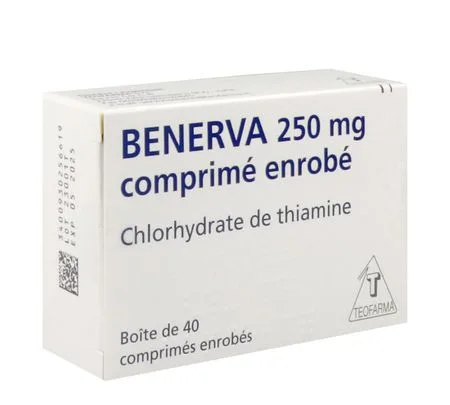
BENERVA 250 mg, coated tablet
Composition
Cthiamine hydrochloride ................................................................................................................250,00 mg.
For one coated tablet
Excipient with known effect: sucrose
Core: povidone, talc, magnesium stearate.
Coating: hypromellose 6mPas, ethylcellulose (solid), rice starch, gum arabic (spray-dried), talc, liquid paraffin, solid paraffin, sucrose.
Indications
Treatment of vitamin B1 deficiency: Beriberi.
Gayet-Wernicke encephalopathy, as a follow-on from the injectable form
Dosage and administration
Dosage
Reserved for adults
1 to 2 tablets per day.
Method of administration
Oral use.
Swallow the tablets with a little water, without chewing them.
Contraindications
Hypersensitivity to the active substance or to any of the excipients listed in section Composition.
Warnings and precautions
Patients with fructose intolerance, glucose-galactose malabsorption syndrome or sucrase/isomaltase deficiency (rare hereditary diseases) must not take this medicine.
Interaction with paraclinical examinations :
Vitamin B1 may induce false positives in the urobilinogen determination test using Ehrlich's reagent.
At high doses, vitamin B1 may interfere with the determination of serum theophylline concentrations by a spectrophotometric method.
Interactions
The data available to date do not suggest the existence of clinically significant interactions.
Fertility, pregnancy and breastfeeding
Pregnancy
There are limited data on the use of thiamine hydrochloride in pregnant women. Animal studies are insufficient to draw conclusions on reproductive toxicity.
This medicinal product may be used in pregnant women only if absolutely necessary.
Breast-feeding
Thiamine is excreted in breast milk. In the absence of data on the consequences of high doses of vitamin B1 passing into milk, this treatment should be avoided during breastfeeding.
Fertility
There are no data in animals or in humans.
Adverse effects
The adverse effects that may occur with BENERVA 250 mg, coated tablet, are presented by system organ class and frequency in the table below.
Adverse effects are listed in decreasing order of severity and their frequency is defined according to the following convention: very common (≥ 1/10); common (≥ 1/100, < 1/10); uncommon (≥ 1/1 000, < 1/100); rare (≥ 1/10 000, < 1/1 000); very rare (< 1/10 000); and frequency not known (cannot be estimated from the available data).
|
System Organ Classes |
Adverse effects |
Frequency
|
|
Immune system disorders |
Anaphylactic shock-type hypersensitivity reactions, pruritus, urticaria, angioedema, abdominal pain, respiratory distress, tachycardia, palpitations, collapse, chest pain, hyperhidrosis |
Not known |
|
Gastrointestinal disorders |
Nausea, vomiting, diarrhea, abdominal pain of mild to severe intensity. |
Not known |
Reporting of suspected adverse reactions
Reporting suspected adverse reactions after authorisation of the medicinal product is important. It allows continued monitoring of the benefit/risk balance of the medicinal product. Healthcare professionals are asked to report any suspected adverse reaction via the national reporting system: National Agency for the Safety of Medicines and Health Products (ANSM) and the network of Regional Centres of Pharmacovigilance - Website: https://signalement.social-sante.gouv.fr/
Overdose
No cases of oral overdose have been reported. However, at very high doses of thiamine, the following symptoms may occur: headache, nausea, irritability and hypotension.
Pharmacokinetics
Absorption
Thiamine is absorbed in the small intestine.
Distribution
Thiamine diffuses into all tissues. It is not stored, even in cases of excess intake.
Elimination
Elimination occurs in the urine in the form of metabolites. Thiamine passes into breast milk.
Prescription, supply and reimbursement
| Marketing authorisation (AMM) |
|
Collect (T/40).
VIA F.LLI CERVI, 8
27010 VALLE SALIMBENE (PAVIA)
Tel: 00 39 0382 422 008 amministrazione@teofarma.it
https://www.teofarmasrl.it/
Source: VIDAL · Updated on 10/11/2026. This information does not replace advice from a healthcare professional.