
Medicines
SmPC of 13/10/2020
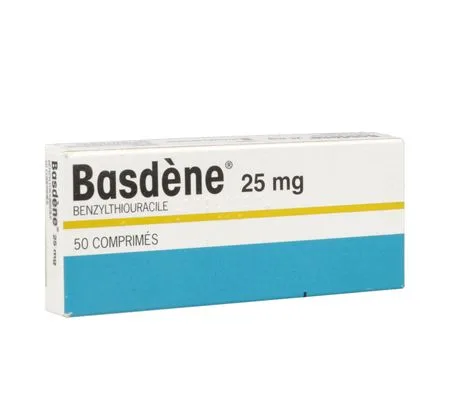
BASDENE 25 mg, tablet
Composition
BENZYLTHIOURACIL………………………………………………………………………………..25,00 mg
For one tablet.
Pregelatinized starch, lactose monohydrate, microcrystalline cellulose, croscarmellose sodium, magnesium stearate, talc.
Dosage and administration
Dosage
Treatment will be initiated with a loading dose for approximately 1 to 2 months, then clinically monitoring the patient. Doses will be gradually reduced to reach a maintenance dose in 3 or 4 months, which will generally be continued for 18 months.
Adjustment of treatment is essential because:
- for an insufficient dosage: the signs of hyperthyroidism reappear or worsen;
- for an excessive dosage: hypothyroidism sets in, characterized by an elevation of TSH and an increase in goiter volume.
Loading treatment : 150 to 200 mg (6 to 8 tablets) per day for a few weeks.
Maintenance treatment : once clinical improvement and normalization of functional tests: 100 mg (4 tablets) per day for several months.
Administration is given in 3 regularly spaced doses throughout the day, preferably administered at meal times.
Another therapeutic regimen consists of:
- in a first phase: administration of the antithyroid agent at the initial treatment dosage mentioned above, until biological hypothyroidism is achieved (obtained after approximately 6 weeks);
- in a second phase: continuation of the antithyroid agent at the same dosage, but combined with levothyroxine to achieve euthyroidism, then progressive reduction of the antithyroid agent by the 12th month while continuing levothyroxine, both products being stopped after 6 to 8 months.
Contraindications
Hypersensitivity to the active substance or to any of the excipients listed in section Composition.
TSH-dependent thyroid cancer.
Pre-existing severe hematological disorders.
Warnings and precautions
Special warnings
Any patient taking this medication must know that the onset of fever, sore throat, or another infection requires an immediate blood count (complete blood count).
Cases of liver involvement have been reported with benzylthiouracil. If signs or symptoms of liver dysfunction occur, liver function must be evaluated. If liver enzyme levels become significantly abnormal during treatment with benzylthiouracil, treatment must be stopped immediately. Signs of liver dysfunction appearing during treatment must be differentiated from disturbances caused by hyperthyroidism, such as elevation of gamma-GT (gamma glutamyl transferase) and alkaline phosphatase or its bone-specific isoform.
Patients who developed liver involvement under carbimazole or thiamazole are at risk of developing liver involvement under benzylthiouracil. Monitoring for signs or symptoms of liver dysfunction is recommended in these patients.
Precautions for use
Do not administer without biological confirmation of hyperthyroidism. During treatment, biological monitoring of the thyroid panel should be planned.
Monitoring of the blood count before the start of treatment and weekly (risk of agranulocytosis, frequency of the order of 0,7%) during the first 6 weeks of treatment.
Interactions
Potentiation of the action of synthetic antithyroid agents when combined with hypoglycemic sulfonamides, hydantoins, iodine and iodides.
Fertility, pregnancy and breastfeeding
Women of childbearing potential
Women of childbearing age must be informed of the potential risks of using benzylthiouracil during pregnancy.
Pregnancy
The fetal thyroid is set up very early but does not begin to fix iodine until the 12th post-conception week. Despite a low risk of impact on fetal thyroid function, treatment is maintained if necessary, with an adjustment of maternal doses to achieve maternal euthyroidism and avoid fetal hypothyroidism linked to the passage of benzylthiouracil across the placenta.
Animal studies are insufficient regarding reproductive toxicity. Epidemiological studies provide contradictory results regarding the risk of congenital malformations.
An assessment of the individual benefit/risk ratio is necessary before initiating treatment with benzylthiouracil during pregnancy. If benzylthiouracil is used during pregnancy, the lowest effective dose should be administered without additional administration of thyroid hormones. If benzylthiouracil is used during pregnancy, close maternal, fetal and neonatal monitoring is recommended.
Breast-feeding
Breastfeeding should be avoided, due to the passage of the drug into breast milk.
Continuation of breastfeeding should be discussed on a case-by-case basis.
Adverse effects
The list below is based on adverse effects reported after marketing.
Infections and infestations
Angina1, Infection1
Blood and lymphatic system disorders
Leukopenia1, Bone marrow aplasia1, Agranulocytosis1,
Immune system disorders
Hypersensitivity2,
Vascular disorders
Vasculitis3
Respiratory, thoracic and mediastinal disorders
Pulmonary vasculitis3, Pulmonary infiltration3, Alveolar haemorrhage3
Hepatobiliary disorders
Hepatitis, Jaundice, Increased transaminases
Skin and subcutaneous tissue disorders
Allergic dermatitis2, Cutaneous vasculitis3, Leukocytoclastic vasculitis 3, Skin ulcer3
Erythema2, Pruritus2, Rash2, Urticaria2,
Musculoskeletal and systemic disorders
Arthralgia2, Myalgia2
Renal and urinary disorders
Renal vasculitis3, Glomerulonephritis3, Acute renal failure3
General disorders and administration site conditions
Fever1, 2
Investigations
Anti-neutrophil cytoplasmic antibody positive3
1: Leukopenia, which may be heralded by fever, sore throat, infection, or even agranulocytosis or bone marrow aplasia, usually of sudden onset, requiring discontinuation of treatment and an emergency complete blood count with formula.
2: Allergic reactions: skin (pruritus, rash, urticaria), fever, erythema, arthralgia, myalgia, aches, also requiring discontinuation of treatment.
3: As with other synthetic antithyroid agents (in particular propylthiouracil), very rare cases of ANCA-associated vasculitis have been reported, in particular causing glomerulonephritis sometimes progressing to acute renal failure, and requiring discontinuation of treatment. ANCA-associated vasculitis may also manifest as pulmonary infiltrate or alveolar hemorrhage, skin ulceration, or leukocytoclastic vasculitis.
Reporting of suspected adverse reactions
Reporting suspected adverse reactions after authorisation of the medicinal product is important. It allows continued monitoring of the benefit/risk balance of the medicinal product. Healthcare professionals are asked to report any suspected adverse reactions via the national reporting system: National Agency for the Safety of Medicines and Health Products (ANSM) and the network of Regional Pharmacovigilance Centres - Website:www.signalement-sante.gouv.fr..
Pharmacodynamics
Pharmacotherapeutic class: Synthetic antithyroid agent, ATC code: H03BA03.
Mechanism of action
Active orally, benzylthiouracil blocks thyroid hormonogenesis by inhibiting iodine organification. It causes hypersecretion of TSH.
Pharmacokinetics
Absorption occurs via the digestive route and begins 20 to 30 minutes after oral administration. The half-life is approximately 2 hours. Elimination is renal.
SPECIAL PRECAUTIONS FOR DISPOSAL AND OTHER HANDLING
No special requirements for disposal.
Any unused medicinal product or waste material should be disposed of in accordance with local requirements.
Prescription, supply and reimbursement
| Marketing authorisation (AMM) |
|
| Price: |
|
Collection.
LABORATOIRES BOUCHARA-RECORDATI S.A.S. TOUR HEKLA - 52 AVENUE DU GÉNÉRAL DE GAULLE
92800 PUTEAUX
Tel: 01 45 19 10 00 infomed@recordati.com
https://recordati.com/
Source: VIDAL · Updated on 10/11/2026. This information does not replace advice from a healthcare professional.