
Medicines
SmPC of 22/08/2025
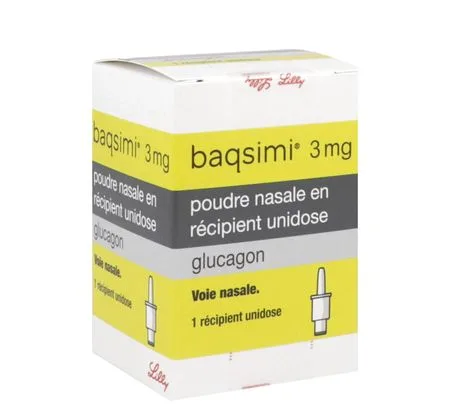
BAQSIMI 3 mg nasal powder in single-dose container
Forms and presentations
Nasal powder (white to off-white).
Single-dose container (contained in a tube sealed by a plastic film + desiccant). Box of 1.
Composition
Each single-dose container delivers nasal powder containing 3 mg of glucagon.
Betadex (E459), dodecylphosphocholine.
Indications
Baqsimi is indicated in the treatment of severe hypoglycaemia in adults, adolescents and children aged 1 year and over with diabetes.
Dosage and administration
Dosage
Adults, adolescents and children aged 1 year and over
The recommended dose is 3 mg of glucagon administered in one nostril.
Elderly
No dose adjustment is required based on age.
Data on efficacy and safety in patients aged 65 years and over are very limited and absent for patients aged 75 years and over.
Renal impairment
No dose adjustment is required based on renal function.
Hepatic impairment
No dose adjustment is necessary based on hepatic function
Paediatric population, aged 0-< 1 year
The safety and efficacy of Baqsimi in infants and children aged 0 to < 1 year have not yet been established. No data are available.
Method of administration
Nasal route only. The nasal powder glucagon is administered in one nostril only. The glucagon is absorbed passively through the nasal mucosa. It is not necessary to inhale or breathe in deeply after administration.
Patients and their caregivers should be informed of the signs and symptoms of severe hypoglycaemia. As severe hypoglycaemia requires the assistance of others to recover, the patient should be informed of the existence of Baqsimi and its package leaflet. Baqsimi should be administered as soon as possible when severe hypoglycaemia is recognised. The patient or caregiver should be informed to read the package leaflet. The following instructions should be emphasised:
Instructions for administration of nasal powder glucagon
- Remove the plastic film by pulling on the red strip.
- Remove the single-dose container from the tube. Do not press the plunger before being ready to administer the dose.
- Hold the single-dose container between the fingers and the thumb. Do not test the device before use, as it contains only one dose of glucagon and cannot be reused.
- Gently insert the tip of the single-dose container into one of the nostrils until the finger(s) touch(es) the outside of the nose.
- Press the plunger all the way down. The dose is fully delivered when the green line is no longer visible.
- If the person is unconscious, turn them on their side to prevent choking.
- After administering the dose, the caregiver must contact medical assistance immediately.
- When the patient has responded to treatment, give him carbohydrates orally to replenish hepatic glycogen stores and prevent a recurrence of hypoglycemia.
For special warnings and precautions for use, see the section Warnings and precautions.
Contraindications
Hypersensitivity to the active substance or to any of the excipients mentioned in the section Composition.
Pheochromocytoma (see section Warnings and precautions).
Warnings and precautions
Pheochromocytoma
In case of pheochromocytoma, glucagon may stimulate the release of catecholamines by the tumor. If a very significant increase in blood pressure occurs in the patient, the use of inhibitors α-adrenergic non-selective has been shown to be effective in reducing blood pressure. Baqsimi is contraindicated in patients with pheochromocytoma (see section Contraindications).
Insulinoma
In patients with insulinoma, administration of glucagon may cause an initial increase in blood glucose. However, administration of glucagon may stimulate, directly or indirectly (by an initial increase in blood glucose) an exaggerated release of insulin by an insulinoma and thereby cause hypoglycemia. A patient presenting symptoms of hypoglycemia after administration of a dose of glucagon must receive glucose orally or intravenously.
Hypersensitivity and allergic reactions
Allergic reactions, which have been reported with injectable glucagon, may occur. They include generalized rashes, and in some cases anaphylactic shocks with breathing difficulties and hypotension. If the patient suffers from breathing difficulties, call medical assistance immediately.
Glycogen stores and hypoglycemia
Glucagon is effective in treating hypoglycemia only if hepatic glycogen stores are sufficient. Glucagon being only slightly or not effective in cases of food deprivation, adrenal insufficiency, chronic alcohol abuse or chronic hypoglycemia, these conditions require the administration of glucose.
In order to prevent a recurrence of hypoglycemia, as soon as the patient has reacted to treatment, it is necessary to administer carbohydrates orally in order to replenish hepatic glycogen stores.
Interactions
No interaction study has been performed.
Insulin
Insulin reacts antagonistically towards glucagon.
Indomethacin
When associated with indomethacin, glucagon is likely to lose its ability to increase blood glucose, or may even induce hypoglycemia.
Beta-blockers
Patients taking beta-blockers may experience an increase in pulse and blood pressure; this increase will be transient due to the short half-life of glucagon.
Glucagon treatment produces a release of catecholamines from the adrenal glands, and concomitant administration with beta-blockers may lead to contrary alpha-adrenergic stimulation, and consequently to an increase in blood pressure (see section Warnings and precautions).
Warfarin
Glucagon may increase the anticoagulant effect of warfarin.
Fertility, pregnancy and breastfeeding
Pregnancy
No study on reproduction and fertility has been conducted in animals with nasal glucagon powder.
Baqsimi may be used during pregnancy. Glucagon does not cross the human placental barrier. The use of glucagon has been reported in pregnant women with diabetes and no harmful effect is known regarding the course of pregnancy and the health of the unborn baby and the newborn.
Breastfeeding
Baqsimi may be used during breastfeeding. Glucagon is eliminated very rapidly from the bloodstream; thus, the amount of glucagon excreted in breast milk after treatment of severe hypoglycemia should be extremely low. Glucagon being degraded in the digestive tract and unable to be absorbed in intact form, it will exert no metabolic effect in the child.
Fertility
No fertility study has been conducted with nasal glucagon powder.
Studies in rats have shown that glucagon does not affect fertility.
Driving and using machines
Baqsimi has a negligible effect on the ability to drive vehicles and use machines.
The patient's concentration abilities and reflexes may be decreased due to hypoglycemia which may persist for a short period following administration of the treatment. This may generate a risk in situations where these abilities are particularly important, such as driving vehicles or using machines.
Adverse effects
Summary of the safety profile
The most frequently reported adverse reactions are increased lacrimation (36 %), upper respiratory tract irritation (34 %), nausea (27 %), headache (21 %) and vomiting (16 %).
Tabulated list of adverse reactions
Adverse reactions are listed in Table 1 according to the terms of the MedDRA classification by system organ classes and by frequency. The frequency category of each adverse reaction is based on the following convention: very common (≥ 1/10); common (≥ 1/100, < 1/10); uncommon (≥ 1/1 000, < 1/100); rare (≥ 1/10 000, < 1/1 000); very rare (< 1/10 000).
|
System organ class |
Very common |
Common |
Uncommon |
|
Nervous system disorders |
Headache |
Dysgeusia |
|
|
Eye disorders |
Increased lacrimation |
Ocular hyperaemia
|
|
|
Respiratory, thoracic and mediastinal disorders |
Upper respiratory tract irritationa |
||
|
Gastrointestinal disorders |
Vomiting
|
||
|
Skin and subcutaneous tissue disorders |
Pruritus |
||
|
Investigations |
Increased systolic blood pressureb
|
Increased heart rateb |
a Upper respiratory tract irritation: rhinorrhea, nasal discomfort, nasal congestion, nasal pruritus, sneezing, throat irritation, cough, epistaxis and parosmia.
b Increases in heart rate and blood pressure: based on the evaluation of vital signs. The frequencies are based on the changes between the values before treatment and those after treatment.
Immunogenicity
Overall, 5,6 % of patients developed anti-glucagon antibodies during treatment. These antibodies were not neutralizing and did not lead to a decrease in the efficacy of glucagon. Furthermore, they were not associated with the occurrence of adverse effects during treatment.
Pediatric population
Based on data from clinical trials, the frequency, type and severity of adverse effects observed in children aged 1 year and older would be identical to those observed in adults.
Reporting of suspected adverse effects
Reporting suspected adverse effects after authorization of the medicinal product is important. It allows continued monitoring of the benefit/risk balance of the medicinal product. Healthcare professionals report any suspected adverse effect via the national reporting system: Agence nationale de sécurité du médicament et des produits de santé (ANSM) and network of Regional Pharmacovigilance Centers - Website: https://signalement.social-sante.gouv.fr.
Overdose
In case of overdose, the patient may present with nausea, vomiting, inhibition of gastrointestinal motility, an increase in blood pressure and pulse rate. In case of suspected overdose, a decrease in serum potassium may occur; it must therefore be monitored and corrected if necessary. In case of a very significant increase in blood pressure in the patient, the use of non-selective α-adrenergic inhibitors has been shown to be effective in reducing blood pressure during the short period requiring its control (see section Warnings and precautions).
Pharmacodynamics
Pharmacotherapeutic group: pancreatic hormones, glycogenolytic hormones, ATC code: H04AA01
Mechanism of action
Glucagon increases blood glucose by activating hepatic glucagon receptors, thereby stimulating glycogen breakdown and glucose release by the liver. Hepatic glycogen stores are necessary for glucagon to produce an anti-hypoglycemic effect.
Pharmacodynamic effects
Gender and body weight did not have a clinically relevant effect on the pharmacodynamics of nasal glucagon powder.
After administration of 3 mg of nasal glucagon powder to adult patients with type 1 diabetes, blood glucose began to increase after only 5 minutes (see figure 1). After 10 minutes, median blood glucose was above 3,9 mmol/L (70 mg/dL). The mean maximum increase in blood glucose was 7,8 mmol/L (140 mg/dL).
In pediatric patients with type 1 diabetes (aged 4 to < 17 years), after administration of 3 mg of nasal glucagon powder, blood glucose began to increase after only 5 minutes with a mean maximum increase in blood glucose of 5,7 mmol/L (102 mg/dL) to 7,7 mmol/L (138 mg/dL). The mean maximum increase in glucose level from baseline was 7,33 mmol/L (132 mg/dL) (1 to < 4 years), 7,67 mmol/L (138 mg/dL) (4 to < 8 years), 7,39 mmol/L (133 mg/dL) (8 to < 12 years) and 5,67 mmol/L (102 mg/dL) (12 to < 17 years) (figure 2).
A simple cold with nasal congestion with or without concomitant use of a decongestant had no impact on the pharmacodynamics of nasal glucagon powder.
Figure 1. Mean blood glucose over time in adult patients with type 1 diabetes.
Figure 2. Mean blood glucose over time in pediatric patients with type 1 diabetes.
Clinical efficacy
The pivotal study in adults was a randomized, multicenter, open-label, 2-period, crossover study conducted in adult patients with type 1 or type 2 diabetes. The primary objective was to compare the efficacy of a single dose of 3 mg of nasal glucagon powder versus a dose of 1 mg of intramuscular glucagon in adult patients with type 1 diabetes. Insulin was used to lower blood glucose into the hypoglycemic range with a target blood glucose nadir of < 2,8 mmol/L (< 50 mg/dL).
This pivotal study included a total of 83 patients, aged 18 to < 65 years. Seventy-seven patients had type 1 diabetes, with a mean age of 32,9 years and a mean duration of diabetes of 18,1 years, and 45 patients (58 %) were female. The mean age of patients with type 2 diabetes (n = 6) was 47,8 years, with a mean duration of diabetes of 18,8 years, and 4 patients (67 %) were female.
The primary efficacy endpoint was the proportion of patients achieving treatment success, defined as an increase in blood glucose to a level ≥ 3,9 mmol/L (≥ 70 mg/dL) or an increase ≥ 1,1 mmol/L (≥ 20 mg/dL) from the blood glucose nadir, within 30 minutes after administration of the study glucagon, without receiving additional measures aimed at increasing blood glucose. The glucose nadir was defined as the minimum glucose measurement at the time of glucagon administration or within the following 10 minutes.
For patients with type 1 diabetes, the mean blood glucose nadir was 2,5 mmol/L (44,2 mg/dL) for nasal glucagon powder and 2,7 mmol/L (48,9 mg/dL) for intramuscular glucagon. Non-inferiority of nasal glucagon powder versus intramuscular glucagon was demonstrated for resolution of insulin-induced hypoglycemia, with treatment success within 30 minutes in 98,7 % of patients treated with nasal glucagon powder and 100 % of patients treated with intramuscular glucagon (see table 2). All patients met the treatment success criteria within 40 minutes. Treatment success occurred within 30 minutes for all patients with type 2 diabetes (100 %).
The mean time to achieve treatment success was 16,2 and 12,2 minutes in the nasal glucagon powder and 1 mg intramuscular glucagon treatment groups, respectively. The time to treatment success corresponds to the time elapsed between administration of glucagon to the patient and treatment success; it does not include the time required for reconstitution and preparation of the intramuscular injection in the control group.
Thirty minutes after administration of glucagon, patients in the nasal glucagon powder and intramuscular glucagon groups showed similar improvement in hypoglycemia symptoms assessed using the Edinburgh Hypoglycemia Symptom Questionnaire.
|
Type 1 diabetes
|
Type 1 and type 2 diabetes
|
||||
|
nasal glucagon powder 3 mg |
intramuscular glucagon 1 mg |
nasal glucagon powder 3 mg |
intramuscular glucagon 1 mg |
||
|
Treatment success - n (%) |
74 (98,7 %) |
75 (100 %) |
79 (98,8 %) |
80 (100 %) |
|
|
Treatment difference (two-sided 95 % confidence interval)b,c |
1,3 % (-3,8 % ; 7,2 %) |
1,3 % (-3,6 % ; 6,8 %) |
|||
|
Blood glucose criterion met - n (%)d |
|||||
|
(i) ≥ 3,9 mmol/L (≥ 70 mg/dL) |
72 (97 %) |
74 (99 %) |
77 (97 %) |
79 (99 %) |
|
|
(ii) Increase of ≥ 1,1 mmol/L (≥ 20 mg/dL) compared with nadir |
74 (100 %) |
75 (100 %) |
79 (100 %) |
80 (100 %) |
|
|
(i) and (ii) |
72 (97 %) |
74 (99 %) |
77 (97 %) |
79 (99 %) |
|
a The efficacy analysis population included all patients who received both doses of the study drug and with evaluable primary endpoint.
b Difference calculated by the formula (percentage with success in the intramuscular glucagon group) - (percentage with success in the nasal glucagon powder group).
c Two-sided 95 % confidence interval (CI) based on the unconditional profiled likelihood function (exact method); non-inferiority margin = 10 %.
d Percentage based on the number of patients achieving treatment success.
In a similarly designed confirmatory clinical study, 70 patients with type 1 diabetes were included, with a mean age of 41,7 years (20-64 years) and a mean diabetes duration of 19,8 years. Twenty-seven patients (39 %) were female. Insulin was used to lower blood glucose to a level < 3,3 mmol/L (< 60 mg/dL).
The mean blood glucose nadir was 3 mmol/L (54,2 mg/dL) for nasal glucagon powder and 3,1 mmol/L (55,7 mg/dL) for intramuscular glucagon. Non-inferiority of nasal glucagon powder versus intramuscular glucagon was demonstrated for resolution of insulin-induced hypoglycemia, with treatment success in 100 % of patients treated with nasal glucagon powder and 100 % of patients treated with intramuscular glucagon (see table 3). The mean time to achieve treatment success was 11,4 and 9,9 minutes in the nasal glucagon powder and 1 mg intramuscular glucagon treatment groups, respectively.
|
Type 1 diabetes
|
|||
|
nasal glucagon powder 3 mg |
intramuscular glucagon 1 mg |
||
|
Treatment success - n (%) |
66 (100 %) |
66 (100 %) |
|
|
Treatment difference (two-sided 95 % confidence interval)b,c |
0 % (-5,4 %, 5,4 %) |
||
|
Blood glucose criterion met - n (%) |
|||
|
(i) ≥ 3,9 mmol/L (≥ 70 mg/dL) |
66 (100 %) |
66 (100 %) |
|
|
(ii) Increase of ≥ 1,1 mmol/L (≥ 20 mg/dL) compared with nadir |
66 (100 %) |
66 (100 %) |
|
|
(i) and (ii) |
66 (100 %) |
66 (100 %) |
|
a The efficacy analysis population included all patients who received both doses of the study drug and with evaluable primary endpoint.
b Difference calculated by the formula (percentage with success in the intramuscular glucagon group) - (percentage with success in the nasal glucagon powder group); non-inferiority margin = 10 %.
c Two-sided 95 % confidence interval (CI) based on the unconditional profiled likelihood function (exact method)
In a real-world adult study of approximately 6 months' duration, 129 patients with type 1 diabetes (mean age, 46,6 years; range 18 to 71 years) and their caregivers used nasal glucagon powder to treat moderate or severe hypoglycemia events at home or at work. A total of 157 moderate or severe hypoglycemia events, reported by 69 patients, were included in the efficacy analysis. A severe hypoglycemia episode was defined as an episode during which the person with diabetes is clinically incapacitated (i.e., unconsciousness, convulsions, severe mental disorientation) to the point of needing assistance from a third party to treat the hypoglycemia. A moderate hypoglycemia episode was defined as an episode during which the person with diabetes presented signs of neuroglycopenia (i.e., weakness, difficulty speaking, double vision, drowsiness, inability to concentrate, blurred vision, anxiety, hunger, fatigue or confusion) and obtained a blood glucose result of approximately 60 mg/dL (3,3 mmol/L) or less. In 151 of these events (96,2 %), patients woke up or returned to normal within 30 minutes after administration of nasal glucagon powder. For all 12 severe hypoglycemia events (100 %), the patient woke up, convulsions stopped (7 events in 4 patients who had convulsions prior to administration of nasal glucagon powder) or their condition returned to normal within 5 to 15 minutes after administration of nasal glucagon powder.
Pediatric population
The pivotal pediatric study was a randomized, multicenter clinical study comparing nasal glucagon powder with intramuscular glucagon in children and adolescents with type 1 diabetes. Glucagon was administered after blood glucose reached < 4,4 mmol/L (< 80 mg/dL) on the day of administration. Efficacy was assessed based on the percentage of patients with an increase in blood glucose of ≥ 1,1 mmol/L (≥ 20 mg/dL) from the blood glucose nadir within 30 minutes after glucagon administration.
Forty-eight patients were included and received at least one dose of the study drug. The mean age in the young children cohort (4 to < 8 years) was 6,5 years. In the children cohort (8 to < 12 years), the mean age was 11,1 years, and in the adolescents cohort (12 to < 17 years), the mean age was 14,6 years. In all age cohorts, patients were predominantly male and Caucasian.
In all age groups, nasal glucagon powder 3 mg and intramuscular glucagon 0,5 mg (children weighing less than 25 kg) or 1 mg (children weighing 25 kg or more) demonstrated similar glycemic responses. All patients (100 %) in both treatment arms and in all age groups benefited from an increase in blood glucose of ≥ 1,1 mmol/L (≥ 20 mg/dL) compared with the blood glucose nadir within 20 minutes after glucagon administration.
The mean time to achieve an increase in blood glucose of ≥ 1,1 mmol/L (≥ 20 mg/dL) was similar for nasal glucagon powder and intramuscular glucagon in all age groups (see table 4).
|
Increase from nadir |
Mean time after glucagon administration (minutes) |
|||||
|
Young children
|
Children
|
Adolescents
|
||||
|
intramuscular glucagona
|
nasal glucagon powder 3 mg
|
intramuscular glucagona
|
nasal glucagon powder
|
intramuscular glucagona
|
nasal glucagon powder
|
|
|
≥ 1,1 mmol/L
|
10,0 |
10,8 |
12,5 |
11,3 |
12,5 |
14,2 |
a 0,5 mg or 1 mg of intramuscular glucagon (depending on body weight)
In a real-world pediatric study of approximately 6 months' duration, 26 patients aged 4 to < 18 years with type 1 diabetes (mean age, 11,7 years; range 5 to 17 years) and their caregivers used 3 mg nasal glucagon powder to treat moderate and severe hypoglycemia events at home or at school. In total, 33 moderate hypoglycemia events, reported by 14 patients, were included in the efficacy analysis. A severe hypoglycemia episode was defined as an episode with neuroglycopenic symptoms and blood glucose less than 50 mg/dL (2,8 mmol/L). A moderate hypoglycemia episode was defined as an episode during which the diabetic child/adolescent presented symptoms and/or signs of neuroglycopenia and blood glucose ≤ 70 mg/dL (3,9 mmol/L). For all events, including severe hypoglycemias (8 events in 5 patients), patients returned to their normal state 5 to 30 minutes after administration of nasal glucagon powder.
In the context of a phase 1, open-label, multicenter pediatric study, the safety and tolerability of a single dose of 3 mg of nasal glucagon (NG) were evaluated in pediatric patients aged 1 to less than 4 years with type 1 diabetes. Seven patients were enrolled, all received the planned dose of 3 mg of the study drug and completed the study. Participants were recommended to fast overnight before administration of the drug in order to reach the target blood glucose of 70 to 140 mg/dL (3,9 to 7,8 mmol/L) at the time of administration. Efficacy was assessed based on the percentage of patients presenting an increase in blood glucose ≥ 1,1 mmol/L (20 mg/dL) from the blood glucose nadir within 30 minutes after administration of Baqsimi. All patients (100 %) presented an increase in blood glucose ≥ 1,1 mmol/L (20 mg/dL) from the blood glucose nadir within 30 minutes after administration of glucagon. The mean time to reach an increase in glucose level ≥ 1,1 mmol/L (20 mg/dL) with Baqsimi was 15,6 minutes (see the section Dosage and administration for more information on use in children).
Pharmacokinetics
Absorption
Absorption of glucagon by the nasal route allowed mean maximum plasma concentrations of 6 130 pg/mL to be reached at 15 minutes.
Distribution
The apparent volume of distribution of glucagon was approximately 885 L by the nasal route.
Biotransformation
Glucagon is known to be degraded in the liver, kidneys and plasma.
Elimination
The mean half-life of glucagon was approximately 38 minutes by the nasal route.
Renal impairment
No formal study has been conducted to evaluate the effect of renal impairment.
Hepatic impairment:
No formal study has been conducted to evaluate the effect of hepatic impairment.
Pediatric population
In pediatric patients (aged 1 to < 17 years), absorption of glucagon by the nasal route allowed maximum plasma concentrations to be reached in 10 to 20 minutes.
Common cold and use of a decongestant
Based on clinical data in adults and children, no significant effect on the response is expected in the event of inability to clear the nasal passages, as in the case of young children who have a runny nose, because exposure to glucagon is sufficient to produce a near-maximum glycaemic response, despite the cold and/or nasal congestion.
Preclinical safety
Non-clinical data reveal no particular risk to humans based on conventional studies of safety pharmacology, repeated dose toxicity, genotoxicity, carcinogenicity, and reproductive and developmental toxicity.
Special storage precautions
Do not store at a temperature above 30 °C.
Store the single-dose container in the tube sealed with plastic film until use in order to protect it from moisture.
SPECIAL PRECAUTIONS FOR DISPOSAL AND HANDLING
Handling
This medicinal product is ready for use and intended for single use only.
The single-dose container contains only one dose and must therefore not be purged or tested before administration.
Follow the instructions for use of the medicinal product mentioned in the package leaflet carefully.
If the tube has been opened, the single-dose container may have been exposed to moisture. The medicinal product might then not act as intended. Regularly examine the tube under shrink film. If the tube has been opened, replace the medicinal product.
Disposal:
Discard the nasal glucagon single-dose container and the tube after use.
Any unused medicinal product or waste must be disposed of in accordance with applicable regulations.
Prescription, supply and reimbursement
| MA |
|
| Price: |
|
Social Security reimbursement at 65 % and Collect in the indication "Treatment of severe hypoglycaemia in adults, adolescents and children aged 4 years and over with type 1 diabetes or type 2 diabetes treated with insulin".
Not reimbursable and not approved Collect as of 02.10.2025, in the indication "treatment of severe hypoglycaemia in children aged 1 year to less than 4 years with diabetes (applications under review)".
MA Holder: Amphastar France Pharmaceuticals, Usine Saint-Charles, Eragny-sur-Epte, 60590, France.
ALLOGA FRANCE
ZAC de Chapotin Sud
Rue du Professeur-Dargent. 69970 Chaponnay
Medical Information:
Tel: 01 81 79 38 34
www.alloga.fr
Source: VIDAL · Updated on 10/11/2026. This information does not replace advice from a healthcare professional.