
Medicines
SmPC of 08/02/2024
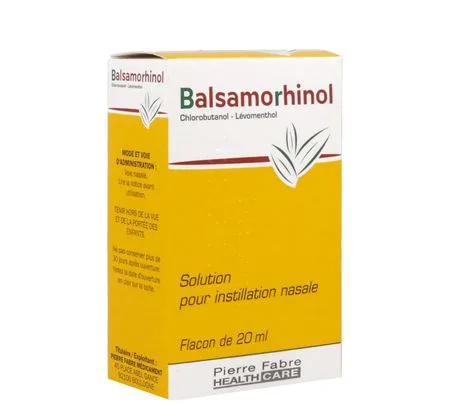
BALSAMORHINOL, solution for nasal instillation
Forms and presentations
Solution for nasal instillation.
Oily solution, colourless to very pale yellowish, clear.
Composition
Chlorobutanol hemihydrate..............................................................................................................................350 mg
Levomenthol.......................................................................................................................................................105 mg
For 100 ml of solution.
Excipients with known effect: citral, farnesol, geraniol, limonene, linalool.
Essential oil of bergamot*, essential oil of sweet orange**, essential oil of Neroli***, liquid paraffin.
*Main components of essential oil of bergamot: limonene, linalyl acetate, linalool, γ-terpinene, β-pinene, geranial, geraniol and farnesol.
** Main components of essential oil of sweet orange: limonene, β-myrcene, sabinene, linalool, α-pinene, octanal, decanal, β-pinene, valencene and citral.
*** Main components of essential oil of Neroli: linalool, limonene, β-pinene, linalyl acetate, α-terpineol, geranyl acetate, trans-nerolidol, farnesol, neryl acetate, methyl anthranilate, geraniol, citral.
Indications
Treatment of post-traumatic atrophic (crusty) rhinitis and post-operative care after endonasal surgery.
BALSAMORHINOL is indicated in adults and children over 30 months of age.
Dosage and administration
Dosage
Adults and adolescents over 15 years: 3 drops in each nostril 2 to 5 times a day.
Paediatric population
|
Age of the child |
Dosage |
|
Less than 30 months |
BALSAMORHINOL is contraindicated (see section Contraindications) |
|
From 30 months to 6 years |
1 drop in each nostril 1 to 2 times a day |
|
From 6 years to 15 years |
2 drops in each nostril 1 to 3 times a day |
Method of administration
Nasal use.
Nasal instillation after blowing the nose.
Contraindications
• Hypersensitivity to the active substances or to any of the excipients listed in section Composition.
• Due to the presence of terpene derivatives (levomenthol and essential oils):
- Child under 30 months of age.
- Children with a history of convulsions (febrile or not).
- Pregnancy (see section Fertility, pregnancy and breastfeeding).
Warnings and precautions
Special warnings
This medicinal product contains terpene derivatives (levomenthol and essential oils) which may lower the epileptogenic threshold.
The patient should be advised to follow the instructions for use and the recommended dosages and never to exceed the recommended doses.
Oily pneumonia due to pulmonary deposition following repeated nasal instillations and chronic use (most often more than 1 month of treatment) has been reported. It should therefore be ensured that the patient does not misuse this medicinal product and the prescription should always be restricted to the minimum duration of use.
This medicinal product contains perfumes containing citral, farnesol, geraniol, limonene and linalool which may cause allergic reactions.
Precautions for use
• In case of a history of epilepsy, take into account the presence of terpene derivatives.
• The indication does not justify prolonged treatment.
Interactions
Associations to be taken into account
+ Other medicinal products lowering the epileptogenic threshold
Increased risk of convulsions.
Fertility, pregnancy and breastfeeding
Pregnancy
A study in rats showed embryotoxicity after oral administration of high doses of chlorobutanol (see section Preclinical safety).
Due to the presence of terpene derivatives, this medicinal product may have respiratory and neurological toxicity for the foetus. BALSAMORHINOL is therefore contraindicated during pregnancy (see section Contraindications).
Breast-feeding
The use of this medicinal product is not recommended during breast-feeding due to:
• the absence of kinetic data on the passage of chlorobutanol and terpene derivatives into milk,
• the potential respiratory and neurological toxicity of terpene derivatives in infants.
Fertility
There is no data on the effect of levomenthol or chlorobutanol on human fertility. A reproductive toxicity study in rats showed deleterious effects on female fertility after oral administration of high doses of chlorobutanol (see section Preclinical safety).
Adverse effects
Within each system organ class, adverse reactions are ranked by frequency, with the most frequent first, using the following convention: very common (≥ 1/10); common (≥ 1/100 to < 1/10); uncommon (≥ 1/1000 to < 1/100); rare (≥ 1/10 000 to < 1/1000); very rare (< 1/10 000); not known (cannot be estimated from the available data).
|
System organ class |
MedDRA preferred terms Frequency not known |
|
Immune system disorders |
Hypersensitivity |
Reporting of suspected adverse reactions
Reporting suspected adverse reactions after authorisation of the medicinal product is important. It allows continued monitoring of the benefit/risk balance of the medicinal product. Healthcare professionals are asked to report any suspected adverse reaction via the national reporting system: National Agency for the Safety of Medicines and Health Products (ANSM) and the network of Regional Centres of Pharmacovigilance - Website: https://signalement.social-sante.gouv.fr/.
Overdose
• In case of prolonged use (more than 1 month of treatment) (see section 4.4), oily aspiration pneumonia has been reported.
• In case of exceeding the recommended doses and due to the presence of terpene derivatives:
- risk of neurological adverse events such as convulsions in children,
- possibility of agitation and confusion in elderly subjects.
• Acute toxicity from chlorobutanol (at excessive doses) may lead to depression of the central nervous system, respiratory depression and loss of consciousness. Symptomatic treatment should be initiated.
Pharmacodynamics
Pharmacotherapeutic class: DECONGESTANTS AND OTHER NASAL PREPARATIONS FOR LOCAL USE, ATC code: R01AX10.
Levomenthol is a terpene derivative. Terpene derivatives may lower the epileptogenic threshold.
Paraffin is a mineral oil consisting of saturated long-chain aliphatic hydrocarbons that are neither absorbable nor metabolisable.
Preclinical safety
Levomenthol
Preclinical studies show no specific toxicity with levomenthol applicable to the clinical situation.
Chlorobutanol
A combined screening study of repeated-dose toxicity and of toxicity for reproduction and development showed that chlorobutanol affects fertility and is embryotoxic after oral administration in rats. However, the effects were only observed at maternally toxic doses considered sufficiently higher than the maximum recommended human dose, indicating low relevance for clinical use. After repeated-dose oral treatment in rats, effects on the kidneys and liver were observed. In addition, the reduction in locomotor activity was considered a sign of sedative effects of chlorobutanol. Chlorobutanol is not genotoxic and no experimental study was available to assess its carcinogenic potential.
Special storage precautions
This product does not require any special storage precautions before or after opening.
Upon opening the packaging, and even more so upon first use of a nasal preparation, microbial contamination is possible.
For storage conditions of the medicine after first opening, see section Shelf life.
Prescription, supply and reimbursement
| Marketing authorisation (AMM) |
|
CHARTREUSE INDUSTRIAL PARK
81106 CASTRES CEDEX
Tel: 01 49 10 80 00 Tel (Freephone): 0 800 326 326
https://www.pierrefabremedicament.fr/
Source: VIDAL · Updated on 10/11/2026. This information does not replace advice from a healthcare professional.