
Parapharmacy
Updated on 19/08/2026
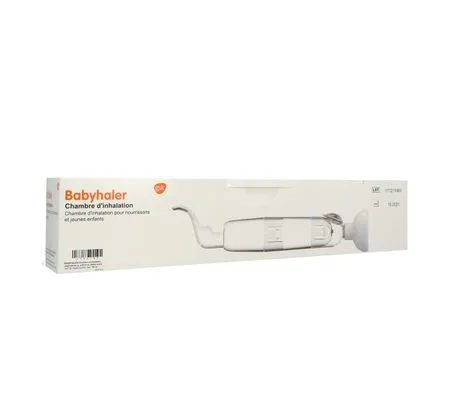
CE BABYHALER® inhalation chamber with mask for infants and young children
Presentation
Single-patient multi-use inhalation chamber made of transparent plastic (polycarbonate), elongated, with a volume of 350 ml, fitted with two valves and a standard facial mask for babies and infants (silicone), usable with Ventoline, Flixotide, Becotide, Seretide and Serevent metered-dose inhalers, as prescribed by the doctor.A protective bag is intended for storing the inhalation chamber after use.
Babyhaler is supplied without a metered-dose inhaler. This is prescribed separately by the doctor.
Properties
Babyhaler is a medical device that facilitates the inhalation of metered-dose inhalers in infants and young children. The soft facial mask fits gently over the child's nose and mouth.INSTRUCTIONS FOR USE
Before use: clean Babyhaler before the first use (see the section "How to clean Babyhaler").
- Valve check:
-
- Before using Babyhaler, check that both blue valves are working properly. Hold Babyhaler with the facial mask facing you. Press the facial mask onto the mouth. In this position, both blue valves must be at least partially visible.
Breathe in and out gently through the facial mask. During exhalation, the outer valve on the top of Babyhaler should move slightly. During inhalation, the inner valve should in turn move slightly (if this is not the case, refer to the section "Valve maintenance").
- Before using Babyhaler, check that both blue valves are working properly. Hold Babyhaler with the facial mask facing you. Press the facial mask onto the mouth. In this position, both blue valves must be at least partially visible.
- Preparing the metered-dose inhaler:
-
- Remove the protective cap from the metered-dose inhaler and shake the inhaler.
- Gently place the metered-dose inhaler into the inhaler holder. The mouthpiece of the metered-dose inhaler must face the Babyhaler device.
- Remove the protective cap from the metered-dose inhaler and shake the inhaler.
- Administering the medication to the child:
-
- The doctor will have previously indicated the number of inhaler puffs the user must have the child inhale. Each time, spray only one dose of medication into Babyhaler. Make sure the child is held securely and remains calm.
- Hold Babyhaler horizontally as illustrated below.
- With your thumb, press the inhaler canister to spray one dose of medication into Babyhaler. As quickly as possible, place the facial mask gently - but ensuring it stays firmly in place - over the child's nose and mouth (position Babyhaler so that it is comfortable for both the child and the user). Keep Babyhaler in this position for the time it takes the child to take 5 to 10 breaths (about 15 seconds). The child's breaths can be counted by observing the movement of the valves with each breath. Remove the facial mask from the child's face.
- If the doctor has prescribed two or more sprays of the medication per administration, repeat steps 2 and 3.
- Remove the inhaler from Babyhaler. Store Babyhaler in its protective bag. Replace the protective cap on the inhaler.
- The doctor will have previously indicated the number of inhaler puffs the user must have the child inhale. Each time, spray only one dose of medication into Babyhaler. Make sure the child is held securely and remains calm.
If using Babyhaler is difficult when the child is awake, try using the device while the child is asleep. Be sure to hold Babyhaler horizontally when the inhaler is actuated to release a dose of medication (see step 2 above).
Inform a doctor, nurse or pharmacist if you have difficulties using the Babyhaler device.
It is important to clean Babyhaler regularly, at least once a week. To do so, Babyhaler must be disassembled. Wash all parts, then reassemble it.
- Disassembling Babyhaler:
-
- Make sure the inhaler is not attached to the Babyhaler device. Gently remove the soft facial mask.
- Remove the next part by pressing the two grooved clips with your thumb and index finger, and gently separate the plastic parts.
- To detach the two remaining parts, press the other two grooved clips and carefully separate the parts.
- To remove the blue inner valve, gently pinch it at its centre between your thumb and index finger and remove it from its housing. Always handle the valves with great care so as not to damage them. They must always be held at the centre, never at the edge.
- To remove the blue outer valve, lift the cover of the outer valve, gently pinch the centre of the valve and remove it from its housing.
- Make sure the inhaler is not attached to the Babyhaler device. Gently remove the soft facial mask.
- Cleaning the parts:
-
- All parts must be cleaned with a sterilising solution or tablets, or a mild detergent solution. Rinse the facial mask thoroughly with warm water. Do not rinse the other parts of the Babyhaler, as this may create an electrostatic charge. The valves must be handled with care.
- Leave all parts to air dry at room temperature until completely dry. Do not use a heat source to speed up drying. Do not rub the inside surfaces of the Babyhaler with a cloth to dry or clean them, as this could cause an electrostatic charge and affect the proper functioning of the Babyhaler.
Do not place the Babyhaler in an autoclave.
- All parts must be cleaned with a sterilising solution or tablets, or a mild detergent solution. Rinse the facial mask thoroughly with warm water. Do not rinse the other parts of the Babyhaler, as this may create an electrostatic charge. The valves must be handled with care.
- Reassembling the Babyhaler:
-
- The two valves are identical and therefore interchangeable. Take one valve between your thumb and index finger, holding it at the centre, and place it in the housing located in the central compartment.
- Make sure the valve is placed flat. If in doubt, refer to the illustrations in the section "How to check whether the valves are correctly positioned" at the end of the monograph.
- Place the other valve in the housing provided for the outer valve. Make sure the valve is placed flat. Close the cover of the outer valve.
- Assemble the two compartments of the Babyhaler carrying the valves as illustrated below. The two compartments should then snap together.
- Reattach the part bearing the aerosol holder housing to the part bearing the inner valve, as illustrated below. The two parts should then snap together. Make sure that the aerosol holder housing and the cover of the outer valve are both facing upwards.
- Replace the facial mask. Store the Babyhaler in its protective bag if it is not to be used immediately.
- The two valves are identical and therefore interchangeable. Take one valve between your thumb and index finger, holding it at the centre, and place it in the housing located in the central compartment.
To ensure that the child receives the prescribed amount of medication each time, check that the two blue valves of the Babyhaler are working correctly at each use. The section "Checking the valves" at the beginning of the monograph describes the procedure to follow for this check.
If a valve is not working perfectly, it may be:- incorrectly positioned on the Babyhaler device, or
- worn or damaged, in which case the Babyhaler must be replaced.
- How to check whether the valves are correctly positioned:
-
-
- To check the outer valve, lift its cover and verify that the valve is flat.
- To check the inner valve, remove the upper part of the Babyhaler: to do this, press the two grooved clips near the blue inner valve and gently separate the two compartments from each other. Make sure the valve is flat. Then reassemble the two components.
- Check the functioning of the Babyhaler again (see the section "Checking the valves" at the beginning of the monograph). If one of the valves still does not work perfectly, the Babyhaler must be replaced.
- To check the outer valve, lift its cover and verify that the valve is flat.
- Handling the valves:
- Always handle the valves with care. Always hold them at the centre, never at the edges.
Precautions for use
- Read the leaflet carefully before using this inhalation chamber.
- Keep the leaflet so that you can consult it again later if necessary.
- If you have any questions, seek advice from a doctor, nurse or pharmacist.
- The medicine to be inhaled using this inhalation chamber has been prescribed for the child. Do not give it to other people. The medicine could in fact harm them even if they have the same symptoms as the child.
- For hygiene reasons, the Babyhaler must always be used for the same patient.
- Do not let the child play with the Babyhaler.
- For use only with metered-dose aerosols from GSK laboratories, as prescribed by the doctor.
- For use only with the standard facial mask provided.
- Reporting of an incident or risk of incident:
- Any serious incident associated with the Babyhaler medical device must be reported to the manufacturer. Any incident or risk of incident associated with the Babyhaler medical device may be reported directly through the national reporting system: Agence nationale de sécurité du médicament et des produits de santé (ANSM) and regional materiovigilance and reactovigilance centres - Website: materiovigilance@ansm.sante.fr. Reporting incidents helps provide more information about the medical device to aid in identifying defects and prevent an incident from recurring.
STORAGE CONDITIONS
Store Babyhaler in its protective bag.Protect the valves from heat, direct sunlight and frost. Never place them in boiling water.
With daily use, the user may need to replace Babyhaler every six months, or sooner if it is damaged.
Ask the pharmacist to dispose of medical devices that are no longer in use. These measures will help protect the environment.
ADMINISTRATIVE INFORMATION
| LPPR rate and public price: | 14,30 euros (inhalation chamber of 350 ml and accessories; LPPR code 6188111; ACL 3401060240370). |
Manufacturer: GlaxoSmithKline Trading Services Limited, 12 Riverwalk, Citywest Business Campus, Dublin 24, Ireland.
Distributed in France by: GlaxoSmithKline Laboratories, 23, rue François-Jacob, 92500 Rueil-Malmaison.
Medical Information and Reception Department (DIAM): Tel: 01 39 17 84 44. Fax: 01 39 17 84 45. E-mail: diam@gsk.com.
Trademarks owned by or licensed to the GSK Group.
©2026 GSK Group or its licensors.
GlaxoSmithKline Laboratories
23, rue François-Jacob. 92500 Rueil-Malmaison
Tel: 01 39 17 80 00
Medical information:
Tel: 01 39 17 84 44. Fax: 01 39 17 84 45
www.fr.gsk.com
Source: VIDAL · Updated on 10/11/2026. This information does not replace advice from a healthcare professional.