
Medicines
SmPC of 03/09/2020
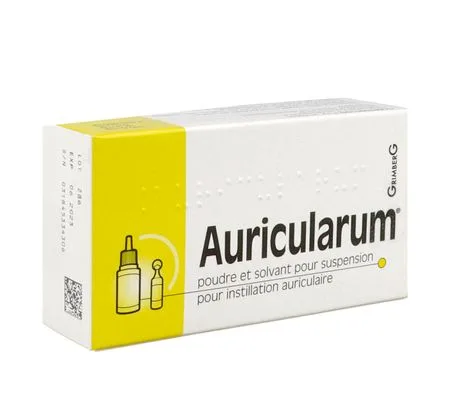
AURICULARUM, powder and solvent for auricular instillation suspension
Composition
Oxytetracycline hydrochloride ................................................................................................... 100,0 mg
Polymyxin B sulfate ............................................................................................................... 12,3 mg
Dexamethasone sodium phosphate ....................................................................................... 10,0 mg
Nystatin.................................................................................................................................1 000 000 IU
For one vial
Excipient(s) with known effect: Sodium lauryl sulfate
Sodium lauryl sulfate
Composition of the solvent : sodium chloride, purified water.
Indications
Local treatment:
- of external otitis of bacterial and/or fungal origin;
- of chronic otitis:
- preoperatively for drying,
- postoperatively for petromastoid cavities with or without tympanoplasty.
Official recommendations concerning the appropriate use of antibacterial agents should be taken into account.
Dosage and administration
Local auricular route.
Dosage
In powder form:
Insufflate one dose of product obtained by pressing the vial into the ear canal of the affected ear 1 to 2 times a day, or every 2 to 3 days.
In suspension form:
Instil 5 to 10 drops of the obtained suspension into the ear canal of the affected ear, 1 to 2 times a day.
Method of administration
In powder form:
Orient the flexible vial head down; bring all the powder back by packing it toward the neck portion;
Press the vial to obtain one dose of product;
In suspension form :
In certain particular cases, it is possible to use the powder suspended with the contents of the solvent ampoule.
This auricular suspension, prepared at the time of use, retains its activity for 8 days between +2 °C and +8 °C (in the refrigerator).
Warm the vial before use by holding it for a few minutes in the palm of the hand, in order to avoid the unpleasant contact of the cold solution in the ear. Shake well before use.
Instil the drops into the affected ear with the head tilted, pulling several times on the auricle. Keep the head tilted to the side for approximately 5 minutes, in order to facilitate penetration of the drops into the external auditory canal. Repeat, if necessary, in the other ear.
At the end of treatment, the remainder of the vial must be discarded and must not be kept for reuse.
Duration of treatment :
The duration of treatment is usually 7 days, and may go up to a maximum of 15 days in the treatment of otomycosis.
Contraindications
Hypersensitivity to the active substances, or to another product of the cycline family, or to any of the excipients mentioned in the section Composition.
Dry tympanic perforation (see Warnings and precautionsand special precautions for use).
Viral infections of the external auditory canal including varicella and infections due to Herpes simplex.
Warnings and precautions
Check the tympanic membrane status before any prescription.
This product contains oxytetracycline, an antibiotic belonging to the cycline family, which is known, when administered systemically, for its toxicity to the teeth in children under 8 years of age, as well as for its risk of photosensitization.
In the absence of data with this medicine administered as a powder or ear suspension, these risks cannot be completely ruled out but are certainly minimal, given the quantities administered; the passage of oxytetracycline into the general circulation is even more uncertain when this medicine is administered as a powder.
The administration of local antibiotics contributes to the occurrence of sensitisation to these active substances, with the possible occurrence of systemic reactions.
The presence of a corticosteroid does not prevent manifestations of allergy to the antibiotic, but may modify their clinical expression.
Discontinue treatment at the first signs of onset of a skin rash or any other sign of local or general hypersensitivity.
Athletes' attention is drawn to the fact that this specialty contains an active ingredient (dexamethasone) that may induce a positive reaction in tests carried out during anti-doping controls.
The persistence of a brownish powder deposit in the external auditory canal may require cleaning.
Particular attention should be paid to patients wearing hearing aids; indeed, the persistence of this deposit may interfere with the proper functioning of the device.
Do not inject, do not swallow.
At the time of use, avoid contact of the applicator tip with the ear or fingers in order to limit the risk of contamination.
It is advised not to combine this medicine with another local treatment.
If after 10 days, or even 15 days in case of otomycosis, the symptoms persist, the patient should be reviewed to re-evaluate the condition and the treatment.
This medicine contains 3,25 mg of sodium lauryl sulfate per vial.
Sodium lauryl sulfate may cause local skin reactions (such as a stinging or burning sensation) or increase skin reactions caused by other products when applied to the same area.
Fertility, pregnancy and breastfeeding
Pregnancy
The use of this medicine will only be considered during pregnancy if necessary.
Breast-feeding
This medicine may be prescribed during breastfeeding.
Adverse effects
- Exceptionally: burning or itching sensation at the start of treatment, local allergy, dizziness.
- Persistence of brownish residues in the auditory canal (see section .Warnings and precautions).
- Selection of resistant germs.
Reporting of suspected adverse reactions
Reporting suspected adverse reactions after authorisation of the medicinal product is important. It allows continued monitoring of the benefit/risk balance of the medicinal product. Healthcare professionals are asked to report any suspected adverse reactions via the national reporting system: National Agency for the Safety of Medicines and Health Products (ANSM) and the network of Regional Pharmacovigilance Centres - Website:www.signalement-sante.gouv.fr
Pharmacodynamics
Pharmacotherapeutic class: otological drugs; corticosteroid and anti-infective in combination; dexamethasone and anti-infective - ATC code: S02CA06.
Dexamethasone is a steroidal anti-inflammatory agent.
Oxytetracycline is an antibiotic of the cycline family.
Polymyxin B is an antibiotic of the polypeptide family.
Nystatin is an antifungal agent.
Antibiotic, antifungal and anti-inflammatory activity in otology due to the anti-inflammatory properties of dexamethasone, the antifungal power of nystatin and the antibacterial power of two antibiotics with complementary activity.
The combination of these two antibiotics is justified by their good local tolerance and by the microbial flora encountered in middle ear infections. Moreover, the combination of oxytetracycline and polymyxin B is synergistic. This property allows the spectrum to be extended to Pseudomonas and all Proteus.
ANTIBACTERIAL ACTIVITY SPECTRUM OF OXYTETRACYCLINE AND POLYMYXIN B.
OXYTETRACYCLINE
The critical concentrations separate susceptible strains from strains of intermediate susceptibility, and the latter from resistant ones: S ≤ 4 mg/l and R > 8 mg/l.
The prevalence of acquired resistance can vary according to geography and time for certain species. It is therefore useful to have information on local resistance prevalence, especially for the treatment of severe infections. These data can only provide guidance on the probabilities of the susceptibility of a bacterial strain to this antibiotic.
Where the variability of resistance prevalence in France is known for a bacterial species, it is indicated in the table below:
|
Categories |
Frequency of acquired resistance in France
|
|
SUSCEPTIBLE SPECIES |
|
|
Gram-positive aerobes |
|
|
Bacillus |
|
|
Enterococci |
40-80 % |
|
Staphylococcus spp. methicillin-S * |
|
|
Staphylococcus spp. methicillin-R ** |
70-80 % |
|
Streptococcus A |
20 % |
|
Streptococcus B |
80-90 % |
|
Streptococcus pneumoniae |
20-40 % |
|
Gram-negative aerobes |
|
|
Branhamella catarrhalis |
|
|
Brucella |
|
|
Escherichia coli |
20-40 % |
|
Haemophilus influenzae |
10 % |
|
Klebsiella |
10-30 % |
|
Neisseria gonorrhoeae |
|
|
Pasteurella |
|
|
Vibrio cholerae |
|
|
Anaerobes |
|
|
Propionibacterium acnes |
|
|
Other |
|
|
Borrelia burgdorferi |
|
|
Chlamydia |
|
|
Coxiella burnetii |
|
|
Leptospira |
|
|
Mycoplasma pneumoniae |
|
|
Rickettsia |
|
|
Treponema pallidum |
|
|
Ureaplasma urealyticum |
|
|
RESISTANT SPECIES |
|
|
Gram-negative aerobes |
|
|
Acinetobacter |
|
|
Proteus mirabilis |
|
|
Proteus vulgaris |
|
|
Pseudomonas |
|
|
Serratia |
* Clinical efficacy demonstrated for susceptible strains in the approved clinical indication in combination with polymyxin B.
** The frequency of methicillin resistance is approximately 30 to 50 % of all staphylococci and is found mainly in hospital settings.
POLYMYXIN B
The critical concentrations separate susceptible strains from strains of intermediate susceptibility, and the latter from resistant ones: S ≤ 2 mg/L and R > 2 mg/L
The prevalence of acquired resistance can vary according to geography and time for certain species. It is therefore useful to have information on local resistance prevalence, especially for the treatment of severe infections. These data can only provide guidance on the probabilities of the susceptibility of a bacterial strain to this antibiotic.
Where the variability of resistance prevalence in France is known for a bacterial species, it is indicated in the table below:
|
Categories |
Frequency of acquired resistance in France
|
|
SUSCEPTIBLE SPECIES |
|
|
Gram-negative aerobes |
|
|
Acinetobacter |
|
|
Aeromonas |
|
|
Alcaligenes |
|
|
Citrobacter freundii |
|
|
Citrobacter koseri |
|
|
Enterobacter |
|
|
Escherichia coli |
|
|
Klebsiella |
|
|
Moraxella |
|
|
Pseudomonas aeruginosa* |
|
|
Salmonella |
|
|
Shigella |
|
|
Stenotrophomonas maltophilia |
0-30 % |
|
Categories |
|
|
RESISTANT SPECIES |
|
|
Gram-positive aerobes |
|
|
Cocci and bacilli |
|
|
Gram-negative aerobes |
|
|
Branhamella catarrhalis |
|
|
Brucella |
|
|
Burkholderia cepacia
|
|
|
Chryseobacterium meningosepticum |
|
|
Legionella |
|
|
Morganella |
|
|
Neisseria |
|
|
Proteus |
|
|
Providencia |
|
|
Serratia |
|
|
Vibrio cholerae El Tor
|
|
|
Cocci and bacilli |
|
|
Other |
|
|
Mycobacteria |
* Clinical efficacy demonstrated for susceptible strains in the approved clinical indication in combination with oxytetracycline.
Note: this spectrum corresponds to that of the systemic form of these antibiotics. With local pharmaceutical presentations, the concentrations obtained in situ are much higher than plasma concentrations. Some uncertainties remain regarding the kinetics of in situ concentrations, the local physicochemical conditions that may modify the activity of the antibiotic, and the stability of the product in situ.
NYSTATIN
Polyene-family topical antifungal, extracted from a culture of Streptomyces noursei.
Nystatin is thought to act by binding to a sterol fraction of the fungal membrane, causing changes in membrane permeability.
Antifungal spectrum of action: nystatin is active against a wide variety of yeast-like and filamentous fungi, including the main agents responsible for otomycosis (Candida, Aspergillus).
Shelf life
Before reconstitution: 2 years.
After reconstitution: the suspension for ear instillation must be stored for a maximum of 8 days.
Special storage precautions
Before reconstitution: store at a temperature not exceeding +25 °C.
After reconstitution, the suspension for ear instillation must be stored between +2 °C and +8 °C (in a refrigerator).
SPECIAL PRECAUTIONS FOR DISPOSAL AND OTHER HANDLING
Any unused medicinal product or waste material should be disposed of in accordance with local requirements.
Prescription, supply and reimbursement
| Marketing authorisation (AMM) |
|
| Price: |
|
Non Remb Séc soc (Fl+Amp/10ml).
Collect (Fl+Amp solv/10ml).
5 RUE VERMONT
78700 CONFLANS-SAINT-HONORINE
contact@laboratoires-grimberg.com
http://www.laboratoires-grimberg.com/
Source: VIDAL · Updated on 10/11/2026. This information does not replace advice from a healthcare professional.