
Medicines
SmPC of 12/06/2026
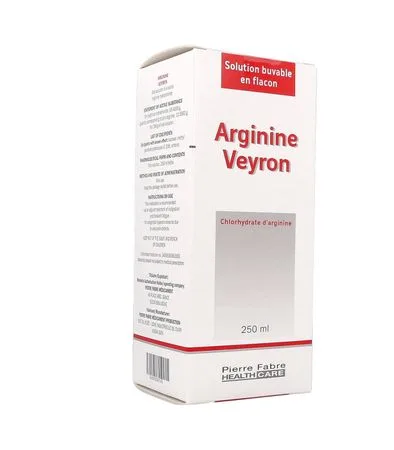
ARGININE VEYRON, oral solution in vial
Composition
L(+) arginine hydrochloride...............................................................................................................16,4000 g
Corresponding quantity of L(+) arginine..........................................................................................13,5562 g
For 100 g of oral solution
One teaspoon (i.e. 5 ml of oral solution) contains 0,9184 g of L(+) arginine hydrochloride.
Excipients with known effect : one teaspoon contains 0,8000 g of sucrose, 0,0220 g of ethanol* and 0,0075 g of methyl parahydroxybenzoate (E218).
* contained in the caramel flavouring
Caramel flavouring*, methyl parahydroxybenzoate (E218), sucrose solution at 67% (m/m), saccharin, purified water.
*Composition of the caramel flavouring : caramel, extracts of coffee, fenugreek, cocoa, vanillin, ethylvanillin, benzaldehyde, piperonal, furfural, diacetyl, methyl ethyl ketone, γ-nonalactone, dihydroxycoumarin, glycerol, ethanol and water.
Indications
• Adjunctive treatment of dyspeptic disorders in adults.
• Adjunctive treatment of functional asthenia in adults and children over 6 years.
• Congenital hyperammonaemias due to urea cycle deficiency in adults, children and infants.
Dosage and administration
Dosage
Adults :
• Dyspepsia:
1 to 2 teaspoons, before the 3 main meals or at the time of disorders.
• Asthenia:
1 teaspoon, 2 to 3 times a day. The duration of treatment should not exceed 4 weeks.
• Congenital hyperammonaemias:
250 to 500 mg/kg/day (up to a limit of 12 g of L(+) arginine hydrochloride per day).
Paediatric population :
• Children over 6 years of age
- Asthenia:
1 teaspoon, 2 to 3 times a day.
The duration of treatment must not exceed 4 weeks.
• Children and Infants
- Congenital hyperammonemias: 250 to 500 mg/kg/day (up to a limit of 12 g of L(+) Arginine hydrochloride per day).
Method of administration
• Oral route
• Dilute in a little water and swallow immediately.
• For infants, dilute in water or in the feeding bottle before taking.
Contraindications
Hypersensitivity to the active substance or to any of the excipients listed in section Composition.
Warnings and precautions
USE THIS MEDICINE WITH CAUTION in cases of biliary tract obstruction and severe hepatocellular insufficiency.
In case of diarrhoea or abdominal pain, the product must be discontinued.
This medicine contains:
• 0,8 g of sucrose per teaspoon (5 ml). This must be taken into account for patients with diabetes mellitus. May be harmful to teeth. Patients with fructose intolerance, glucose-galactose malabsorption syndrome or sucrase/isomaltase deficiency (rare hereditary diseases) must not take this medicine.
• methyl parahydroxybenzoate (E218) and may cause allergic reactions (possibly delayed).
• 22 mg of ethanol per teaspoon of solution (5 ml). The amount per teaspoon in this medicine is equivalent to less than 1 ml of beer or 1 ml of wine. The small amount of alcohol contained in this medicine is not likely to produce any noticeable effect.
Interactions
The data available to date do not suggest the existence of clinically significant interactions.
Fertility, pregnancy and breastfeeding
Pregnancy
There are no or limited data on the use of arginine in pregnant women.
Animal studies are insufficient to draw conclusions on reproductive toxicity (see section Preclinical safety).
ARGININE VEYRON is not recommended during pregnancy and in women of childbearing potential not using contraception.
Breast-feeding
Arginine is a natural amino acid, excreted in breast milk. There are no sufficient data on the excretion of arginine in breast milk during treatment with ARGININE VEYRON. A risk to breastfed newborns/infants cannot be excluded.
The use of ARGININE VEYRON should be avoided during breastfeeding.
Fertility
There are no data concerning the effects of arginine on fertility.
Driving and using machines
No specific study on the ability to drive vehicles and use machines has been performed. No effect is expected on the ability to drive vehicles and use machines.
Adverse effects
List of adverse effects
The adverse effects that may occur with ARGININE VEYRON are listed below by System Organ Classes and by frequency according to the following convention: Very common (≥ 1/10); common (≥ 1/100, < 1/10); uncommon (≥ 1/1 000, < 1/100); rare (≥ 1/10 000, < 1/1 000), very rare (< 1/10 000), not known (cannot be estimated from the available data).
|
System Organ Classes |
MedDRA preferred term |
Frequency |
|
Immune system disorders |
Hypersensitivity |
Not known |
|
Gastrointestinal disorders |
Diarrhoea, abdominal pain |
Not known |
Reporting of suspected adverse reactions
Reporting of suspected adverse effects after marketing authorisation of the medicinal product is important. It allows continuous monitoring of the benefit/risk balance of the medicinal product. Healthcare professionals report any suspected adverse effect via the national reporting system: National Agency for the Safety of Medicines and Health Products (ANSM) and network of Regional Pharmacovigilance Centres – Website: https://signalement.social-sante.gouv.fr/.
Pharmacodynamics
Pharmacotherapeutic class: CHOLAGOGUE-CHOLERETIC, ANTI-ASTHENIC, HYPOAMMONAEMIC
ATC code: A: Alimentary tract and metabolism
In the case of inherited deficiencies of ureagenesis, arginine enables detoxification and elimination of ammonia in the form of citrulline or argino-succinic acid.
Preclinical safety
Non-clinical data reveal no particular risk of acute toxicity, toxicity after repeated administration, genotoxicity or carcinogenesis.
There is no adequate toxicity data available to assess the effects of arginine on fertility and embryo-foetal development.
Prescription, supply and reimbursement
| Marketing authorisation (AMM) |
|
| Price: |
|
- Congenital hyperammonaemia due to urea cycle deficiency
CHARTREUSE INDUSTRIAL PARK
81106 CASTRES CEDEX
Tel: 01 49 10 80 00 Tel (Freephone): 0 800 326 326
https://www.pierrefabremedicament.fr/
Source: VIDAL · Updated on 10/11/2026. This information does not replace advice from a healthcare professional.