
Medicines
Update of 21/08/2018
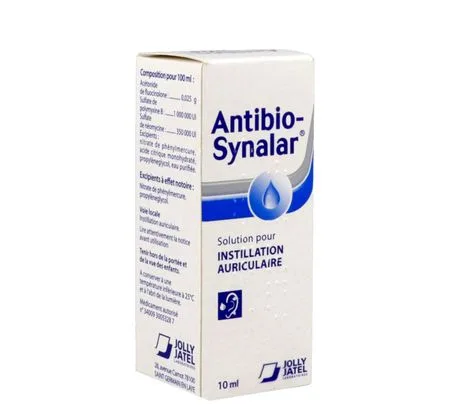
ANTIBIO-SYNALAR®
fluocinolone acetonide, polymyxin B, neomycin
Forms and presentations
Solution for auricular instillation: Bottle of 10 ml, with dropper tip.Composition
| p bottle | |
| Fluocinolone acetonide (INN)
|
2,5 mg |
| Polymyxin B (INN) sulfate
|
100 000 IU |
| Neomycin (INN) sulfate
|
35 000 IU |
Excipients with known effect: phenylmercuric nitrate, propylene glycol.
Indications
Local treatment of bacterial external otitis with intact tympanic membrane, in particular infected eczema of the external auditory canal.This medicine must never be used in case of tympanic membrane perforation due to the risk of ototoxicity.
Official recommendations concerning the appropriate use of antibacterial agents should be taken into account.
Dosage and administration
DosageInstil 3 to 6 drops into the auditory canal of the affected ear every morning and repeat the procedure in the evening.
The duration of treatment is usually 7 days.
Method of administration:
Topical use.
Auricular instillation.
Warm the bottle at the time of use by holding it for a few minutes in the palm of the hand, in order to avoid the unpleasant contact of the cold solution in the ear.
Instil the drops into the affected ear with the head tilted, pulling several times on the auricle. Keep the head tilted to the side for approximately 5 minutes, in order to facilitate penetration of the drops into the external auditory canal. Repeat, if necessary, in the other ear.
It is recommended not to use this medicine under high pressure.
At the end of treatment, the remainder of the bottle must be discarded and must not be kept for reuse.
Contraindications
- Hypersensitivity to the active substances or to any of the excipients listed in section Composition.
- Known or suspected tympanic perforation (see Warnings and Precautions for Use).
- Viral infections of the external auditory canal including chickenpox and Herpes simplex infections.
Warnings and precautions
Ensure tympanic integrity before any prescription.
In case of tympanic destruction, intra-auricular administration risks bringing the product into contact with the structures of the middle ear and causing irreversible ototoxic adverse effects (deafness, balance disorders).
The administration of local antibiotics contributes to the occurrence of sensitisation to these active substances, with the possible occurrence of systemic reactions.
The presence of a corticosteroid does not prevent manifestations of allergy to the antibiotic, but may modify their clinical expression.
Discontinue treatment at the first signs of onset of a skin rash or any other sign of local or general hypersensitivity.
Athletes are advised that this specialty contains an active ingredient (fluocinolone) that may induce a positive reaction in tests carried out during anti-doping controls.
Do not inject, do not swallow.
At the time of use, avoid contact of the applicator tip with the ear or fingers in order to limit the risk of contamination.
It is advised not to combine this medicine with another local treatment.
If symptoms persist after 10 days, the patient should be reviewed to reassess the condition and the treatment.
Fertility, pregnancy and breastfeeding
There are no animal and clinical studies. However, to date, no harmful effect has been reported in pregnant women. Moreover, systemic passage, in the absence of a tympanic breach, is unlikely.
Consequently, this medicine may, if needed, be administered during pregnancy or breastfeeding.
Adverse effects
- Local reactions (irritation).
- Allergy to antibiotics (neomycin, polymyxin B) and sensitisation that may compromise the subsequent systemic use of a related antibiotic.
- Due to the presence of phenylmercury, risk of contact eczema and hypersensitivity reaction; risk of skin irritation.
- Vestibular or cochlear ototoxicity in case of an open eardrum (see Warnings and Precautions for Use).
- Selection of resistant organisms and development of mycosis.
Reporting suspected adverse reactions after authorisation of the medicinal product is important. It allows continuous monitoring of the benefit/risk balance of the medicinal product. Healthcare professionals should report any suspected adverse reaction via the national reporting system: National Agency for the Safety of Medicines and Health Products (ANSM) and the network of Regional Pharmacovigilance Centres. Website: www.ansm.sante.fr.
Pharmacodynamics
Pharmacotherapeutic class: Otological medicines; corticosteroid and anti-infective in combination; fluocinolone and anti-infective (ATC code: S02CA05).
- Fluocinolone: steroidal anti-inflammatory.
- Neomycin: antibiotic of the aminoglycoside family.
- Polymyxin B: antibiotic of the polypeptide family.
- Spectrum of antibacterial activity: Polymyxin B:
- The critical concentrations separate susceptible strains from strains of intermediate susceptibility and the latter from resistant ones: S ≤ 2 mg/L and R > 2 mg/L.
- The prevalence of acquired resistance can vary according to geography and time for certain species. It is therefore useful to have information on local resistance prevalence, especially for the treatment of severe infections. These data can only provide guidance on the probabilities of the susceptibility of a bacterial strain to this antibiotic.
- When the variability of resistance prevalence in France is known for a bacterial species, the frequency of acquired resistance in France (> 10 %; extreme values) is indicated in parentheses:
-
Susceptible species:
- Gram-negative aerobes: acinetobacter, aeromonas, alcaligenes, Citrobacter freundii, Citrobacter koseri, enterobacter, Escherichia coli, klebsiella, moraxella, Pseudomonas aeruginosa*, salmonella, shigella, Stenotrophomonas maltophilia (0 - 30 %).
- Gram-negative aerobes: acinetobacter, aeromonas, alcaligenes, Citrobacter freundii, Citrobacter koseri, enterobacter, Escherichia coli, klebsiella, moraxella, Pseudomonas aeruginosa*, salmonella, shigella, Stenotrophomonas maltophilia (0 - 30 %).
-
Resistant species:
- Gram-positive aerobes: cocci and bacilli.
- Gram-negative aerobes: Branhamella catarrhalis, brucella, Burkholderia cepacia, Burkholderia pseudomallei, campylobacter, Chryseobacterium meningosepticum, legionella, morganella neisseria, proteus, providencia, serratia, Vibrio cholerae El Tor.
- Anaerobes: cocci and bacilli.
- Others: mycobacteria.
- Gram-positive aerobes: cocci and bacilli.
-
* Clinical efficacy demonstrated for susceptible strains in the approved clinical indication in combination with neomycin.
- Spectrum of antibacterial activity: Neomycin:
- The prevalence of acquired resistance can vary according to geography and time for certain species. It is therefore useful to have information on local resistance prevalence, especially for the treatment of severe infections. These data can only provide guidance on the probabilities of the susceptibility of a bacterial strain to this antibiotic.
- When the variability of resistance prevalence in France is known for a bacterial species, the frequency of acquired resistance in France (> 10 %; extreme values) is indicated in parentheses:
-
Susceptible species:
- Gram-positive aerobes: corynebacterium, Listeria monocytogenes, methicillin-susceptible staphylococcus*.
- Gram-negative aerobes: acinetobacter (50-75 %) essentially Acinetobacter baumannii, Branhamella catarrhalis, campylobacter, Citrobacter freundii (20-25 %), Citrobacter koseri, Enterobacter aerogenes (?), Enterobacter cloacae (10-20 %), Escherichia coli (15-25 %), Haemophilus influenzae (25-35 %), klebsiella (10-15 %), Morganella morganii (10-20 %), Proteus mirabilis (20-50 %), Proteus vulgaris (?), Providencia rettgeri (?), salmonella (?), serratia (?), shigella (?), yersinia (?).
- Gram-positive aerobes: corynebacterium, Listeria monocytogenes, methicillin-susceptible staphylococcus*.
-
Moderately susceptible species (in vitro intermediate susceptibility):
- Gram-negative aerobes: pasteurella.
- Gram-negative aerobes: pasteurella.
-
Resistant species:
- Gram-positive aerobes: enterococci, Nocardia asteroides, methicillin-resistant staphylococcus**, streptococcus.
- Gram-negative aerobes: Alcaligenes denitrificans, burkholderia, flavobacterium sp, Providencia stuartii, Pseudomonas aeruginosa, Stenotrophomonas maltophilia.
- Anaerobes: strict anaerobic bacteria.
- Others: chlamydia, mycoplasmas, rickettsiae.
- Gram-positive aerobes: enterococci, Nocardia asteroides, methicillin-resistant staphylococcus**, streptococcus.
-
* Clinical efficacy demonstrated for susceptible strains in the approved clinical indication in combination with polymyxin B.
-
** The frequency of methicillin resistance is approximately 30 to 50 % of all staphylococci and is found mainly in hospital settings.
Note: these spectra correspond to those of the systemic forms of antibiotics belonging to the aminoglycoside and polypeptide families. With local pharmaceutical presentations, the concentrations obtained in situ are far higher than plasma concentrations. Some uncertainties remain regarding the kinetics of in situ concentrations, the local physicochemical conditions that may modify the antibiotic's activity, and the stability of the product in situ.
Pharmacokinetics
In the absence of a tympanic perforation, there is no systemic passage.
Storage conditions
- Shelf life
- 18 months.
Store at a temperature below 25 °C and protected from light.
HANDLING/DISPOSAL INSTRUCTIONS
No special requirements.
Any unused medicinal product or waste material should be disposed of in accordance with local requirements.
Prescription, supply and reimbursement
LIST I| Marketing authorisation (AMM) | 3400930053287 (1965/96, RCP rev 14.06.2018). |
| Price: | 2,00 euros (10 ml of solution). |
| Social security reimbursement at 15 %. Collect | |
Laboratoires JOLLY-JATEL
28, av Carnot. 78100 St-Germain-en-Laye
Tel: 01 34 51 00 83
Source: VIDAL · Updated on 10/11/2026. This information does not replace advice from a healthcare professional.