
Medicines
Update of 03/09/2026
ANTARENE® gel
ibuprofen
Forms and presentations
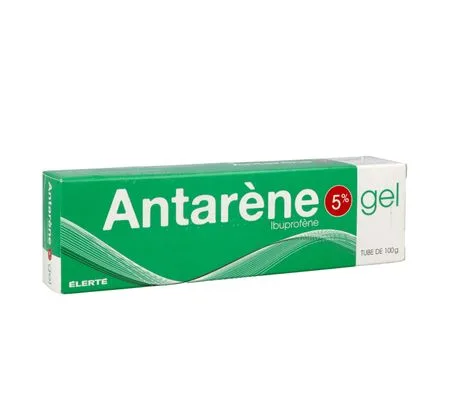
Gel at 5 % : Tubes of 50 g and 100 g.Composition
| p 50 g | p 100 g | |
| Ibuprofen (INN)
|
2,5 g | 5 g |
Indications
- Symptomatic treatment in minor traumatology: sprains, contusions.
- Symptomatic treatment of superficial tendinitis.
Dosage and administration
Reserved for adults (more than 15 years).
Topical use.
Dosage1 application, 3 times per day.
Method of administration:
Apply the gel, by gentle and prolonged massage, to the painful or inflamed area.
Wash hands thoroughly after each use.
Contraindications
This medicine is contraindicated in the following situations:- Hypersensitivity to the active substance or to any of the excipients listed in section Composition.
- History of allergy to ibuprofen and to substances of similar activity such as other NSAIDs, aspirin.
- Pregnancy, from the beginning of the 6th month (24 weeks of amenorrhea) (see Fertility/Pregnancy/Breastfeeding).
- Damaged skin, regardless of the lesion: weeping dermatoses, eczema, infected lesion, burn or wound.
Warnings and precautions
- In the absence of specific safety studies conducted in children, this medicine is reserved for adults (over 15 years).
- Do not apply to mucous membranes, nor to the eyes.
- The appearance of a skin reaction after application of the gel requires immediate discontinuation of treatment.
- Wearing gloves by the physiotherapist, in case of intensive use, is recommended.
Severe cutaneous adverse reactions (SCAR):
Severe cutaneous adverse reactions (SCAR), such as exfoliative dermatitis, erythema multiforme, Stevens-Johnson syndrome (SJS), toxic epidermal necrolysis (TEN), drug reaction with eosinophilia and systemic symptoms (DRESS or hypersensitivity syndrome) and acute generalised exanthematous pustulosis (AGEP), which may be life-threatening or fatal, have been reported in association with the use of ibuprofen (see Undesirable effects). Most of these reactions occurred during the first month of treatment.
If signs and symptoms suggestive of these reactions appear, ibuprofen should be stopped immediately and another treatment should be considered (where appropriate).
Interactions
Drug interactionsDue to the low systemic absorption during normal use of the gel, drug interactions reported for oral ibuprofen are unlikely.
Fertility, pregnancy and breastfeeding
Pregnancy:Inhibition of prostaglandin synthesis by NSAIDs may affect the course of pregnancy and/or the development of the embryo or foetus.
There are no data on the use of topical forms of ANTARENE in pregnant women. Even though systemic exposure is lower compared to oral administration, it is not known whether systemic exposure to ANTARENE after topical administration may be harmful to the embryo/foetus. During the first two trimesters of pregnancy, ANTARENE should not be used, except in cases of absolute necessity. If used, the dose should be kept as low as possible and the duration of treatment as short as possible.
From the beginning of the 6th month of pregnancy (24 weeks of amenorrhoea), systemic use of prostaglandin synthesis inhibitors, including ANTARENE, may induce cardiopulmonary and renal toxicity in the foetus. Prolonged bleeding time in the mother and the child may occur at the end of pregnancy and labour may be delayed. Therefore, ANTARENE is contraindicated from the beginning of the 6th month of pregnancy (24 weeks of amenorrhoea) (see Contraindications).
Breastfeeding:
NSAIDs pass into breast milk, so this medicine is not recommended for women who are breastfeeding.
During breastfeeding, this medicine must under no circumstances be applied to the breast.
Fertility:Like all NSAIDs, use of this medicinal product may temporarily impair female fertility by affecting ovulation; it is therefore not recommended in women wishing to conceive. In women having difficulty conceiving or undergoing fertility investigations, discontinuation of treatment should be considered.
Adverse effects
- Related to the route of administration: local skin hypersensitivity reactions, such as pruritus or localised erythema.
- Hypersensitivity reactions:
- dermatological;
- respiratory: the occurrence of asthma attacks may be related in some subjects to an allergy to aspirin or an NSAID (see Contraindications) ;
- general: anaphylactic-type reactions.
- dermatological;
- Other systemic effects of NSAIDs: these depend on the transdermal passage of the active ingredient, and therefore on the amount of gel applied, the surface area treated, the degree of skin integrity, the duration of treatment and whether or not an occlusive dressing is used (gastrointestinal and renal effects).
Skin and subcutaneous tissue disorders:
Severe cutaneous adverse reactions (SCAR) (including erythema multiforme, exfoliative dermatitis, Stevens-Johnson syndrome and toxic epidermal necrolysis) - very rare frequency.
Drug reaction with eosinophilia and systemic symptoms (DRESS or hypersensitivity syndrome) - undetermined frequency.
Acute generalised exanthematous pustulosis (AGEP) - frequency not known.
Reporting of suspected adverse reactions:Reporting suspected adverse reactions after authorisation of the medicinal product is important. It allows continuous monitoring of the benefit/risk balance of the medicinal product. Healthcare professionals should report any suspected adverse reaction via the national reporting system: National Agency for the Safety of Medicines and Health Products (ANSM) and the network of Regional Pharmacovigilance Centres. Website: https://signalement.social-sante.gouv.fr.
Overdose
In case of overdose, rinse thoroughly with water.
Application of excessively high doses may lead to exacerbation of undesirable effects.
Pharmacodynamics
Non-steroidal anti-inflammatory agent for topical use (M: muscles and skeleton).
Ibuprofen is a non-steroidal anti-inflammatory agent of the propionic acid group, derived from arylcarboxylic acid.
In the form of a gel for cutaneous application, it has anti-inflammatory and analgesic activity.
Pharmacokinetics
The relative bioavailability of the gel containing 5 % ibuprofen compared with oral administration is 5 to 7,4 %.
INCOMPATIBILITIES
No known incompatibilities.
Storage conditions
- Shelf life
- 3 years.
No special precautions for storage.
HANDLING/DISPOSAL INSTRUCTIONS
No special requirements.
Prescription, supply and reimbursement
| Marketing authorisation (AMM) | 3400935562708 (2000, SmPC rev 20.07.2026) 50 g. |
| 3400936438040 (2000, SmPC rev 20.07.2026) 100 g. |
| Price: | 1,86 euros (tube of 50 g). |
| 3,12 euros (tube of 100 g). | |
| Social Security reimbursement at 30%. Collect. | |
ÉLERTÉ
181-183, rue André-Karman
93300 Aubervilliers. Tel: 01 48 34 75 03
Source: VIDAL · Updated on 10/11/2026. This information does not replace advice from a healthcare professional.