
Medicines
SmPC of 06/08/2025
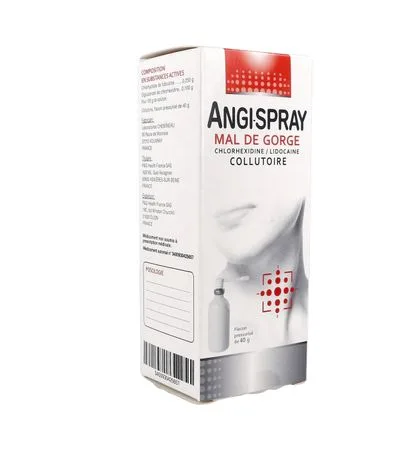
ANGI-SPRAY SORE THROAT CHLORHEXIDINE / LIDOCAINE, oral spray
Composition
Lidocaine hydrochloride....................................................................................................................... 0,2500 g
Chlorhexidine digluconate..................................................................................................................0,1000 g
For 100 g of solution.
Propellant gas: nitrogen (pressure: 7,0 bars).
Glycerol, Sucralose, Mint flavouring*, Purified water.
*Composition of the mint flavouring: L-menthol, trans-menthone, menthol, menthyl acetate, 4,5,6,7-tetrahydro-3,6-dimethylbenzofuran, (R)-p-mentha-1,8-diene, (S)-p-mentha-1,8-diene, l-p-mentha-1(6),8-diene-2-one, pin-2(10)-ene, pin-2(3)-ene, p-mentha-1,3-diene.
Indications
Adjunctive local antibacterial and analgesic treatment of conditions limited to the oral mucosa and the oropharynx.
NB: in the presence of general clinical signs of bacterial infection, systemic antibiotic therapy should be considered.
Dosage and administration
Dosage
Doses should be spaced at least 4 hours apart.
Adults:
1 spray 4 to 5 times a day.
Children aged 6 to 15 years:
1 spray 2 to 3 times a day.
Contraindications
Hypersensitivity to the active substances or to any of the excipients listed in section Composition.
Known allergy to local anaesthetics and to chlorhexidine.
Do not use in children under 6 years of age.
Warnings and precautions
Special warnings
Possible risk of aspiration due to anaesthesia of the oropharyngeal junction:
• use this medicine with caution in children under 12 years of age
• do not use this medicine before meals or before drinking.
The indication does not justify prolonged treatment beyond 5 days, particularly as it could expose to an imbalance of the normal microbial flora of the oral cavity with a risk of bacterial or fungal spread.
Repeated or prolonged treatment of the mucosa may expose to the risks of toxic systemic effects of topical anaesthetics (central nervous system involvement with convulsions, depression of the cardiovascular system).
Athletes are advised that this product contains an active substance (local anaesthetic) that may cause a positive reaction in tests carried out during anti-doping controls.
Special precautions for use
If symptoms persist beyond 5 days and/or if associated fever occurs, the course of action should be reassessed.
Interactions
Simultaneous or successive use of other antiseptics should be avoided given possible interferences (antagonism, inactivation…).
Fertility, pregnancy and breastfeeding
Pregnancy
There are no data or limited data on the use of chlorhexidine in pregnant women. Animal studies have not shown direct or indirect harmful effects (under normal conditions of use) on reproduction (see section Preclinical safety).
A large quantity of data on the use of lidocaine during pregnancy has not indicated an increased risk of congenital malformations or foetal/neonatal toxicity of lidocaine when used for local treatment of conditions limited to the oral mucosa and oropharynx. Lidocaine crosses the placenta. However, it is only systemically absorbed to a limited extent when administered locally due to significant first-pass metabolism (see section Pharmacokinetics).
As a precaution, it is preferable to avoid use of ANGI-SPRAY MAL DE GORGE CHLORHEXIDINE / LIDOCAINE, mouthwash during pregnancy.
Breast-feeding
It is not known whether chlorhexidine is excreted in breast milk. Lidocaine may be excreted in breast milk in small amounts.
Under normal conditions of use, no adverse effects are expected in the breastfed newborn.
Use of ANGI-SPRAY MAL DE GORGE CHLORHEXIDINE / LIDOCAINE, mouthwash, may be considered during breastfeeding if necessary.
Fertility
For lidocaine and chlorhexidine, no effect on fertility has been demonstrated.
Adverse effects
• Brown discolouration of the tongue and teeth, reversible on cessation of treatment (chlorhexidine).
• Sensitisation to chlorhexidine and local anaesthetics with risk of anaphylactic reaction.
• Transient numbness of the tongue and possibility of aspiration (see 4.4 Special warnings and precautions for use)
Reporting of suspected adverse reactions
Reporting suspected adverse reactions after marketing authorisation of the medicinal product is important. It allows continuous monitoring of the benefit/risk balance of the medicinal product. Healthcare professionals report any suspected adverse reaction via the national reporting system: National Agency for the Safety of Medicines and Health Products (ANSM) and network of Regional Pharmacovigilance Centres - Website https://signalement.social-sante.gouv.fr/
Pharmacodynamics
Pharmacotherapeutic class: LOCAL ANTISEPTIC / LOCAL ANAESTHETIC, ATC code: R: respiratory system.
Preparation for oral or oropharyngeal use combining a local antiseptic of the biguanide family (chlorhexidine digluconate) and a local anaesthetic (lidocaine hydrochloride).
Pharmacokinetics
Chlorhexidine
Absorption
Absorption of chlorhexidine after oral or topical use is negligible.
On topical application to intact skin, chlorhexidine is absorbed by the outer layers of the skin, ensuring a long-lasting antimicrobial effect on the skin. Pharmacokinetic studies have established that after rinsing the oral cavity following an oral dose of 0,12% chlorhexidine digluconate solution, approximately 30% of chlorhexidine remains, which is then slowly released into saliva.
Distribution
Chlorhexidine binds tightly to salivary proteins.
Biotransformation and elimination
Chlorhexidine does not accumulate in the body. A small amount is metabolised. After ingestion of a dose of 300 mg of chlorhexidine gluconate, approximately 90% of it is excreted in bile via faeces and less than 1% via urine.
Lidocaine
Absorption
Absorption of lidocaine is variable; it depends on the location and the mode of application. It is rapidly absorbed by the digestive system, the mucous membranes and by damaged skin. In healthy adults, no significant plasma concentration of lidocaine was observed after use of a mouthwash solution at 2 %. Children and immunodeficient adults absorb lidocaine from the oral mucosa into the plasma. The values were approximately 0,2 µg/ml, the pharmacologically active plasma concentration being 1,5 to 5 µg/ml.
The anaesthetic action of lidocaine after topical application appears after 2 to 5 minutes and lasts from 30 to 45 minutes. This is superficial anaesthesia that does not reach the submucosa.
Distribution
Lidocaine is well distributed in tissues (kidneys, lungs, heart, adipose tissue). Lidocaine crosses the blood-brain barrier and the placenta and passes into breast milk.
Biotransformation and elimination
It is metabolised after first pass through the liver; its bioavailability after oral intake is 35%. Its metabolism consists of successive de-ethylation at 90% in the liver into mono-ethyl-glycine-xylidine and glycine-xylidine. These two metabolites are pharmacologically active.
Lidocaine is excreted as metabolites by the liver; 10 % of lidocaine is excreted unchanged. The biological half-life of lidocaine is 1,5 to 2 hours in adults. The biological half-life of lidocaine metabolites is 2 to 10 hours.
Preclinical safety
For lidocaine, no repeated-dose toxicity data are available; it is not suspected of mutagenic or carcinogenic properties.
In reproductive toxicity studies, embryotoxic or foetotoxic effects were detected at doses of‑25 mg/kg of lidocaine by subcutaneous route in rabbits.‑At doses below the maternal toxic dose in rats, lidocaine has no effect on the postnatal development of the offspring. Fertility in male or female rats treated with lidocaine was not impaired. Lidocaine crosses the placental barrier by simple diffusion. The ratio between foetal embryo dose and maternal serum concentrations is‑0,4 to 1,3.
For chlorhexidine, non-clinical data from the literature did not reveal any particular risk for humans based on repeated-dose toxicity, fertility, teratogenicity and carcinogenicity studies conducted in animals.
Special storage precautions
Pressurised container:
• do not expose to temperatures above 50°C, nor to sunlight,
• do not puncture,
• do not throw into a fire even when empty.
SPECIAL PRECAUTIONS FOR DISPOSAL AND OTHER HANDLING
Any unused medicinal product or waste material should be disposed of in accordance with local requirements.
Prescription, supply and reimbursement
| Marketing authorisation (AMM) |
|
CENTRAL PARK 9-15 RUE MAURICE MALLET
92130 ISSY-LES-MOULINEAUX
Tel: 01 46 94 86 86 contact@eglabo.fr
https://www.eglabo.fr/
Source: VIDAL · Updated on 10/11/2026. This information does not replace advice from a healthcare professional.