
Medicines
SmPC of the 03/03/2026
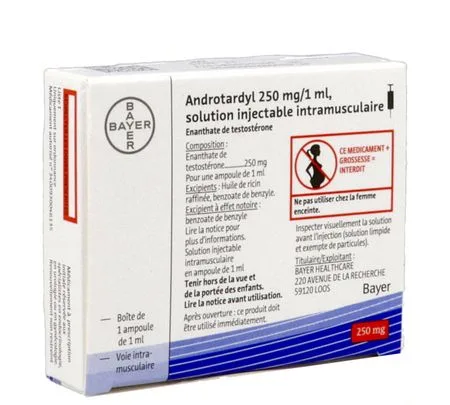
ANDROTARDYL 250 mg/1 ml, solution for intramuscular injection
Forms and presentations
Solution for intramuscular injection (oily, clear, yellowish in colour).
Ampoule of 1 ml. Box of 1.
Composition
For one ampoule of 1 ml:
Testosterone enanthate: 250 mg
Excipient with known effect: benzyl benzoate (342,0 mg per ampoule).
Refined castor oil, benzyl benzoate.
Indications
Replacement therapy for male hypogonadism, when testosterone deficiency has been confirmed clinically and biologically.
Dosage and administration
Method of administration
The oily solution must be administered very slowly (see sections Warnings and precautions and Adverse effects) and immediately after opening the ampoule. It is advised to use a glass syringe for the injection.
Dosage
250 mg IM every 2 to 4 weeks.
Serum testosterone levels should be measured before starting treatment and occasionally during treatment at the end of the interval between two injections. Serum levels below normal may indicate that the intervals between injections need to be shortened. In case of high serum levels, an increase in the time interval between injections may be considered.
Special populations
Paediatric population
ANDROTARDYL is not indicated in children or adolescents (see section Warnings and precautions).
The efficacy and tolerability of ANDROTARDYL have not been sufficiently established in this population.
Elderly patients
Limited data do not suggest the need to adjust doses in elderly patients (see section Warnings and precautions).
Hepatic impairment
No formal study has been conducted in patients with hepatic impairment. The use of ANDROTARDYL is contraindicated in case of liver tumour, history of liver tumour or severe hepatic impairment (see section Contraindications).
Renal impairment
No formal study has been conducted in patients with renal impairment. The use of ANDROTARDYL is contraindicated in case of severe renal impairment (see section Contraindications).
Contraindications
- Hypersensitivity to the active substance or to any of the excipients listed in section Composition.
- Androgen-dependent cancer of the prostate or breast in men.
- Prostatic adenoma.
- Hypercalcaemia associated with a malignant tumour.
- Liver tumour or history of liver tumour.
- Severe cardiac, renal or hepatic insufficiency.
Warnings and precautions
Paediatric population
In children, testosterone, in addition to virilisation, may cause accelerated growth and bone maturation as well as early fusion of the growth cartilages, leading to a reduction in final height. Consequently, the use of ANDROTARDYL is not recommended in children and adolescents.
Diagnosis
Treatment with ANDROTARDYL should only be started if hypogonadism (hypo- or hypergonadotrophic) has been confirmed and if other causes that may be responsible for the symptoms have been excluded. Testosterone deficiency must be clearly demonstrated by clinical signs (regression of secondary sexual characteristics, changes in body composition, asthenia, decreased libido, erectile dysfunction...) and confirmed by 2 separate testosterone measurements.
Elderly patients
The available experience regarding the safety and efficacy of ANDROTARDYL used in patients over 65 years of age is limited. Currently, there is no consensus regarding age-related reference values for testosterone levels. However, the age-related decline in physiological testosterone levels must be taken into account.
Medical examination and laboratory tests
Medical examination
Before initiating testosterone treatment, patients must undergo a thorough examination in order to rule out any pre-existing risk of prostate cancer. Careful and regular monitoring of the prostate and breasts should be carried out using the usual recommended methods (digital rectal examination and PSA - prostate-specific antigen - testing), at least once a year, in all patients receiving testosterone treatment, and twice a year in elderly subjects and patients at risk (clinical or family factors).
Laboratory tests
Testosterone levels should be checked before starting treatment, then at regular intervals during treatment. The dosage must be adjusted for each patient, to ensure that testosterone levels are maintained at a eugonadal level.
Furthermore, due to the variability in analytical results between different laboratories, all testosterone measurements should be performed by the same laboratory for a given subject.
In patients receiving long-term androgen treatment, the following biological parameters should be monitored regularly: haemoglobin and haematocrit levels (in order to detect possible cases of polycythaemia - see section Adverse effects), liver function and lipid profile.
Tumours
Androgens may accelerate the progression of locally advanced or metastatic prostate cancer.
To date, there is no evidence that they increase the risk of prostate cancer or benign prostatic hyperplasia. Likewise, there is no evidence that they can convert subclinical prostate cancer into clinically detectable prostate cancer, although this cannot be entirely excluded to date.
Therefore, it is imperative to rule out prostate cancer before starting treatment with testosterone-based preparations.
ANDROTARDYL should be used with caution in patients with cancer at risk of hypercalcaemia and hypercalciuria associated with bone metastases. Regular monitoring of serum calcium is recommended in these patients.
Rarely, benign and malignant liver tumours have been reported, sometimes complicated by intra-abdominal haemorrhage that is life-threatening, particularly with high-dose use (misuse) (see section Adverse effects).
In cases of severe abdominal pain, hepatomegaly, or signs of intra-abdominal haemorrhage, a liver tumour should be considered in the differential diagnosis.
Cardiac, hepatic and renal insufficiency
In patients with severe cardiac, hepatic or renal insufficiency, the use of ANDROTARDYL is contraindicated (see section Contraindications). As ANDROTARDYL may cause sodium and water retention, it should be used with caution in patients with cardiac, hepatic or renal disease or risk factors for oedema (see section Contraindications). In patients with ischaemic heart disease, testosterone treatment could lead to severe complications characterised by oedema, with or without congestive heart failure. In such cases, treatment must be stopped immediately.
Testosterone may cause an increase in blood pressure. Therefore, ANDROTARDYL should be used with caution in men with hypertension.
Coagulation disorders
As a general rule, the restrictions on the use of intramuscular injections in patients with acquired or hereditary blood coagulation disorders should be observed.
Testosterone and its derivatives may enhance the activity of coumarin-derived oral anticoagulants (see also section Interactions).
Testosterone should be used with caution in patients with thrombophilia or with risk factors for venous thromboembolism (VTE), as cases of thromboembolic events have been reported in these patients receiving testosterone treatment in clinical studies and post-marketing surveillance (for example: deep vein thrombosis, pulmonary embolism, retinal vein thrombosis). In patients with thrombophilia, cases of VTE have been reported even under anticoagulant treatment. Therefore, the continuation of testosterone treatment after a first thrombotic event should be carefully evaluated. If treatment is continued, further measures must be taken to minimise the risk of VTE as far as possible.
Other
ANDROTARDYL should be used with caution in patients with epilepsy, due to the risk of recurrence and/or worsening of their condition during treatment.
ANDROTARDYL must not be used in women, as depending on individual sensitivity to androgens, they may develop signs of virilisation such as acne, hirsutism, voice change (see section Fertility, pregnancy and breastfeeding).
If in individual cases frequent or persistent erections/priapism occur, the dose must be reduced or treatment discontinued in order to avoid penile lesions (see section Adverse effects).
Certain clinical signs, such as irritability and weight gain, may indicate excessive androgen exposure and require dose adjustment (see section Dosage and administration).
Pre-existing sleep apnoea may worsen during treatment.
Androgens must not be used to build muscle mass in healthy subjects, nor to increase physical performance.
Athletes' attention is drawn to the fact that this medicine contains an active substance that may induce a positive result in tests carried out during anti-doping controls.
Drug abuse and dependence
Testosterone has been subject to abuse, generally at doses higher than those recommended in the approved indication and in combination with other anabolic androgenic steroids. Abuse of testosterone and other anabolic androgenic steroids may cause serious adverse effects including: cardiovascular events (with fatal outcome in some cases), hepatic and/or psychiatric events. Abuse of testosterone may lead to dependence and withdrawal symptoms upon significant dose reduction or abrupt discontinuation of use. Abuse of testosterone and other anabolic androgenic steroids presents serious health risks and should be discouraged.
Administration
As with all oily solutions, ANDROTARDYL must only be injected intramuscularly and very slowly. Pulmonary micro-embolism due to oily solutions may, in rare cases, lead to signs and symptoms such as cough, dyspnoea, chest pain. Other signs and symptoms including vasovagal reactions may occur, such as malaise, hyperhidrosis, dizziness, paraesthesia or syncope. These reactions may occur during or immediately after injection and are reversible. The patient should therefore be monitored during and immediately after each injection so that any signs and symptoms of pulmonary micro-embolism due to oily solutions can be detected promptly. Treatment is generally symptomatic, for example with oxygen therapy.
Information on excipients:
This medicine contains 342,0 mg of benzyl benzoate in each ampoule of 1 ml.
Interactions
Associations requiring precautions for use
Medicinal products that affect testosterone
+ Barbiturates and other enzyme inducers
Risk of decreased plasma concentrations of the androgen and consequently of its efficacy, through increased hepatic metabolism by the inducer.
Clinical and biological monitoring during the combination and 1 to 2 weeks after discontinuation of the inducer.
Effects of androgens on other medicinal products:
+ Oral anticoagulants (vitamin K antagonists)
Cases of increased activity of coumarin-derived oral anticoagulants have been reported, resulting in an increased risk of haemorrhage through direct effects on coagulation and/or fibrinolytic systems.
More frequent monitoring of INR. Adjustment of the vitamin K antagonist dose during androgen treatment and after its discontinuation.
+ Oxyphenbutazone
Cases of increased serum levels of oxyphenbutazone have been reported.
+ Insulin and other antidiabetic medicinal products
Androgens may enhance the blood glucose-lowering effects of hypoglycaemic medicinal products, including oral antidiabetics and insulin. Therefore, a reduction in the dose of hypoglycaemic medicinal products may be necessary.
Concomitant use of testosterone-based replacement therapy and inhibitors of the sodium-glucose co-transporter type 2 (SGLT2) has been associated with an increased risk of erythrocytosis. As both substances can each independently cause an increase in haematocrit, a cumulative effect is possible (see also section Warnings and precautions). Monitoring of haematocrit and haemoglobin levels is recommended in patients receiving these two treatments.
Fertility, pregnancy and breastfeeding
Pregnancy
ANDROTARDYL is indicated in men only. ANDROTARDYL is not indicated in women and must not be used in pregnant women (see section Preclinical safety).
Breast-feeding
ANDROTARDYL is indicated in men only. ANDROTARDYL is not indicated in women and must not be used in women who are breastfeeding (see section Preclinical safety).
Fertility
Testosterone replacement therapy may reduce spermatogenesis in a reversible manner (see sections Adverse effects and Preclinical safety).
Adverse effects
Regarding adverse effects associated with the use of androgens, see also section Warnings and precautions.
The adverse reactions most frequently reported under treatment with ANDROTARDYL are pain at the injection site, erythema at the injection site, as well as cough and/or dyspnoea during or immediately after the injection.
Adverse reactions from spontaneous reports and the scientific literature for which a frequency cannot be estimated from the available data are classified under the heading "unknown frequency" and are presented in the table below.
|
System organ class† |
Common
|
Rare
|
Unknown frequency |
|
Benign and malignant neoplasms |
Benign and malignant liver tumours (see section Warnings and precautions) |
||
|
Blood and lymphatic system disorders |
Polycythaemia |
||
|
Immune system disorders |
Hypersensitivity |
||
|
Metabolism and nutrition disorders |
Weight gain |
Increased appetite
|
|
|
Psychiatric disorders |
Increased libido
|
||
|
Nervous system disorders |
Headache
|
||
|
Vascular disorders |
Hot flushes
|
||
|
Respiratory, thoracic and mediastinal disorders |
Pulmonary micro-embolism due to oily solutions |
Cough
|
|
|
Gastrointestinal disorders |
Diarrhoea
|
||
|
Hepatobiliary disorders |
Jaundice |
||
|
Renal and urinary disorders |
Decreased urine output
|
||
|
Skin and subcutaneous tissue disorders |
Acne
|
||
|
Musculoskeletal and connective tissue disorders |
Arthralgia
|
||
|
General disorders and administration site conditions |
Various types of injection site reactions2
|
||
|
Investigations |
Increased prostate-specific antigens (PSA)
Increased blood testosterone
|
||
|
Disorders of the reproductive system and breast |
Gynaecomastia
|
† The most appropriate MedDRA term to describe a certain adverse reaction and its synonyms or associated diseases is based on MedDRA version 26.1.
1 Muscle disorders: muscle spasms, muscle tension
2 Pain, erythema, induration, swelling, inflammation, hematoma, injection site reaction.
Description of certain particular adverse effects
Pulmonary micro-embolisms due to oily solutions may, in rare cases, lead to signs and symptoms such as cough, dyspnea, malaise, hyperhidrosis, chest pain, dizziness, paresthesia or syncope. These reactions may occur during or immediately after the injection and are reversible. Suspected cases of pulmonary micro-embolism have been reported after marketing (see section Warnings and precautions).
High-dose or long-term treatment with testosterone (notably ANDROTARDYL) increases the tendency to fluid and sodium retention and edema (see sections Contraindications and Warnings and precautions).
Spermatogenesis is reversibly inhibited by long-term, high-dose treatment with ANDROTARDYL (see section Warnings and precautions).
If, in individual cases, frequent or persistent erections/priapism occur, the dose should be reduced or treatment discontinued in order to avoid penile lesions.
The use of ANDROTARDYL could be associated with a frequent risk of increased hematocrit, red blood cell count and hemoglobin level. This frequency has been linked to the use of medicinal products containing testosterone.
Reactions of hostility and aggression as well as an increase in hair growth have been reported under treatment with preparations containing testosterone.
Reporting of suspected adverse reactions
Reporting suspected adverse reactions after authorisation of the medicinal product is important. It allows continued monitoring of the benefit/risk balance of the medicinal product. Healthcare professionals are asked to report any suspected adverse reactions via the national reporting system: National Agency for the Safety of Medicines and Health Products (ANSM) and the network of Regional Pharmacovigilance Centres - Website: https://signalement.social-sante.gouv.fr.
Overdose
No therapeutic measure other than discontinuation of treatment or dose reduction is necessary after an overdose.
Pharmacodynamics
Pharmacotherapeutic class: ANDROGEN (H. Sex hormones), ATC code: G03BA03.
In hypogonadal subjects, testosterone produces: cessation of bone growth, through fusion of the epiphyseal cartilages, generally preceded by a growth spurt; development of external and internal genital organs; a surge in hair growth; voice breaking; the appearance of libido; a general protein-anabolic effect; development of skeletal musculature; and a reduction in urinary excretion of nitrogen, sodium, potassium, chloride, phosphorus and water.
N.B.: Testosterone does not cause testicular development: it decreases pituitary secretion of gonadotrophins.
Pharmacokinetics
Absorption
After intramuscular injection, testosterone enanthate becomes completely available systemically. The compound is gradually released with a half-life of approximately 4,5 days and cleaved into testosterone and enanthic acid. A dose of 250 mg of testosterone enanthate corresponds to 180 mg of testosterone. After approximately 4 weeks, testosterone is completely released from the injection site.
Distribution
Maximum testosterone concentrations of 20 ng/ml were measured 1,5 to 3 days after IM administration of 250 mg of testosterone enanthate to young men. Thereafter, plasma testosterone levels decline with a half-life of approximately 4,5 days, corresponding to the release rate of the oily solution. Testosterone concentrations ≥ 2 ng/ml were maintained for 20 days and those ≥ 1 ng/ml for 26 days.
Testosterone is strongly bound to serum proteins, in particular to SHBG (Sex Hormone Binding Globulin) and albumin.
Biotransformation
Testosterone, obtained by cleavage of the ester bond of testosterone enanthate, is metabolized and excreted in the same way as endogenous testosterone. The absolute bioavailability of testosterone from the ester is almost complete, indicating rapid and efficient cleavage of the ester. Enanthic acid is metabolized by β-oxidation in the same way as other aliphatic carboxylic acids.
Elimination
The calculated metabolic clearance of testosterone is 16 ± 7 ml/min/kg and refers to hepatic and extra-hepatic metabolism of testosterone. The metabolites of testosterone are eliminated with a half-life of 7,8 days. Approximately 90 % are excreted via the kidneys and approximately 10 % via the bile.
Steady state
The injection of 250 mg of testosterone enanthate every 3 to 4 weeks does not lead to any clinically significant accumulation of serum testosterone.
Preclinical safety
Chronic toxicity
Research on systemic tolerance following repeated administration has revealed no findings opposing the use of the active substances at therapeutic doses.
Mutagenic and tumorigenic potential
In vitro studies on the mutagenic effect of testosterone derived from testosterone enanthate have revealed no mutagenic potential. Moreover, based on the negative results of mutagenicity studies carried out with other steroid hormones, such a risk is not to be anticipated with ANDROTARDYL.
No study assessing a possible carcinogenic effect following repeated administration of ANDROTARDYL has been carried out. Such studies were not considered necessary in view of the negative systemic tolerance data obtained after repeated administration in rats and dogs over a period of six months. Moreover, the clinical experience acquired with ANDROTARDYL has revealed no evidence in favour of a carcinogenic effect in humans.
However, and in general, it should be recalled that sex steroids may promote the growth of certain hormone-dependent tissues and tumours.
Toxicity on reproductive functions
No fertility study examining cellular damage to germ cells has been performed with ANDROTARDYL. Such studies were not considered necessary given that long-term systemic tolerance studies did not indicate any toxic effect on the testes, but only a central inhibition of spermatogenesis and oogenesis. Furthermore, the temporary inhibition of spermatogenesis after treatment with ANDROTARDYL in humans has provided no evidence of damage to the spermatic lineage that could lead to malformations or impaired fertility in offspring.
The administration of ANDROTARDYL is contraindicated during pregnancy because of the risk of virilisation of the female fetus. However, research on embryotoxic effects, in particular teratogenic effects, has provided no evidence suggesting a subsequent disturbance of organ development.
Local tolerance
Local tolerance studies following intramuscular administration have shown that testosterone enanthate does not increase the irritant effect already caused by the solvent alone. The solvent of ANDROTARDYL has been used for several years in many preparations used in humans. To date, no local irritant effect likely to call its use into question has been observed.
Studies using the oily solvent contained in ANDROTARDYL have shown no sensitising effect. No other study has been carried out on the sensitising effect of testosterone enanthate. Clinical experience shows only a few sporadic cases of allergic reactions. No sensitising effect has been clearly proven.
The available toxicological results present no objection to the use of ANDROTARDYL in humans, within the scope of its indication and at the authorised dose.
INCOMPATIBILITIES
In the absence of compatibility studies, this medicinal product must not be mixed with other medicinal products.
SPECIAL PRECAUTIONS FOR DISPOSAL AND OTHER HANDLING
Visually inspect the solution for intramuscular injection before administration and use it only if the solution is clear and free of particles.
Prescription, supply and reimbursement
Initial prescription reserved for specialists in endocrinology-diabetology-nutrition, urology, gynaecology or reproductive medicine and biology-andrology.
Unrestricted renewal.
| Marketing authorisation (AMM) |
|
| Price: |
|
Advanz Pharma SAS
75, bd Haussmann. 75008 Paris
Tel: 01 77 68 89 17
Customer Service:
E-mail: TendersFrance@advanzpharma.com
Tel: 01 77 68 89 17
Fax: 01 85 78 76 43
Source: VIDAL · Updated on 10/11/2026. This information does not replace advice from a healthcare professional.