
Medicines
SPC of 24/07/2023
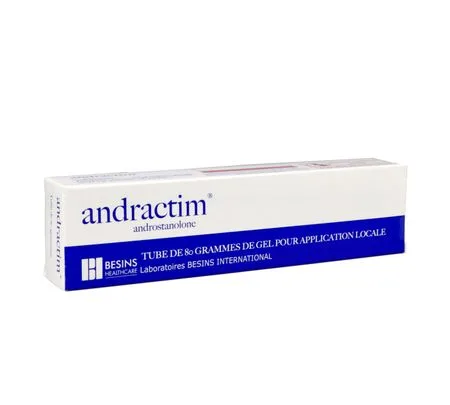
ANDRACTIM, gel for topical application
Composition
For 100 g of gel :
Androstanolone: 2,50 g
Excipient with known effect : ethanol.
This medicine contains 2,44 g of alcohol (ethanol) per dose of 5 g of gel, which is equivalent to 488 mg/g (48,8 % w/w).
Carbomer 980, triethanolamine, alcohol at 96 percent, purified water.
Indications
- General treatment in men: general androgenic deficiencies, permanent or transitory, in particular: organic and functional hypogonadism when the testosterone deficiency has been confirmed clinically or biologically.
- Topical treatment:
- In men: sclero-atrophic lichen, gynecomastia,
- In women: vulvar sclero-atrophic lichen.
Dosage and administration
- General treatment in men : daily administration on the chest and/or abdomen of 5 to 10 grams of gel per day, avoiding washing the area during the six hours following administration.
- Topical application (men and women) : 2,5 g every other day on the affected region, avoiding application on mucosal areas.
Contraindications
This medicine is contraindicated in the following situations:
- hypersensitivity to the active substance or to any of the excipients (see section Composition),
- in men: prostate cancer,
- in women: use of ANDRACTIM is strictly contraindicated within the framework of general androgen therapy, due to the risk of virilization.
Warnings and precautions
Athletes' attention is drawn to the fact that this medicine contains an active substance that may induce a positive result in tests carried out during anti-doping controls.
In patients with severe heart, liver or kidney failure or ischemic heart disease, testosterone treatment could lead to severe complications characterized by edema, with or without congestive heart failure. In this case, treatment must be stopped immediately.
Testosterone may cause an increase in blood pressure. Therefore, ANDRACTIM should be used with caution in men with hypertension.
Testosterone levels should be checked before starting treatment, then at regular intervals during treatment. The dosage must be adjusted for each patient, to ensure that testosterone levels are maintained at a eugonadal level.
In patients receiving long-term androgen treatment, the following biological parameters should be monitored regularly: hemoglobin level, hematocrit, liver function and lipid profile.
The available experience regarding the safety and efficacy of ANDRACTIM used in patients older than 65 years is limited. Currently, there is no consensus on age-related reference values for testosteronemia. However, the age-related decline in physiological testosteronemia values must be taken into account.
Coagulation disorders
Testosterone should be used with caution in patients with thrombophilia or with risk factors for venous thromboembolism (VTE), as thromboembolic events have been reported in these patients under testosterone treatment, during studies and post-marketing surveillance (for example, deep vein thrombosis, pulmonary embolism, ocular thrombosis). In patients with thrombophilia, cases of VTE have been reported even under anticoagulant treatment. Therefore, continuation of testosterone treatment after a first thrombotic event should be carefully evaluated. If treatment is continued, other measures must be taken to minimize the risk of VTE as much as possible.
Excipients
This medicine contains 2,44 g of alcohol (ethanol) per dose of 5 g of gel, which is equivalent to 488 mg/g (48,8 % w/w). It may cause a burning sensation on damaged skin.
This medicine may be flammable until the product has dried.
Interactions
Associations requiring precautions for use
+ Vitamin K antagonists
Increased risk of bleeding through direct effect on coagulation and/or fibrinolytic systems. More frequent monitoring of INR. Adjustment of the vitamin K antagonist dosage during treatment with the androgen and after its discontinuation.
Interactions with laboratory tests:
Androgens may decrease thyroxine-binding globulin levels, resulting in a reduction of plasma levels of T4 and an increase in resin uptake of T3 and T4. However, free thyroid hormone levels remain unchanged and without clinical signs of thyroid insufficiency.
Fertility, pregnancy and breastfeeding
ANDRACTIM must not be used in pregnant women or women who may be pregnant, nor in women who are breastfeeding.
Adverse effects
Those of androgenic hyperactivity in androgen-dependent tissues, controllable by dose reduction.
Frequent effects: increased hematocrit, increased red blood cell count, increased hemoglobin level.
Reporting of suspected adverse reactions
Reporting suspected adverse reactions after authorisation of the medicinal product is important. It allows continued monitoring of the benefit/risk balance of the medicinal product. Healthcare professionals are asked to report any suspected adverse reactions via the national reporting system: National Agency for the Safety of Medicines and Health Products (ANSM) and the network of Regional Pharmacovigilance Centres - Website: https://signalement.social-sante.gouv.fr/.
Overdose
No cases of overdose have been reported. However, a possible overdose may lead to an exacerbation of the adverse effects.
Pharmacodynamics
Pharmacotherapeutic class: ANDROGENS, ATC code: G03BB02.
(G GENITO-URINARY SYSTEM AND SEX HORMONES)
Testosterone and dihydrotestosterone (DHT), endogenous androgens, are responsible for the normal growth and development of the male genital organs and the maintenance of secondary sexual characteristics. The effects of endogenous androgens include: growth and maturation of the prostate, seminal vesicles, penis and scrotum, development of male hair on the face, chest, armpits and pubis, enlargement of the larynx and voice breaking, development of musculature and distribution of body fat.
Insufficient secretion of testosterone due to testicular insufficiency, pituitary pathology or GnRH deficiency leads to male hypogonadism and a low plasma testosterone concentration. Symptoms associated with low testosterone levels are: decreased libido with or without impotence, fatigue, loss of muscle mass, depressed mood and regression of secondary sexual characteristics. Restoration of testosterone levels to normal values may, after some time, lead to an increase in muscle mass, an improvement in mood, sexual desire and libido, and sexual functions including sexual performance and the number of spontaneous erections.
Upon exogenous administration of testosterone to healthy men, endogenous testosterone secretion may decrease due to negative feedback inhibition of pituitary luteinizing hormone (LH). When high doses of exogenous androgens are administered, spermatogenesis may also be suppressed due to inhibition of pituitary follicle-stimulating hormone (FSH).
Administration of androgens induces retention of sodium, nitrogen, potassium and phosphorus and a decrease in urinary calcium excretion. Androgens have been reported to increase protein anabolism and decrease protein catabolism. Nitrogen balance is improved only after sufficient intake of calories and protein. Androgens appear to stimulate red blood cell synthesis by increasing erythropoietin production.
Preclinical safety
In chronic toxicity studies in rabbits and rats, dihydrotestosterone showed excellent local tolerance; the histological changes described are related to hormonal overload, evidence of good dermal penetration of the product without notable toxicity criteria.
No carcinogenicity or photocarcinogenicity study has been performed with dihydrotestosterone. Reproductive function as well as mutagenic or carcinogenic potential have not been evaluated.
Prescription, supply and reimbursement
Medicine subject to initial prescription reserved for specialists in dermatology, endocrinology, gynecology-obstetrics, urology.
Unrestricted renewal
| Marketing authorisation (AMM) |
|
| Price: |
|
Exception medicine
Reimbursed by the Social Security (Séc soc) at 15% solely for the indication "Local treatment of idiopathic gynecomastia in males". Collect.
7 RUE AUBER
75009 PARIS
info@besins-healthcare.com
https://www.besins-healthcare.com/ - http://www.besins-healthcare.fr/
Source: VIDAL · Updated on 10/11/2026. This information does not replace advice from a healthcare professional.